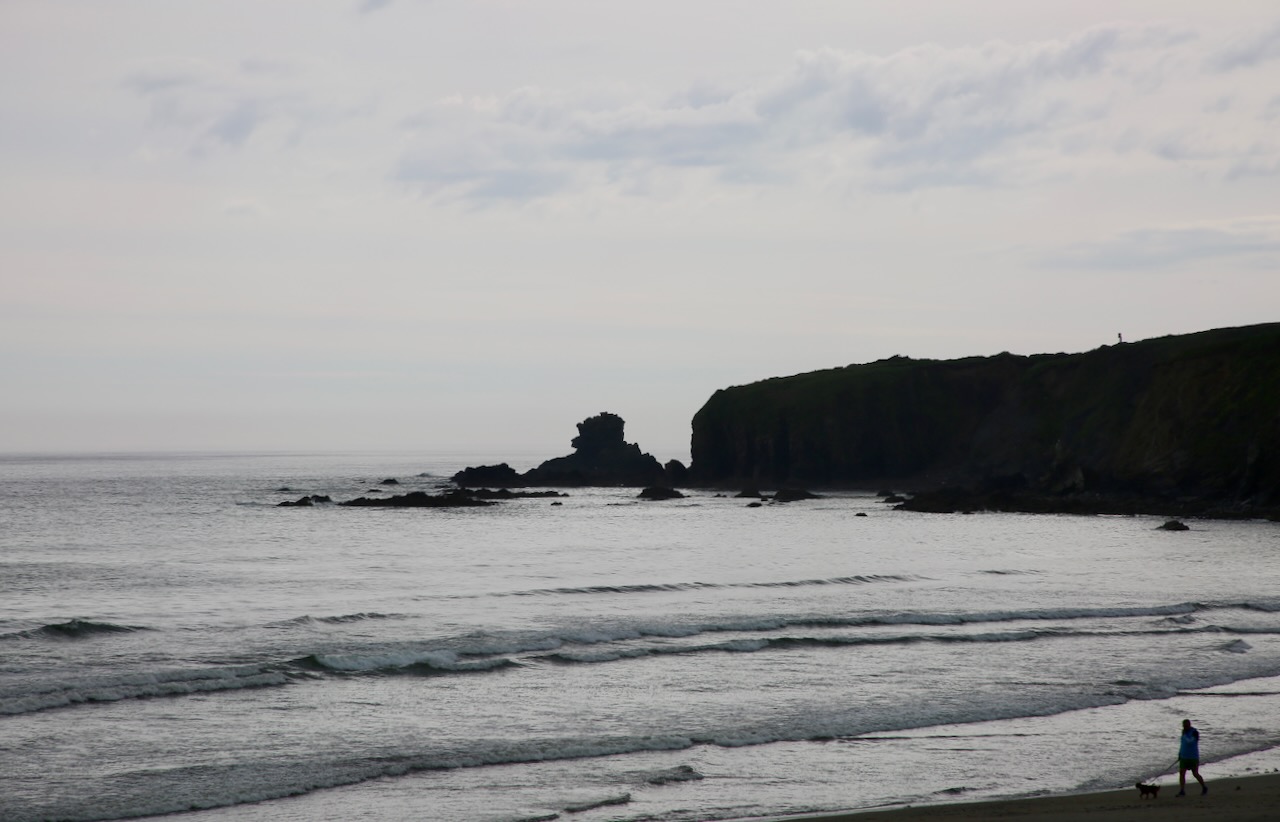
In the Spring of Hibernia

Mountain View B&B

Hibernia is the Classical Latin (one of its three varieties) name for Ireland which means autumn. The name is said to have originated in the Greek’s description of Ireland as the ‘island of winter’ (Iouernia) and the Romans’s interpretation of the Latin word hibernus, meaning wintry. This history dates back to the double digits of AD. The name appeared on a farthing from 1744 and continues via a Scottish football club founded in 1875, four ships and one shore establishment from 1763 to 2010, and a chamber orchestra founded in 1981.

Ireland maintains its gusty personality ranking in the top countries for wind power to generate electricity, having supplied one-third of its energy in 2022. On December 6, 2023, wind helped the island reach 70% of its electricity demands for the day. Ireland is able to provide 37% of electricity via wind power, making it fourth on the list with Denmark in the lead at 57%, but if you look at power generated then the top three countries are China, the US, and Germany.
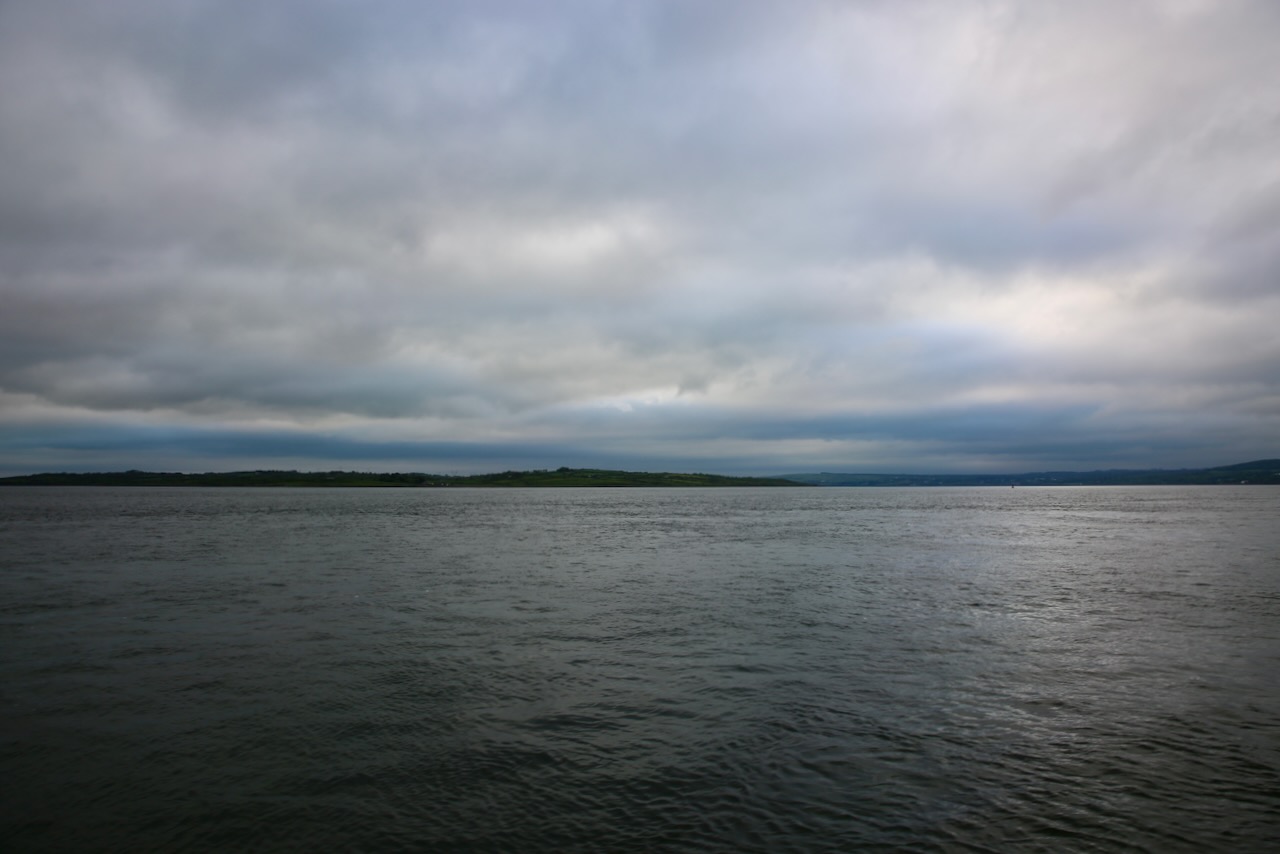
Shannon Ferry

Following the quote of Benjamin Franklin, “Early to bed, early to rise…” and getting at least eight hours of sleep makes for a couple who is “…healthy, wealthy, and wise” (at least formerly) and ready to seize the day. Listening to the advice of our night’s landlord, we leave hours before the promise of breakfast to catch the second ferry, Tarbert to Killimer, leaving on the half hour. A twenty-minute ride will cost us €23 ($25). The reason for the rush is so we can get to and enjoy part of the Cliffs of Moher before the tour buses arrive.

We looked at the map and the route suggested did have the least distance, only 125 km, so we skipped driving through Limerick and whatever we would’ve seen between as my itinerary had us stopping to walk along a canal, Lough Derg Way Clonlara, before heading north. On the other side of the Shannon Estuary, we are greeted with a few road signs and then quickly are into the lush countryside with a steep drop, a 20% decline, before coming out towards houses and coastline that we will follow to the Cliffs. Parking is across the street for cars but the coach buses have been afforded the large lot across from the visitor center.
Cliffs of Moher

These cliffs along with Burren National Park are a UNESCO Global Geopark; they are being preserved for their geological significance to protect the resources, educate the masses, and sustain development with the local communities. There are currently 213 such parks in 48 countries, the US is not one of them but has plans to add Appalachian (3 counties in West Virginia), Gold Belt (131-mile byway in Colorado), and Keweenaw (65-mile peninsula in Michigan) to the list. We pay our $26 (12 euro each) and proceed to their exhibits which seem placed in an underground space bunker. A screen tells us it’s 53° F with a wind speed of 8.5 mph and the barometric pressure is 1021 mb (millibars).

The barometric pressure is the weight of air surrounding us and a millibar is the force it takes to move an object weighing a gram, one centimeter, in one second. Perhaps this information will inspire the scientists and weather analysts of the future, but I’m more impressed with its effect on me. The visitor count was up to 100,000 in 1978 and 1.6 million in 2019 (150k more visitors at half the price of Blarney Castle). There’s some history about J.P. Holland, the designer of the world’s first successful submarine in May 1881 (he was born in Clare County in 1841). Today, it sits in a museum in New Jersey where Holland died in 1914.
Of course, the first thing I think about is the tide pod of a sub built by billionaires that lasted 105 minutes into its mission in 2023. Thankfully, the implosion took less than a second, too fast for them to see it coming. I’m all about advancing our species and others but some things shouldn’t be rushed and I know this isn’t the first group to let their curiosity and excitement get the better of them.. or all of them in a moment. Though I’m sure these guys span the gamut of exploration and destruction (spying and protection) that these machines were created for.

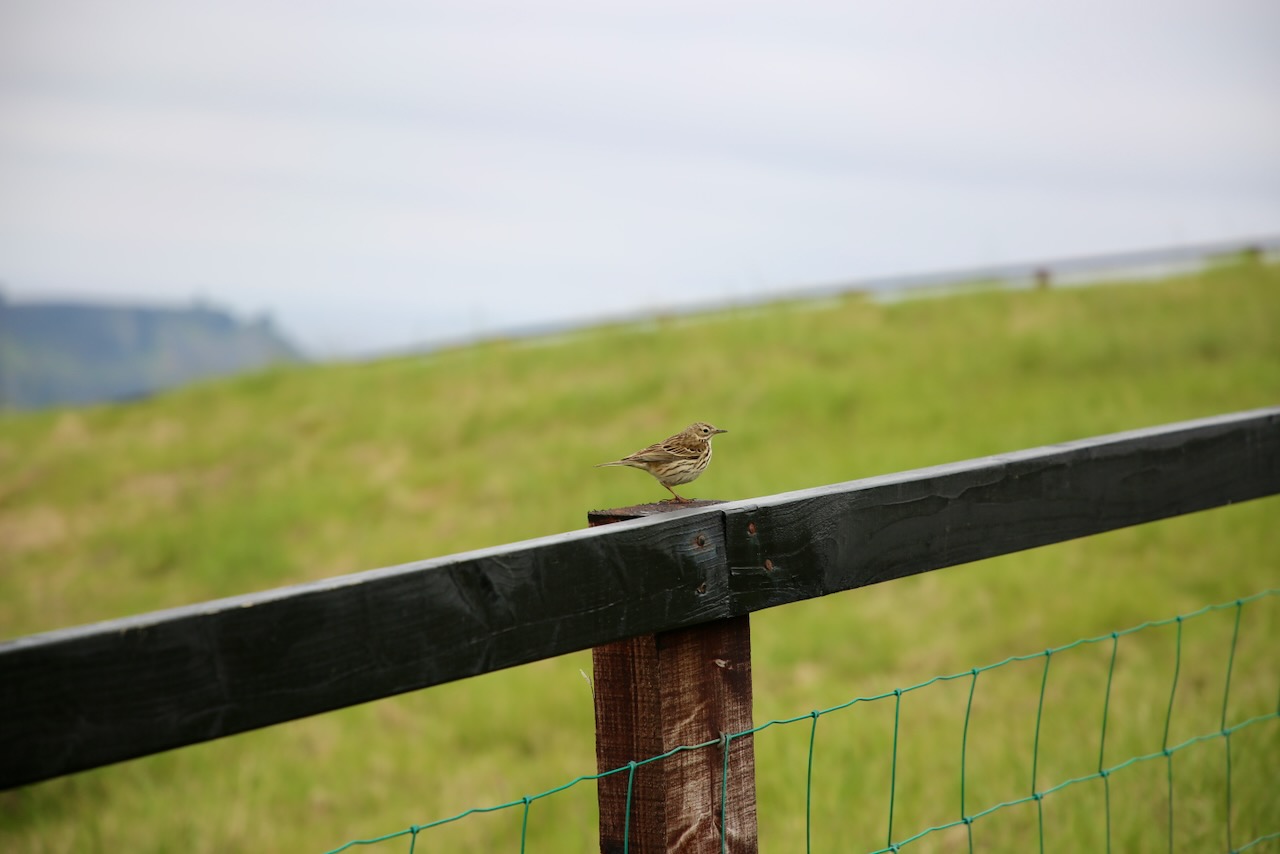
We make our way towards the windy edge while being watched by a meadow pipit, a small bird with a decreasing population. We walk to O’Brien’s Tower, built in 1835 as an observation point to see the Aran Islands and the Twelve Bens (mountain range) of Connemara across Galway Bay, on a clear day. No luck seeing much to the northwest and no tea on offer in the tower, so we take advantage of the momentary wind block before continuing. We notice buses starting to park and will count twenty by 11 am. This means an influx of some 680 to 1,120 visitors within a couple of hours.

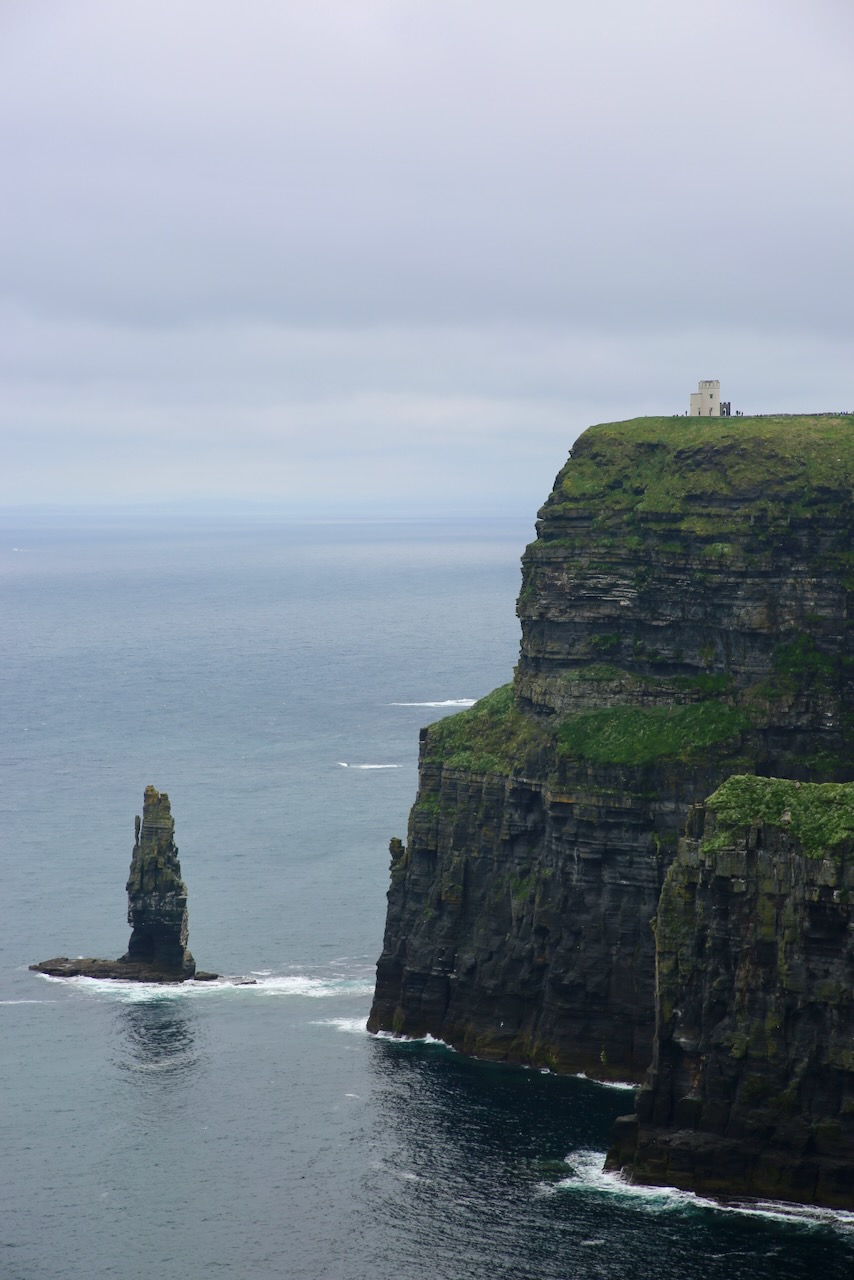
O’Brien’s Tower

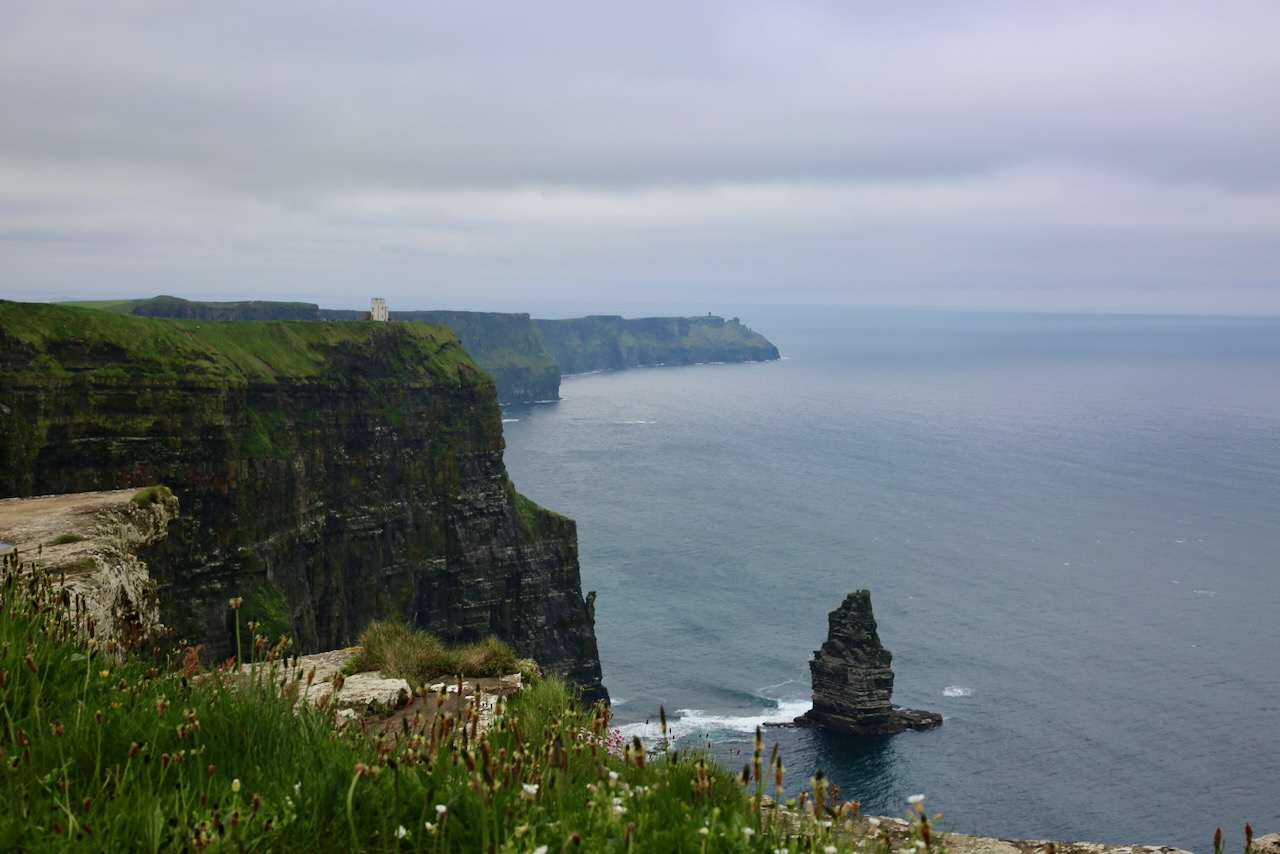
We pass by a Jacob sheep, which on average can weigh up to 160 pounds, but from our perspective, its fluffy wool makes it look the same size as the brown cows behind it. There are Suffolk sheep on the hill to the northeast with a variety of cows and colors seperated by a wire. From here, we see a spire of rock with waves on one side and a thousand birds on its multitude of shelves. History tells us these cliffs are over 300 million years in the making, something I’m sure scientists half a million years from now can appreciate the gradual or drastic changes that will continue on these rocks.

I have no way to grasp that timeline as I’m in my thirties, but parts of me still feel like young mid-twenties while I wonder what my body will look like when I’m fifty — mole placement, freckle coverage, gray hair pattern, new scars and their stories. Compared to the view, my life is just a blink of an eye. At least this makes me feel closer to trees and turtles with similar lifespans. Humans all have their ideal world, but given the chance, could any of us create something so perfect and balanced; as we are yet to be the ideal people.

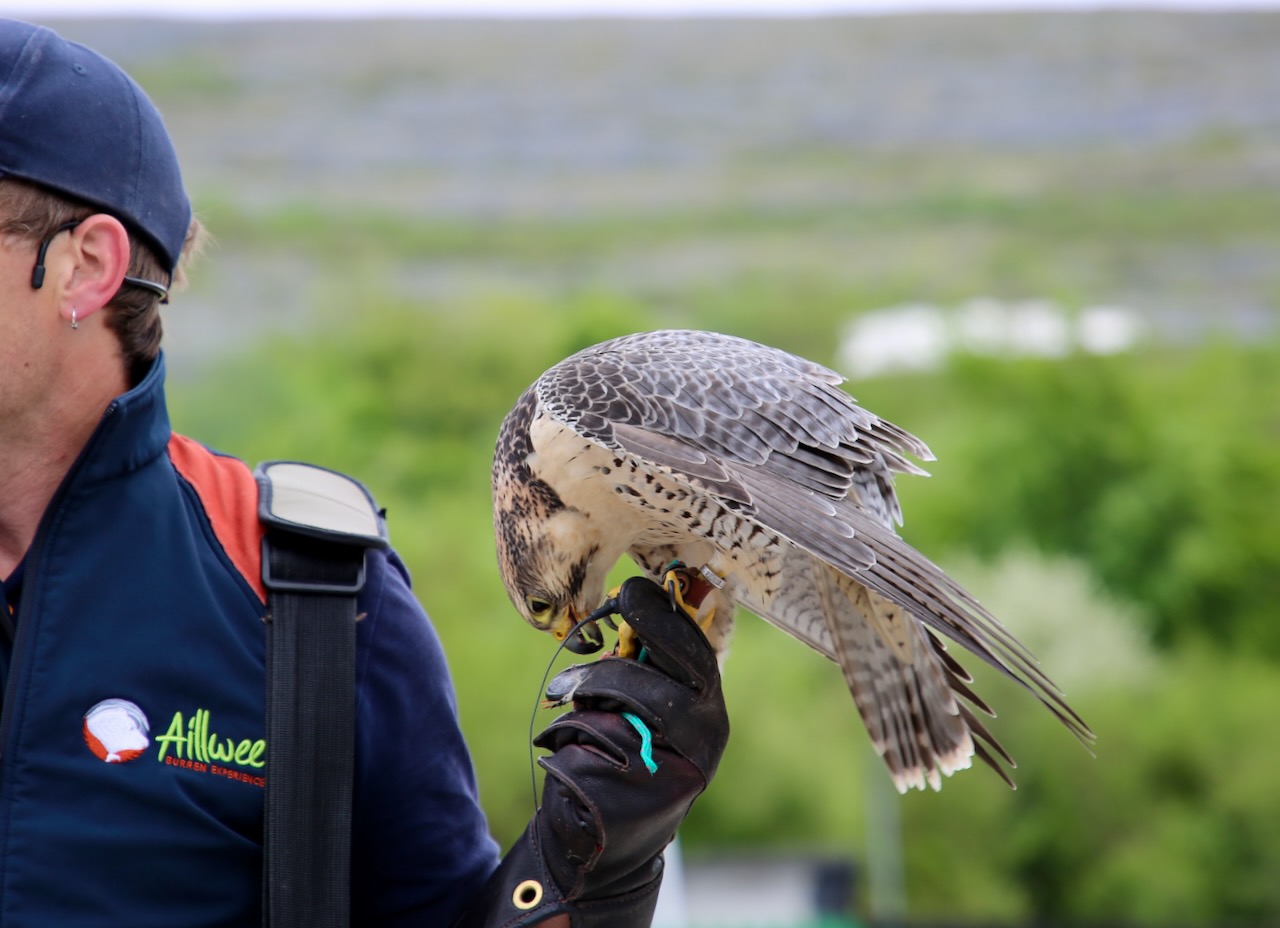
Saker falcon

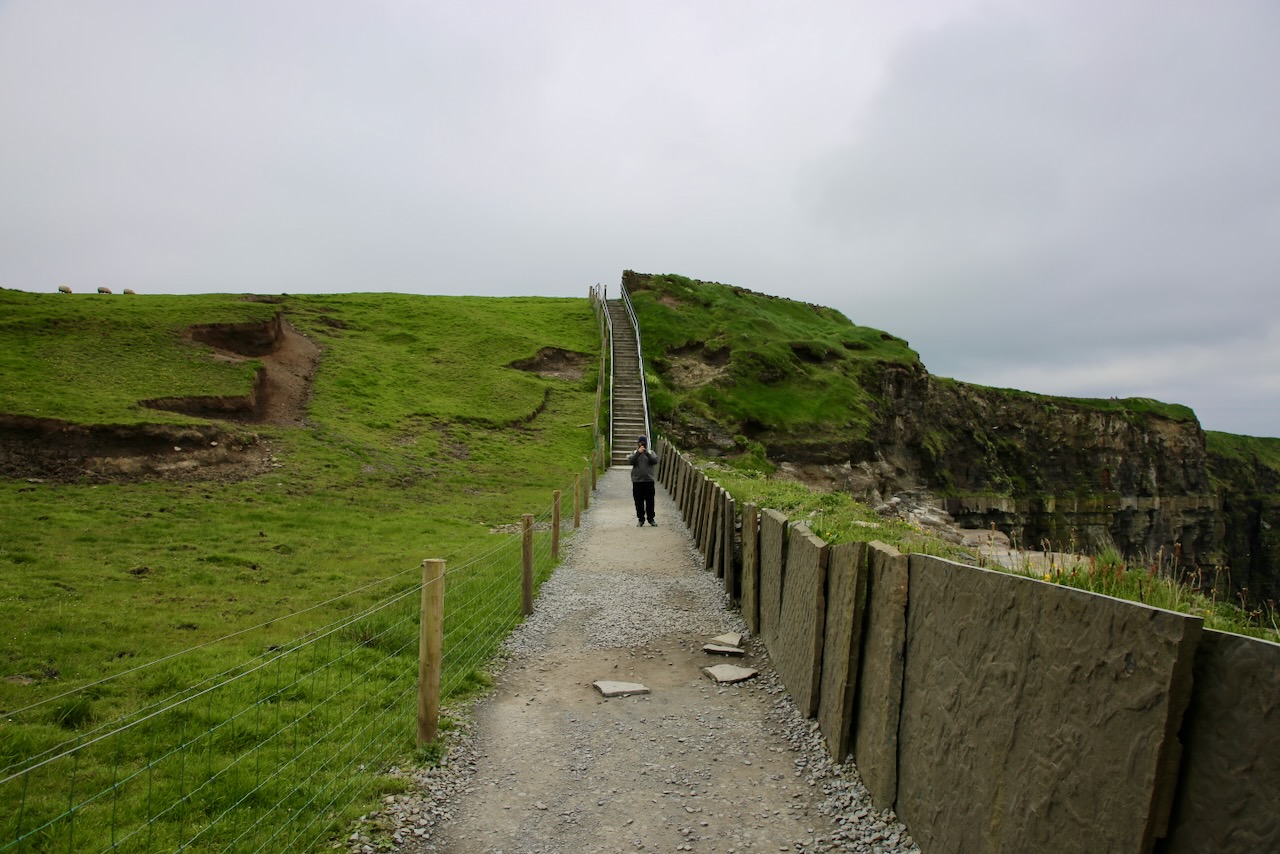
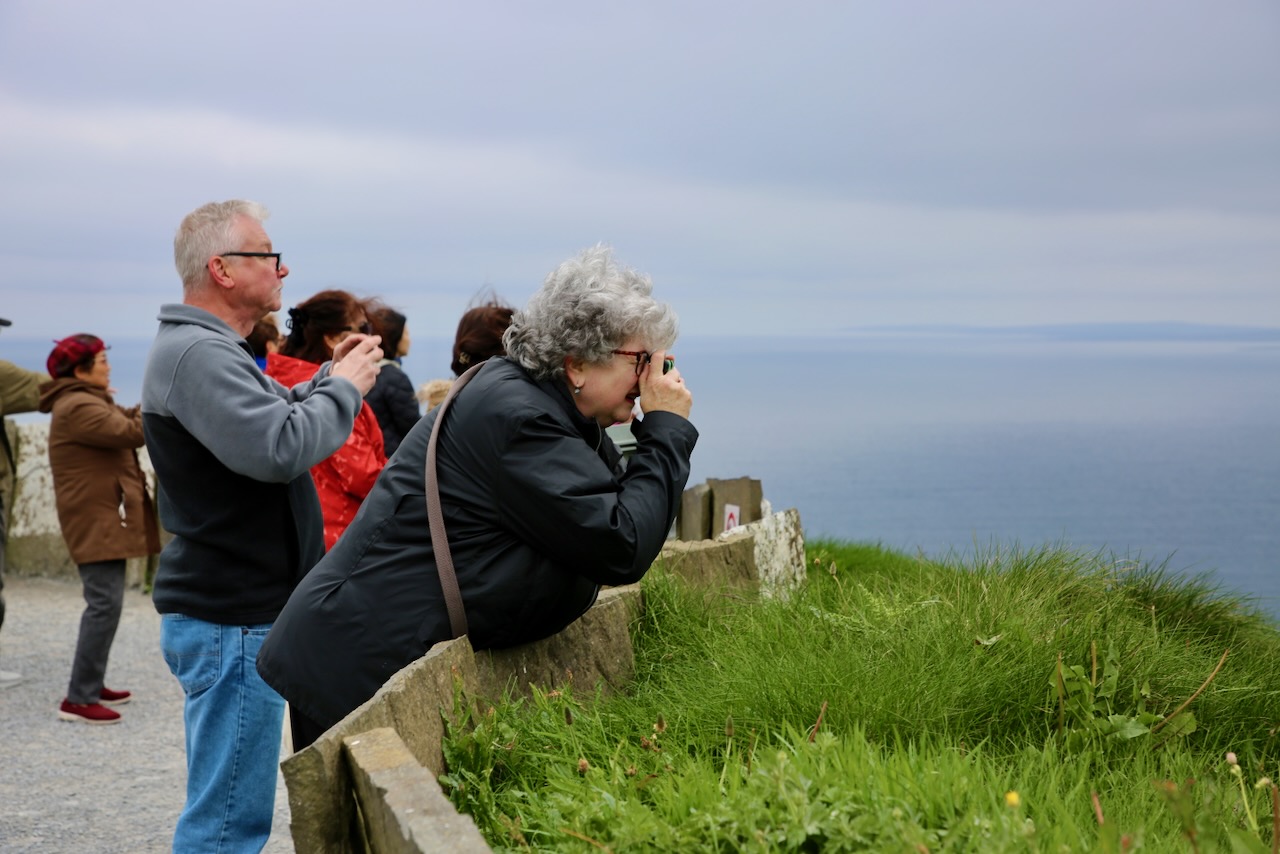
The path continues for some unknown distance as the park boundary is within the 14 km of cliffs, so we are on borrowed property between a protective stone wall and a farmer’s fence to keep his livestock from the fate of former tourists who fell to their death, many in their 20s, and one just two weeks ago, while taking pictures from a range of 390 to 702 feet up from the water. We make our way back towards the tower and pass a mom with a disposable camera in hand, gifted by her daughter who probably didn’t know that the familiar click and winding sound would gain nostalgic attention from a passerby.

I let the woman know she is lucky, and she agreed, to have a set limit of 24 to 27 pictures captured on film that would sum up her trip. What I didn’t say was that it would further feed the relationship with her loving and thoughtful daughter; a compliment that came so easily from my mom. Off towards the southwest of the cliffs, past the suicide helpline posters, is another view of the spire (that better shows its fragility) and the Aran Islands. There are small formations on Goat Island that could almost be mistaken for cairns but only a bird could survive that precipice of wet grass and loose stones.

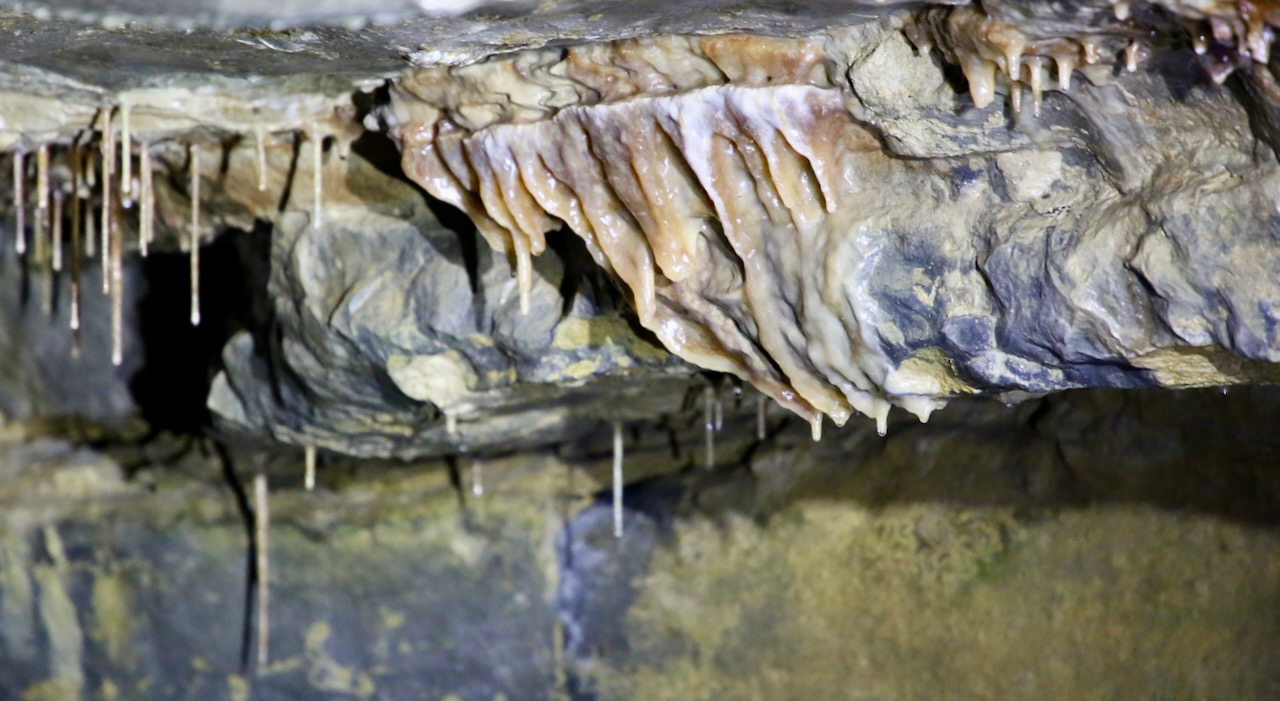
Aillwee Cave

The path narrows as some people stop so we can pass them though I feel there is room for two on this guarded trail that has been pushed back from the edge. The old trail is still visible in parts and it’s more obvious how someone could be injured permanently. I could have stayed another hour to admire the cliffs, cows, and clearing horizon. The growing crowds decided that I should say hello to a little white wagtail, less than an ounce of mass this bird, when I returned to the car, as Caleb is very much over feeling like a needle in a haystack, just one bearded man in a horde of humans.

Some things I assume will be awesome, like seeing a cave in Ireland, so I figure no further research is necessary. The Aillwee (meaning yellow cliff) Burren Experience sounds like a tourist trap because it offers a guided cave tour, cheese and fudge tastings, a woodland walk, and a Birds of Prey center. The hawks that have been trained put on shows for those who don’t live near parks with these beautiful creatures and don’t have the time to wait and watch them hunt. Seeing them eat has been rare in my experience. I would’ve loved to pet the owls, but we had driven up to the cave first to be told a show had started down the hill and the next one wouldn’t be until an hour after our cave tour.
We find a seat while Trainee Jack teaches us about Harris’s hawk which can be found from the southwest US to central Argentina. This bird’s nickname is ‘wolves of the sky’ due to their hunting in family groups of four to six. These hawks have beautiful dark brown-reddish feathers and feed mainly on medium-sized mammals. We watch the bird fly from glove to rock to bleacher top and then I am one of the lucky few who gets to wear a glove while the hawk rests just a moment before taking flight again. I thought Caleb might’ve taken a picture, but the only one I did captures a couple — the one we saw at Guinness Lake three days ago and the same one we’ll see at a cafe later today (also not planned).

For the next show, we’re told to either keep our seats or leave now before the Saker falcon has its hood removed as it prefers moving prey such as running toddlers and hands shooting up to get a good photo. This two-pound bird with a pattern of brown, sand, and white can be found in Central Europe and east towards Manchuria, China. This falcon is endangered and feeds on smaller rodents and birds than the Harris’s hawk even though they weigh about the same, the former has a larger wingspan. We sit through Gary’s presentation while the falcon poses before performing some tricks. This will earn him a meaty treat that he tears apart while Gary talks.
Sticking around, we talk more (which I always love to do) with Gary and then see the other birds perched in their cages and a crow shows us some of his toys, which earns him treats. Across the parking lot, we witness some cheese wheels in their salt bath before returning up the hill. Aillwee Cave was discovered in 1940 and opened to the public 36 years later. We’re shown the cave map, scale 1:625, and the tour route that we’ll be doing that leaves the other half, parts of it underwater, to the professionals.

Dungaire Castle

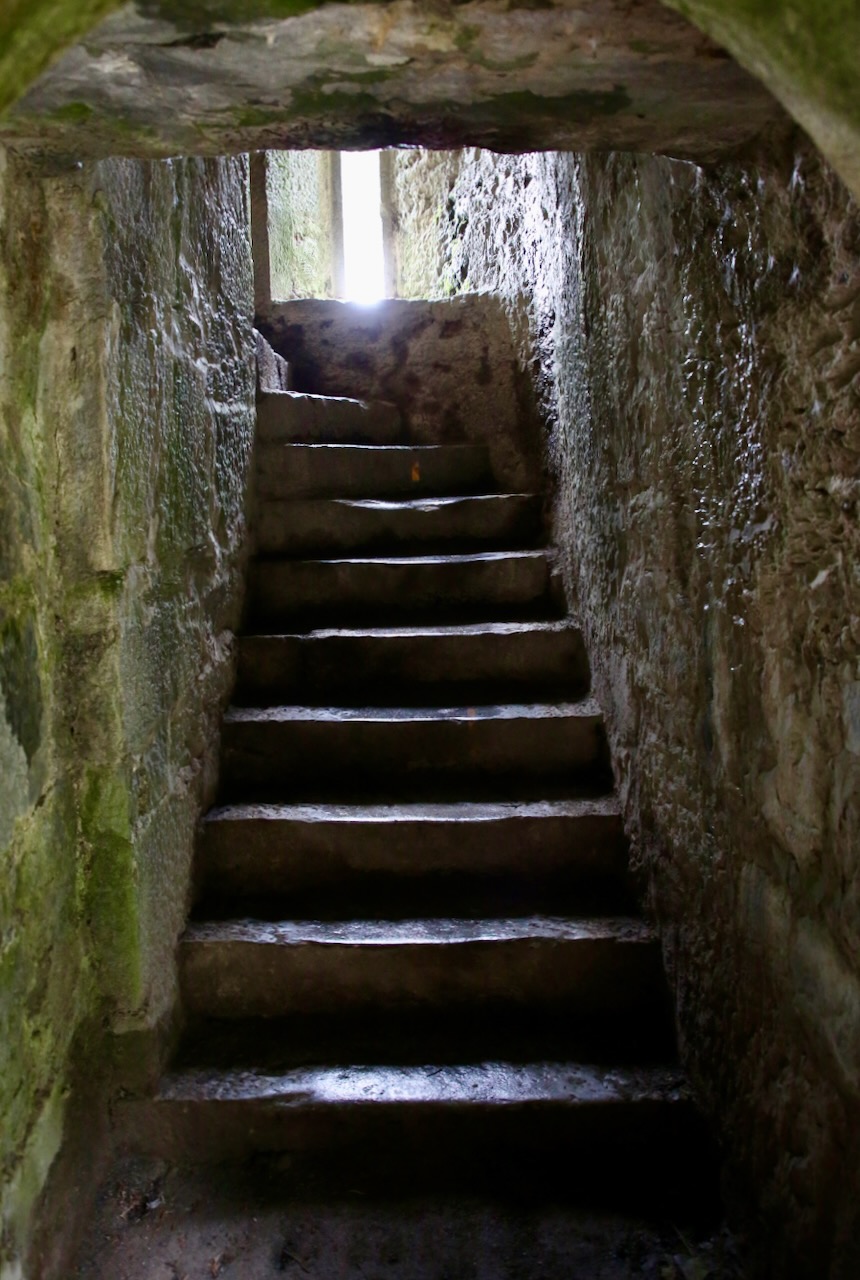
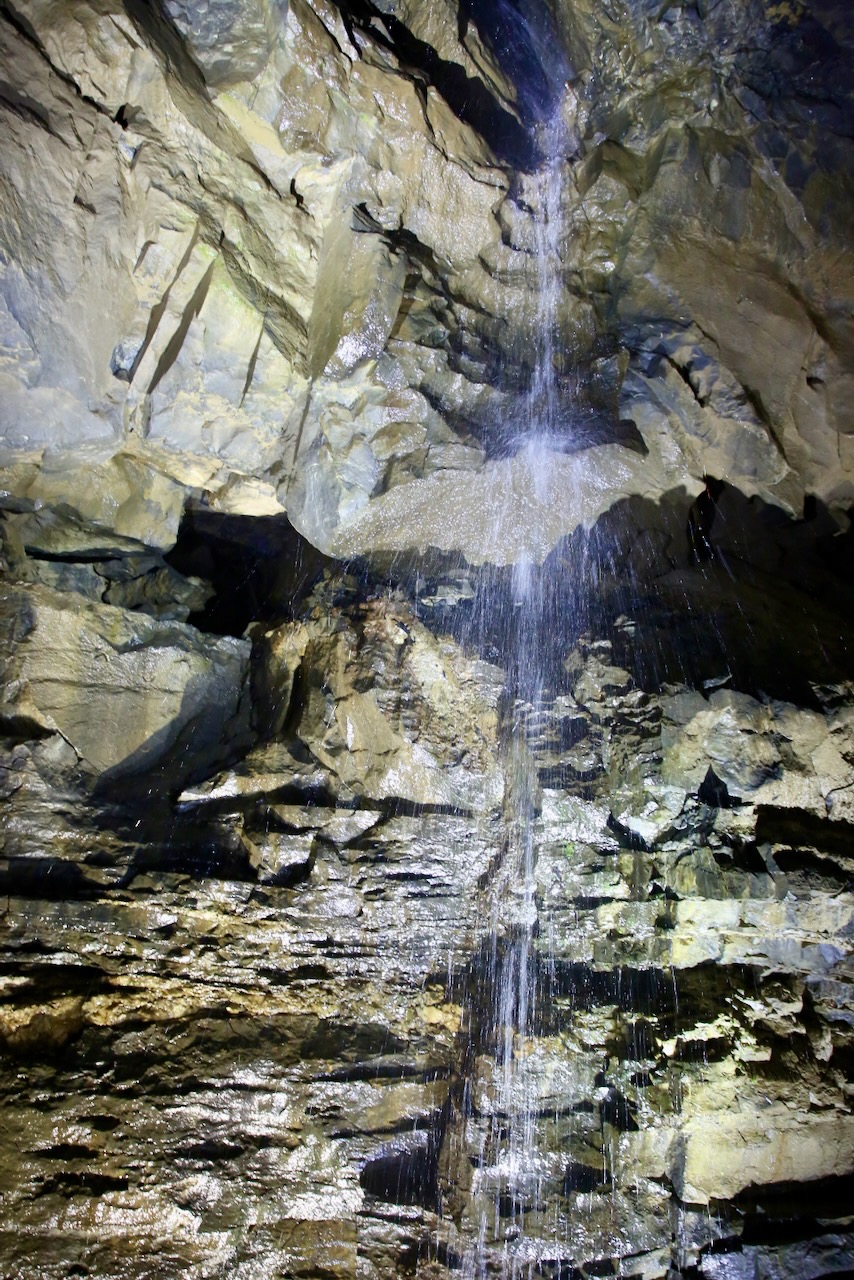
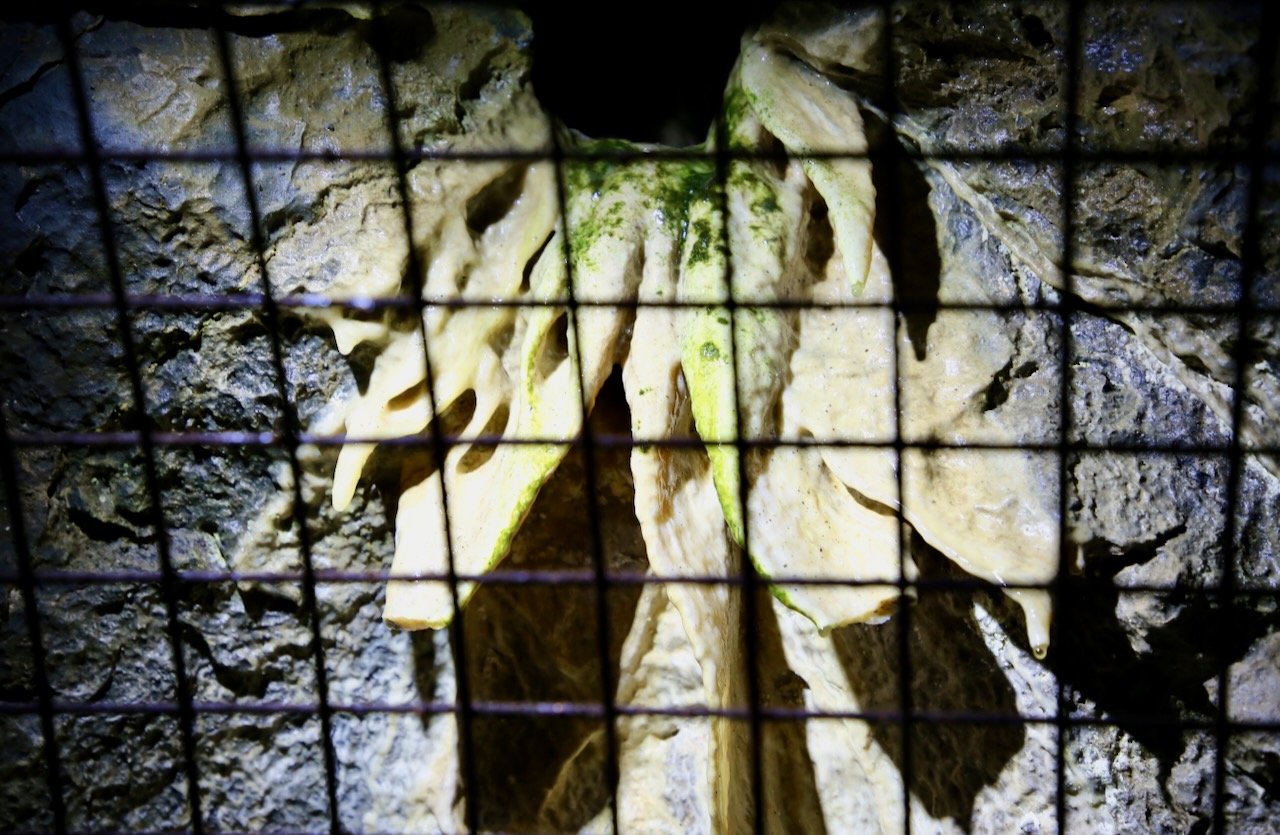
The entry tunnel looks like it was widened with a paved path and a handrail added, in sections. Some of the walls look like the wet portions of the Ballyvoyle Tunnel, keeping true to the overall moist level of Ireland. There are lots of dripping straws and green growth along with smaller formations and a waterfall. We get to walk by the spray, but I don’t reach out my hand as cave rules go: water can touch me, but I have to keep my oily hands to myself. I’ve been to one cave where they have a touching rock hoping that it keeps people from touching the rest.

Time in a cave is always fleeting and soon our 45 minutes is up. Some caves offer self-guided or private tours with advanced reservations and a certain group size. I will be asking about these options in the future. There are possibly 200 caves in Ireland but only six are open to the public (show caves) due to the difficulty of accessing the others or needing permission from the landowner and ensuring non-nuisance parking arrangments. Just up the road we see a cafe sign and pull over to investigate. We parked in the back and walked all around an otherwise closed-looking building to find the front door with a picnic table nearby, that I drove past in my hunger.
The cafe is called The Larder, meaning a large room for storing food, so we are in luck. We clink a mocha and matcha at the bar, between the counter and the tables, while we wait for the savory and sweet treats we ordered. Funny enough, when the barista asks a guy from the couple who sits next to us how much sugar he wants in his matcha, he claims that it’s like hot chocolate. Perhaps he also ordered the green eggs and ham, though most people know that shell color doesn’t affect the contents. I hope he’s not disappointed.
Burren National Park

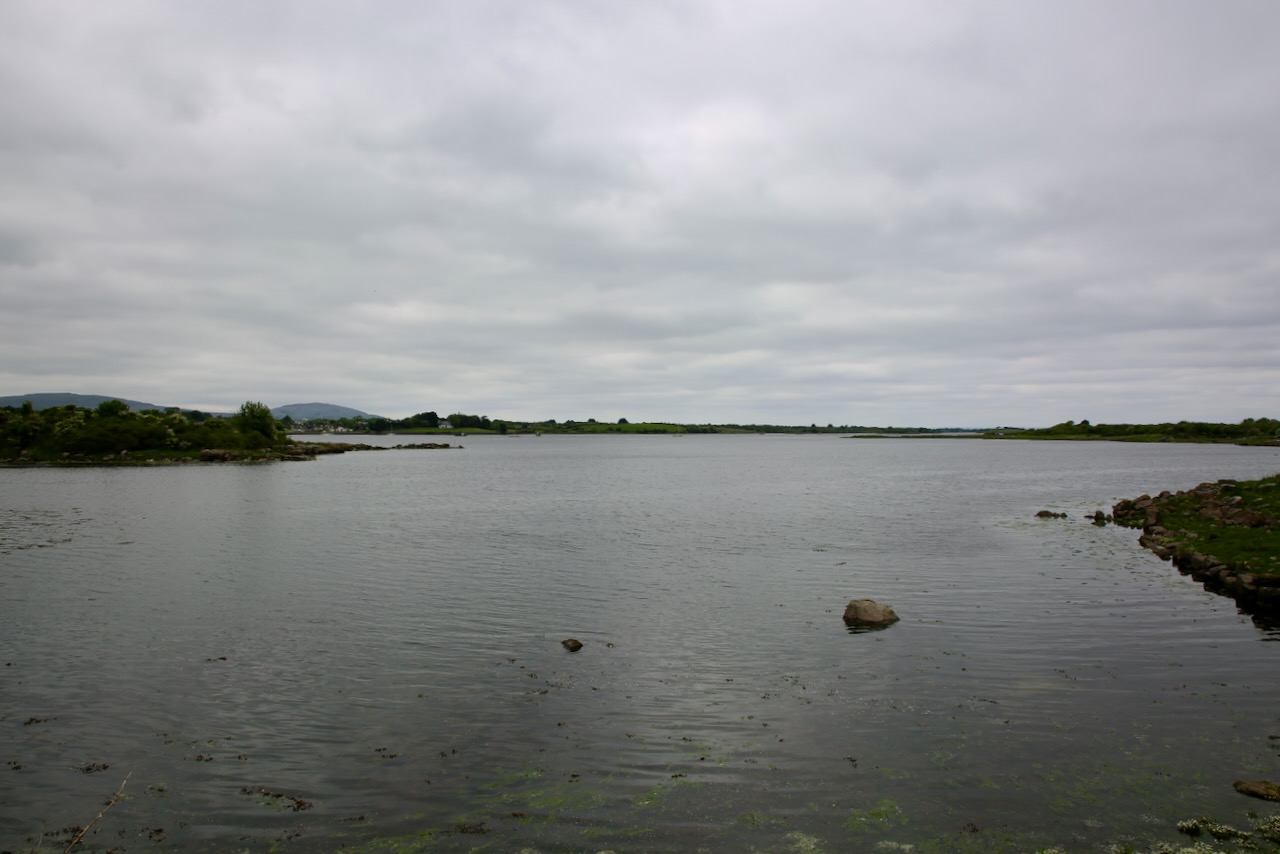
I thought I recognized the hybrid Yaris outside with a similar plate to ours and then I saw the couple from the bird show earlier. They found this cafe with the help of The Irish Road Trip website which they are following more precisely. I only use outside sources for ideas and rarely for places to eat, but local foods to try. Not sure where their path goes next but with lunch consumed, I know we need to get moving. We can see Dungaire Castle, built in 1520, from the road, the same one we’ll walk in to view the castle perimeter, as the car park is 240 meters away and the gate to a romantic getaway locked.
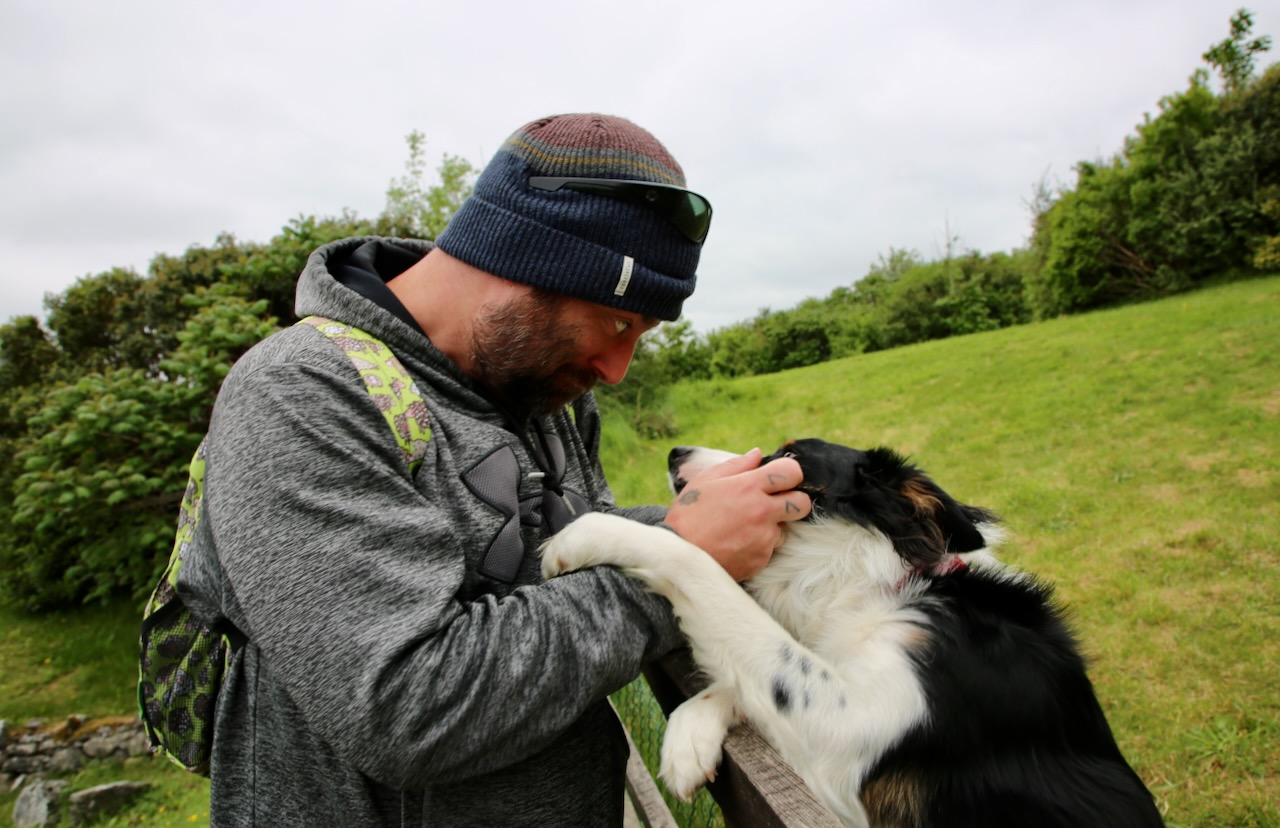
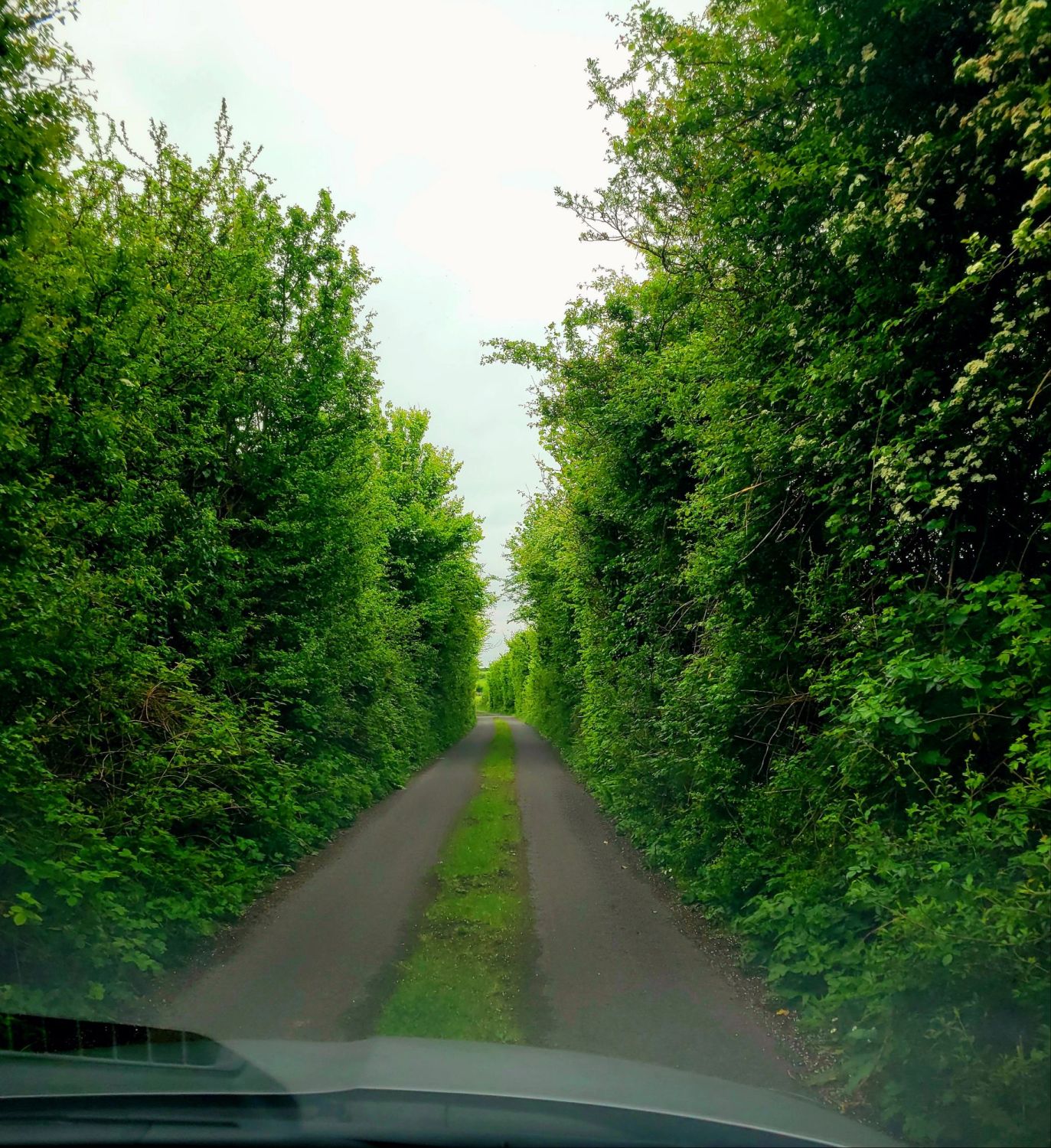
On the way back to the car, Caleb makes short-term friends with an English Shepherd before navigating us down a road that looks more like a private driveway lined with tall trees. Only when we reach the line of cars on the side of the road do we determine that we must have made it to Burren National Park. We find a spot to join them, even though my itinerary said ‘coastal drive’. Before travel, always do a test search of planned stops as some have only one location, but many have different trails, parks, buildings, etc. included and you could easily find yourself as lost, but just where we needed to be, as we were.
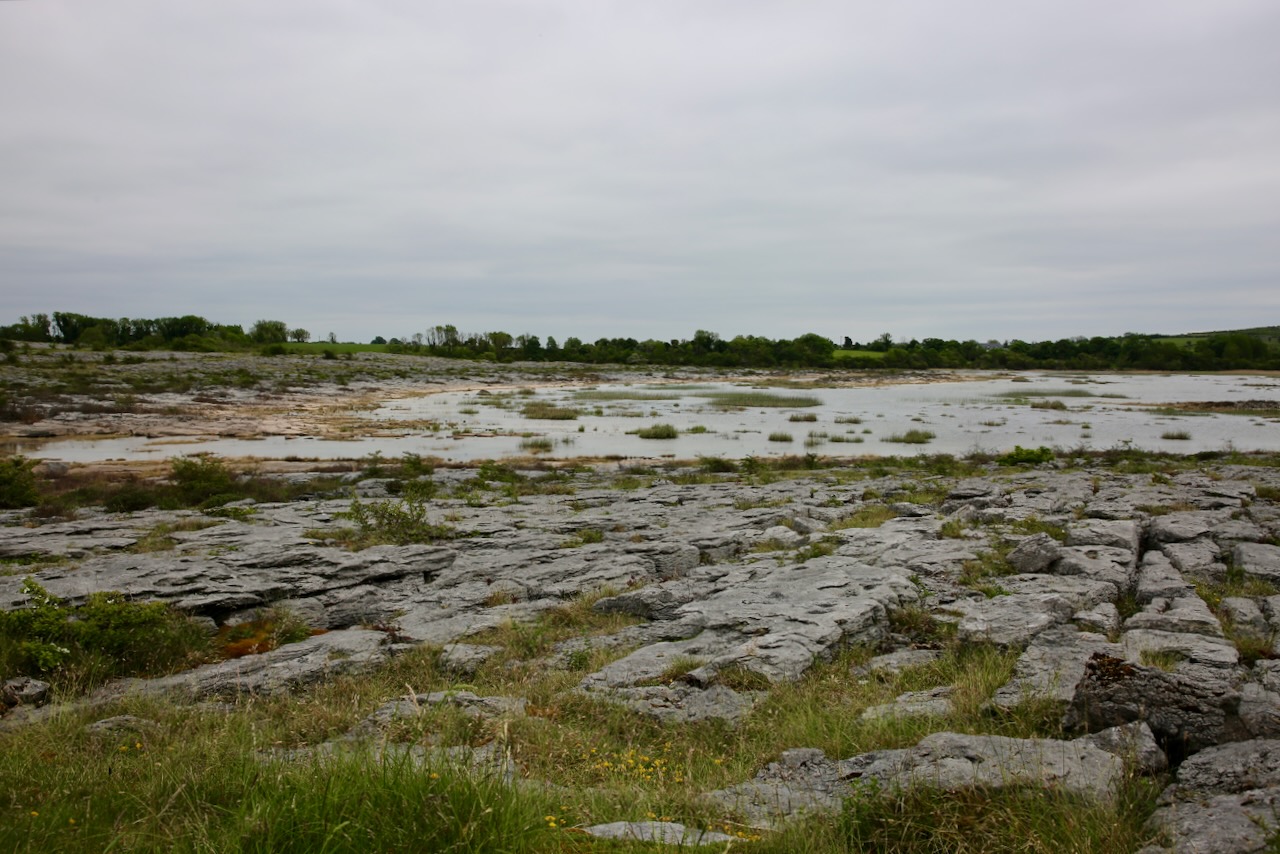
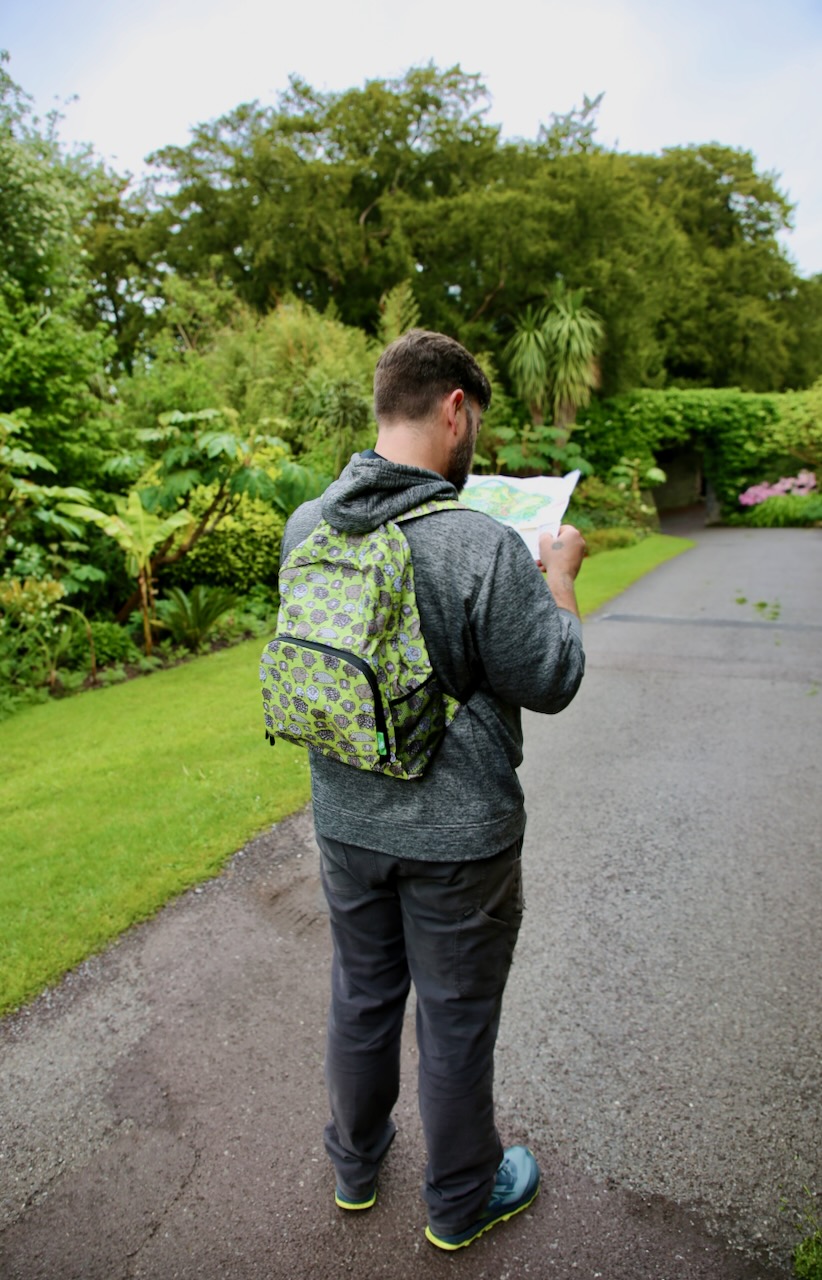
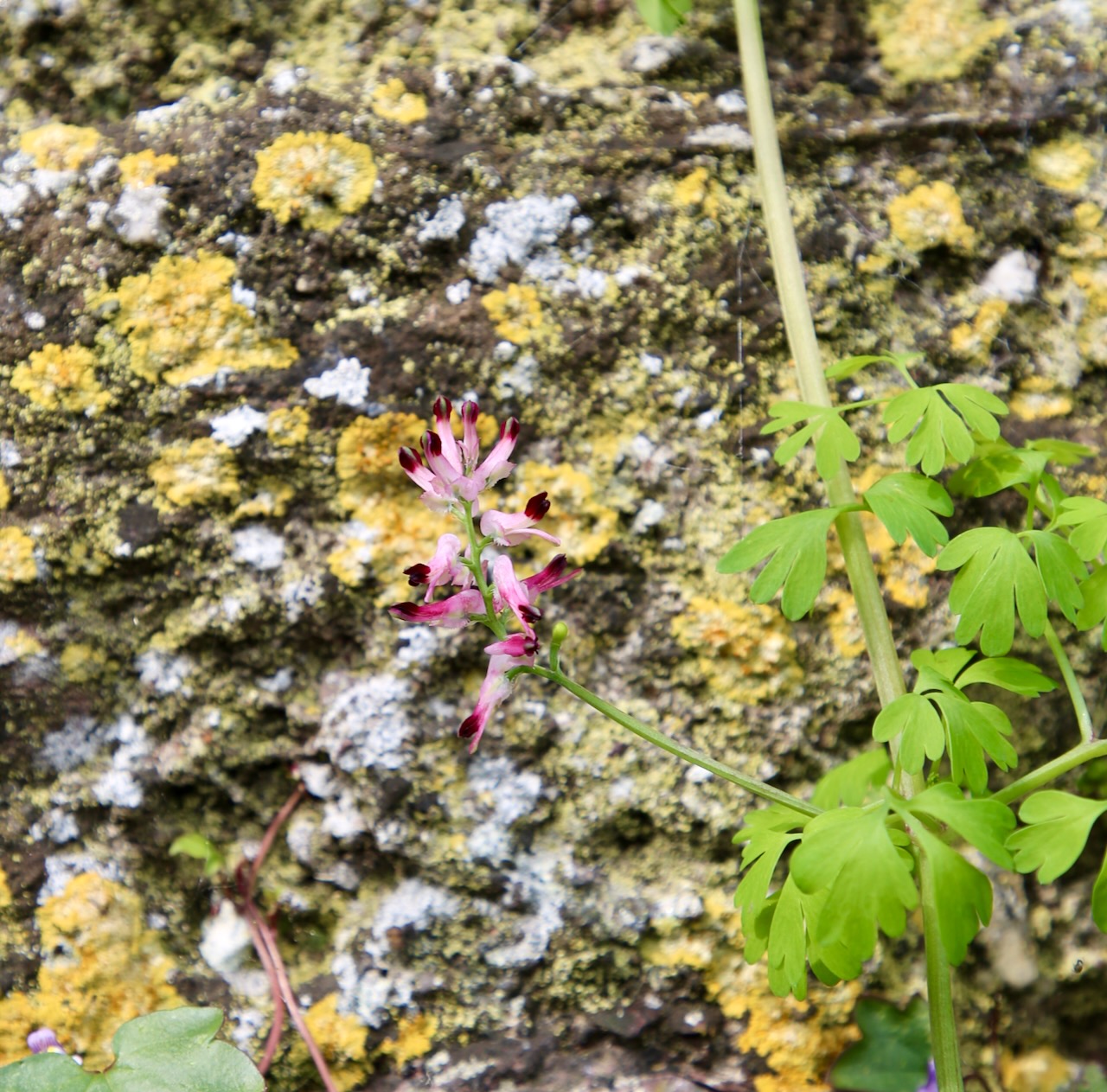
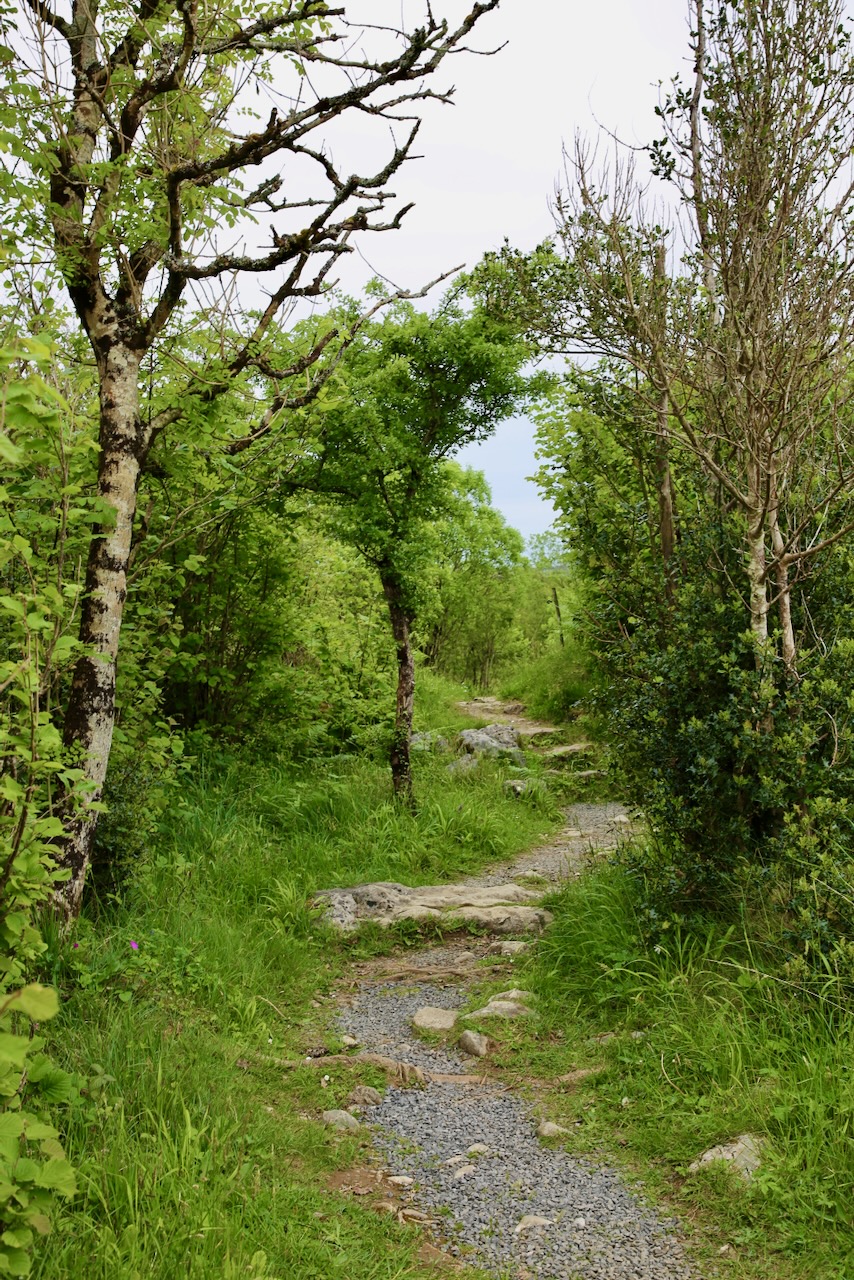
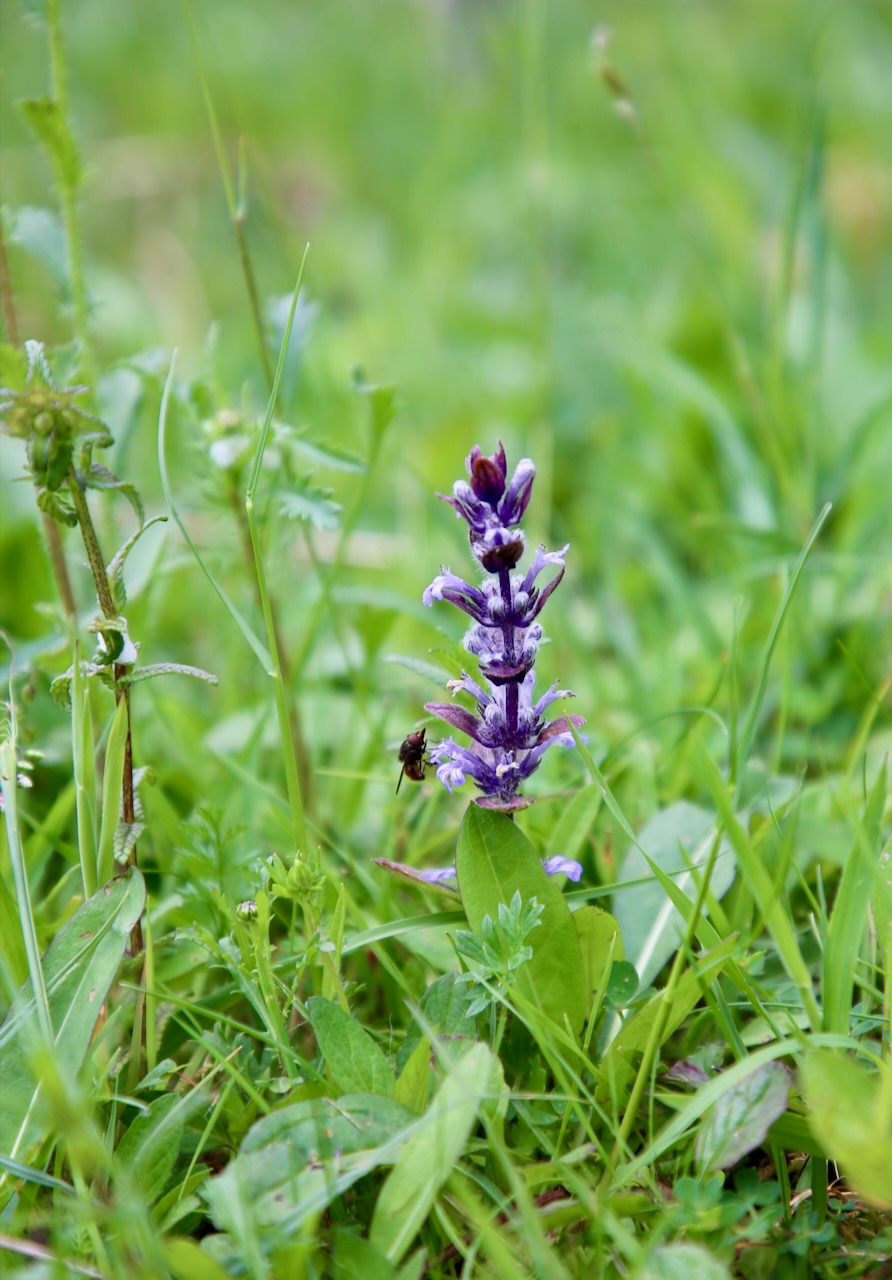
If you zoom in on Gortlecka Crossroads you can see the cars lined up. Thanks to the vague ‘you are here’ map and a certain shaped but unnamed lake I was able to find where we were amidst the trees, limestone, and calcareous grasslands. We pass through a rock wall with space enough for one person to pass through. Attached to a stone are five circle plaques, each in a different color, with boot prints and arrows on them. There’s a single wire fence strung along the trail through the trees, a railing down the stairs, and trail markers over the rocks. There are little flowers of purple being visited by a rhingia, a genus of hoverflies known for their long snout.
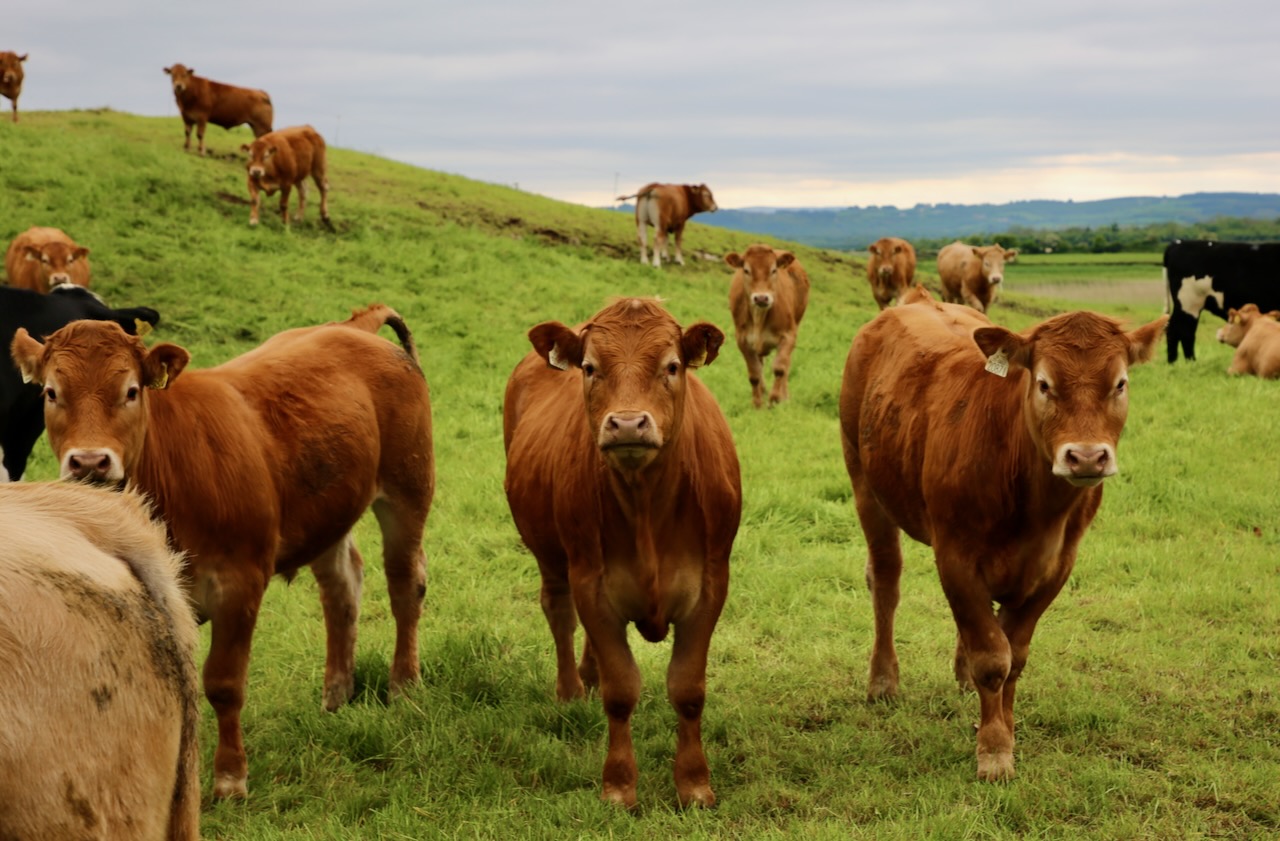
We finish our hike and drive past Ballyportry Castle which can be rented to a maximum of eight people for a minimum of three nights with dinner upon arrival for $2,200. Where we will be sleeping tonight would be about a sixth of that cost for the same stay. If we ever find three other couples that wouldn’t mind staying in a 15th-century Gaelic Tower House with 21st-century comforts, such as underfloor heating, we would split the bill. Just moments from the castle, we’re out of the car to say hello to a herd of cattle who seem to think we’re there to feed them.
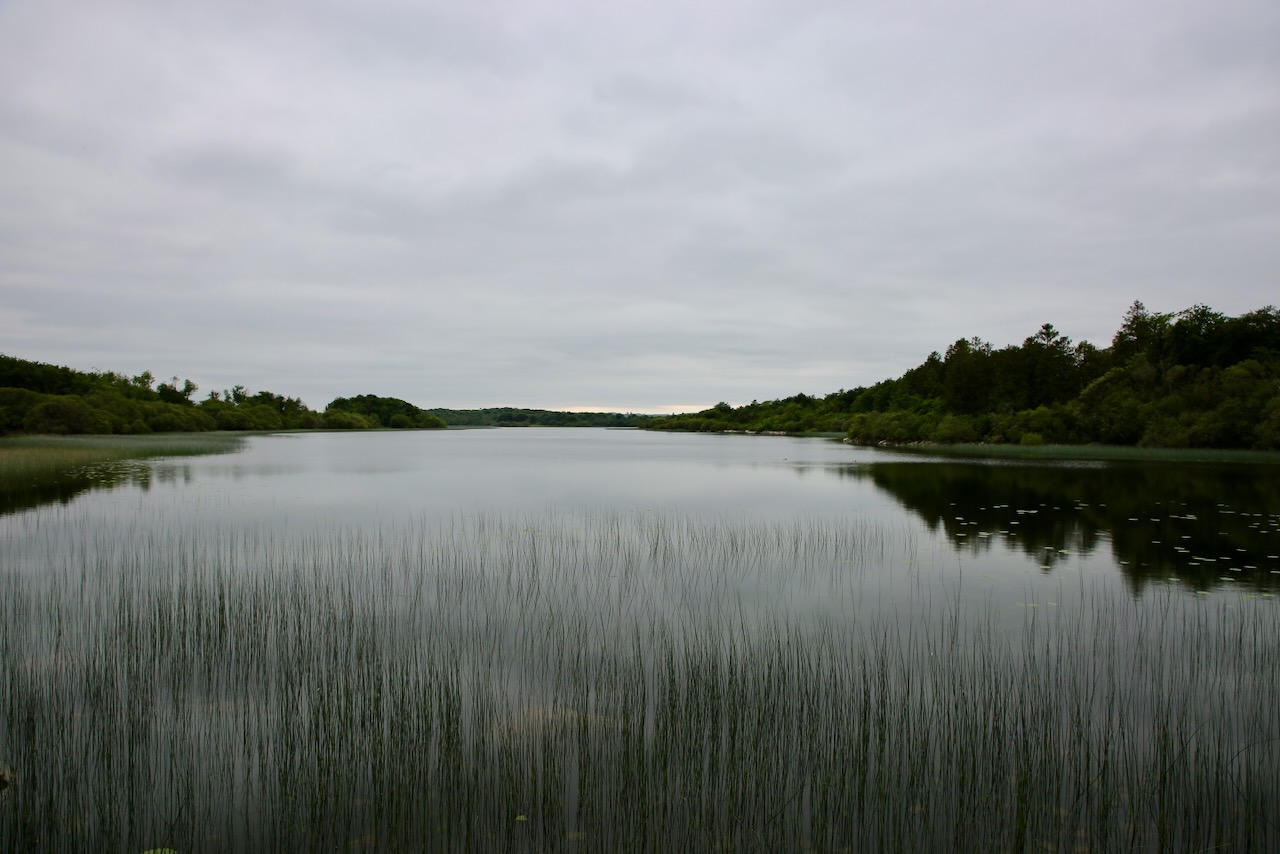
Dromore Wood Nature Reserve

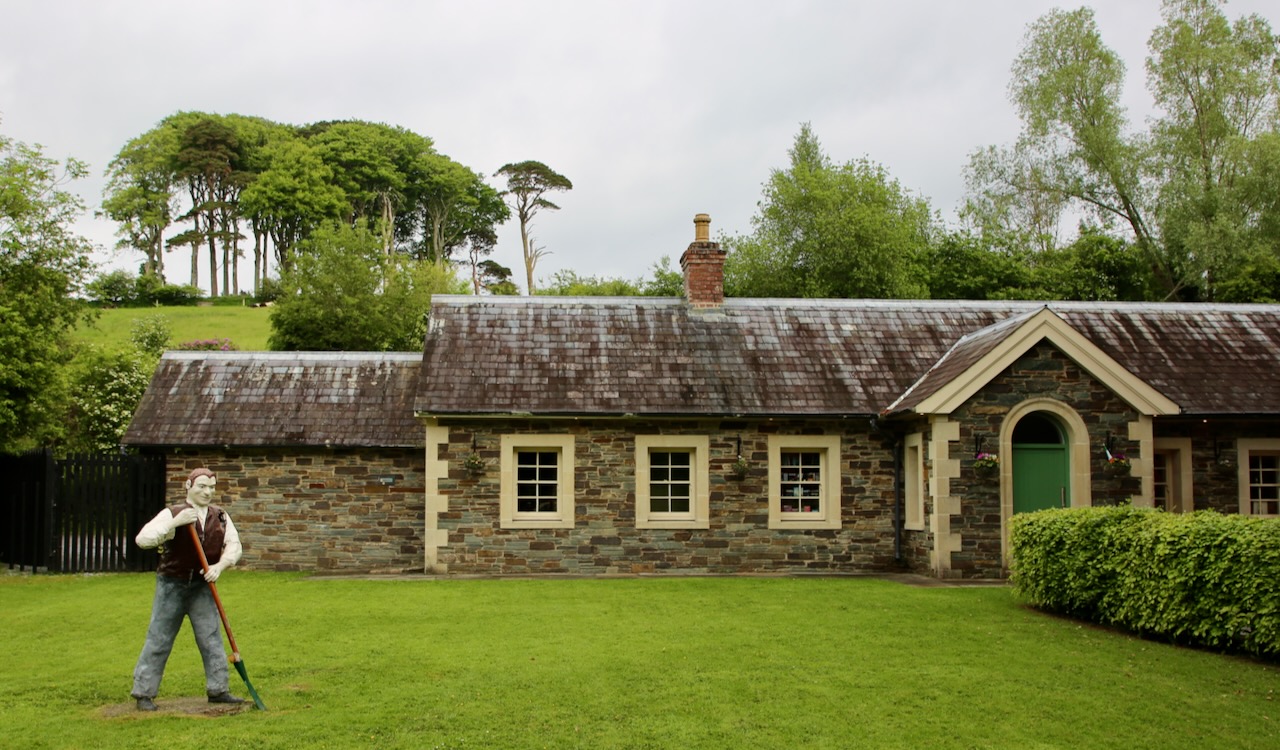
Next on our route, which looks like a Far Side Comic character to Caleb and a running dinosaur to me, is the Dromore Wood Nature Reserve for another free walk in nature. There’s a short trail to the de-roofed and fenced castle that is now a national monument. We make our way east to Birdhill where we will stay at Heron House, a carbon-neutral accommodation, meaning the room will be a consistent 68°F. We park out front and are greeted immediately by Sean, the host. Guest parking is in the back and we will move when we return from dinner. We are shown upstairs to our room and provided towels, soap, and chocolate.
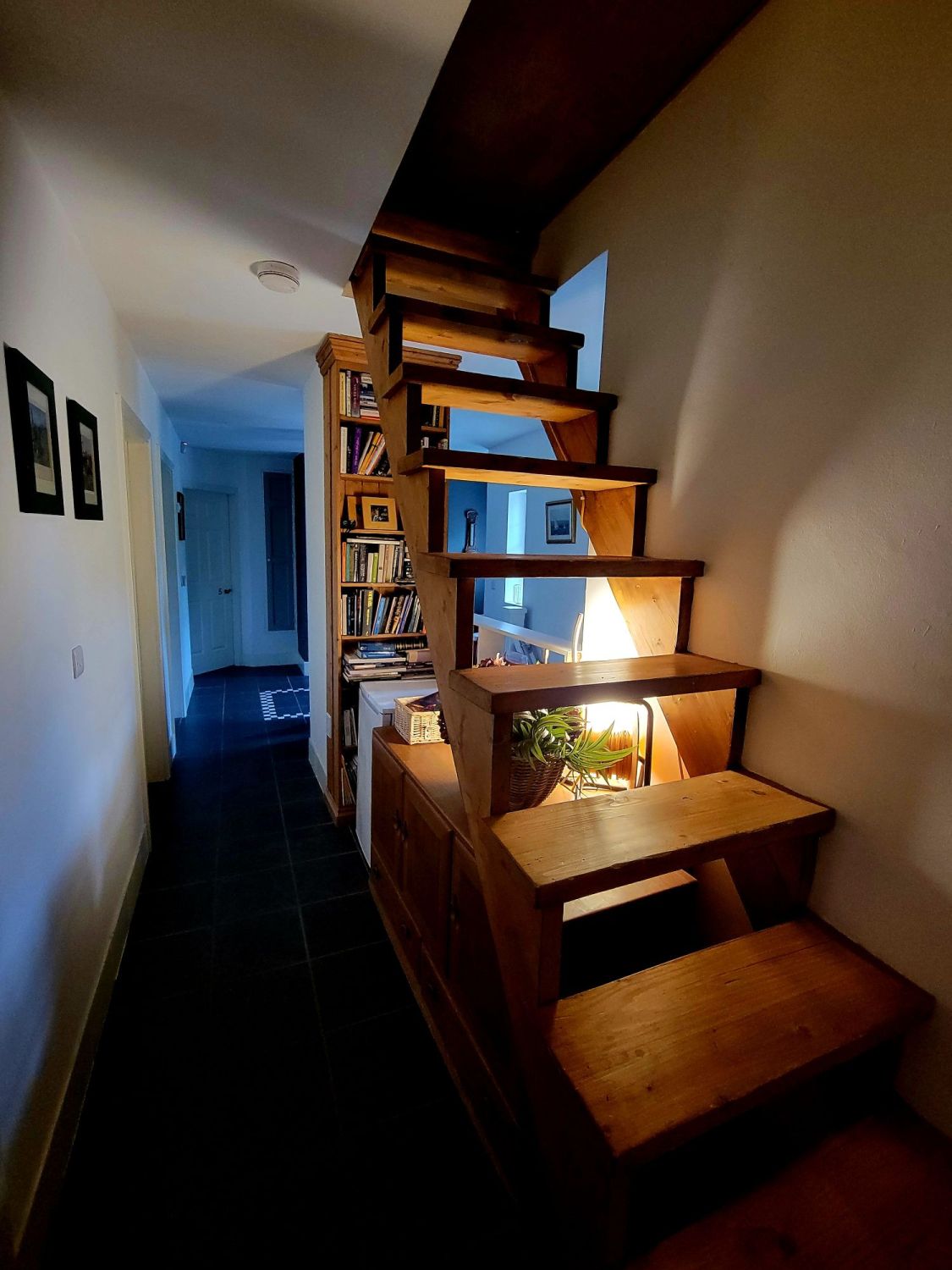
Heron House

We drive back into Birdhill for dinner at Matt the Thresher Inn, established in 1984 and voted the best gastropub in 2023. Luckily, it’s just the two of us and I’m the opposite of peckish. They find a small table tucked by the stairs, though they’re not busy. I order a small bowl of brown soup with two slices of brown bread and Caleb gets a chicken Caesar salad. We get back to our room before sunset and Caleb will read while I update my notes before reading too.

Posted in Animals, Entertainment, Food, Hiking, History, Media, People, Places, Plants, Travel, Water | Tagged , , , , , , , , , | Leave a comment

Motherland of Myths and Milesians

The Milesians represent the Irish people as the final race to settle in Ireland; according to medieval Irish Christian history. They sailed from Hispania after traveling the world for hundreds of years and struggled for domination against the Tuatha Dé Danann, who represent the Irish pantheon of gods. The two groups agreed to divide Ireland with the Milesians taking this world and the Tuatha getting the Otherworld. There are archeological sites that relate to this story: the Newgrange Passage Tomb (one or more burial chambers covered in earth or stone) and the Hill of Tara as a portal between the two worlds.

We managed to get a few hours of sleep at Sheila’s Hostel just as I was drifting away from the mustiness of the room and into myths of my own. I wake with my hair greasy and my throat on fire. I wash my locks with a bar of Irish spring soap and we will walk to Cafe Gusto at Lapps Quay. The employees are still setting up as most of their customers are people on their way to work with no food orders so Caleb looks up another place while we wait on our coffees. We walk the few minutes to Caffè Nero on Oliver Plunkett St. named after an archbishop, from the 1600s, in the 1920s. He was canonized in 1975 and thus became the first new Irish saint in almost 700 years.

The street won the ‘Great Street Award’ in 2016, beating out the competition in Ireland and Britain, 300 years after it was laid out. This title was selected by the Academy of Urbanism for the street’s history, community, and trajectory. It’s the second street in the second city, of Ireland, (who keeps track of that?) with historic buildings; many in their third generation of business, 111 of them independent. Even now, while most of the city is still asleep, this street is busy with locals walking to work while two tourists unknowingly sit in front of The Oliver Plunkett Bar. The name is in Irish between ‘Food & Drink’ and ‘Live Music’. The bar has outside seating so we could eat since our coffees weren’t welcome in the cafe.

Carbs and caffeine ingested we make our way back over the River Lee to collect our rental car before its free parking spot expires. Our first stop of the morning will be Blarney Castle & Gardens. We were the first car to arrive at the closed gate until an Uber pulled in and the crowds started to arrive half an hour before opening. How there was street parking available so close is beyond me as there is no shuttle needed from the parking lot like at some theme parks in the States. We pay our $48 along with the other 4,000-ish people per day that come to kiss the stone and gain eloquence (persuasive speaking) making this site over six hundred thousand dollars per week.

Outside the ticket office is the Muskerry Tram Turntable that was used to bring tourists from Cork, a route of 18 miles. The line ran from 1887, with a packed capacity of over 2,000 passengers, at a price of 13 cents each, until the Irish Civil War when a bridge was destroyed in 1923. The railway was purchased and closed two years later. There are 60 acres to explore the Fern and Poison gardens; trails around the lake, by the river, and through the woodlands; and a Rock Close with sacred yew trees and druidic stones.

We make our way to the main attraction first. The dungeons are occupied by highly endangered tenants, the lesser horseshoe bats, who get their name from their fleshy noseleaf used for echolocation. There are roughly 14,000 of this species in west Ireland that are also only found on the west side of Wales and Britain. Their population has been increasing since the 90s thanks to their love of the dark disturbance-free dungeon as they’re more vulnerable during hibernation. We know tourists can be trouble, bringing bright lights and bad germs, and I unfortunately am carrying a demon that is burning through what precious energy reserves I have, so we carry on to the entrance where the wait time is an hour — if there’s a line.

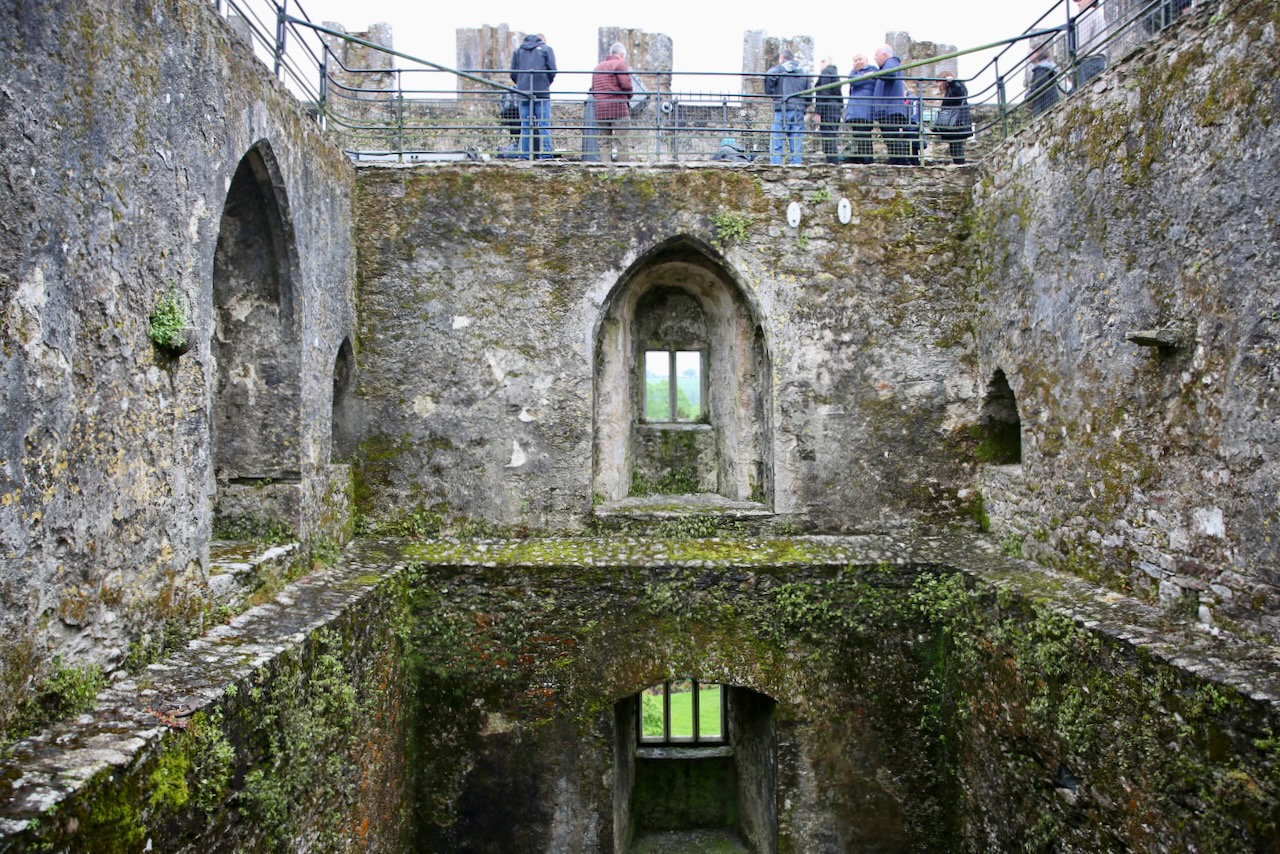
The castle was built on an elevated outcrop of solid limestone rock in the 1400s by the MacCarthys, the Lords of Muskerry, some of whom would be buried in Kilcrea Friary. It remained the family stronghold for over 200 years before being sold to the governor of Cork in 1703. The Blarney Stone was believed to be half of the Stone of Scone, that was used in the coronation of Scottish monarchs for its special powers, as a gift to the king for his help in the battle of Bannockburn in 1314. Geologists determined in 2014 that the stone is of local origin, so it’s more likely that it saved the Lord from losing his land to Queen Elizabeth I by motivating him to talk his way out of the predicament.

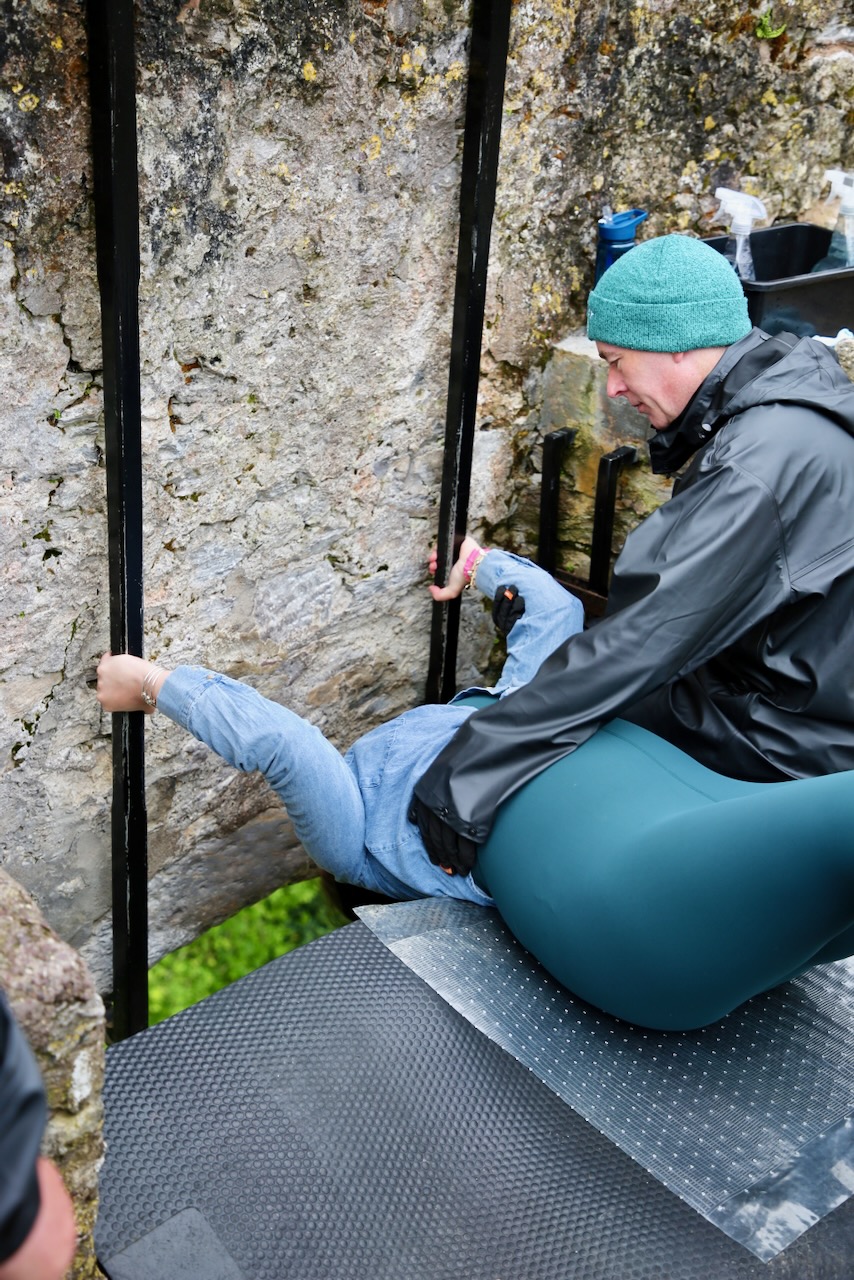
This tower house comes with an oubliette, French for forget, a 15-meter deep pit for unwelcome guests, and three three-seater garderobes (toilets) upstairs if you were invited in. The castle looks great for its age and the wear of guests 363 days of the year. There’s plenty of green throughout the castle and even more beyond the walls once we ascend the 125 narrow spiral steps. Iron rails were added near the stone in 2000 so that tourists would have something to hold onto for added safety, instead of dangling out of the top of a castle by their ankles, but there’s still a man with his hands on your hips instead while his friend takes your photo.

There are rumors that the stone used to be a toilet and that locals still use it to piss on at night. No, I didn’t lean backwards to gain the gift of gab as I’ve been told more often than not that I should learn the art of holding my tongue. I’d be more willing to kiss limestone and chapstick than disinfectant. We watched the process, demonstrated by the three people in front of us, and kindly passed by to admire the view below as ten people queued for their date with destiny and to join the list of kissers before them such as Winston Churchill, Mick Jagger, and Ronald Reagan. I’m not the only one who didn’t realize until we got there that it’s not just a rock in a lobby and that some find the stairs claustrophobic.

There’s a separate set of stairs to descend and to keep traffic moving more smoothly past the murder hole, another defense structure. The name reminds me of a horror comedy film, Murder Party (2007), about art on Halloween in Brooklyn. There has since been another movie of the same name released in 2022 which is a murder mystery, that we haven’t seen. There’s a cafe and gift shop and horse stables turned dining area before we wander to the Rock Close — an ancient druidic settlement with an altar, a hermit’s cell, a witch’s kitchen under ancient yew trees.

We come across a tree that stands out, as the tallest on the estate, at 145 feet. It’s indigenous to the western coast of the US, though the Sitka spruce is commonly grown in Ireland for musical instruments and boat building. The trees’ ancestors would have provided frames for aircraft built prior to WWII and may have a use in the skies again soon as some manufacturers in France prepare to release the kerosene hybrid and hydrogen hybrid models of two-seater touring aircraft made of wood and carbon fiber to combine a historic look with modern technology.

Carrigadrohid Castle

We are struggling for energy through the gripping illness and a lack of sleep. The crowds are growing and the sidewalk shrinking. We could cut across the lawn to see the Blarney House but would need a few more hours to cover the rest of the grounds along the river, around the lake, and across the woodlands. At least the cost makes more sense now knowing that we could’ve spent the day here, and more easily at the slow pace we’re going, but we’ll continue on in hopes of finding somewhere less populated to conserve what’s left of our stamina.

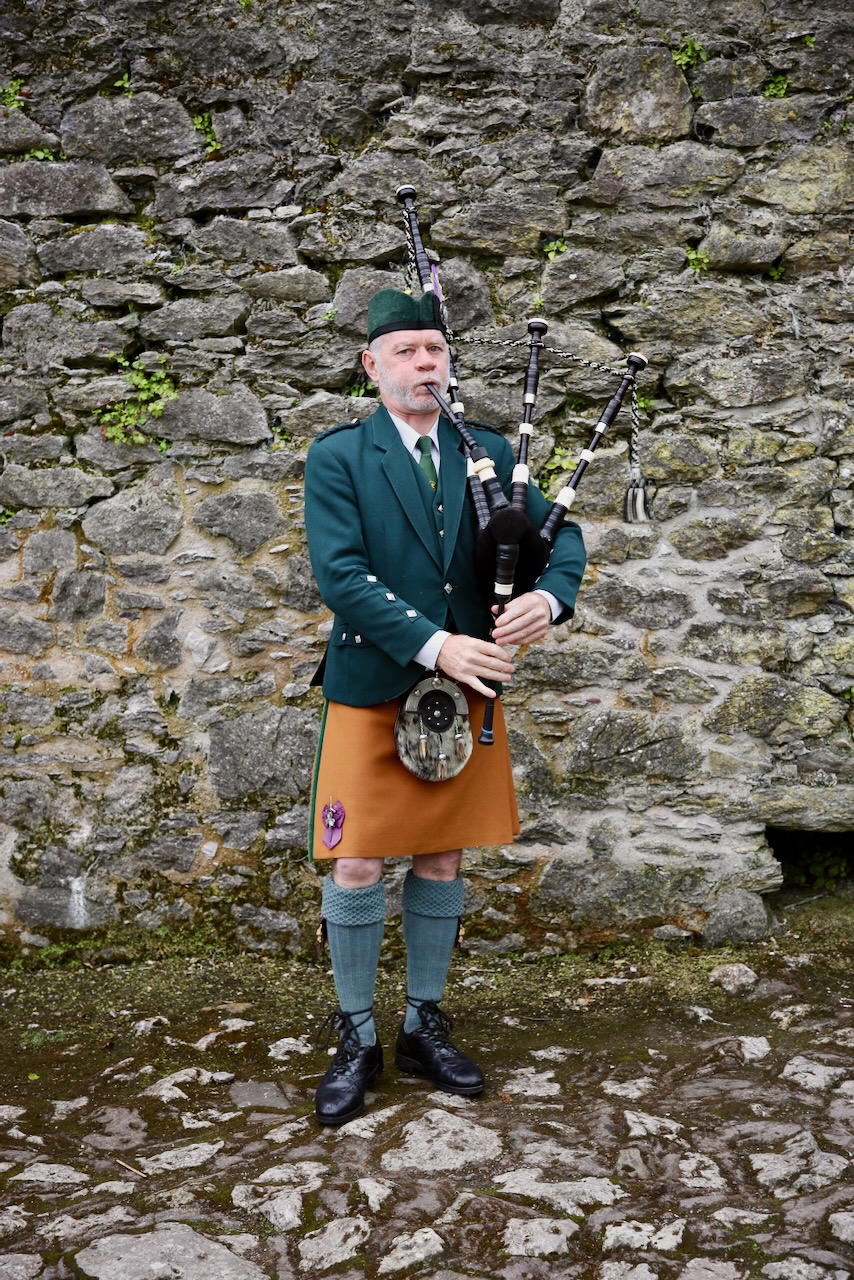
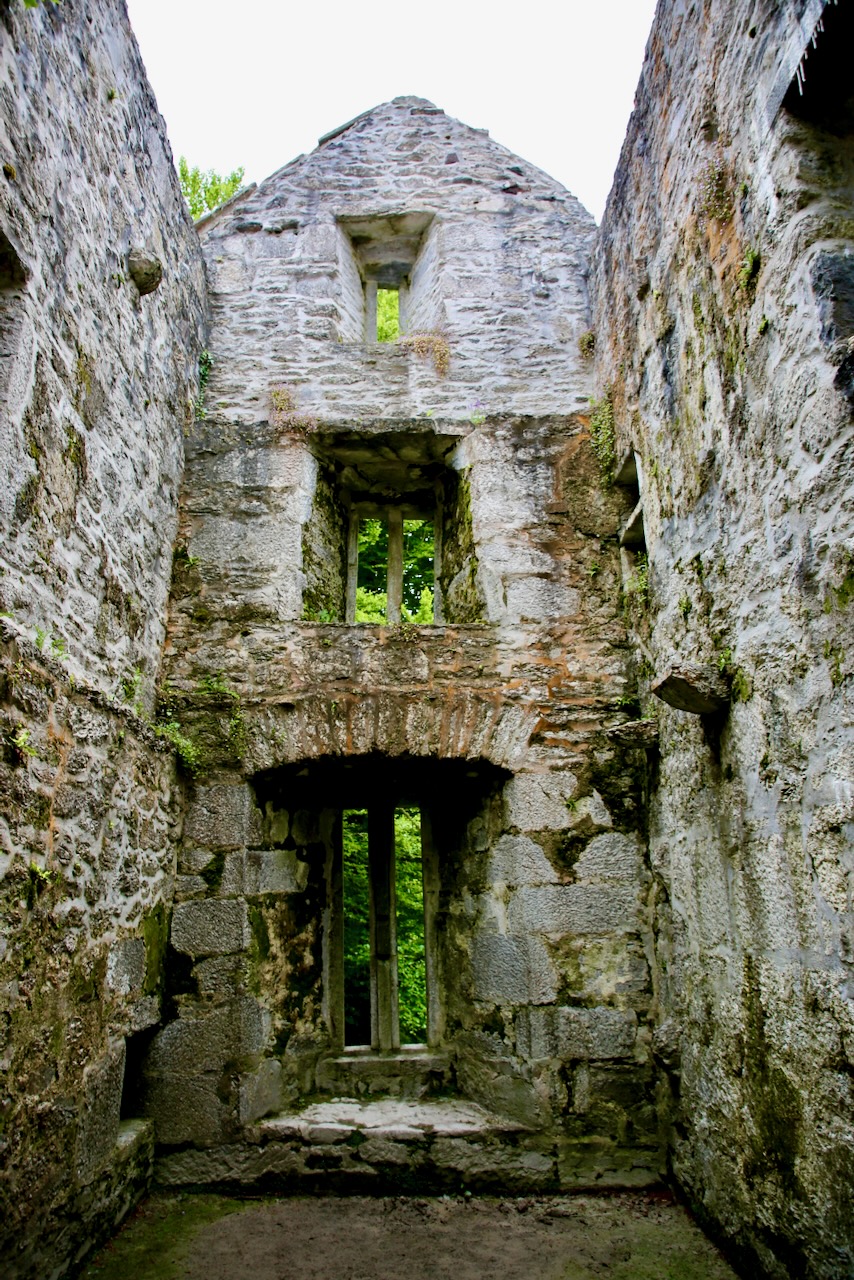
Luckily, we don’t have to leave the park without being serenaded by bagpipes (a square on Ireland’s scavenger hunt bingo card), complete with a request from a six-year-old for Twinkle Twinkle Little Star. Our next destination, Carrigadrohid (the rock of the bridge) Castle, used to control the movement of people and goods along the River Lee by being built on the water that it now stands in due to flooding of the valley for the Hydroelectric Scheme. I’ll park next to Dinan’s House because it doesn’t look lived in and I don’t want to block the road or bridge. The appearance is affirmed with a sign on the door letting us know the last resident died in 1968.

Killarney National Park

On foot to the bridge brings us by Apple Tower, used as a place for tea parties and music listening with a view. It’s believed this structure was once used as an apple store. I walk around the corner to see if there may be a way in but no entrance within sight. The tower and wall give off fairy tale and children’s literature vibes that inspire me to climb to the top, let down my imaginarily long hair, and kiss my prince. Back to the land of reality, I can kiss Caleb and we can walk to the other side of the bridge to catch the castle from each available angle, minus being in a boat.

There’s a radar speed sign that flashes ‘thank you’ when you’re doing the proper speed. I agree that I shouldn’t have to get encouragement to do the right thing, but it’s natural to feel better with positive reinforcement. We pass a bust of the Goddess Áine as we drive west on the bypass that was opened recently (2022 and ’23) with the addition of this sculpture facing the summer solstice and Bronze Age Girl, whose remains were found in the development process, facing the winter solstice. These were commissioned to Sarah Goyvaerts under the Per Cent for Art scheme which allocates a portion of the budget for major road projects for public art.

Ireland has more highways planned so they can reduce travel times for tourists and those driving to work and school. The government is working to improve safety and reduce congestion while locals are concerned that more roads will negatively impact the environment… and the feeling you can only get on a narrow winding road. The Corlea Trackway, or togher from 148 BC, was Ireland’s first roadway. It’s not certain whether the oak planks, between 3 and 4 meters wide, were used to cross the bogs or to ceremoniously enter them. They were first excavated in 1984 and parts of them were destroyed in 2013 by peat extraction. The roadway was only usable for a few years before it sunk under its weight.

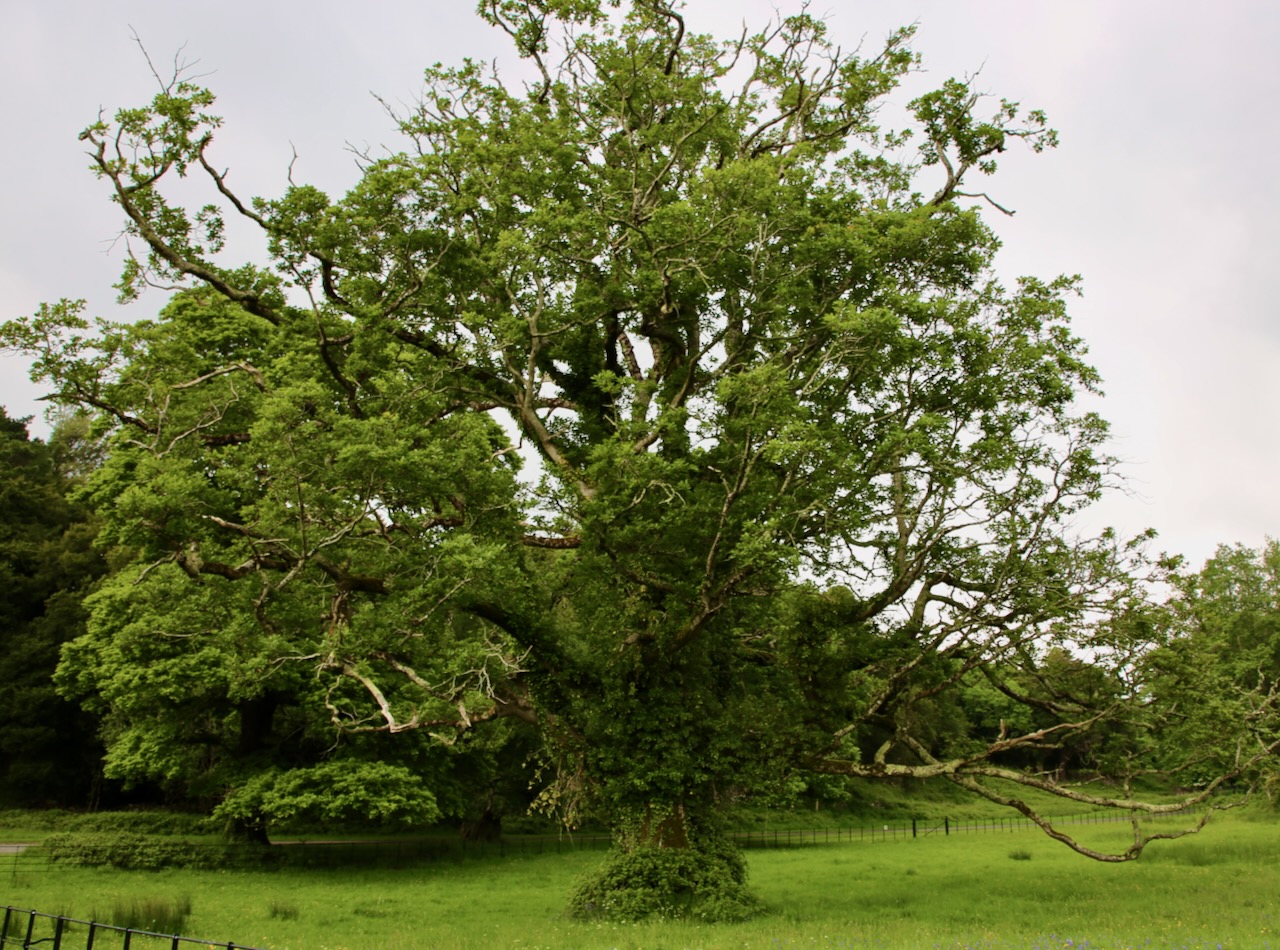
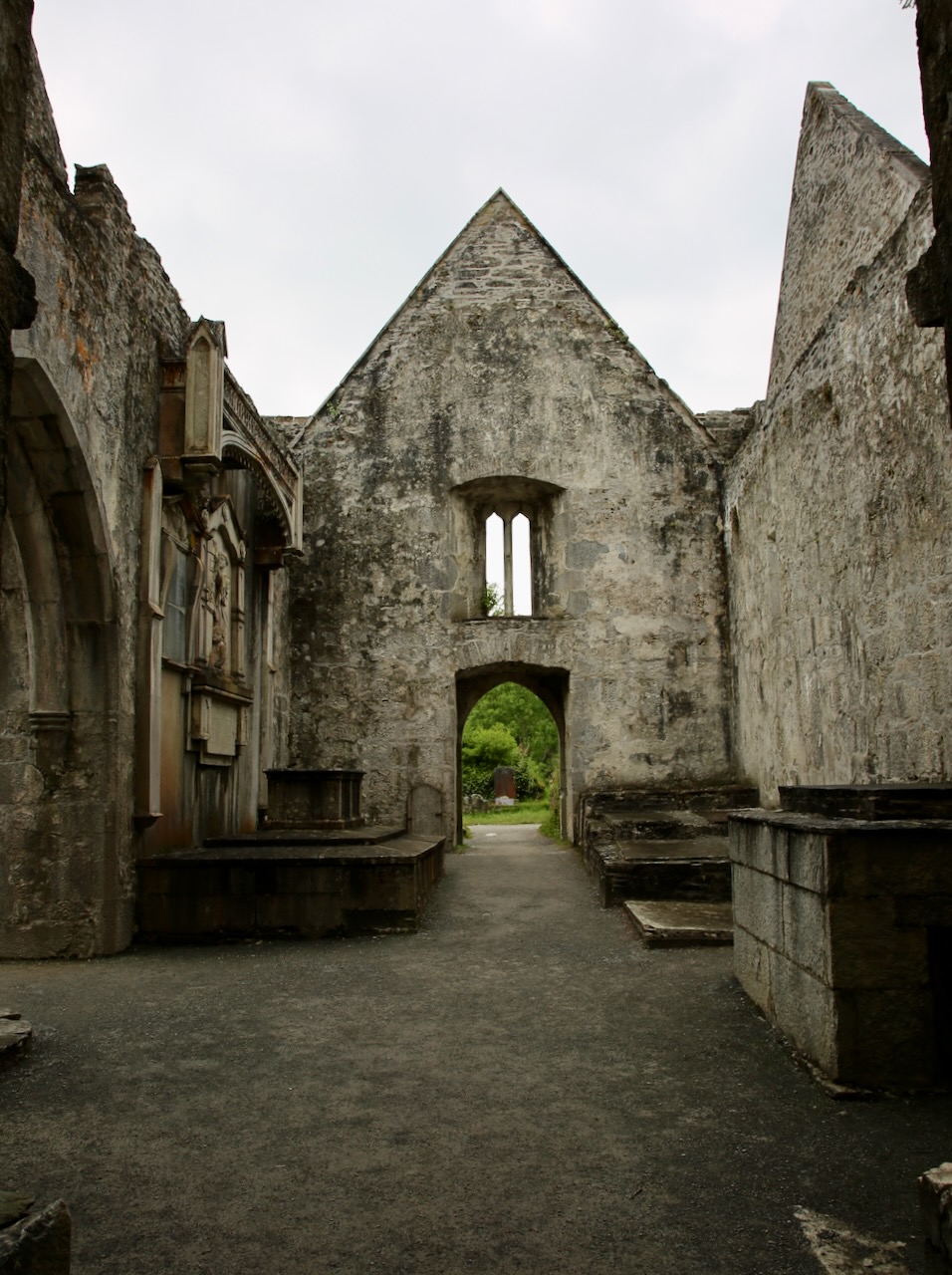
With the highway, we average between 33 and 48 mph and find parking in a large lot at Killarney National Park, which became Ireland’s first in 1932. The park is designated as a Biosphere Reserve by UNESCO. There are wide fields surrounded by low fences, and though there are many trees only a few of them have larger personalities, which is true for any grouping of flora and fauna. We follow a path to Muckross Abbey, one of the park’s many heritage sites, and walk around the perimeter first. Cemeteries are intriguing in various ways — their views, the grounds, and history, but none have inspired me to want to be buried there in a blanket of moist greenery for at least one hundred years waiting for the zombie uprising or the return of sparkly vampires.

We already know Caleb would be a werewolf in that scenario and our pets of choice would be a dragon and a unicorn. We proceed down into the basement with mixed feelings. I can imagine running circles in the shade around the courtyard with my fictional family. This structure reminds me of old buildings in the States that have been turned into schools, shops, and museums with larger upper windows to let in more light. The yew tree in the cloister court looks like two arms together with the hands open and the fingers stretching towards the sun, its branches spreading out over the rooftop.

Muckross House

For a minute or ten, we have the place to ourselves, and for a moment I can imagine living here in the quiet solitude of the forest. We pass a jaunting (now meaning a short journey for pleasure but that used to mean to tire a horse out) car, with a Gypsy Cob horse in the harness, awaiting to return to the depot by Muckross House after chauffeuring their latest passenger around the park. The Irish Black cattle seem to have an easier time as they’re allowed to lounge about in the grass. We make our way back towards the car and there’s a shop for treats, trinkets, and tickets to the Traditional Farms.

Ross Castle

We’re having a look around when a lady comes in upset that there’s no place for her to sit on her phone… because the park doesn’t have much signal. Our ancestors were too busy dying of mishaps and mayhem to perhaps have the time to complain, but I’m sure if they did, it would be about their health, not about expecting the world to cater to their every need. At least that’s one reason I travel, is to see how other people live and what they can live without. Though I can easily recall a few times when I’ve been bratty too, an airport can keep my attitude in check so I don’t end up on the no-fly list.

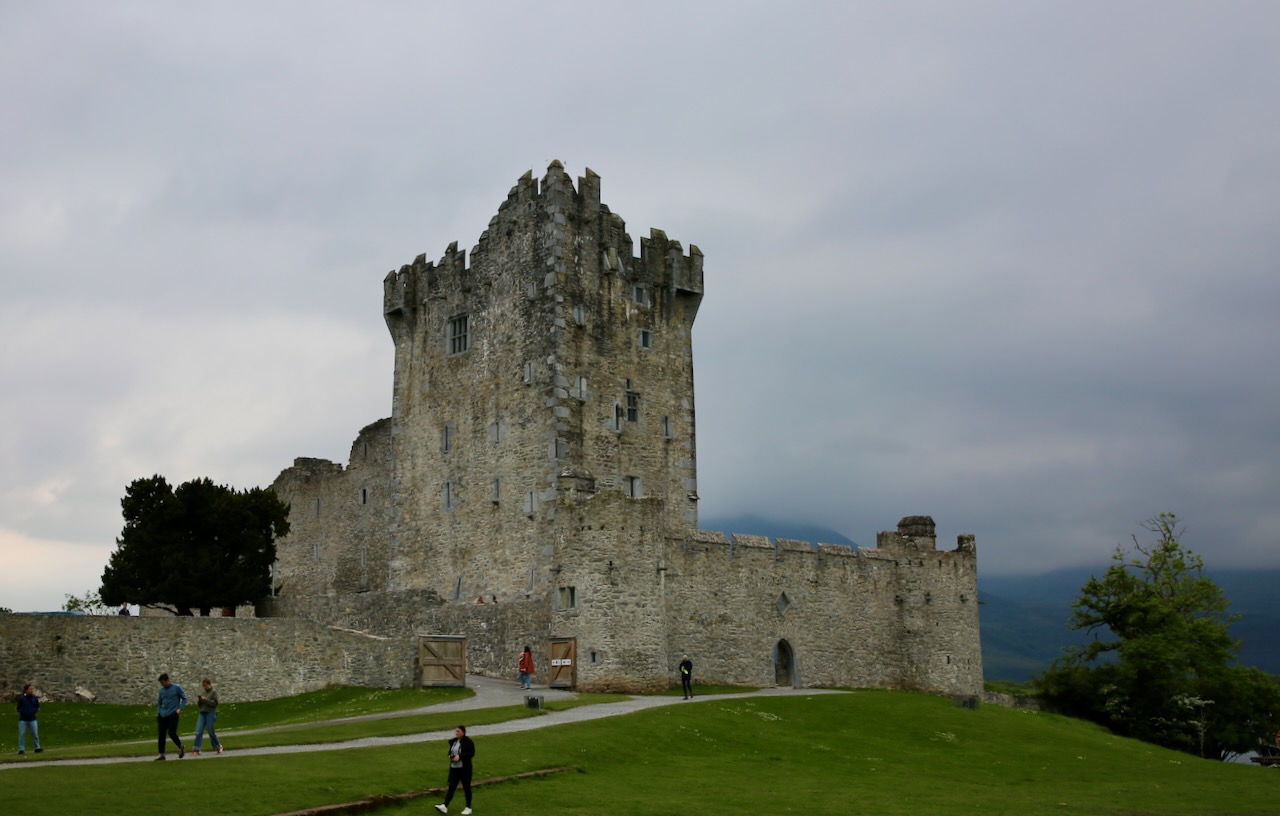
A few people are straggling about outside of Ross Castle along with two ducks and a goose (a familiar childhood game). Inside, we learn that this is just one of the 3,500 tower houses built in the 1400s and 1500s. The castle was restored using cow hair in the walls, wicker and sand in the vaulted ceilings, and timber shaped by an adze and held together with wooden pegs, and opened to the public in 1993. We check in to Mountain View B&B after I throw the stick around for their Breton spaniel and take a 40-minute nap after being shown to our room upstairs.

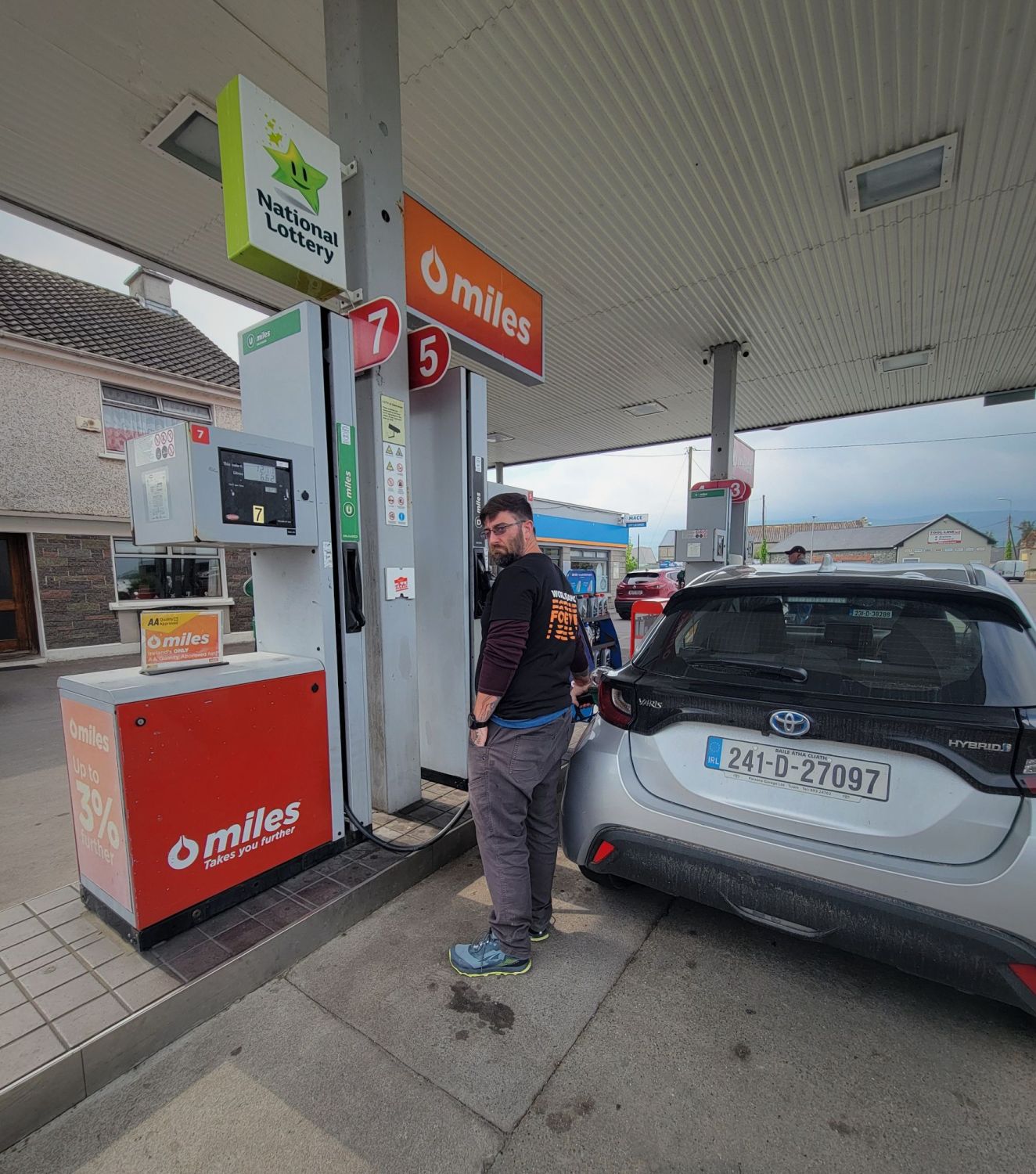
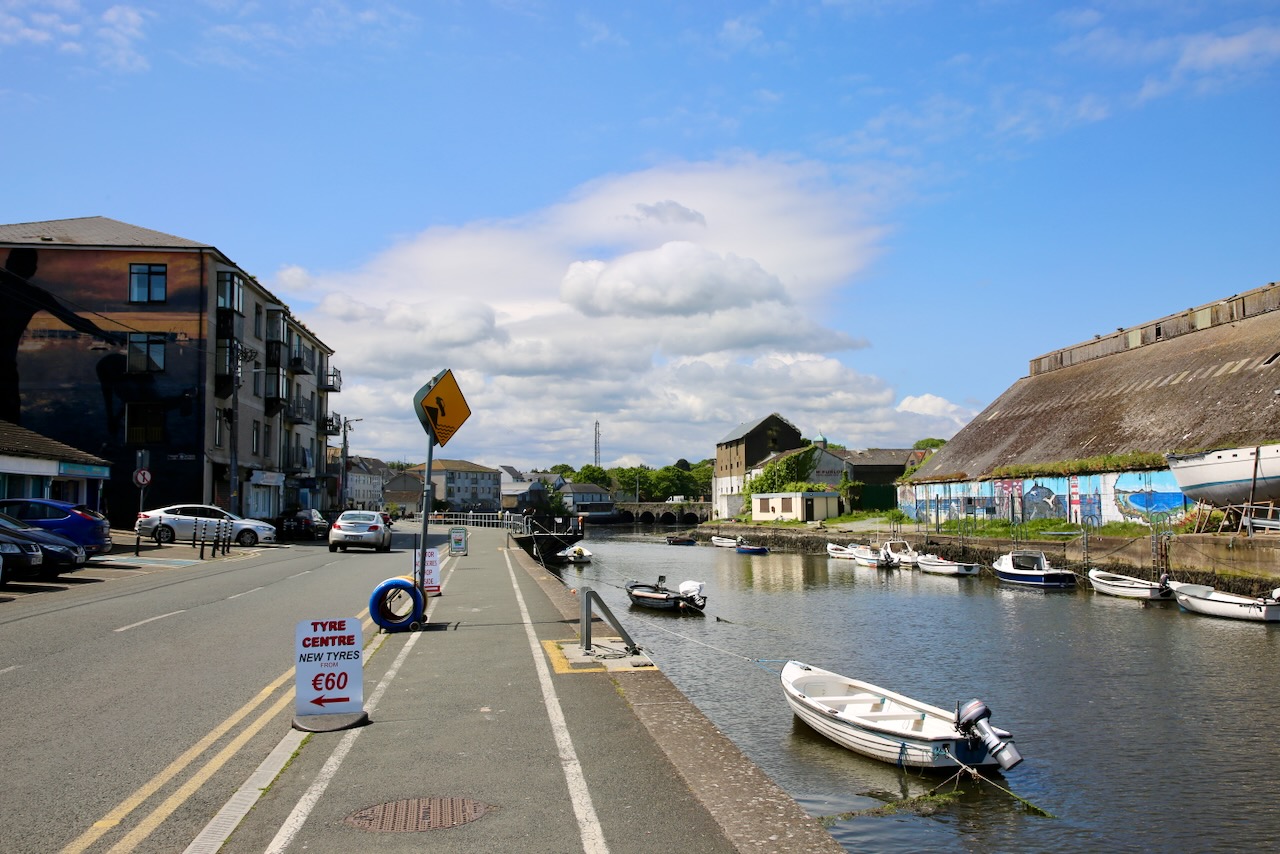
There are two beds, a walk-in closet, a tea station, a porthole window above the sink, and a folding shower door on the tub lit by a skylight. We are given towels but no soap so we drive into Castlemaine for shampoo and to get some gas, our first since leaving Dublin and we still have 190 km in the tank. The 25 L (6.6 gal) cost us 45.73 Euro ($49.85) which equates to $7.55/gal, almost double what we were paying in California. We are at the one-third mark in total trip mileage but I didn’t know that when I decided to get gas now instead of waiting to detour later.

Mountain View B&B

The Anvil Bar & Restaurant is on the way back to our room and though I’m ready for bed, Caleb orders me a cheesecake to go with his steak and beer while we listen to a group of men in the middle of a stag (bachelor) party. The groom-to-be is in a cheerleader’s uniform and his friends are singing, “Orla’s Mom”, the Irish version of Fountains of Wayne’s pop hit from 2003. The Irish name Orlaith means ‘golden’ or ‘princess’, perhaps a perfect reference to the blonde in the original music video. Our night would conclude at the end of a hot shower; their night was just beginning. I’m glad I got a peek into how the other half celebrates, at least at the cusp of evening in Ireland.

Posted in Animals, Art, Hiking, History, Media, Music, People, Plants, Travel, Water | Tagged , , , , , , , , | Leave a comment

Land of Saints and Scholars

Christianity quickly spread throughout Ireland after arriving around 400 AD. The convents and monasteries that followed became educational institutions that led to the island’s Golden Age while the falling of the Roman Empire plunged most of the rest of Europe into the Dark Ages. Though Ireland has 123 saints, from the 3rd century to 1180 and two since, dying in 1681 and 1893, the island has roughly nine percent of France’s saints and blesseds. These numbers have nothing to do with the proportion of UNESCO World Heritage Catholic Churches these countries claim, one and 78, respectively, with Mexico and Italy having 118 and 216.

We’re not a religious couple, but you are more likely to find us in one of the many buildings of God (under various names) while we’re traveling. For me, it’s the history, architecture, and calm that lives inside all structures that invites me in. Sometimes I’m lucky enough to catch a song or service of the followers hoping to find age-old guidance in an ever-changing society. I can appreciate the rituals passed down through centuries that connect people to their ancestors; and though some sermons are now broadcast, these spaces still offer a sanctuary but not always an escape from social media.

We were invited to join our host, Peter, and his wife for breakfast and agreed on 8 am, a time between when we could’ve eaten elsewhere and when they will feed their other guests in the late morning. While we wait, we walk among homes with names. None stand out but usually, estates are encountered when I read biographies or American history of the wealthy. These people are fortunate, at least the retired couple is, in that they can afford their larger home to accommodate tourists; whereas others may struggle to maintain such space without strangers as more foreigners buy homes to rent out at a steeper price nightly than locals or transitory workers can afford monthly.

Back to our morning walk before I delve into the troubles of traveling and ensuring you’re doing the right thing for the local economy and ecosystem. We sit in chairs across from the locked door for ten minutes before I knock. Caleb is ready to continue fasting so we can get on the road, and I agree that if they’d left the tea and toast out, we’d have eaten in the car. We exchange small talk and Peter is glad to hear that his recommendations are already on my list, except for a lighthouse that we are told is worth the half-hour drive detour.

We leave Ocean View before 9 am which gets us to Johnstown Castle, via the Woodland Walk, just as they’re opening. I didn’t understand the size of this place just that it was built in the wake of the Anglo-Norman invasion and was something to see along the route. The castle was remodeled in Gothic Revival style in the 19th century and has one of the longest servant’s tunnels in the country. The castle was donated to the Irish State in 1945 and the Irish Agricultural Museum was opened on the grounds in 1979 but it would be another 40 years before the castle and estate would be available to the public.

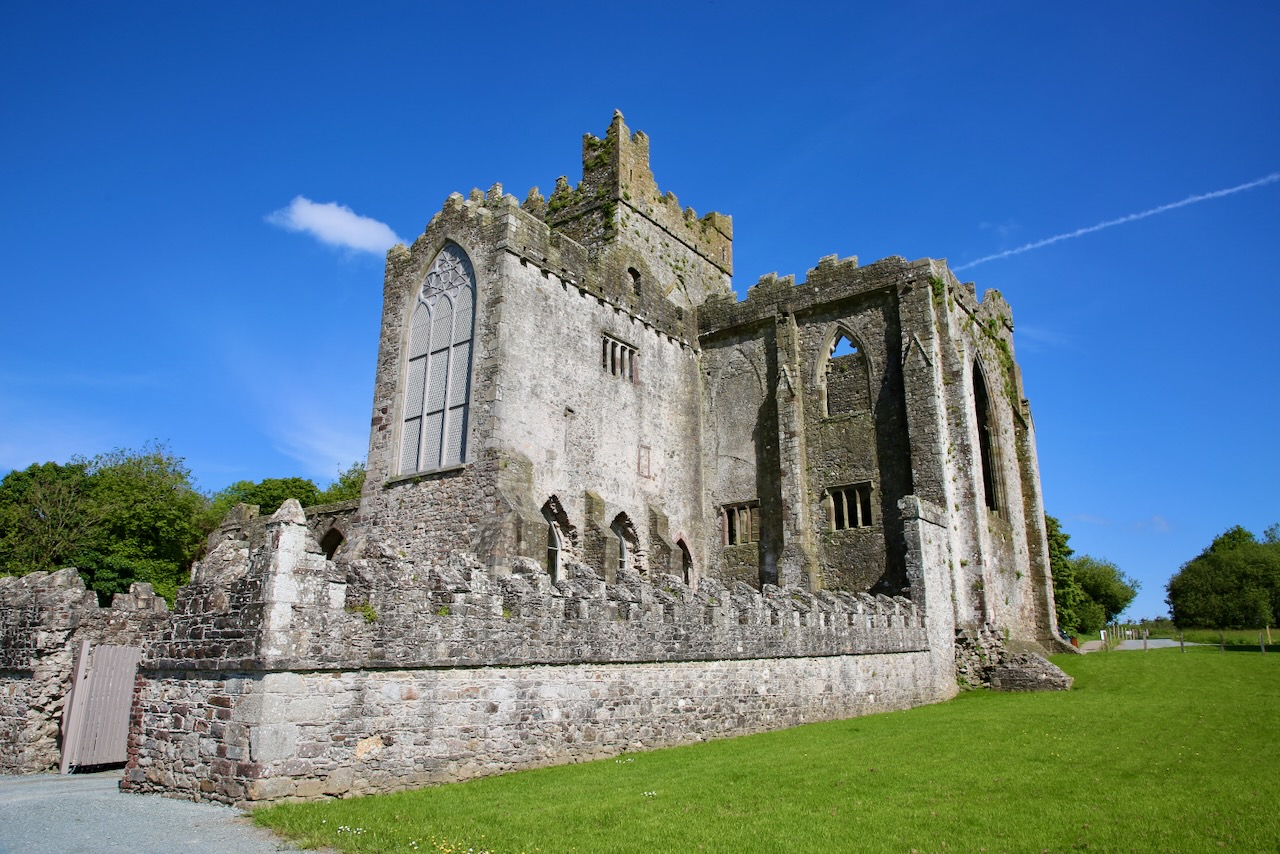
Had I known this piece of history has only been exposed to tourism for the last five years we might have waited the two hours for the first castle tour of the day by exploring the extensive grounds with three lakes and the museum with two floors. This is another reason I always overbook my itinerary — we have plenty more to explore. We park at Tintern Abbey, where monks farmed 9,000 acres of grain and wool, and other foods for international trade in the 13th century. What makes this abbey unique is that most Irish abbeys were closed and turned to rubble in the 16th century but this one was converted into a residence with new floors and partition walls.

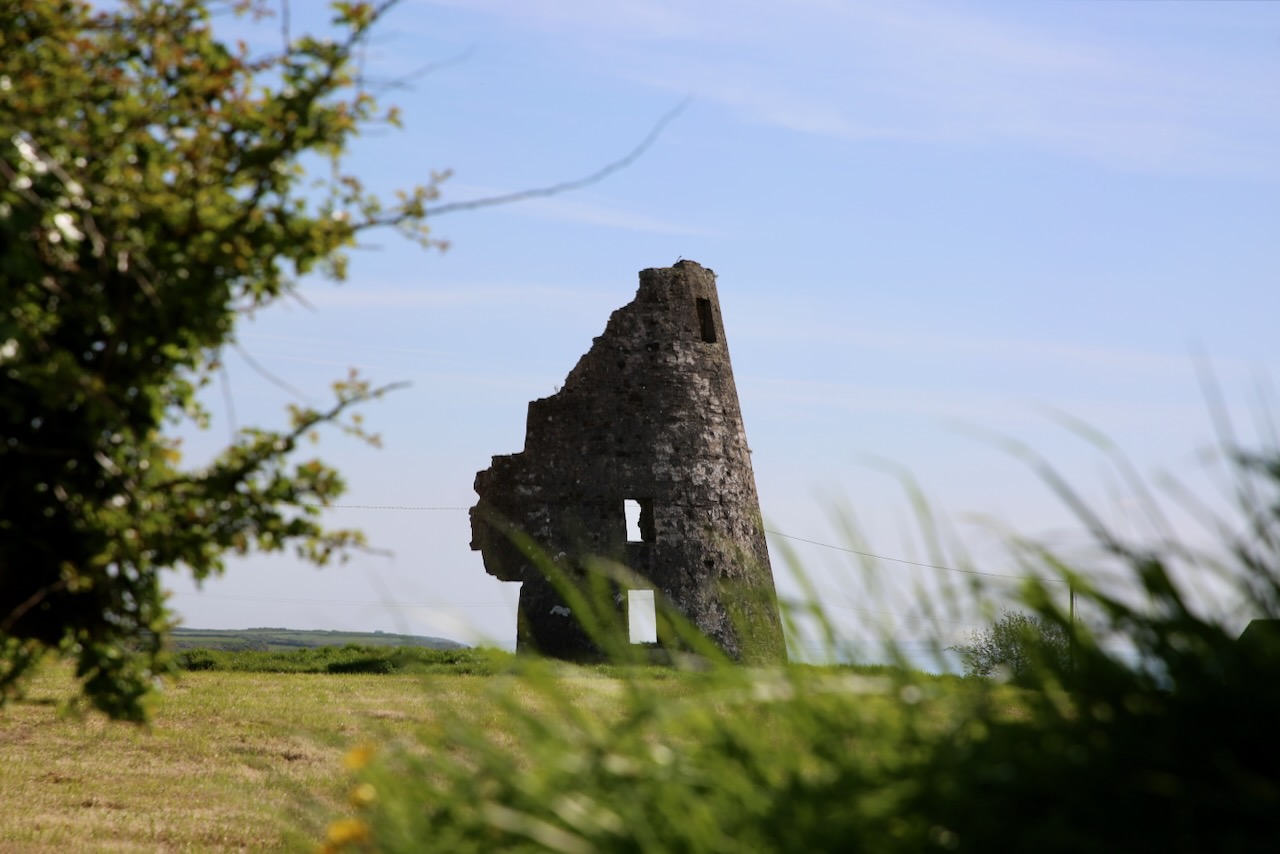
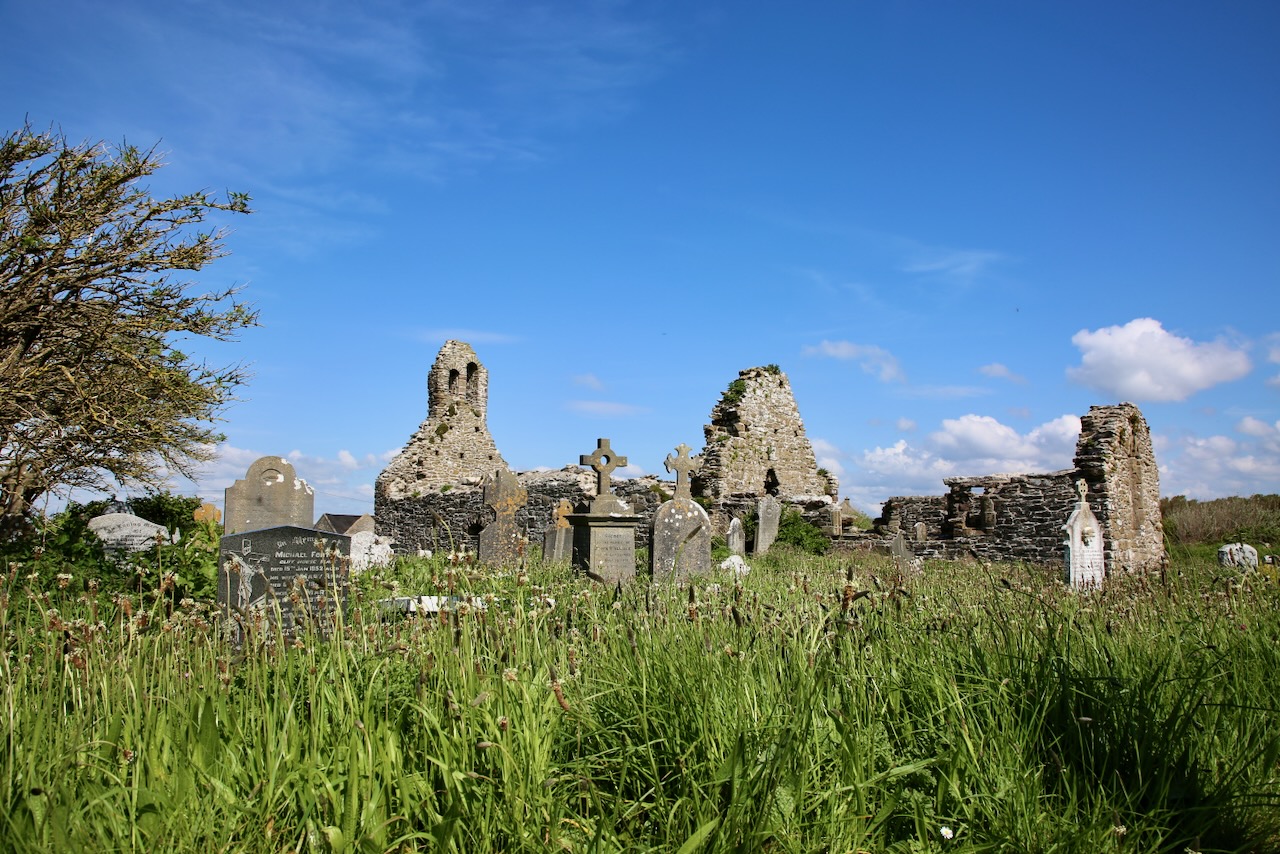
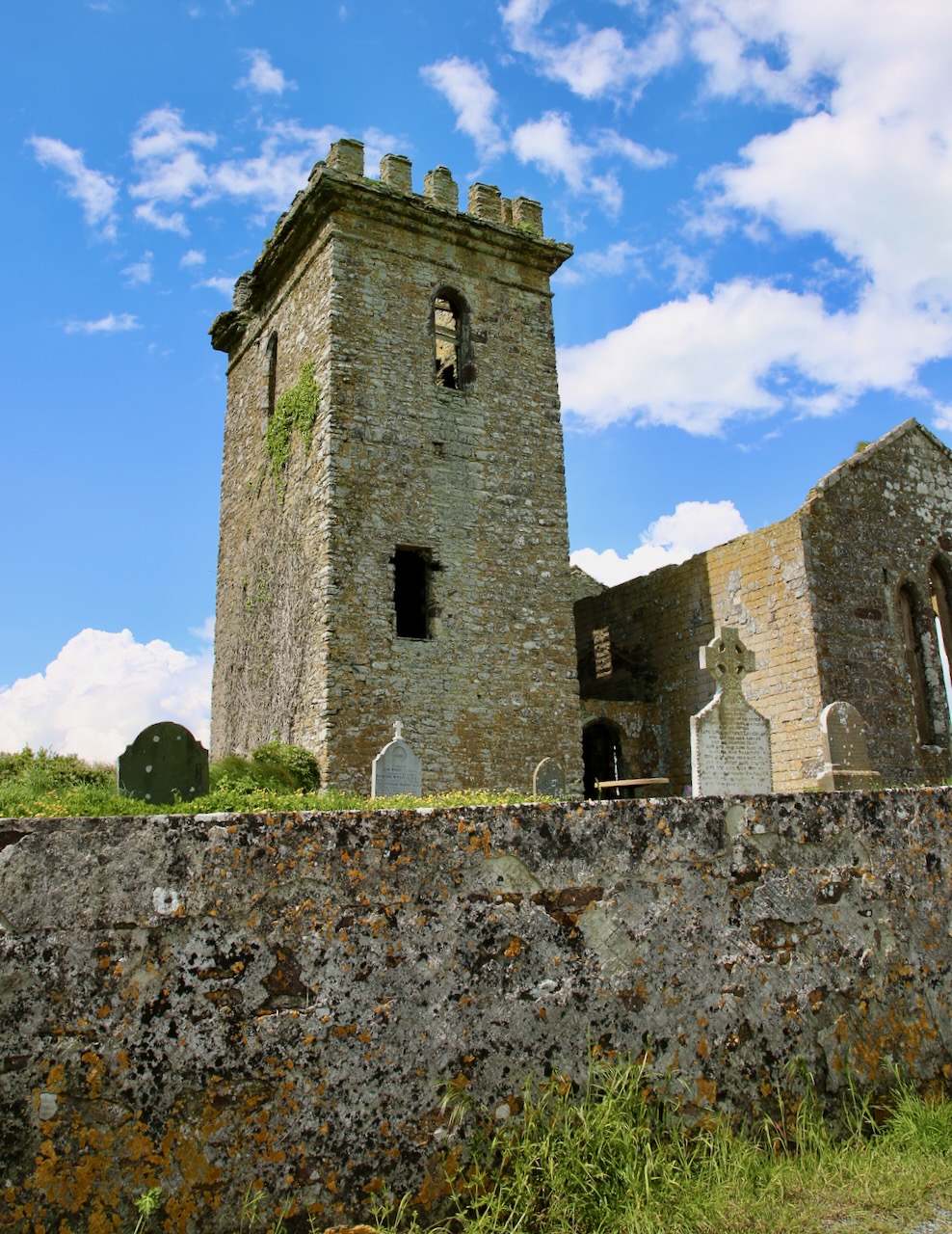
We take the forested trail back to the car and unknowingly pass Saltmills Mass Rock — a place where an altar stone was used for Catholic Mass during the mid-17th century. I only recognize it by the boat ruins on the beach. Our next stop is just a few minutes up the road and has a lady eyeing us as we parked in front of her house, as she’s leaving, to walk back and get a better picture of the tower ruins in her yard. Without unexpected house guests, the lady is on her way and we stop at St. Dubhán’s (translates to fishing hook) Church where a small wooden church was built by the Welsh saint in the 5th century.

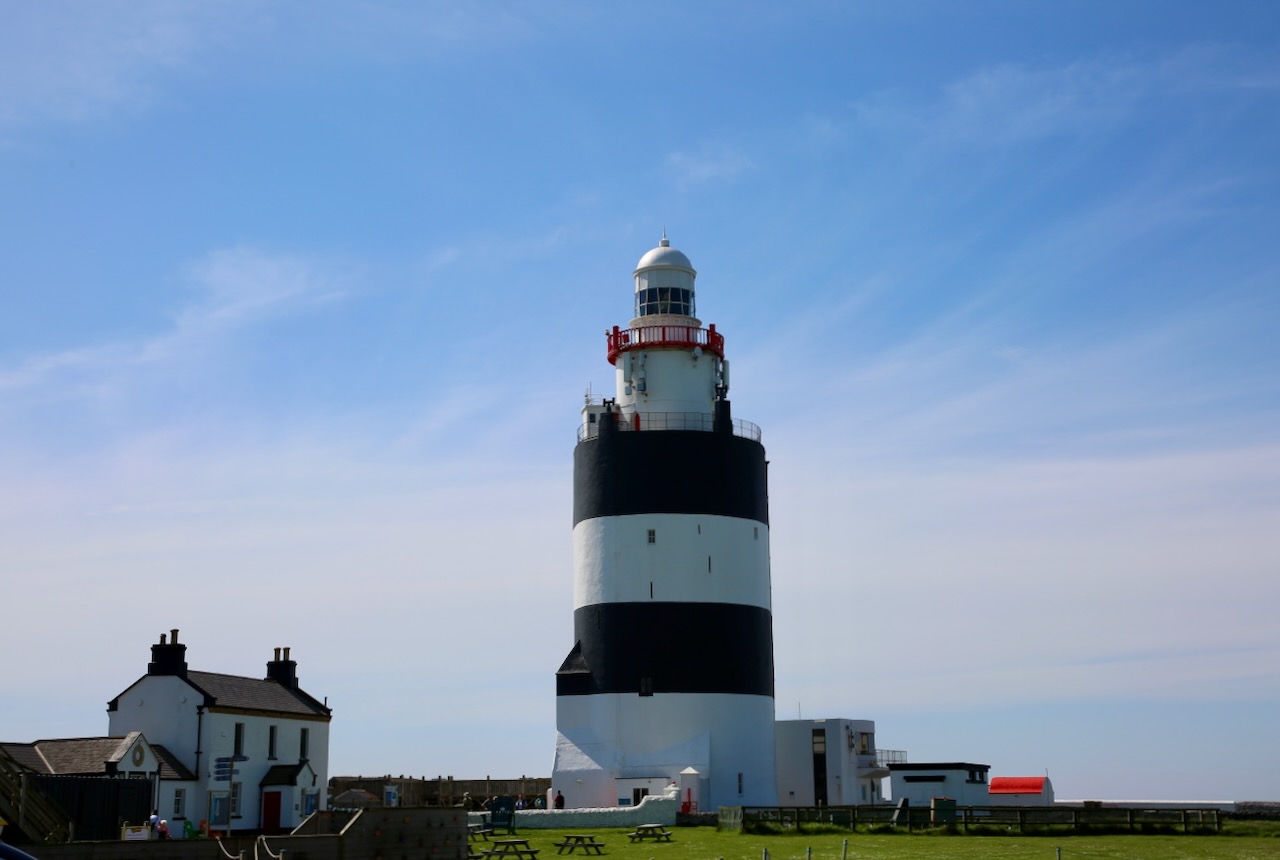
Dubhán’s father founded the St. Brecaun’s Church just 3 km away. The Normans built a stone church on the site 600 years later and Sir William Marshal built Hook Lighthouse (one of the top four oldest in the world) over the monks’ beacon. The tower is four stories high and the walls are four meters thick with 115 steps to the top that had to be constantly climbed with buckets of coal to keep the signal lit. A coal-burning lantern was installed in 1671 by the first lightkeepers who replaced the monks. In 1791 came the whale-oil lantern which was upgraded to gas lights in 1871 that led to paraffin oil in 1911 when a mechanism had to be wound every 25 minutes by the keeper.

Then in 1972, electricity was introduced and automated in 1996 and the lighthouse opened to the public in 2001 after the keepers’ houses were turned into a visitor centre. Ten years later, the fog horn would be heard for the last time as the Commissioners of Irish Lights deemed them unnecessary with the advanced technology available on modern ships. We park at the lighthouse and look at the Bristol Wagon, a 19th-century rocket cart, used by the Coast Guard to haul in shipwrecked persons from up to 200 yards away. This system saved almost 14,000 lives and was replaced in the late 20th century by the Irish Coast Guard helicopter.

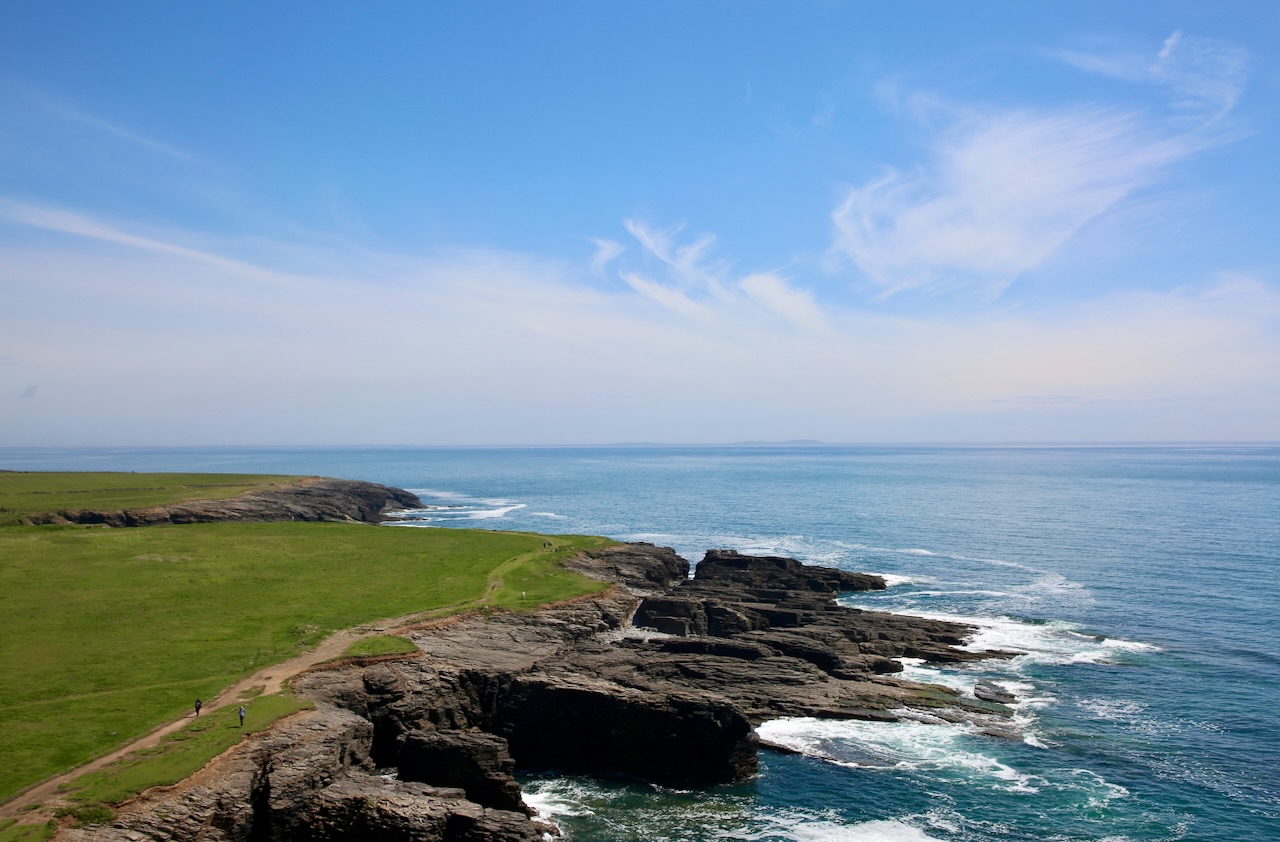
We missed the last morning tour and agreed to wait for the next one. We’ll pass the time with coffee, a large scone (they’re bigger in Ireland), and a full Irish breakfast which is also enough to share. Then it’s back outside to read more about Sir William and other lighthouses on the island (some with lodging and boat tours) while looking for puffins on the rocks. We meet outside the tower with our tour guide and roughly ten others who will be joining us. We’re told this is where three seas (Celtic Sea, Irish Sea, Atlantic Ocean) and three rivers (The Three Sisters: Barrow, Nore, Suir) meet but the oceans surround the island and two rivers converge before joining the third.

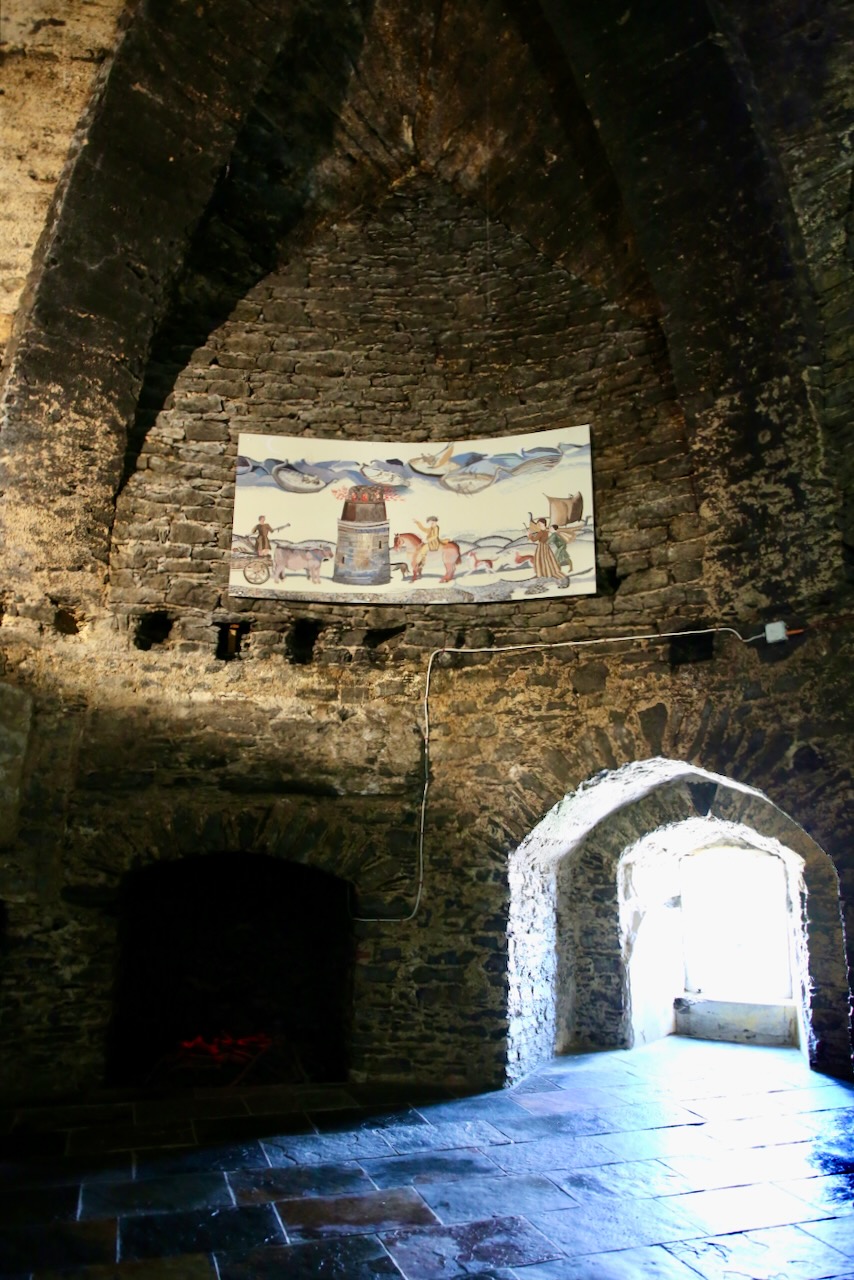
We’re taken inside to see the old Fresnel lens used at Blackrock from 1974 until 1999 when it was replaced with solar power as Ireland moves towards more renewable energy and a reduction for the need of helicopters and ships to help with upkeep for remote offshore locations. As we ascend, we pass built-in shelves, garderobes (toilets in the walls), and large fireplaces. I’m almost sure I can see Wales from here but it could just as easily be more Irish coastline. We’re in the middle of taking smile and frown face selfies when our guide disagrees and does a mini photoshoot of us smiling.

We pass by the attached chapel on our way out while our guide tells Caleb and me how she’s going for her masters to be a librarian, like the famed monk Martin Schrettinger. On the road again and I’ve noticed a few signs — painted on the road: slow, very slow, slow now; a yellow warning sign with three cars meaning queues likely; and the hardest one to figure out: a half-white circle on a brown sign (for tourists) that looks like a Trivial Pursuit game piece which means viewpoint. It’s a good thing the symbol was never alone because when accompanied by a mountain climbing picture it means there’s a walking trail with a vista worth the hike.

This means we skipped out on 500 million-year-old rock, house remains from the 1900s, a grotto, a medieval castle, and a battlefield in the countryside to drive to Waterford instead. We find parking around the corner from Reginald’s Tower, the oldest civic building in Ireland, and have to power walk to the Waterford Treasures: Medieval Museum to use their downstair facilities. We pass the Irish Wake Museum: Rituals of Death. Celebration of Life; a large chess set (resembling the walrus tusk pieces found on the island of Lewis in 1831); and a monument to Luke Wadding, the only Irishman to garner votes in a Vatican papal election. Luke got the Catholic Church to approve St. Patrick’s Day (a local holiday for five centuries now recognized worldwide) and businesses and pubs would close to celebrate, for over 70 years, so that drunkenness wouldn’t disrespect the saint.

His statue is outside the Franciscan Friary also known as the French Church. The “Dragon Slayer” 23-meter sword, the world’s longest, outside the King of the Vikings virtual reality adventure, was carved from a single fallen tree by John Hayes and James Doyle in 2017. There is so much to see here, and our itinerary is of no help. Back to the tower, that has been a fortress, an arsenal, a coin mint, a prison, and now a museum; the only monument in Ireland named in honor of a Viking who founded the city in 914. There are a few things on display and the porcelain plate, silver pennies, and wine jug catch my eye as much as the stone steps, cloud-filled views, and large wooden door.

Not ready to get back in the car, we head southwest on foot and find ourselves quietly appreciating the inside of St. John’s Presbytery. I’m surprised more homes don’t have stained-glass windows as perhaps they want separation from the church or don’t want to pay the $90 – $250 per sq. ft. for privacy with natural lighting or I just haven’t spent enough time in communities with that budget. This congregation was able to raise funds to restore the windows in 2007 that were built in 1850. It starts to sprinkle on the way to the car park and we learn that the town name Waterford is believed to come from old Norse meaning fjord of the rams (sheep export) or windy fjord (a safe harbor).

There is minor flooding at an intersection which slows cars in our lane but isn’t dampening travel plans for cars going the other way. I had plans to go to the Butter Museum and learn about the success of Kerrygold internationally, one of the top three sold in the US, but we were about an hour and a half away when they closed at 4 pm. Instead, we’ll stop at Bonmahon, a historic mining village, along the Copper Coast UNESCO Global Geopark. The visitor centre is closed and the small parking lot could just be a roadside rest stop. We continue to the beach, where horseriding is allowed between 5-11 am between May and Sept.

The boardwalk on the hill lets us admire the view of rock formations, the small tide rolling in, and the immaculate manufactured home lot behind a fence on the other side. Excited to be outside, but also hesitant to soak one of our few outfits; which is exactly why you bring two! Anyway, the Ballyvoyle Tunnel was built in 1878 with alcoves for the rail workers to stand in while trains passed. I wasn’t expecting that or to stumble upon Waterford Greenway, Ireland’s Rail Trail, and one of the top seven international destinations of its type. The railway line operated until 1967 and the trail was opened in 2017. Within 29 miles there are 11 bridges, three viaducts, and the 1,300 ft long tunnel.

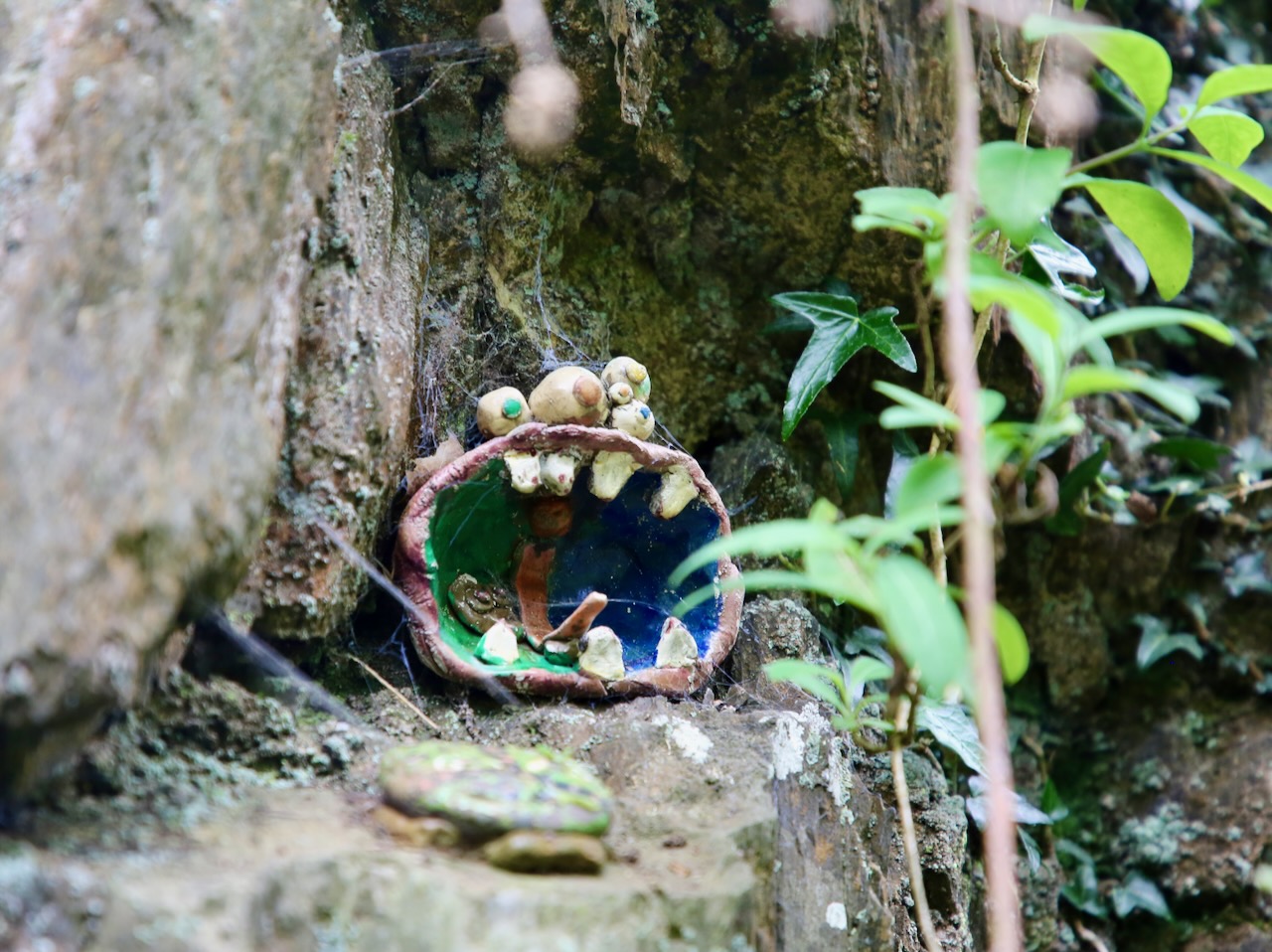
I think knowing so much about a place can be overwhelming; at least to a person who struggles when having to make a decision. This visit just helps to reinforce that idea. I didn’t know the length of the tunnel or what to expect, but leading to the dark passageway are birdhouse facades as a way for people to leave their mark without carving their names in rocks and trees. I’d have enjoyed the tunnel just as much if it were only three feet long. The path is clean and the lights inside illuminate cave-like walls, spider webs, and ferns growing on the wet bricks. The rain seems to be at rest, for now, but we’re hungry and Caleb still feels ill, so we stop in Dungarvan to look for a pharmacy and a place to eat.

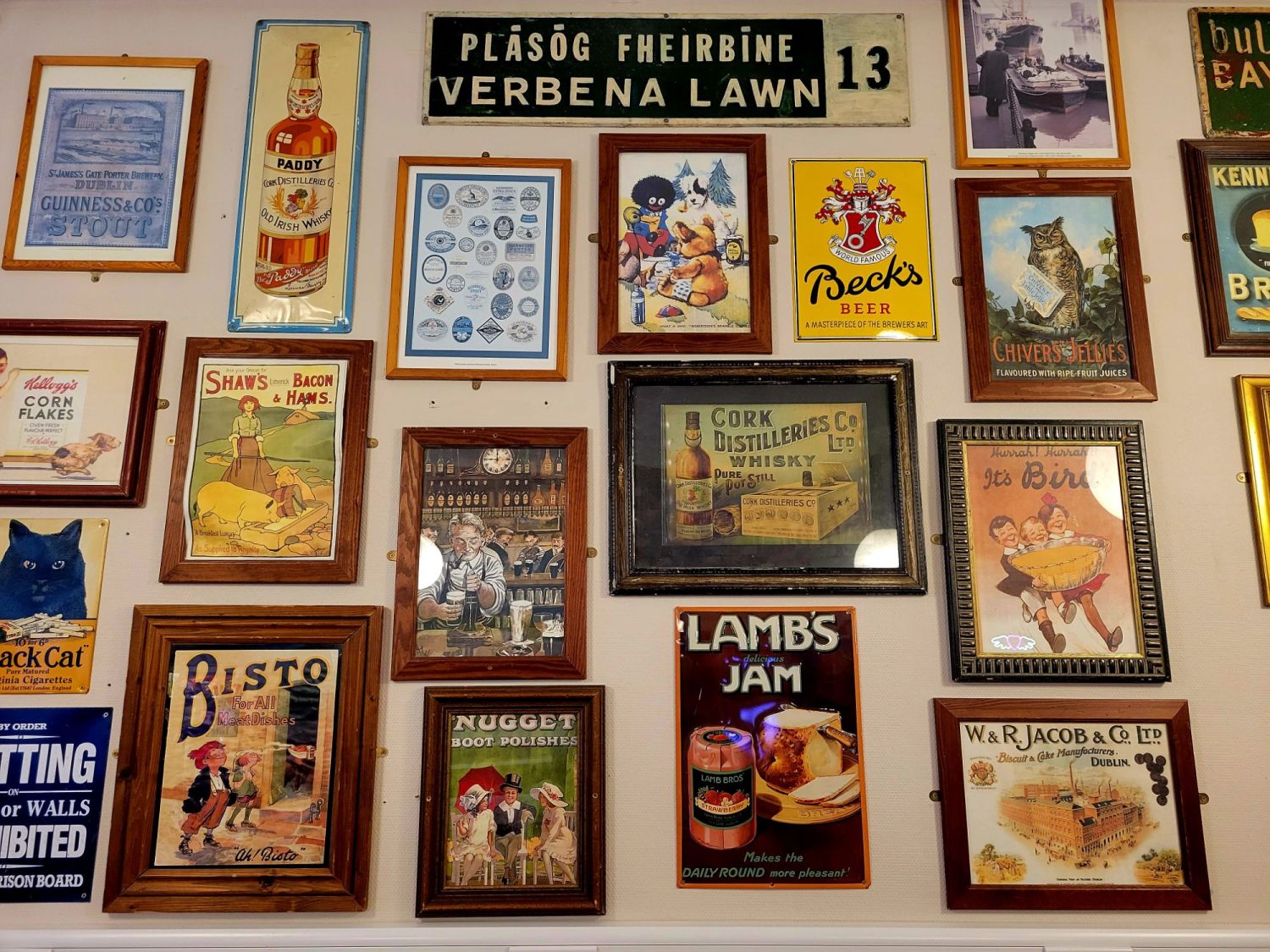
We park near The Poor Man’s Seat, where the parking meter is broken, and walk towards Grattan Square to find food at The Local. We’re sat in the back of the long restaurant and looked at the signs on the walls, mostly for drinks, while we waited for our food to arrive. I looked at the house specials — steak, fish, fried meats, or the goat’s cheese tartlet with rocket, sundried tomato, red onion marmalade, and pesto with homemade chips. No idea why we passed by the Lismore Castle, with a political poster on each lamppost, versus passing through Castlemartyr closer to the coast.

Ballyvoyle Tunnel

Either way, instead of a simple right in Cork, I parked us 700m away from Sheila’s Hostel at Patrick’s Hill due to a road closure. I’ll walk back for the car while Caleb stands in a parking spot to ensure it’s still there as overnight parking is free but very limited. I realize how tired I am when I have to reverse out of a bus’s way at an intersection as I second guess if I’m in the proper lane; though as Caleb will tell you — it’s more stressful being in the passenger seat of a vehicle when you constantly feel like you’re going to hit a tree, ditch, person, sheep or all of them at once.

This is the worst accommodation we’ve ever stayed at. Places with stains, stickiness, and secrets might gross you out but they won’t keep you up all night. A person was joining our room almost every half hour until 2 am and shining their phone lights along with the bright hall light beaming in. We had no idea Bruce Springsteen was in town but I was hoping that meant they’d all come back at once and pass out drunk. The other two girls in the room slept with their phones, one guy gets light alerts and three of them snore. There are slamming doors in the hall, stomping feet up and down the stairs, people outside our window, and constant traffic.

Caleb reminds me that we’re getting too old for this shit. I should’ve booked us in places that are more quiet and have stricter policies, which I agree with when I need to drive the next day. Perhaps these stays wouldn’t be as bad if I could nap on a train, but then I’m still missing out on part of the trip. If we’re over having roommates, who have mostly been friends from work, then why would we want to subject ourselves to a room full of strangers with terrible sleep standards… I’m still coming to terms with growing older and finding those stories that will stay with us through time.

Posted in Art, Food, History, Travel, Water | Tagged , , , , , , , , , , , , | Leave a comment

Auld Sod

This nickname was started by almost a quarter, roughly two million, of the Irish population who were forced to immigrate to the United States after the potato crop failure of 1845, caused by the late blight, led to the Great Famine lasting until 1852. The name means “old land” and helped keep the memories of home alive as the Irish settled in New York, Pennsylvania, and Iowa where they were welcomed to work on the railroad and pray in a Catholic Church. The near-famines of 1861-64 and 1879-82 only continued to ensure, for a while, that one-third of immigrants to the US were Irish.

We wander around the hostel in the morning, being asked to leave each room as we enter for the cleaning schedule. In their vending machine are crisps, toiletries, chocolates, charging cables, sodas, and a rain card (a disposable emergency poncho). We walk down to the corner off-license store for drinks while waiting for the free cereal, toast, and fruit in the kitchen. I appreciate the insight into another culture through what they offer their guests, which is usually what they’re having too. The right grain can be a good way to start the day.
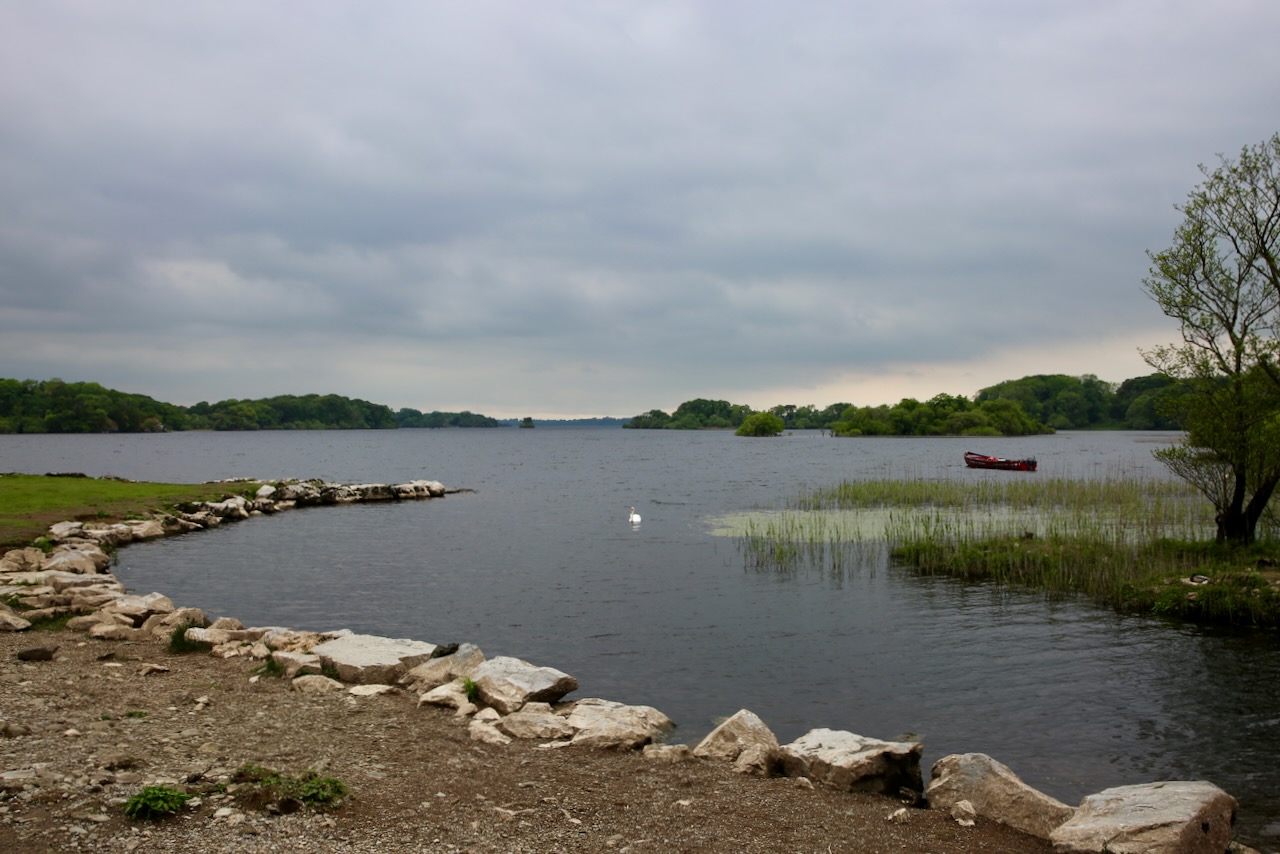
With that done, we can check out and get on our way to Wicklow Mountains National Park where I planned a few short walks to see the forest, lake, mountain, and glen. Some recreational areas are better marked than others, such as a backroad into a US park or no trail markers in a Canadian park. In Ireland, they use a yellow “walking man” to indicate the National Waymarked Way Network and different colored men or arrows for other routes. I didn’t expect a large welcome sign as with slower speed limits comes less need for such grandeur but I missed the roadside placard too… if there is one.

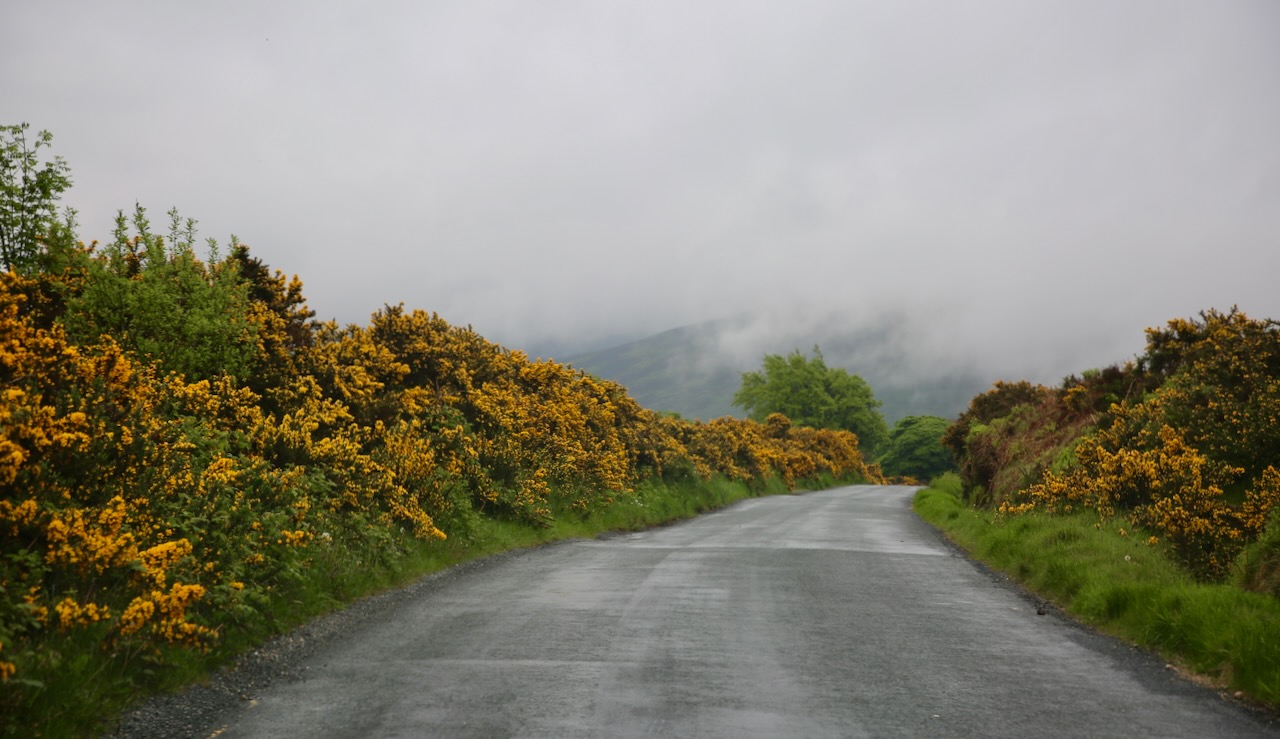
We picked a great time to visit, giving ourselves sixteen hours of daylight to explore, though June has an hour more. Since leaving the city, with cars parked facing both directions on the same side (making it easier to navigate narrow roads), we have only passed a lone cyclist. The road shoulder looks wide but with the opportunity for a ditch or cliff always around the next turn I wait for a clear pull-out or just stop in the middle of the road to say hi to the sheep painted red and blue and take in the view of green, brown, and gray (as the sky matches the stone walls).

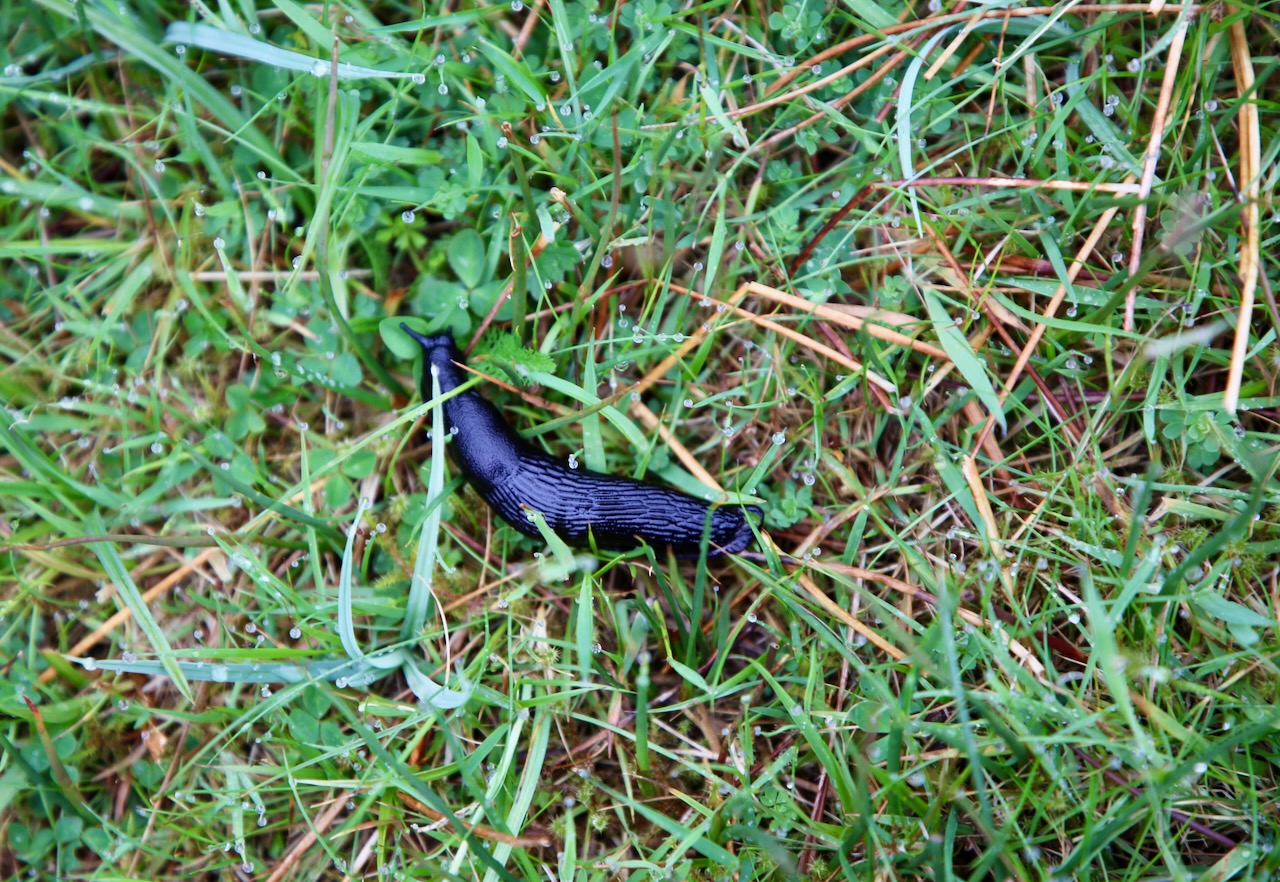
We stop again and notice a purple park sign with a peregrine falcon, the park’s symbol, on it, as these birds nest in the cliffs within the park. We’re not sure if it’s a trail marker or a park border but we see how many black slugs we can count hidden in the wet grass while being weary of the moss-covered rocks and the slippery mud as we explore up and down the hills and along an unnamed, to us, river. We see some deer that appear to be giving us attitude, but they’re just red deer still shedding their winter coats, giving their face that mean-mug appearance.

Red deer were reintroduced to Ireland around 3300 BC, almost went extinct again in the 1900s, and have the smallest deer population on the island. However, they are now the largest non-domesticated land mammal that still exists in the country. Deer stalking (tracking them down and sledding them out) is now legal (for all classes of society) and necessary to cull a prey species with no other predators within reach, but no use of dogs or lamps (flashlights, lanterns, headlights, torches) are allowed. I’m not sure when hunting was legalized for more than the king and his guests in his protected forests, but venison is not the only animal that has traded sides between royalty and the commoner.

We reach a parking lot for the Glenmacnass Waterfall, part of the Avoca-Avonmore River Catchment, that flows from the Wicklow Mountains to the Irish Sea. Harbour to Headwaters is an initiative to raise awareness of the natural and built heritage of the area and preserve it into the future. To get here, we took the Old Military Road that was built over 200 years ago by the British military to eliminate any Irish resistance to British rule around 1805. Today, the only warning of conflict is the man with a crowbar and bag of money stepping away from the car with a broken windshield. I grab my camera, lock the door, and we walk along the Guinness-tinted river.

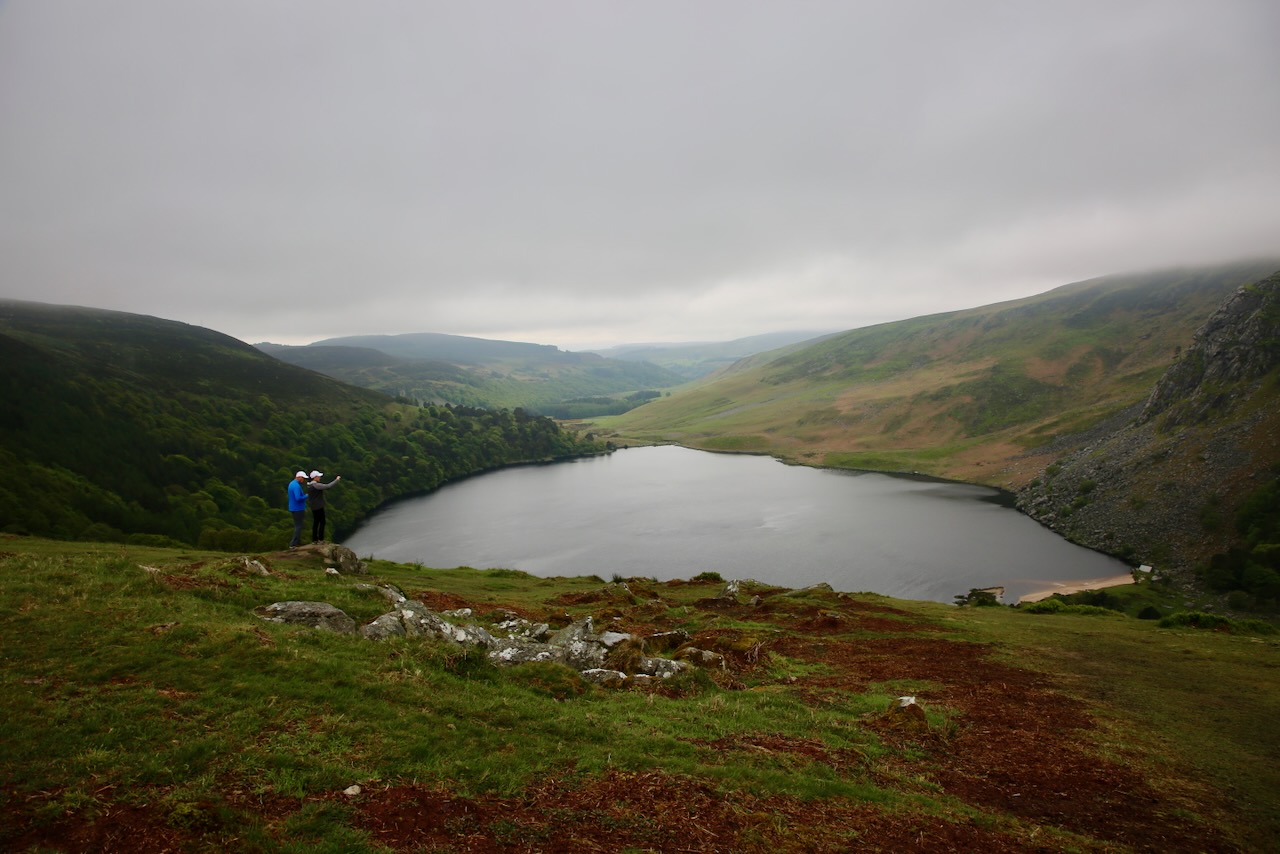
There’s a lake, Lough Tay, that is described similarly because where the water meets the sand looks like the top of a well-poured pint. This seems to be common in Ireland and as everything else is so green we expected the water to be no different but its reddish-brown appearance lets us know there’s a rusting iron pot somewhere that might be leaking manganese too; no gold or rainbow sightings yet. There’s a public notice letting us know that the farm owner isn’t responsible for entrants, whether visitors or trespassers, and damages received for the condition of the premises. This 1995 Occupiers Liability Act was updated in the summer of 2023 to further protect businesses and community organizations.

The other sign posted asks us to please respect the uplands and the grazing animals, wildlife, and other people that inhabit them. We see sheep in the distance but are more interested in the waterfall as we climb closer to its edge, as the rocks get more slippery and steep. There are some metal posts drilled into the middle of some large riverbed rocks to act as handholds for those more brazen than us or perhaps there’s a fishing style we have yet to learn about that adds a side of adrenaline to the catch. Either way, if we’re to see where this water goes from here, it will have to be from the other side down the hill.

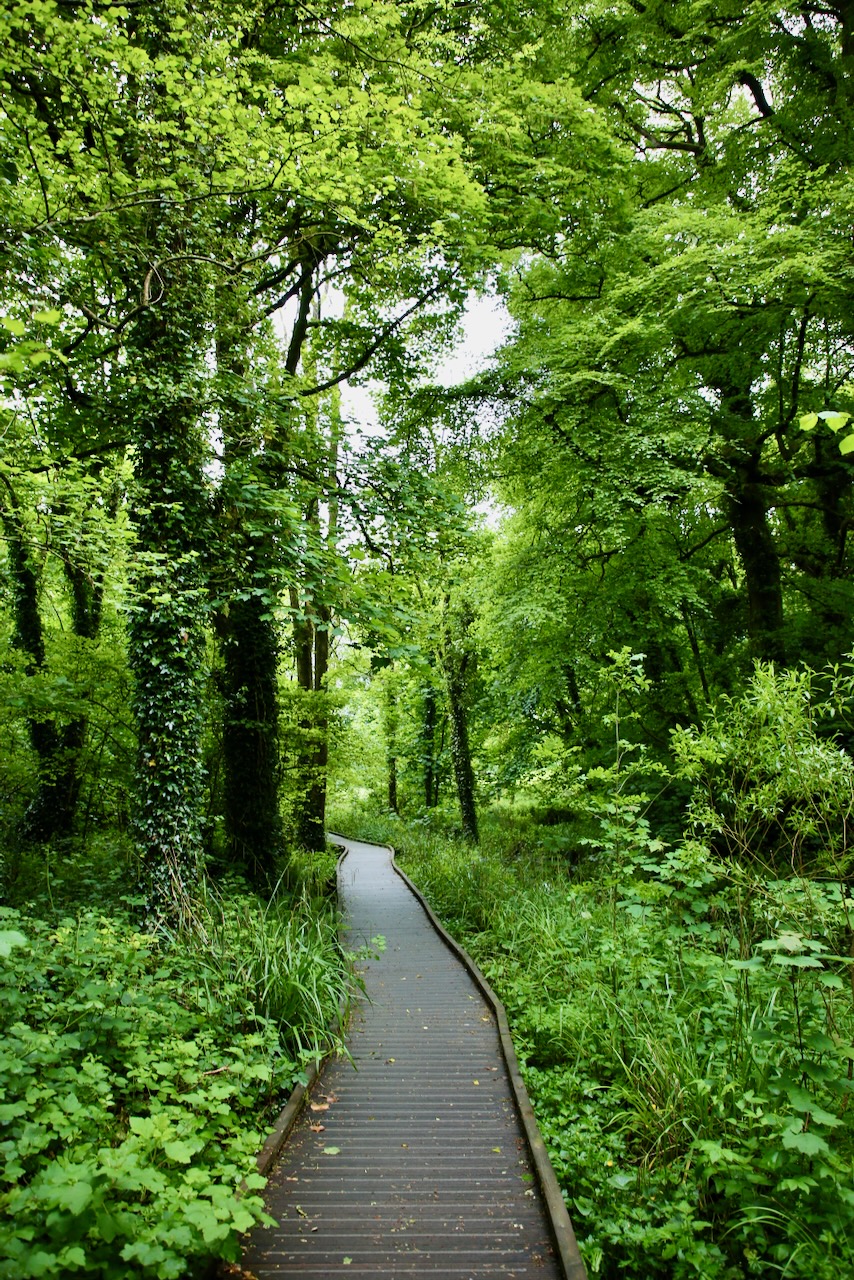
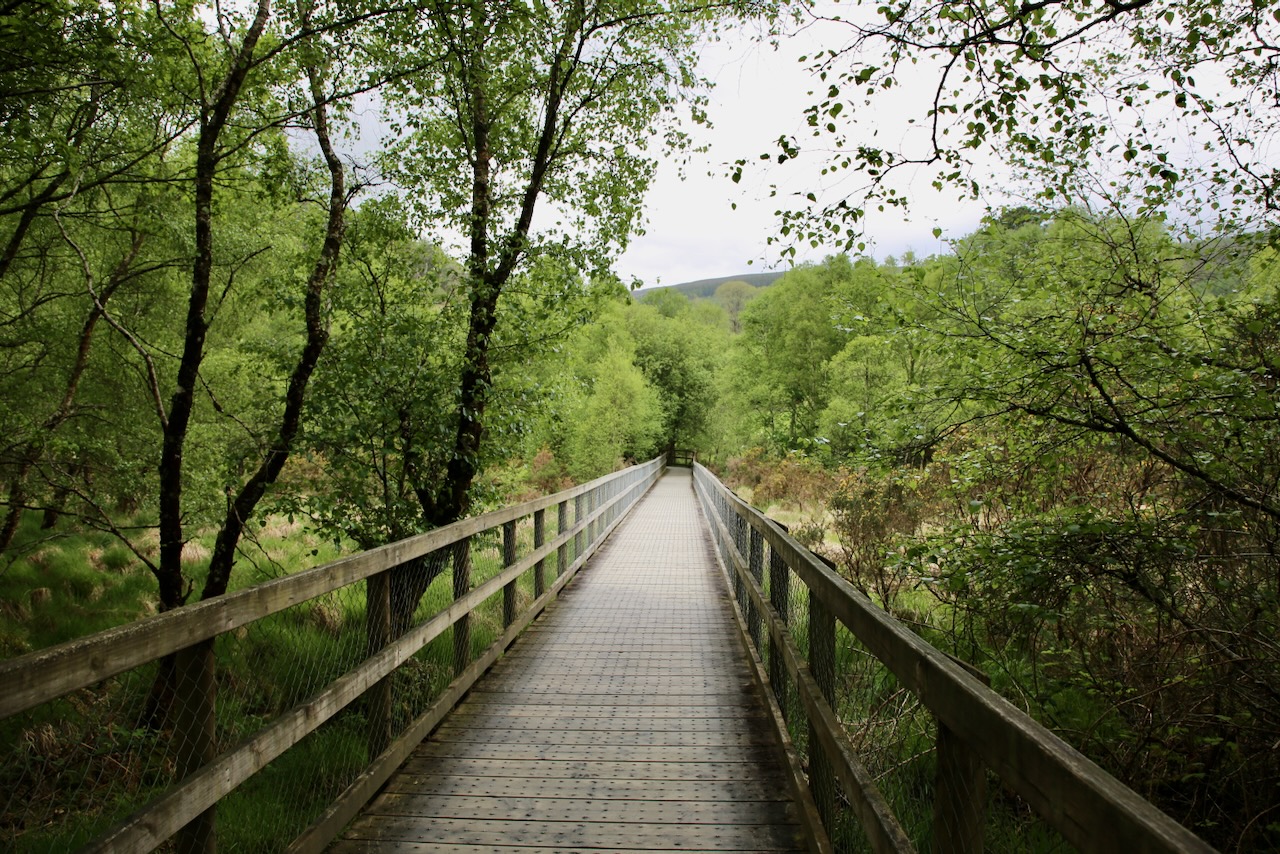
I’ll leave Caleb in the car, a first, minus some random times in our 19-year history that would include paying at the gas station or staying with the dogs in Utah while the other was sightseeing. Caleb wasn’t feeling well as he had decided to bring a virus on vacation but was doing his best to keep up, so we agreed he could catch a nap in the car while I hiked a bit at Ballinastoe Forest Rec Area. Their boardwalks are just as efficient as their roads – thin and more to the point – and come with staples in them to provide a nonslip trail through the wetlands that is Ireland.

I seem to be the only person walking among the trees with exposed roots and branches as I pass a woman and her dog on a more muddy and paw-friendly part of the trail. I’m averaging 2 mph and when I turn around (as a group of school kids descend upon me) realize that the way here is all downhill and I have over 200ft in elevation to climb on my return. As the students’ voices (with talks of singers and wolves) fade in the distance I can return to my walk through this fairytale of a forest to check on my sleeping prince tucked under his coat on this lovely 73ºF morning.

Caleb is bummed to have missed such an enchanting place but grateful to feel one ounce less like death as his body continues to build mucus demons that he will have to expel without the aid of an ordained priest (vs a simple pastor without the Holy orders of the Catholic Church). I park us next to the Glendalough Hotel in hopes of getting some food, but they’re not open yet. Lucky for us, around the corner is The Gateway to the Monastic City, our next stop, and an open food truck. I order a flat white coffee (the favorite drink of the author, Anna McNuff, whose adventures I’ve been reading) and a scone as one does when they’re on the menu.

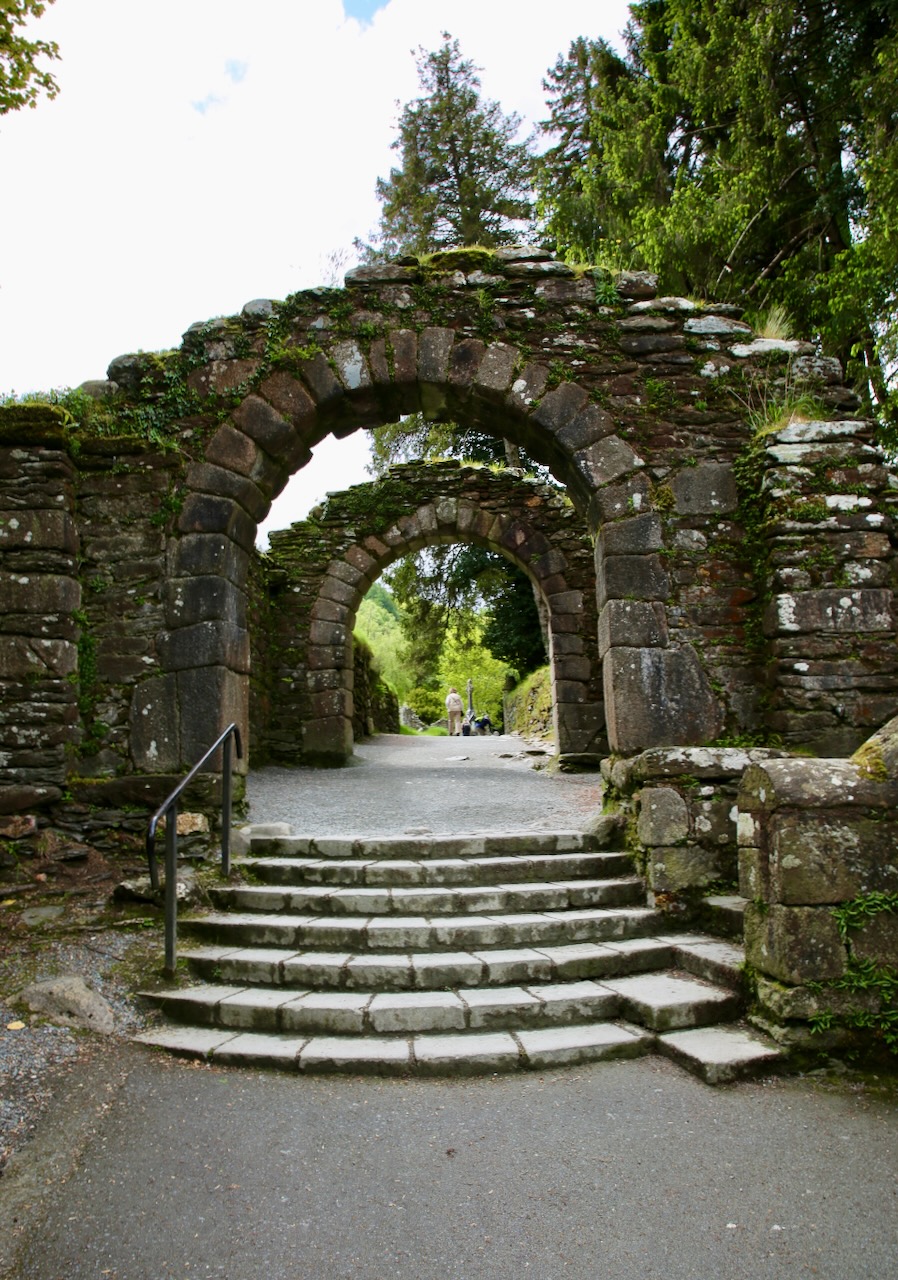
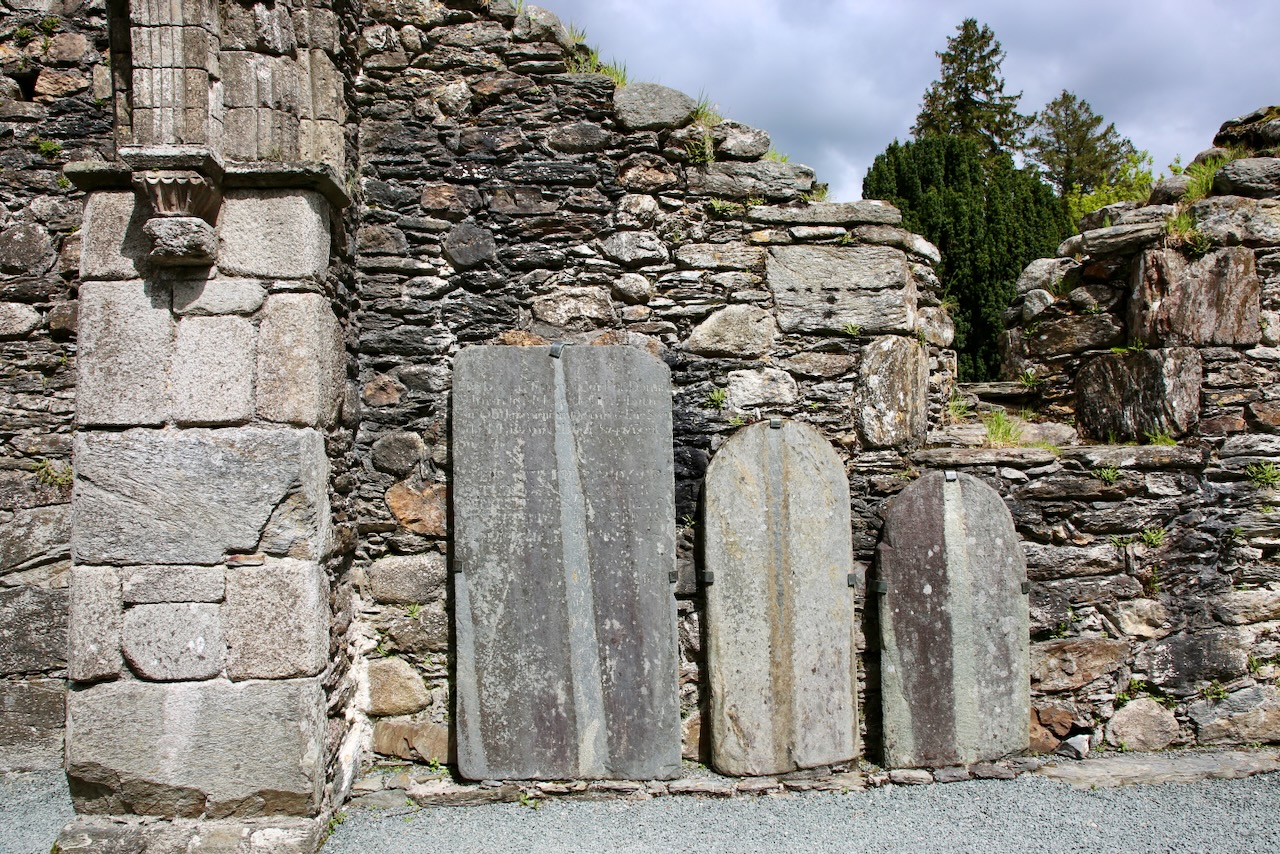
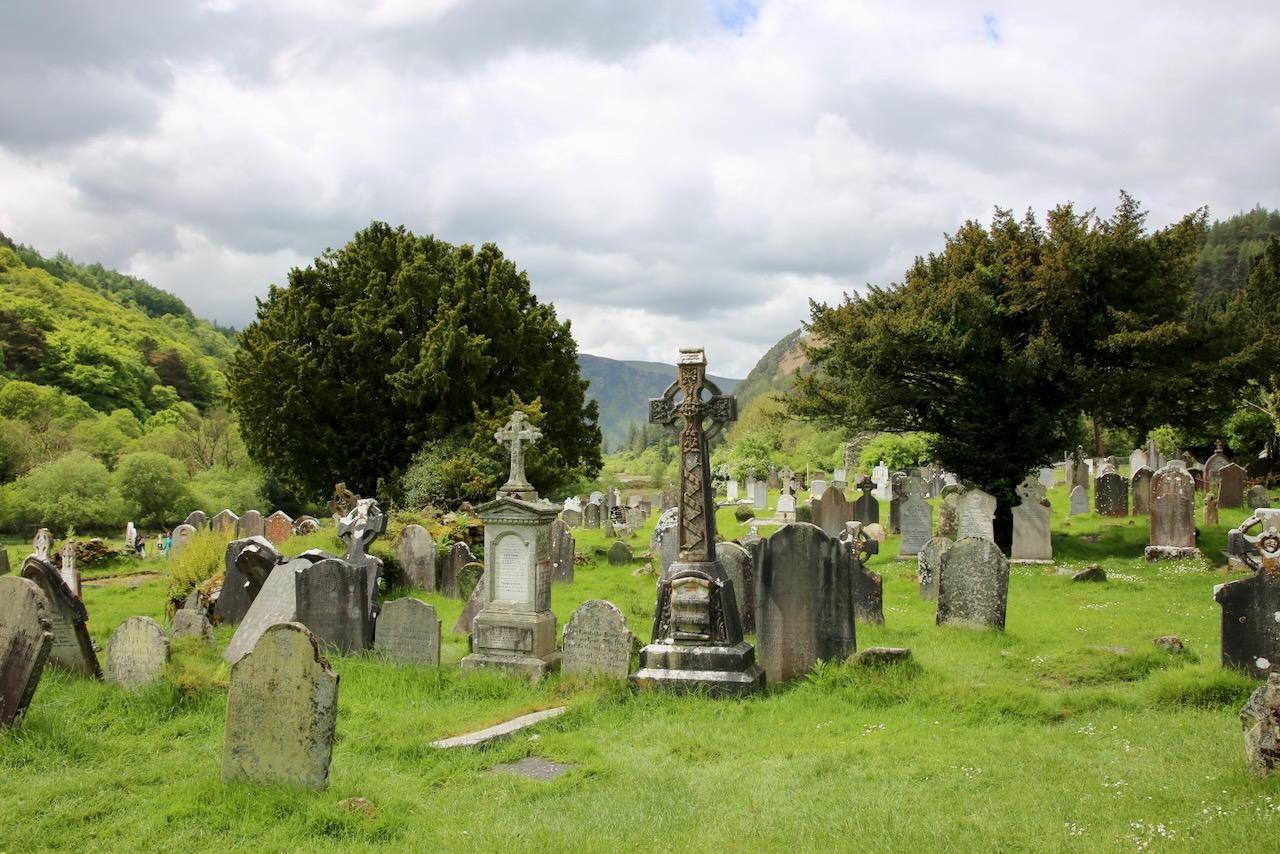
With renewed energy, we walk through the cemetery and around other buildings of the old monastery founded by St. Kevin in the 6th century. This place flourished even through plundering raids lasting until the early 17th century. This double gateway, which had a second story, is the last of its kind and is believed to have been built between 900 and 1200 AD. Some of the tombstones are dated 1793, one possibly as early as 1549, and others are more recent as members join the family plot or perhaps friends went in on a group grave; talk about best friends forever.

We skirt the tour group and take the Green Road Walk towards the Lower Lake. I knew about the upper and lower car park but figured there were just steps involved, not an Upper Lake with attractions and trails of its own… something to come back for. Near the visitor center are two sika deer, one of which Caleb insists is eating for two. We return through The Gateway and approach the now less surrounded round tower that reaches 100 feet high. This tower was used to summon the monks to prayer, consists of six floors with wooden landings (now gone), and has an entry door twelve feet off the ground.

The cathedral, with construction dating between the 10th and 12th centuries, ceased being a cathedral (a church run by a bishop) in 1214. It was originally dedicated to Saints Peter and Paul and is now one of the largest Early Christian churches in Ireland; a church is built for group worship while a chapel is intended for individual prayer. St. Kevin’s Church is also on the grounds and we can see inside through a metal gate. I tell Caleb we’re staying in Wexford tonight, so I want to drive south along the coast and he responds with a trip to Wicklow, the town of roughly 13,000 people that seems perfectly quaint for half that many residents.

This small town reminds me of Crescent City, CA, and crazy enough it’s faster to travel over the Atlantic Ocean from Tampa and drive an hour south from Dublin than it is to fly across the US and get a six-minute ride from the regional airport or fly into San Francisco and make the 6.5-hours drive which saves a quarter of your day. Of course, none of this takes traffic, security wait times, liftoff delays, etc. into consideration. I wonder how The Oregon Trail would’ve played out if the 19th-century pioneers had been exploring a different continent, such as traveling from Brest, France to Oleksandriya, Ukraine.

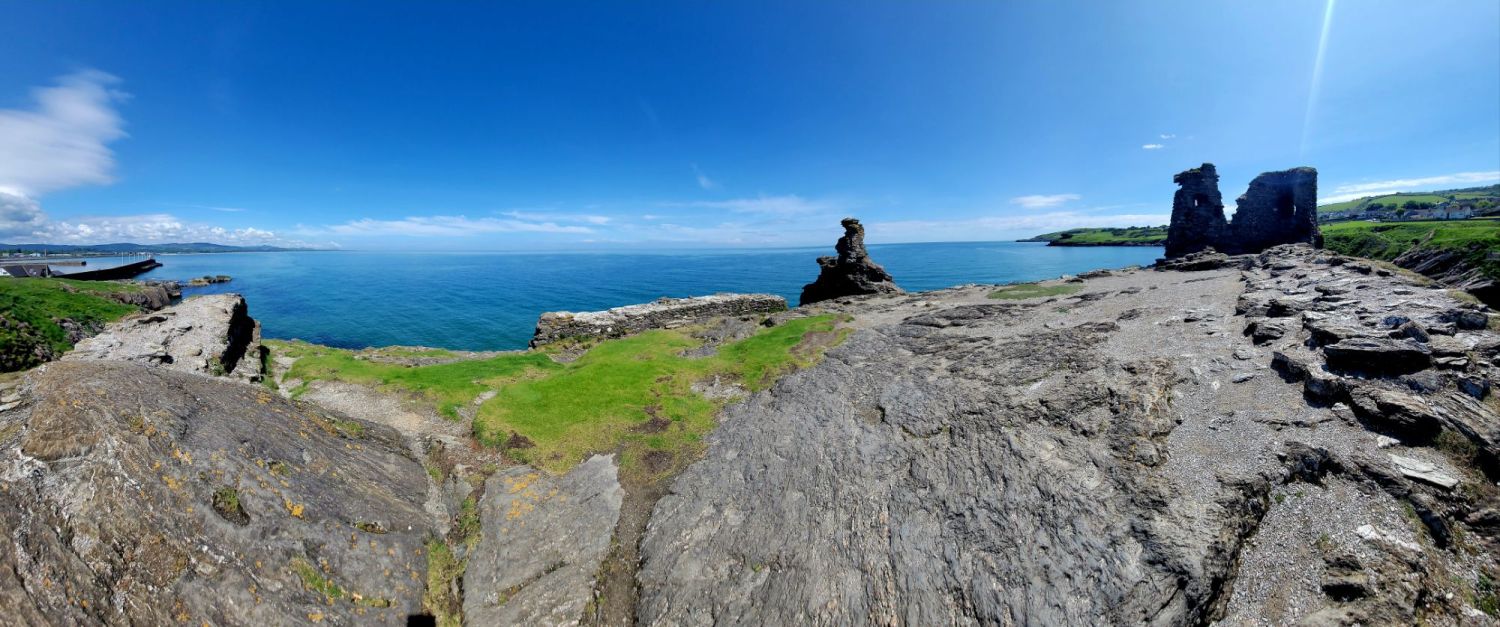
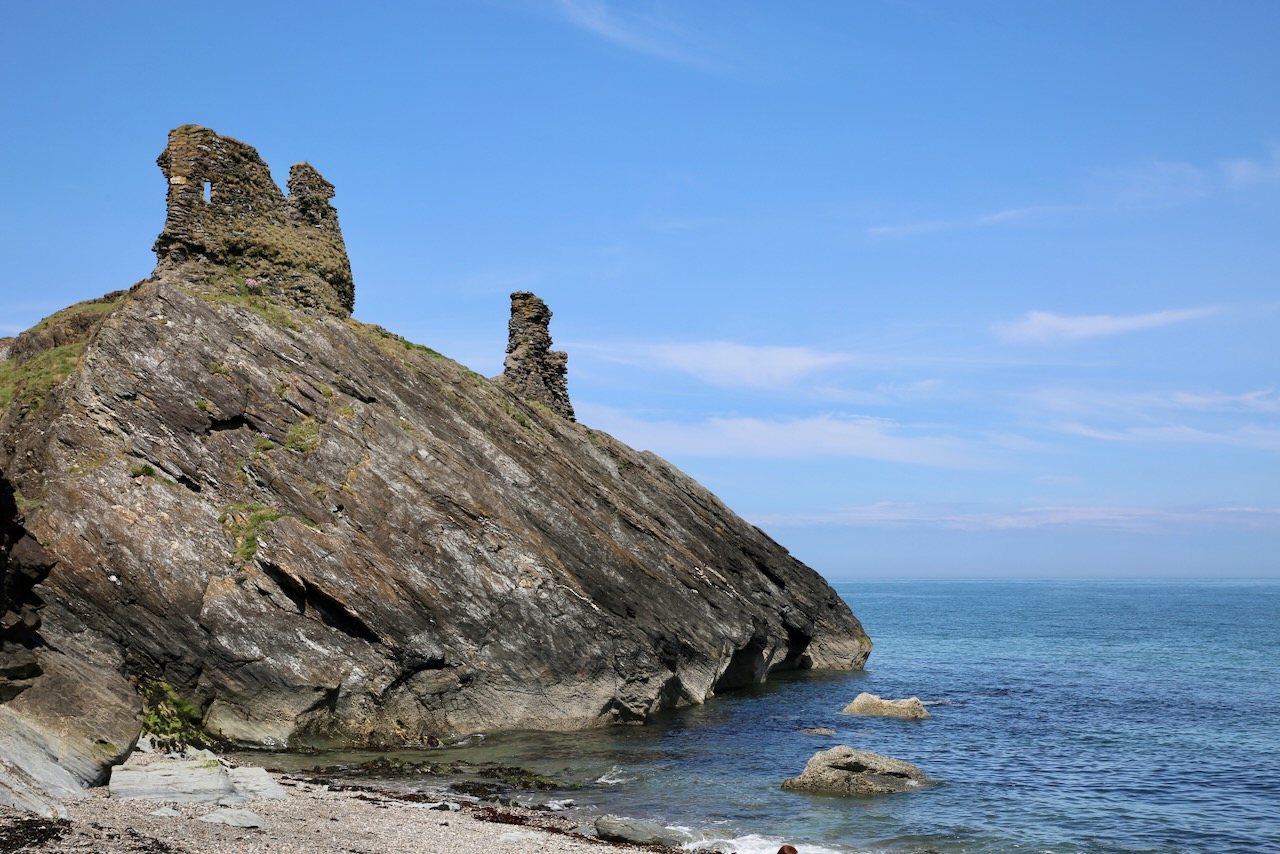
We park out front of Wicklow Inspired Cafe and there’s a bylaw on the wharf that prohibits leaving bait on the pier for transfer stating that it must be sealed and placed on the purchasing vessel or the offender can be fined over $3,000. I can appreciate that just because it’s a fishing town, that also exports lumber, the townspeople don’t have to smell the evidence of someone else’s labors. It’s a short walk from here to Black Castle, a fortification built on top of an earlier Viking structure after the arrival of the Normans in the 12th century that was promptly captured in 1301 by the O’Byrne and O’Toole clans.

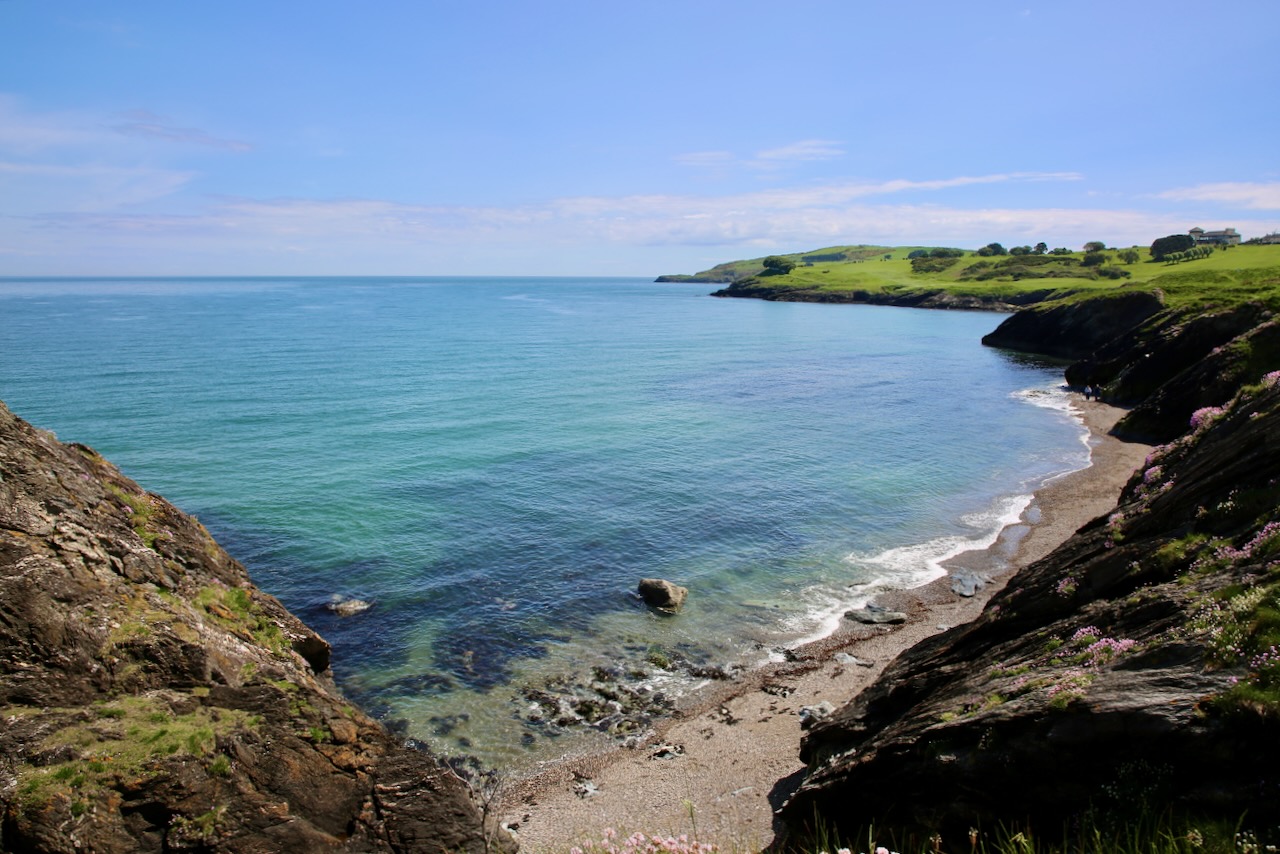
The castle, as the southerly protection of the ‘Pale’, would face fire and bloodshed many times as it changed hands from local Chieftains to the Crown over 350 years until it was left in ruins in the 1640s. These remnants are what we see today. There’s something romantic and dangerous (how these castles are displayed in films) about a fortress on the rocks next to the stormy sea. I can picture myself climbing down the steps to jump in Caleb’s boat so we can watch the sunset and kiss under the stars. The beach is beautiful with an inviting view and stairs to get us down to the stone-covered shore.

We watch as two guys take a quick dip in the ocean, which at its warmest in May is 55ºF, and pass two women who might have the same idea. Back up the hill, I compliment a woman on her cute socks and the couple notices we’re not from here, but neither are they. These travelers are visiting from Toronto and appreciating the few degrees of warmer weather and seeing another country. The return walk to the car is just as charming and then we go inside the cafe where we take a look at their wares in the back, the curved domino set out for use, and the wall of celebrity photos aka every dog that’s ever come in.

We’re heading to our next planned historical site when Caleb sees a sign for a distraction attraction; which is why we don’t have a strict itinerary on trips. This is the only vacation that I prebooked all the rooms before arrival knowing that if something happened we were only a few hours away from the next stop and we wouldn’t be forfeiting any payments. I usually wait to guess where we’re going to land for the evening and then book accordingly, but I’ve also had good luck trying with the location directly as sometimes they offer a better deal than the third-party reservation sites.

We take the detour to the National Botanic Gardens, Kilmacurragh and I see a few purple flowers on our otherwise very verdant stroll through the park. The estate was curated in the 19th century and is known for its rhododendron and conifer collections. On our way out of the gardens, I notice the same couple from Toronto, so we take our time and delve into our travel memories and exchange a few places we’ve been and what countries we’d like to visit next; my answer is all of them. It’s thought-provoking that they are traveling in the opposite direction and yet we still managed to cross paths twice in a day.

I hadn’t planned on taking the highway but if we wanted to get to Fern’s Castle before they closed at 5 pm, with the last admission 45 minutes prior, then the M11 we must take. Ireland is big into talk radio but we listen to the Gaelic and Classical stations when we can and the music adds to the beauty of the road. Finding a motorway without billboards, trash, and tall buildings is rare, so I let these 50 km sink in at speeds up to 120km/h (75mph) as I relish how lucky I am to be here amongst this beauty. This route varies from the last day and a half in that no learner drivers, animals, bicycles, pedestrians, or invalid carriages are allowed; and here I am being in the wrong lane (going the right way) because their slow lane is the left one.

The door to the visitor center was locked, so we assumed we were too late and took to exploring the grounds, but we caught the tour guide coming out of the tower. Though already 430pm as he shows us the Ferns Tapestry he agrees to take us up into the castle remnants too. Each of the 25 panels were hand stitched by crewel (thin, twisted wool) embroidery by local women between 1998 and 2003. Their art depicts the history of Ferns from the arrival of St. Aiden in 598AD to the marriage of Strongbow, a Norman invader, and Aoife, his wifely prize, in 1169, for slaughtering the citizens of her father so that Dermot MacMurrough (his anglicized name) could regain the throne.

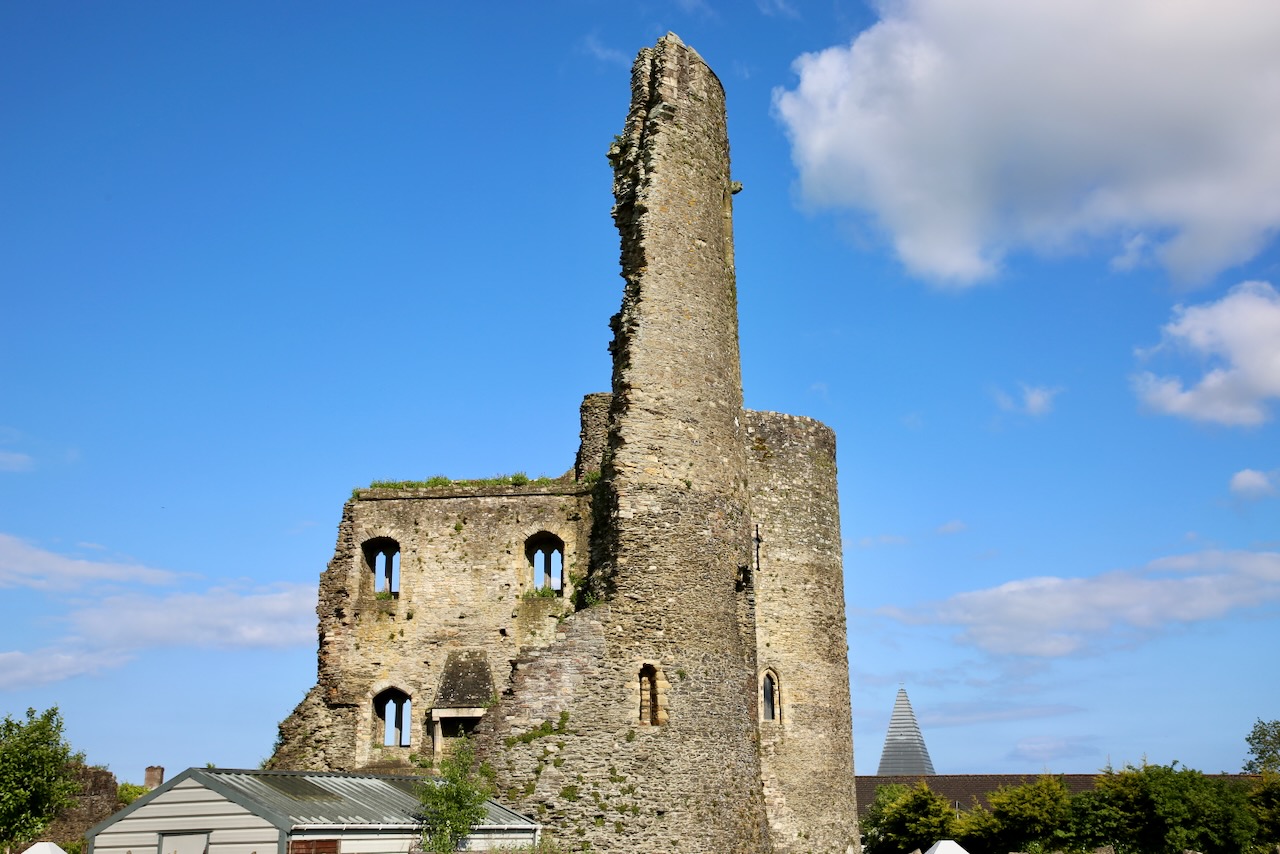
Dermot built the first castle on this site nearly 900 years ago and a second castle was built, probably by his son-in-law, in the 1170s before he died in 1176. The present castle – one of four Marshall castles in Ireland in Kilkenny, Carlow, Ferns, and Lea for land control by another Norman magnate – was completed in 1224. Left standing 800 years later is the southeast tower, with a preserved Chapel inside, walls beside, and another tower with more sun exposure on both sides of its thick walls. There are windows for shooting and others for sitting with benches, just as I imagine my perfect home, complete with a round staircase.

The inside has been preserved by adding glass in the windows and a locked door to keep out vandals. I thought the tour would conclude after a room or two, admiring the arches and fireplace, but we are taken to the top to admire the view. I notice rocks jutting out the top of the tower wall and this masonry method increases stability and makes climbing over uncomfortable. Most of the walls in Ireland were just a stone-clearing method to make space for farming and grazing, but the long walls that divide nothing on nonarable land were built during the famine so that the poor could work for food received from the church or landlord.

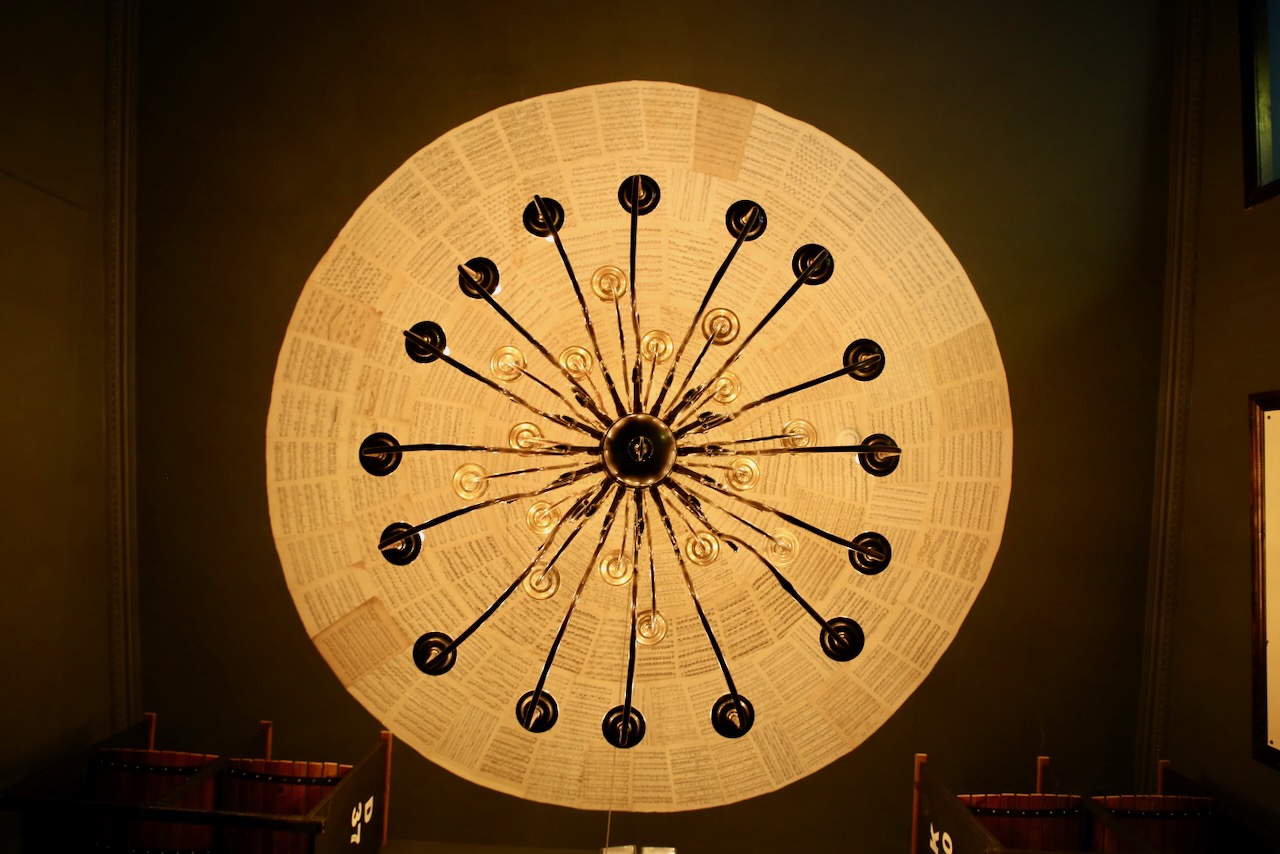
I’ll pan around, while our guide speaks, taking in the mountains, apartments, and fields under the cloudy sky before we descend and make our way south to Wexford. We’re staying at Ocean View, aptly named, with a living room encased in windows. With no one home, we drive back into town for dinner. We stop at Simon Lambert & Sons, a gastropub, with a kitchen closed at 6 pm (as after 4 pm it’s pint o’clock in Ireland). There is sheet music above the chandelier and old seats from the original Theatre Royal that opened in 1832, was converted to a cinema in 1942 with the stage intact, and then demolished in 2005 so that its replacement, National Opera House, could open in 2008 and be over three times larger.

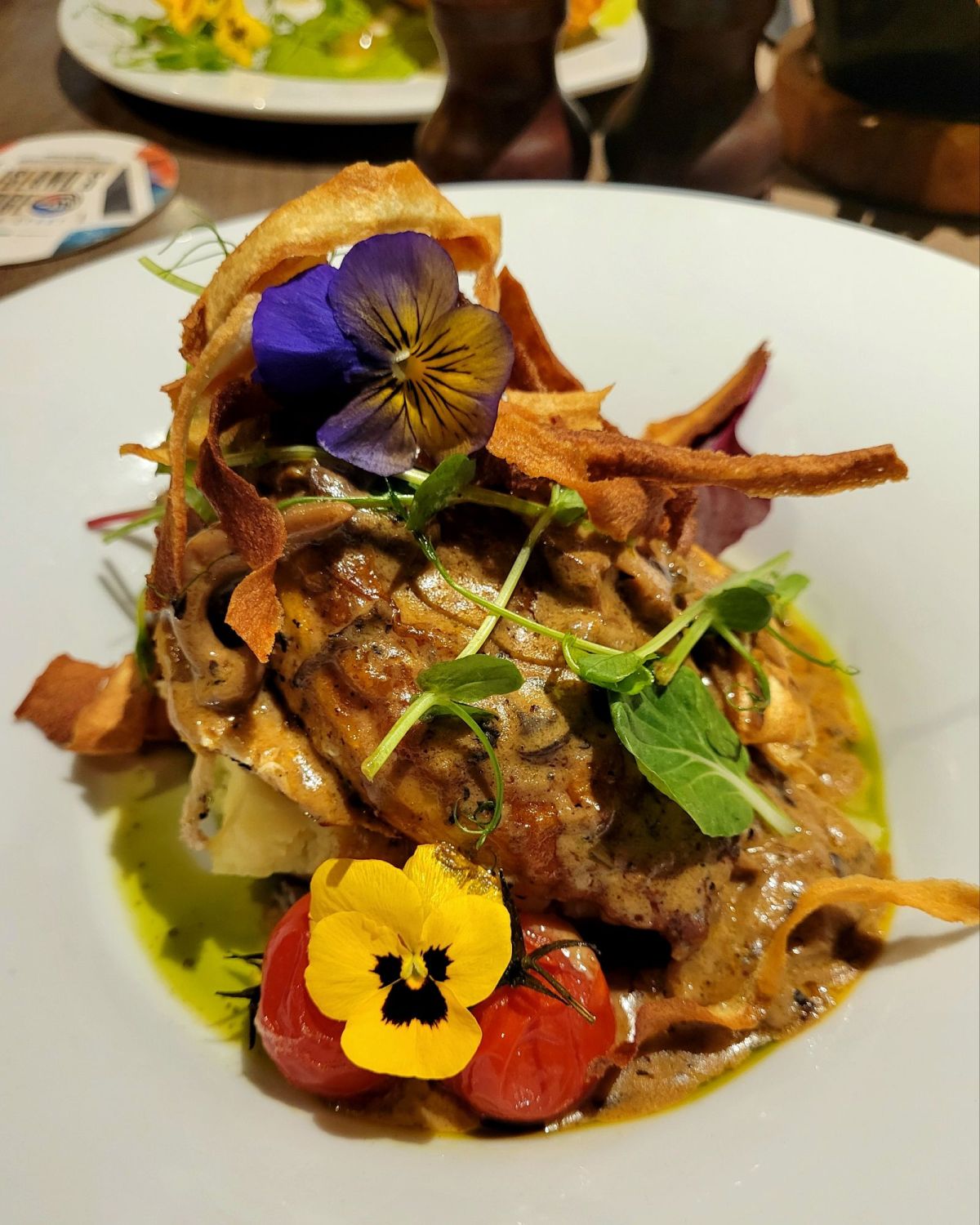
This pub is where Yellowbelly beer, named after the captain of the same name on the Prussian Frontier in 1887, started in the basement in 2015. I’m not sure of the relationship but the two definitely have a history where politics and religion are concerned. We walked to Thomas Moore Tavern instead of The Holy Grail. Had we known that Indians are the third biggest foreign group here we could’ve forgone the tavern for another foreign experience (having had Italian last night). Caleb gets their fish and chips and I order a special, something with chicken that’s beautifully plated.

I’ll call our host after dinner and agree on a meeting time. Peter showed us how to lock the front door (the handle has to be turned up) and then to our room and shared bathroom. We were told we would have this half of the house to ourselves as the twin doors are marked private and kept locked. Still, we were woken at 11 pm when one guest returned and again by a couple from Canada who had taken the bus to Wexford. The nearest stop is over 2km away so Peter had picked them up. We didn’t meet the guests but were also woken by the heat in the room and Caleb’s coughing fit, so perhaps their night was as restless as ours.

Posted in Animals, Art, Fiber Arts, Food, Hiking, History, Military, Music, People, Places, Plants, Travel, Water | Tagged , , , , , , , , , , | Leave a comment

Into The Land of a Thousand Welcomes

This phrase stems from the Irish greeting of “céad míle fáilte” and we would see these words in action more often than we would hear them in Gaelic or spoken with their lovely accent in English. There are only some 30,000 Gaelic speakers left in Ireland as the language was almost wiped out under British rule for over 700 years. The only place outside of Europe with an Irish name is Newfoundland, aka Talamh an Éisc (the Land of the Fish), and as the language makes a comeback, Tamworth, Ontario is the first Gaeltacht (Irish-speaking area) outside of Ireland.

One website would have me believe that the Irish are kind because of the Brehon Laws created in the 7th century, definitely before tourism, but not before the age of houseguests where hospitality was required. The laws seemed more concerned about the details of kinship status, marriage obligations, reparations for crimes based on wound size; and the king’s schedule of drinking ale, judging crimes, playing fidchell (two-person board game), watching hounds hunt and horses race, and creating an heir. It seems the laws weren’t always just a peasant’s concern.

Oddly enough, this isn’t what I was thinking about while being stretched out on the floor in front of our plane seats; we had an empty one between us, but as knees age they prefer to be less bent and pressed upon. Also of note, at 35,000 feet the air outside is at -65ºF which turns the inside floor of the plane to a cold 64ºF (no thermometer was used), so after I stick plane food in my bag (for dinner) I recline in my seat to return to a disturbed but warmer slumber with two blankets and three flimsy and foldable neck pillows between the window and unmovable armrest.

I’m groggy from sleep when the overcooked egg patty on a cheap burger bun almost passes me by. I don’t remember the first choice, but I held up two fingers to indicate I wanted the second option. Luckily, this interaction woke Caleb enough to translate his wife’s language into something the stewardess could understand. Minutes later we were on the ground in our 23rd country (of which nine we have done solo, so they vary). We are greeted with windowed buildings, grey clouds, and green surrounds. All the signs are in Gaelic and English and the glass has drops of recent rain.

We are shuttled to the rental car location and there are two desks – one for paperwork (which we did in the airport) and the other for picking up keys (after a short wait while they finish cleaning the car) and listening to Louis Armstrong singing “What a Wonderful World”. We are in a Toyota Yaris Hybrid automatic so I return inside to check on fuel preference (unleaded and diesel in most places, but I saw signs with more options) and the clerk updates the key tag with a QR code. For those wondering, I thought we were going in the off-season, but it’s the shoulder season between too hot and too cold, and there were enough people for us.

The seasons have an effect on cost, but we are very budget-friendly regardless of the weather or region and will sometimes make accommodations (uncomfortable to some) to keep us traveling; though to save money on this trip we could’ve flown in January and gotten our flights for half price. As it stands, we paid $8.04 per flight mile and traveled at 228mph, averaging in layover and ground time between Tampa and Dublin and back. The rental car was $37.50 per day and insurance can easily double or triple that price. We’ll spend $125 in unleaded fuel and could’ve saved a couple of bucks on the ferry by booking online or $12 by being on foot.

I get into the driver’s seat and we prepare to leave the airport – check mirrors, check phones, and realize mine still hasn’t found a signal (a first, and something I need to address with the cell company). Good thing Caleb’s phone is more agreeable and we’re off into downtown traffic on a Tuesday afternoon. On four hours of sleep, on the left side of the road, I managed to pass some of the attractions I had planned and realized I should know better by now. Don’t rent a car in a large city, ie., New York, London, Istanbul, etc., because the parking will be sparse and the fees and tolls constant.

We couldn’t check into our hostel until 3 pm where parking was guaranteed for the night for €12 so we managed to find a spot on Conyngham Rd. where we could walk around Phoenix Park not realizing how close we were to Kilmainham Gaol, Guinness Storehouse, and St. Patrick’s Cathedral (an hour and a half walking loop) amongst the many other attractions that weren’t on either of my lists. It felt good to be out of the car as Caleb had pointed out that I had been driving in the bus and bike lanes but they do overlap, especially for left turns, so it wasn’t because I couldn’t stay in my lane.

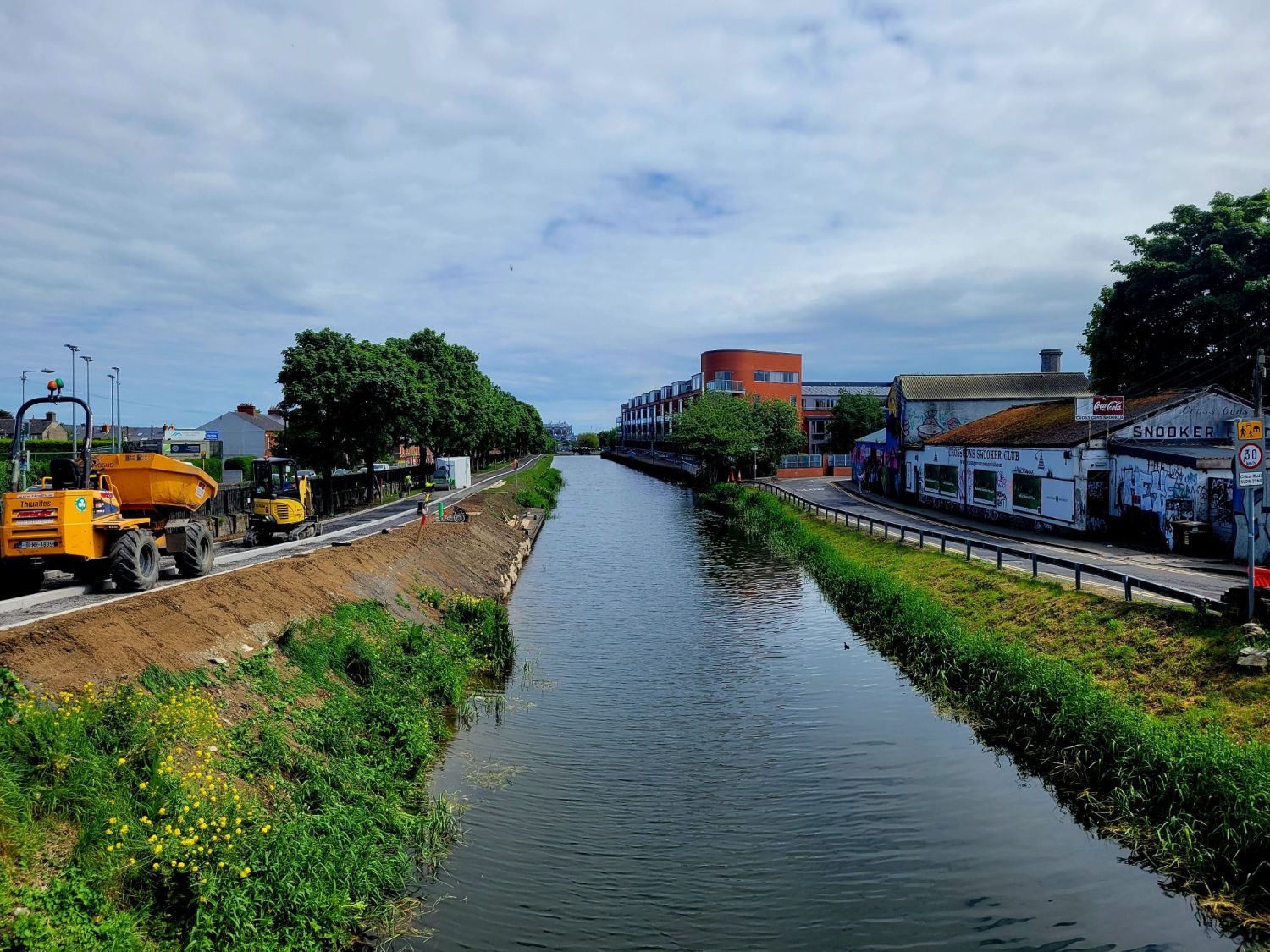
Once out of traffic, I could better observe the green everywhere and the blue and white of the sky that only islands can capture. I notice the knitwork decorations on the sidewalk bollards (originally used to moor boats and now used to slow cars from mowing down pedestrians on the pavement) and the cross-stitched cows walking in a fence. I welcome all pleasant art into public spaces, and if I could afford it, into my home as well. We move from the River Liffey to the Royal Canal to see the king’s disposal of his rubber ducky collection along with a few local drink options from the men who use the lock as an afternoon bar and the water to carry away the evidence.

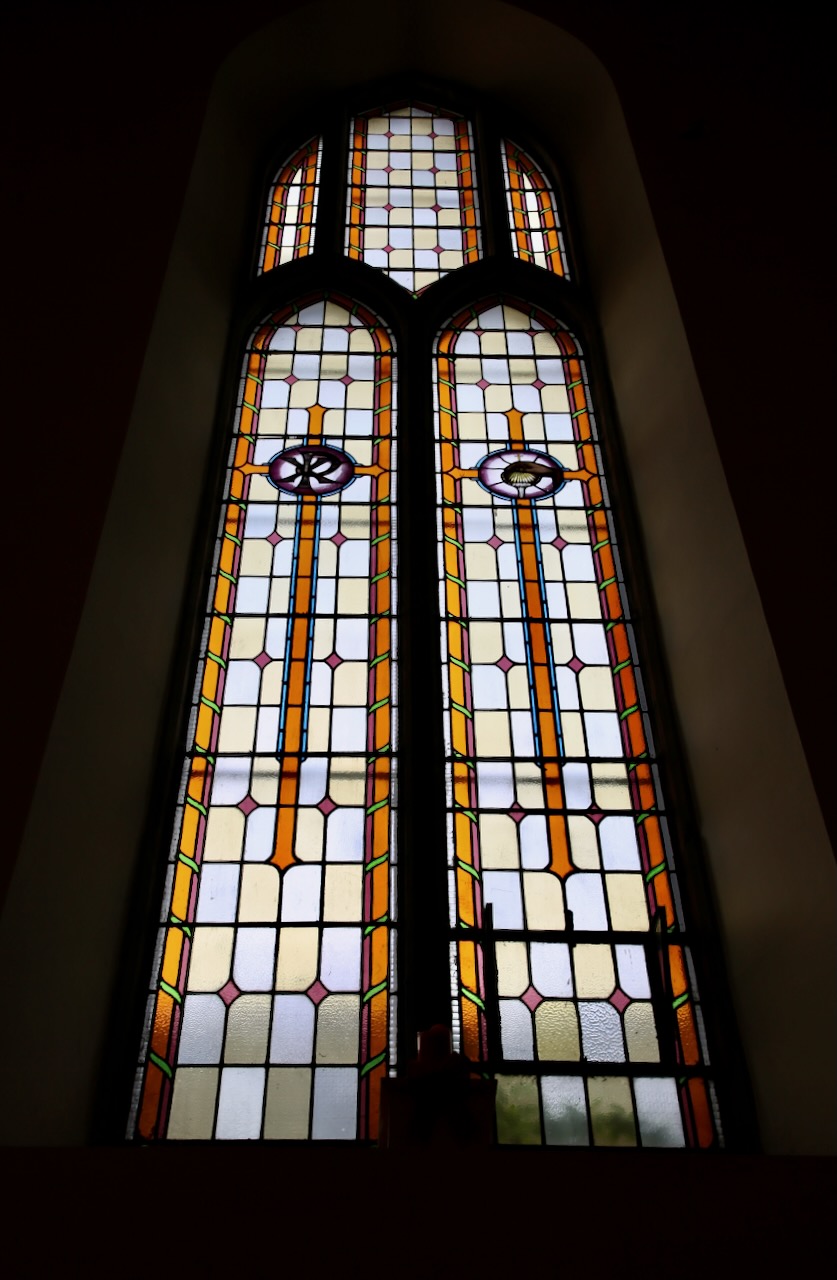
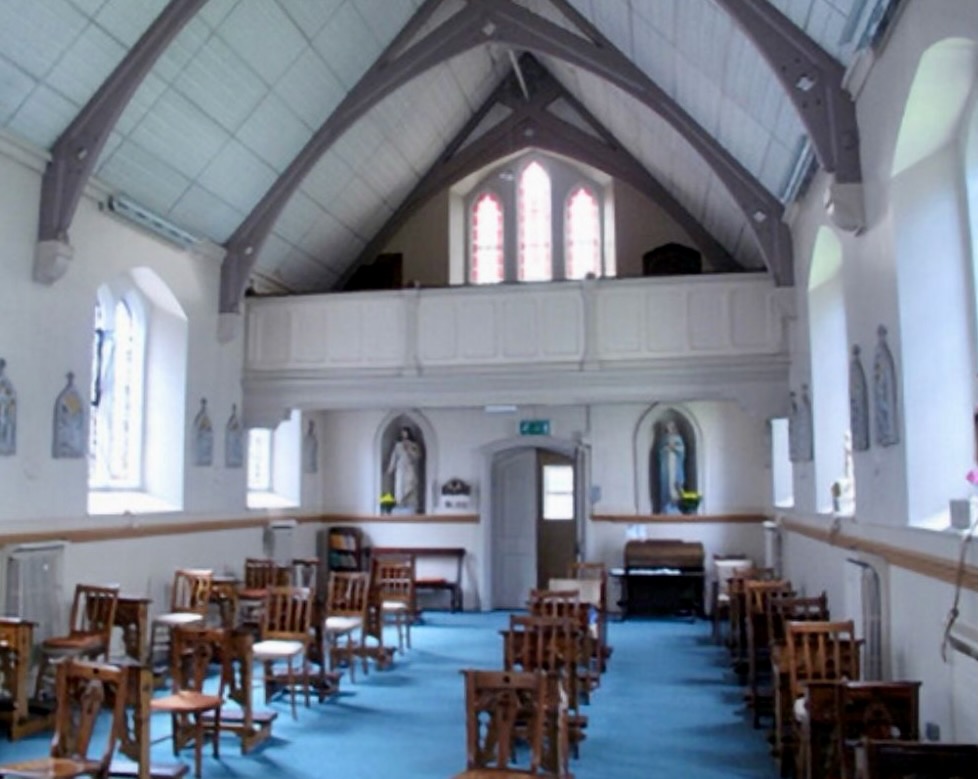
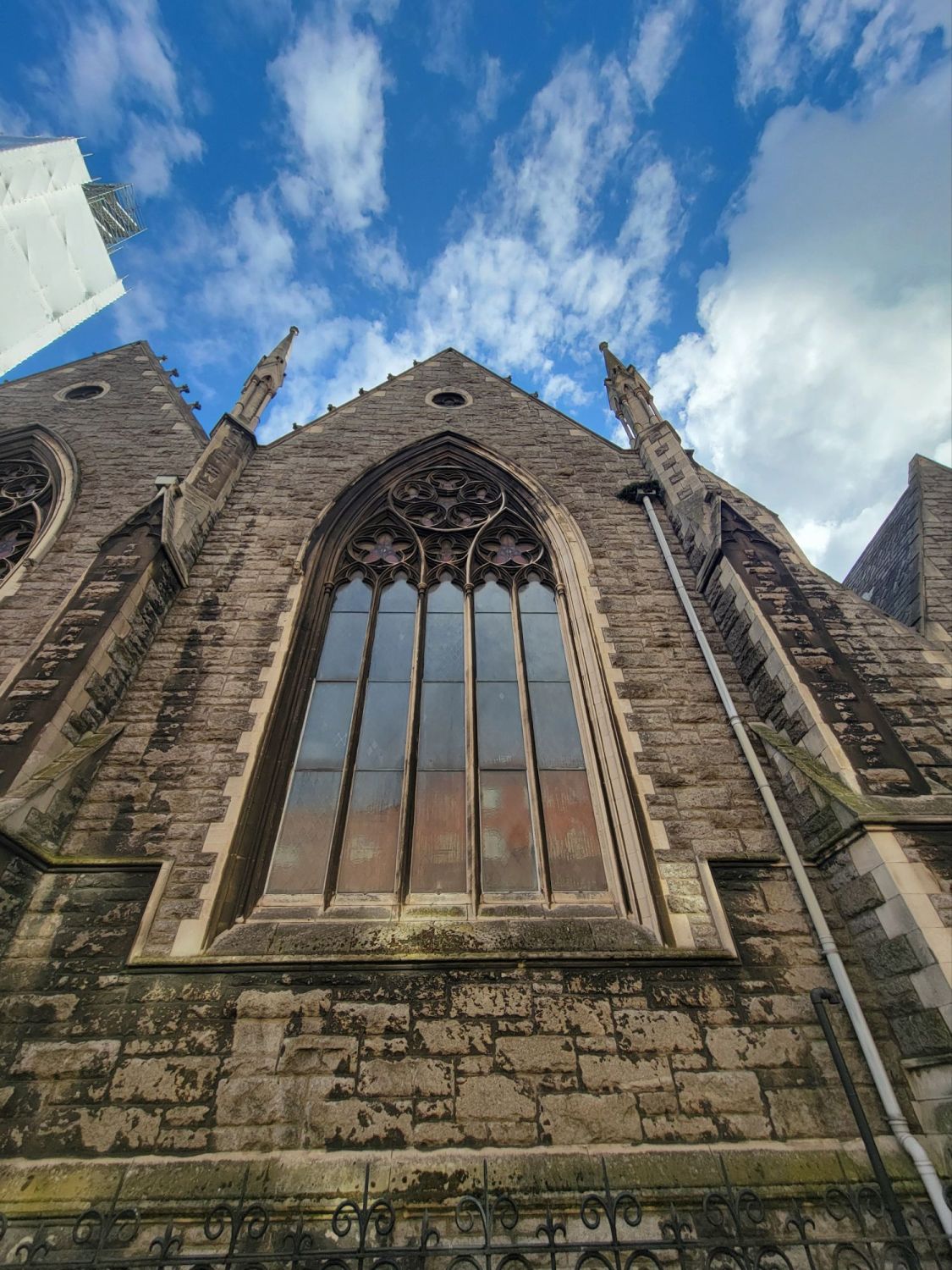
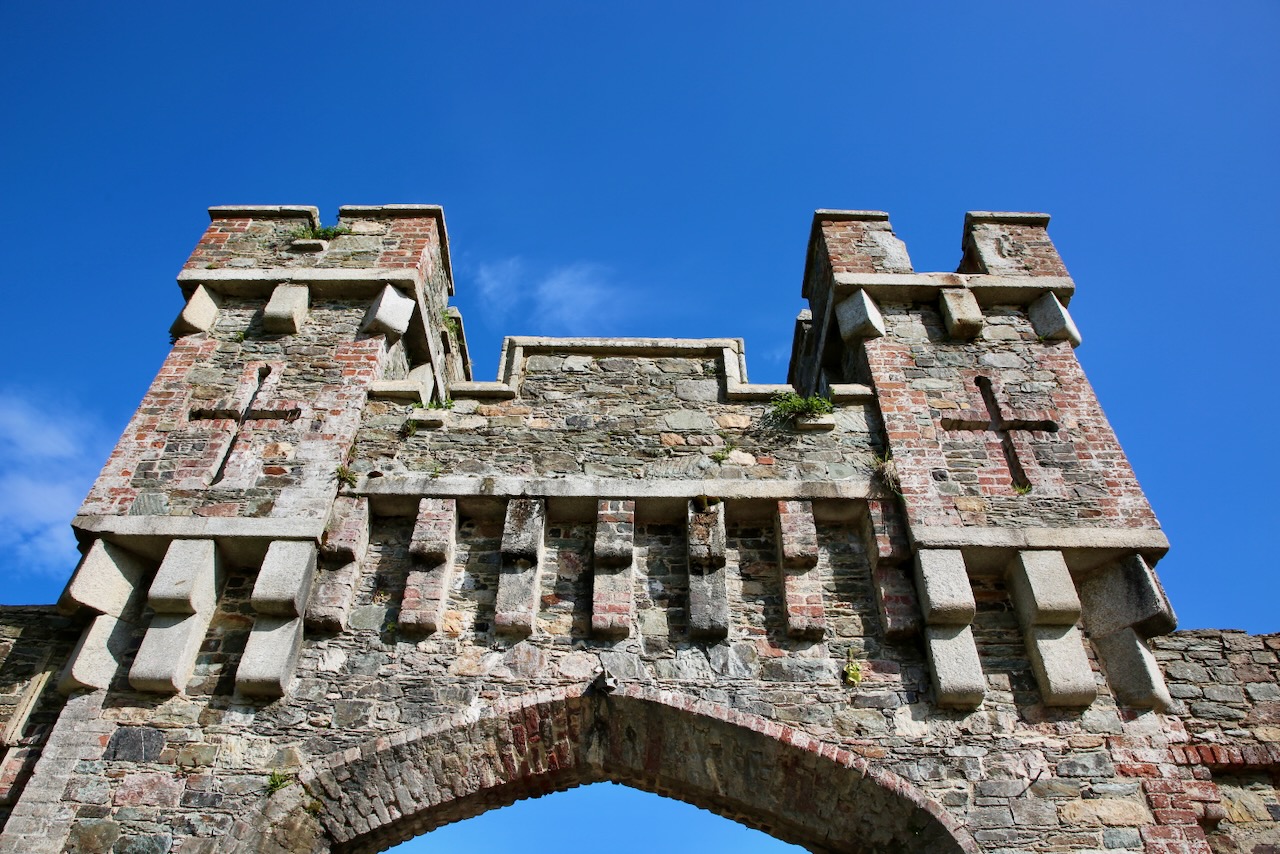
We park a block away after driving past our hostel and walk back. I’m given two pieces of paper – one with our room and bed numbers on it and the other with a parking spot and gate code on it for the car. We walk up to the Chapel Experience and I’m impressed, not with the metal military bunks, but with the repurposing of a church so that my first night in Ireland is under stained glass windows attached to a Georgian house built circa 1820s and with a history of residents involved in the Dublin lock-out of 1913 between 20,000 employees and their 300 employers. This dispute led to the acceptance of a right to unionize but left many blacklisted workers in the trenches of WWI and forced some commercial businesses into bankruptcy.

We grab the car and I park along the wall inside the gate with no numbered spot or markings to guide me. We leave our bags in the car and head north in search of a meal. We walk into Murray’s Bar and the hostess seats us next to another couple. I admire the soaps, lotions, and oils caged in the wall and the pictures and bottles displayed en route to the toilet. I appreciate the many levels of these buildings (the hostel and bar) as there is more privacy built into a large room than just having an open space for voices to carry. Having not known what we wanted immediately we are dismissed and seemingly forgotten about so we help ourselves to the bar where there are a few helpful men.

As we sat at the bar, Sam the bartender exchanged our lunch menus for the dinner menu that starts at 4 pm. On the back is a short history of this house, no. 35, which first acquired a license in 1797 as a Shellfish Tavern. In the 1840s, the license was transferred to the Findlater Group, a spirit merchant. In 1904, a fruiterer and florist was one of many merchants working from this address. Lambe would be the one mentioned in Ulysses, the greatest literary work of James Joyce, regarded as Ireland’s most prominent writer. Murray’s witnessed the upheaval of the 1916 Easter Rising, the 1919-21 Irish War of Independence, and the 1922-23 Irish Civil War.

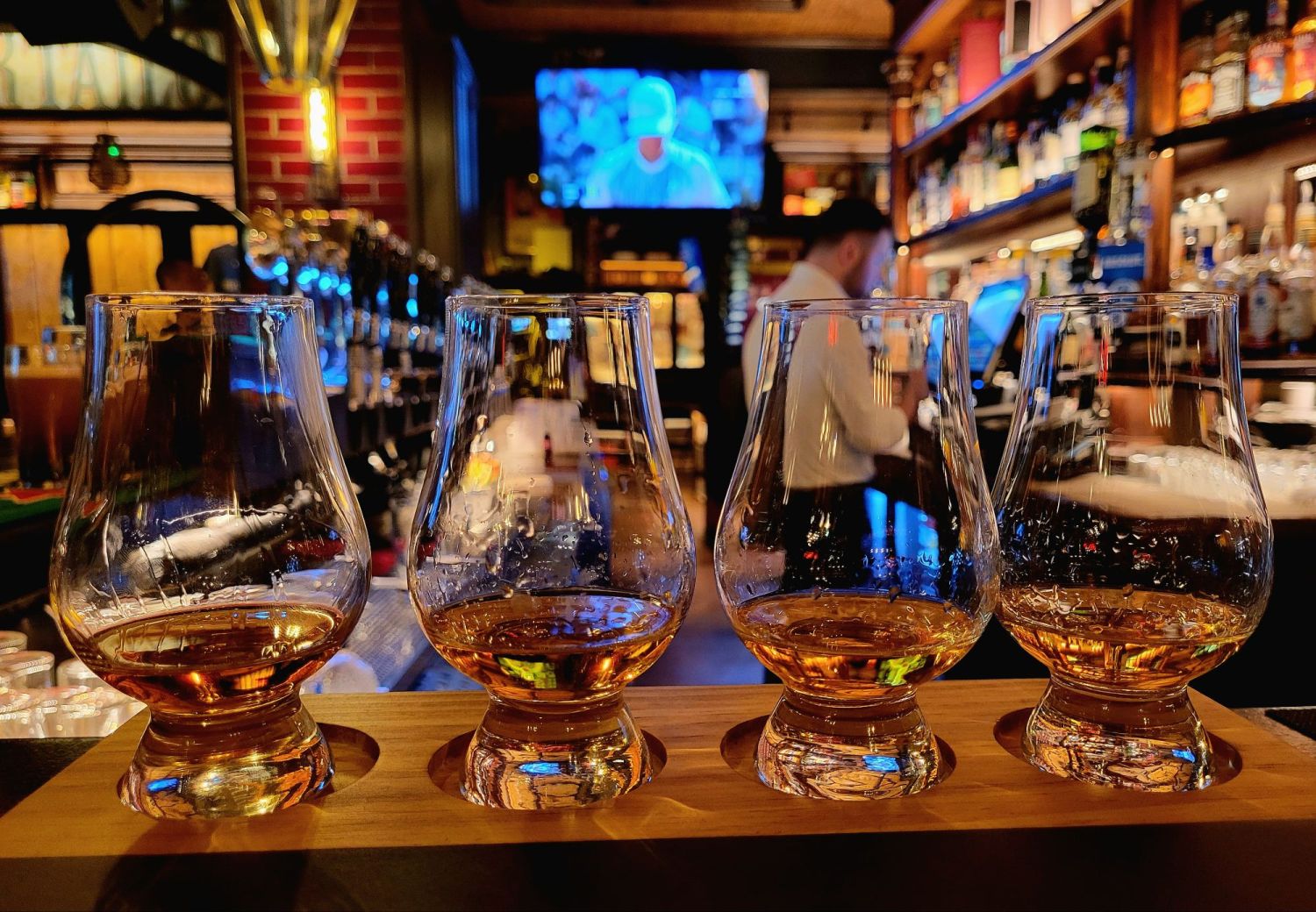
Now, over 200 years later, this bar and grill still offers Guinness, first poured in 1759, and a variety of whiskeys, like Jameson available from 1780; and serves up roast chicken, beef pie, lamb stew, and fish and chips. We order a whiskey flight – Jameson Black Barrel (sweet and popular), Powers Three Swallow Release (tastes like tires), Green Spot (bitter, and the spots come in different colors), and Knappogue Castle 12-Year-Old (burns the nostrils). Caleb orders a Guinness, a stout that requires two pours to serve, and not to feel left out I order a snakebite – half Guinness and half Rockshore Cider. The younger guys aren’t used to this drink order but still give the older man a hard time while he gets my glass just right by letting the Guinness settle and then topping the cider with it.

Our first food order will be Murray’s chunky chips (thick-cut fries) which can soak up more vinegar and be covered with plenty of salt and a truffle pig pizza, from their outside kitchen, made with crushed Italian tomatoes (canned since 1913), Italian smoked pancetta (first cured in 500BC), wild mushrooms (first used in 2500BC), Italian Fior di Latte (meaning flower of milk) cheese (dating back to the 12th century), and Italian white truffle oil (introduced in the 1980s as a more affordable alternative to fresh truffles). The word pizza was first documented in 997 AD and eaten mostly in Italy until WWII. I order a side of brown (homemade Guinness and treacle) bread to complete the carbohydrate trio.

We go for a walk after dinner, something that’s easy and inviting to do on a wide European sidewalk, and happen upon the Spire of Dublin (aka the Monument of Light, An Túr Solais). This stainless steel, pin-like monument began its installation in 2002 to replace Nelson’s Pillar which was destroyed by a bomb in 1966. The Anna Livia monument was placed in 1988 for the Millenium celebrations until it was moved to Croppies’ Acre Memorial Park in 2001 to make room for the stiletto in the ghetto or the stiffy by the Liffey as some of the locals call it. The base is lit at night, and almost 12,000 LEDs shine through the top.

Back at the hostel, we are grabbing our things from the car, while a man out for a smoke kindly tells me that it would be better if I backed against the wall so others could park (even if the other three cars were closer to the stairs). We take up two beds in a twelve-bed room with two roommates – one of which seems to be one of the 33 guests with a personal kitchen bin downstairs, some marked long-term. Caleb stretches out on the bottom bunk and had the privacy wall been more sturdy we could’ve shared the twin mattress but I gladly climbed up the few steps for more headroom and space to spread out too.
Posted in Art, Books, Food, History, Music, People, Places, Travel, Water | Tagged , , , , , , , , , | Leave a comment