It’s Beginning to Look A Lot Less Broken


img_20171201_214950_992381306904.jpg

six weeks in recovery

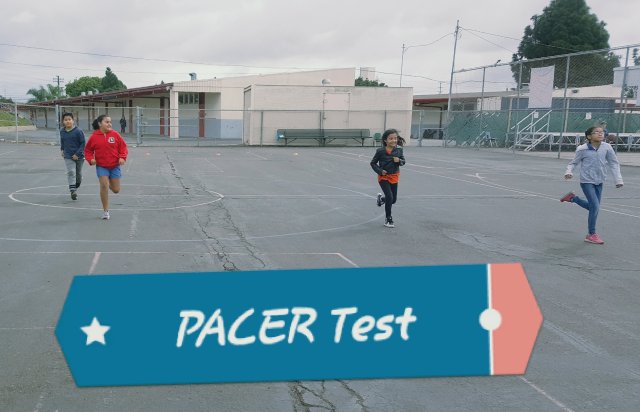
It has been nine weeks since I broke my first proximal phalanx on my left foot. Since then, I have volunteered at Hawking STEAM Charter School for a couple of weeks and was able to administer the PACER test to the sixth grade by myself and have taken on more responsibilities with Youth to the Core and at McGill School of Success (where I now receive a paycheck). I wrote out the test questions for the 3rd to 5th grades, did skin folds on 2nd grade, and am the permanent pitcher during kickball (even after a hit to the sunglasses which bruised my eyebrow for a day).

Next year I will be in charge of the new interns and it will be my job to teach them how to: raise their voice positively when necessary, prep for the indoor lesson, and the rules of recess so they can help me during games outside. They are not allowed to eat during instruction/coaching and should not be on their phone unless it’s an emergency. I have to set three goals to accomplish during my time with the program next semester and I’m glad I haven’t started yet as I might set the bar too low (though I impress the kids with my one-legged push-ups, touching my nose to my knees, and doing a standing figure-four stretch).

img_20171030_204214_6211714646074.jpg

I didn’t let my toe slow me down much in classes either. I missed the one day for my orthopedic appointment where I was told no surgery would be needed as the bone is aligned nicely, but if it were the increased mobility of my fingers it would be a different story. I spent all but the last two of my spin classes on a mat doing push-ups, abs, and headstands — and the crutches with the boot helped improve my upper body strength and allow me to hold the pose for one minute.

I switched from a knee-high boot to a below the ankle shoe Nov. 27 and was so happy to move my joints again. This has helped me improve my stationary bike time from 5 to 9.5 miles in 30 minutes. I’m not allowed to run or jump yet, but have another appointment on January 4th for more x-rays to assess my progress. It took about 5.5 weeks before I braved a standing shower and it felt so liberating, but I still prop my foot up with my glass shower doors during my shortened showers.

img_20171105_200634_405764996315.jpg

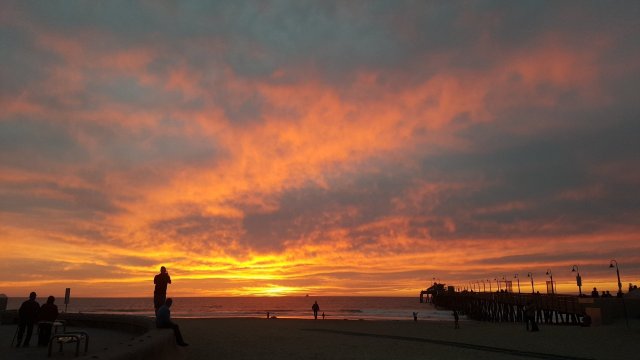
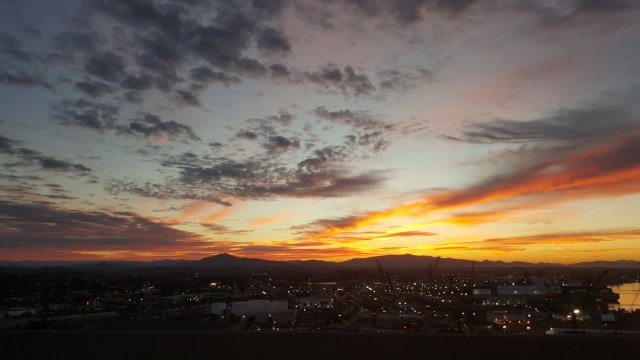
sunset in IB

Halloween: a holiday we celebrate intermittently depending on if our friends with kids are around and willing to share. I was able to crutch around the neighborhood for a mile and half and then get carried back the last block so the kids could pass out most of the candy they just collected while we helped them eat some before they went to bed. We saw two other people on crutches, so it seems to be the season of injuries (and I’m glad they’re not letting it slow them down either).

20171204_1517291731454466.jpg

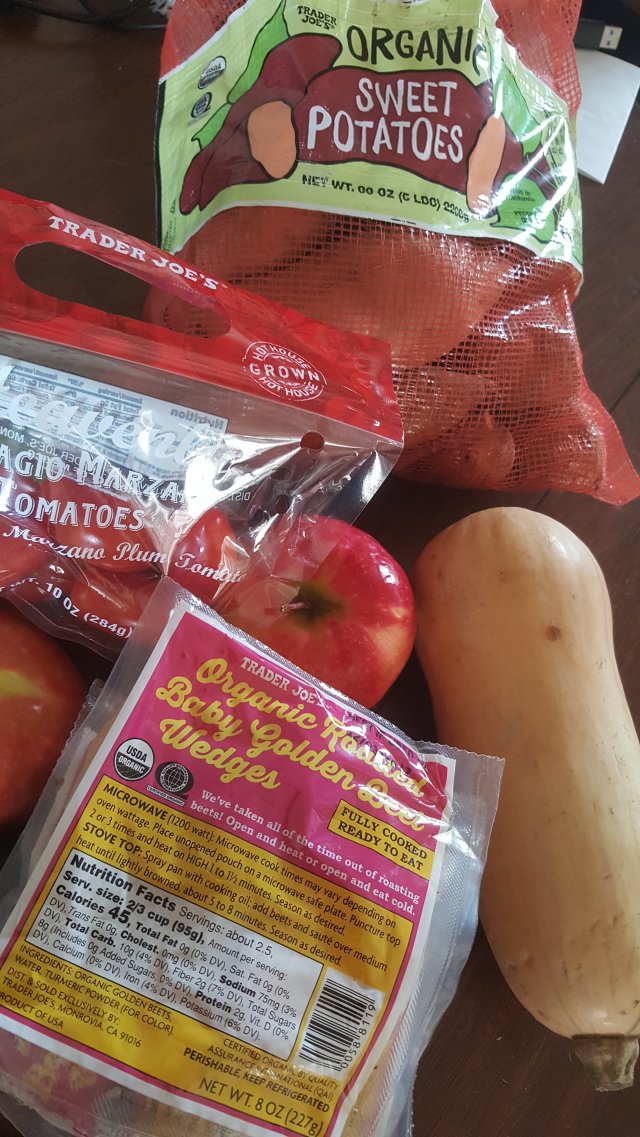
free food on campus

We drove up to Montana for a close family reunion — all the siblings with their kids and new pets and a visit with each parent (even if one of them wasn’t most grateful); but that’s another post. We stopped in Las Vegas on the way home to say hi to Julie and Dustin, teachers we met in Bahrain, that will be married next year and just adopted a puppy. We stayed the night and then took them to breakfast in the morning and ordered all the food so we wouldn’t be hungry till we got home.

Caleb’s neck is still improving (he had two discs replaced with Mobi-C in August) and is one minute away from his run time to pass his physical test in March. He was approved to start lifting last month (yay, more than ten pounds) and he’s taking it slowly while helping me carry weights around so I stumble less. Not only have I not done a lot of yoga poses, Zumba, box jumps, squats, lunges, running, paddle boarding, stairs, etc., but I stopped doing other upper body workouts that require more balance on both feet.

20171208_110154838289174.jpg

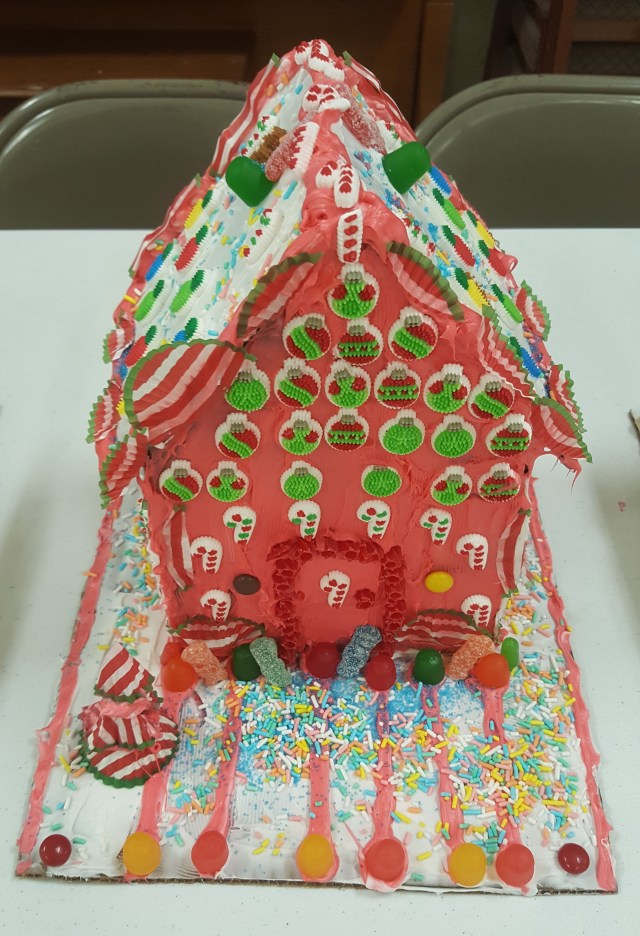
3rd grade cardboard house

It feels good to be able to wiggle my toes again and I feel the need to pop my second toe, but the toes are still swollen and I have lots of dead skin that I still soak in the bath. I should be wearing a boot of my own soon and hope that helps with the walking, and gaining the inch and a half back that I lost in my calf. People have noticed my foot goes in a bit, but without an arch or being able to toe off I do walk funny, but I don’t want it to effect my back, hip, or knee. I went to the chiropractor Dec. 20th and he said I’m doing great, but to keep an eye on my foot. Aye, aye, Doc.

Posted in Art, Education, Food, Friends, Holidays, People, Places, Sports, Volunteer | Tagged , , , , , | 2 Comments

All the Turkeys Together

east on the Coronado Bay Bridge

Caleb and I have always enjoyed seeing family over the holidays as it’s the most guaranteed time off in the military. We would buy the turkey or Tofurky and then the fake tree with lights and gifts to go under it. Then we found traveling to be way more awesome than a white picket fence tradition and used the road time on the way to Montana to see history, nature, and horses (that we could feed carrots to). This year would be different.

20171116_071730910367916.jpg

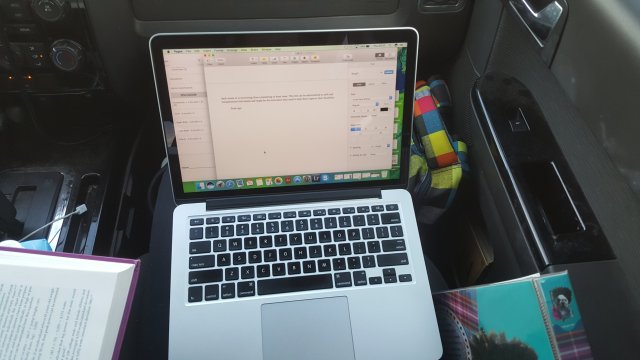
passenger homework station

With a boot still on my left leg, I’d be unable to go hiking or diving, so I was bummed that we’d have a week off for Thanksgiving and nothing to do — except that Caleb had talked about hunting, shooting, killing, skinning, gutting, cooking, and eating a deer for months and that’s all he wanted to do over break. He’s usually not demanding at all and hadn’t been hunting in at least 12 years, so I considered it. Then somehow he convinced his family (mother, sister, and brother) to all be in the same place at the same time. His dad would already be there as he lives in Missoula along with Caleb’s sister, Jessi.

20171116_1428011319577152.jpg

north on Nevada 361

Caleb was all excited about the siblings, nieces, and nephews and all I could think about was all the things I couldn’t do with my crutches in the snow. I had bragged to my classmates about all the homework I wouldn’t do over the holidays, but figured it would give me something to do and brought my bag of books, with laptop, to keep me company. We left the house before 6am on Thursday and Caleb had wanted to leave by 5 so we could avoid most of the LA traffic. That didn’t happen and I napped while he continued to detour further east.

20171117_1000472010508330.jpg

I-86 Idaho, I touched snow

I woke up to eat bread, write my lab report, and read my book. Caleb drove us to within an hour of Pocatello, Idaho the first day and we “rested” for two hours at a truck stop before I was ready to go again. I tried propping my foot up in the backseat while Caleb slept up front, but I couldn’t get comfortable, so I drove. I got us to his mom’s car, the 2000-ish Ford Probe we agreed to drive to Missoula for her, parked outside a small apartment complex. Kris, Caleb’s brother, was picking her up from Big Timber and they would arrive on Sunday.

img-20171118-wa00002009585887.jpeg

morning view from guest room

We got there in time to say hi to Jessi before she went to work and then I watched Labyrinth with the girls, Sammi and Lyra, and their kittens, 1 and 2 (I don’t remember their real names or the weird ones the girls gave them daily), and their deaf dog Rufus while Caleb hung out with his dad and we waited for Jake to get home from work so he could eat leftovers and we could sleep.

20171120_1117331444166632.jpg

Monday morning

The weekend was spent making pancakes, playing with plastic ponies, finishing puzzles, playing a homemade board game (Donut Race), doing laundry, shopping and more shopping, going to the dog park, and more shopping. We definitely bought more than we ate, but I can’t say the same about the drinks. Robert, Caleb’s dad, would come over for dinner and conversation and Jake had the days off while Jessi slept for her next 12-hour shift of 7pm – 7am.

20171120_1422161209775710.jpg

Caleb, Terri, Jessi, Kris, and tail of Rufus

Monday morning brought homework with the help of kittens and kombucha until Kris arrived with his wife, Vicki, and their boys, Tristan and Jordan, and Caleb’s mom, Terri. One might think that’s too many kids in the house, ages 10, 8, 4, and almost 2, but they helped keep me entertained (Tristan loves to pass out papers and crayons, and I shared blueberries with Jordan) while the adults ran around outside and stood around making nachos (because that takes four adult-age people).

20171120_1507281567978860.jpg

Jordan sharing blueberries

Tuesday, Caleb was out the door before the sun. It was nice to be up with just the stove light on, a cup of coffee, and some adult conversation. Caleb went with his siblings and Robert armed with some rifles to find Bambi’s dad and introduce him to lead. They went one place and walked five feet (too far in the cold) and went to another place that ended up with Caleb throwing a body in the back of the truck — one they could hang from the clothes line in the backyard while they went inside for whiskey and muffins.

20171122_103500141157746.jpg

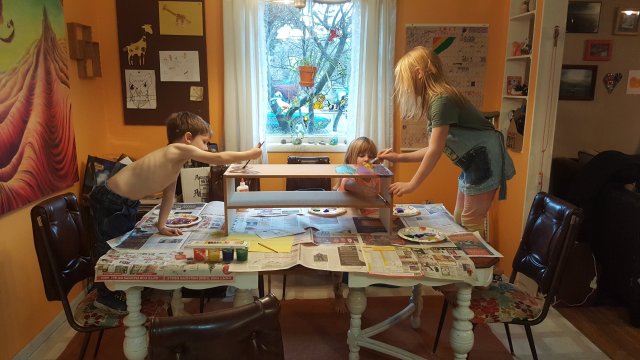
Tristan, Lyra, Sammi — grandkids’ paint project for grandpa

Having a lot of people in the house with only one bathroom can be a scheduling issue, but the only person with the problem was Tristan and his Aunt Jessi introduced him to the backyard. That was permissible the first time, but hilarious the second time when he asked for his coat to go outside without stating his intention only to come back in with a wet coat due to an aiming issue. We let him know he could use the bathroom again. I would spend the evening doing sticker-by-number and coloring an anatomy book.

20171122_1918321734085039.jpg

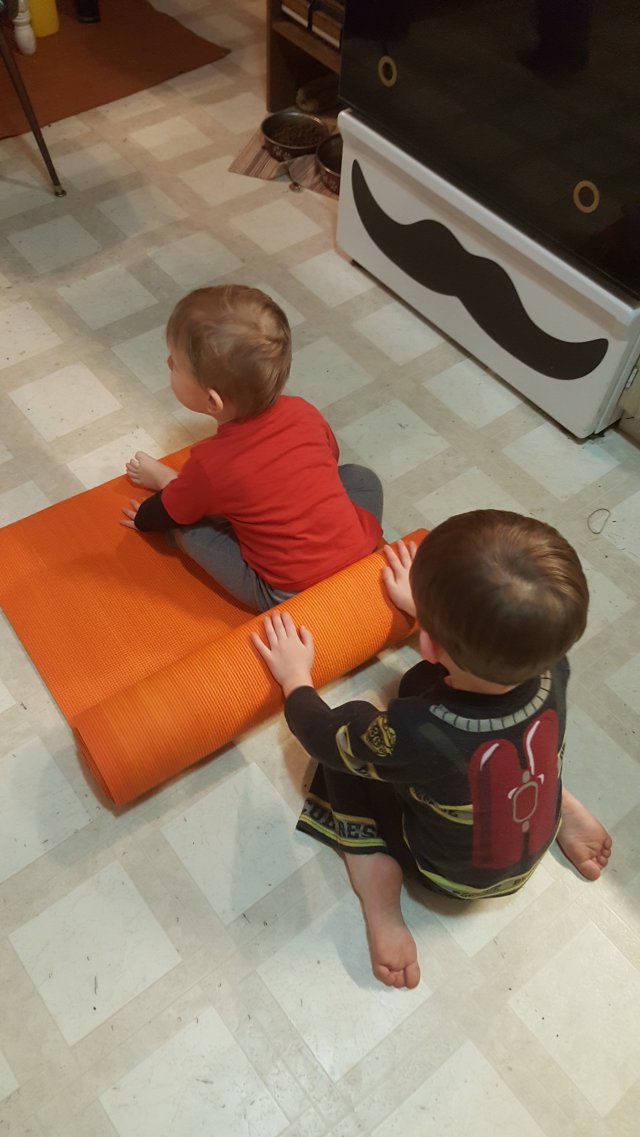
Jordan and Tristan, yoga in the kitchen

Wednesday, the boys went hunting with Robert (no luck) while Terri cleaned her car and Vicki got a pedicure. Jessi and I were going to take the kids to a museum, but they were all closed till 11am so we let the kids do yoga, puzzles, and paint instead. I gave the boys a bath and then it was back to puzzles and yoga for the boys and plastic ponies and kittens for the girls. Terri made her famous biscuits and even though the bottoms were burnt the men made them disappear.

20171123_1703171583033897.jpg

pre-pie plate

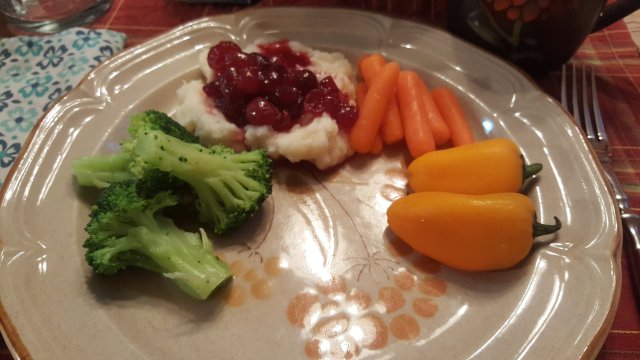
Thursday, Terri left early (ex can’t be in the same room) and forgot her coat. The cousins played together in the kitchen while the adults were busy prepping three turkeys (one fried) and eventually the Tofurky would get put in the oven with most of the pies (pecan, cherry, pumpkin, apple, and mincemeat). There were cranberries, corn, peppers, broccoli, carrots, gravy, and dinner rolls (store-bought). We quickly had seconds and took some family photos and then packed up leftovers for Kris to take when he leaves at 5pm because Vicki starts a new job on Monday morning and they live in Virginia.

20171123_1745102111635491.jpg

Robert, Kris, Jessi, Caleb

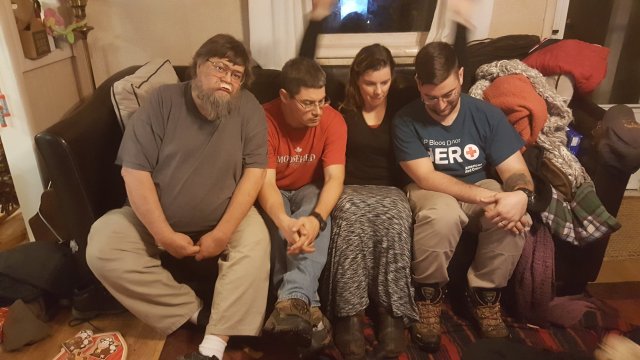
At some point during our stay Jake and Caleb set up the teepee and the kids roasted marshmallows inside. There was lots of screaming (good and bad); screens on for background noise, entertainment, and sanity; and tons of food, booze, and laughs. There’s always going to be drama when family gets together for long periods of time, but ours was centered around one individual, which is the deciding factor for us getting together again anytime soon.

20171126_215007359533104.jpg

Piggy and Sparky

We agreed to leave early the next morning to give us more time on the open road and a bit of time in Las Vegas to visit our friends. We stopped in Dell, Montana for lotion and huckleberry stuff and arrived at Julie and Dustin’s at 7:15pm. Their personalities and tastes merge so well together, a happy couple and a beautiful place. They offered us a key thinking we were staying longer and I would have loved to, but I was also ready to get home, see my puppies, and put Caleb’s deer in the freezer, the half we brought in a cooler on dry ice.

Kris had a car fly over the median and into his truck somewhere past Chicago. It was a big fiasco, but everyone is ok and he’ll be getting a new truck. Terri says she’ll visit Jessi more often since she lives closer again. Robert wants to know what we’re doing for his 60th birthday and the kids agree that he needs to be in better shape before we set out into the woods for hiking and hunting with no store to escape to or a chair to rest in for miles. Jessi had a ton of fun, but she’s a family loving nerd like that. Caleb hopes I heal fast and never break again so we can spend more time hiking and diving on our next vacation regardless of which state or group of people we are with.

Posted in Animals, Art, Family, Food, Holidays, Travel | Tagged , , , , , | Leave a comment

My First Week With a Broken Big Toe


sunset at the beach; no sand in my toes

My big toe is broken, which means no morning runs and nightly walks, but this is only temporary. I spent the first night taking hydrocodone and talking to a nurse on the phone at 4am. I tried walking off the pain to get the blood flowing (the opposite of RICE — rest, ice, compression, elevation) and broke into a cold-sweat just a few houses down. I was able to sit it out, recover while I called Caleb (who didn’t answer), and then walk back home.

For those of you still wondering how this happened… Friday evening I was invited over to my neighbor’s house for s’mores and the kids invited me into the bounce house. I wasn’t in there over a minute before I came back out and iced and elevated my foot for three hours before stumbling home (not booze related). Caleb said we were going to the ER, so I used WebMD symptom checker first and it came up with turf toe (not a good diagnosis), so I agreed to go.

img_20171014_003007_7792102285968.jpg

more than hairline

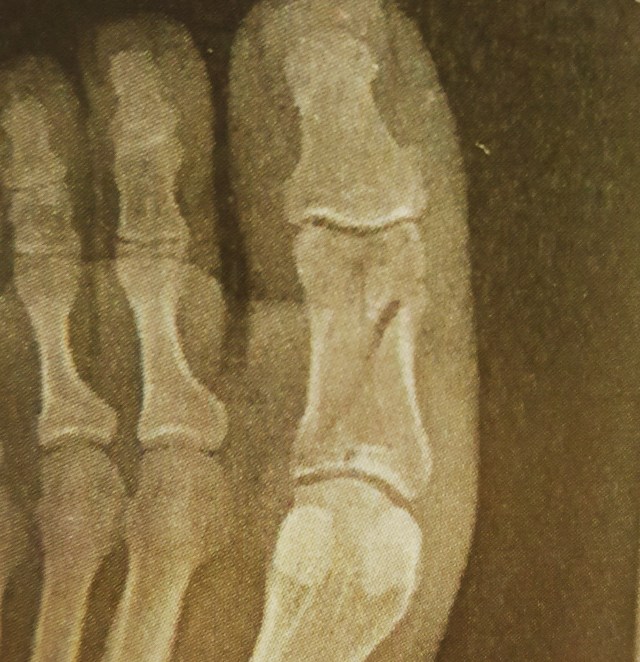
I told the x-ray tech that it was probably a hairline fracture between the metatarsophalangeal joint (between foot and toe) and the interphalangeal joint (between mid and tip of my big toe on my left foot. He started with a full foot and we both saw the fracture immediately — from medial distal to lateral proximal, from joint to joint of my first proximal phalanx. I had done well when I landed on the side of my toe after being pulled down in the bounce house. He took two more x-rays and then it was back to the waiting room. 

Saturday we went shopping so that I could try the electric cart, but it wasn’t as fun as I had hoped. It is slow going forward and jerks to a stop unless you ease the handle. I made it past the squash before I was back up into my crutches. Again, shopping is the opposite of recovery for a broken toe, especially of the weight-bearing variety. So, while I rested Caleb went out and bought an assortment of ice packs. I’m grateful that our bed folds up on both ends — one to keep the swelling fluid out of my foot and the other to keep my sinuses drained while I continue to get over a cold.

img-20171017-wa00062115818518.jpegMonday I got a doctor’s note, after watching Sandlot and most of Monster House in the waiting room from 7 – 10am, for a handicap parking pass on campus and then went to their L – Bldg. in the afternoon with Caleb for the pink paper. It was stressful to think about all the parking and walking I would have to do, and how exhausted I might otherwise be if I wasn’t in the shape I was — balance in strength, endurance, and flexibility is important.

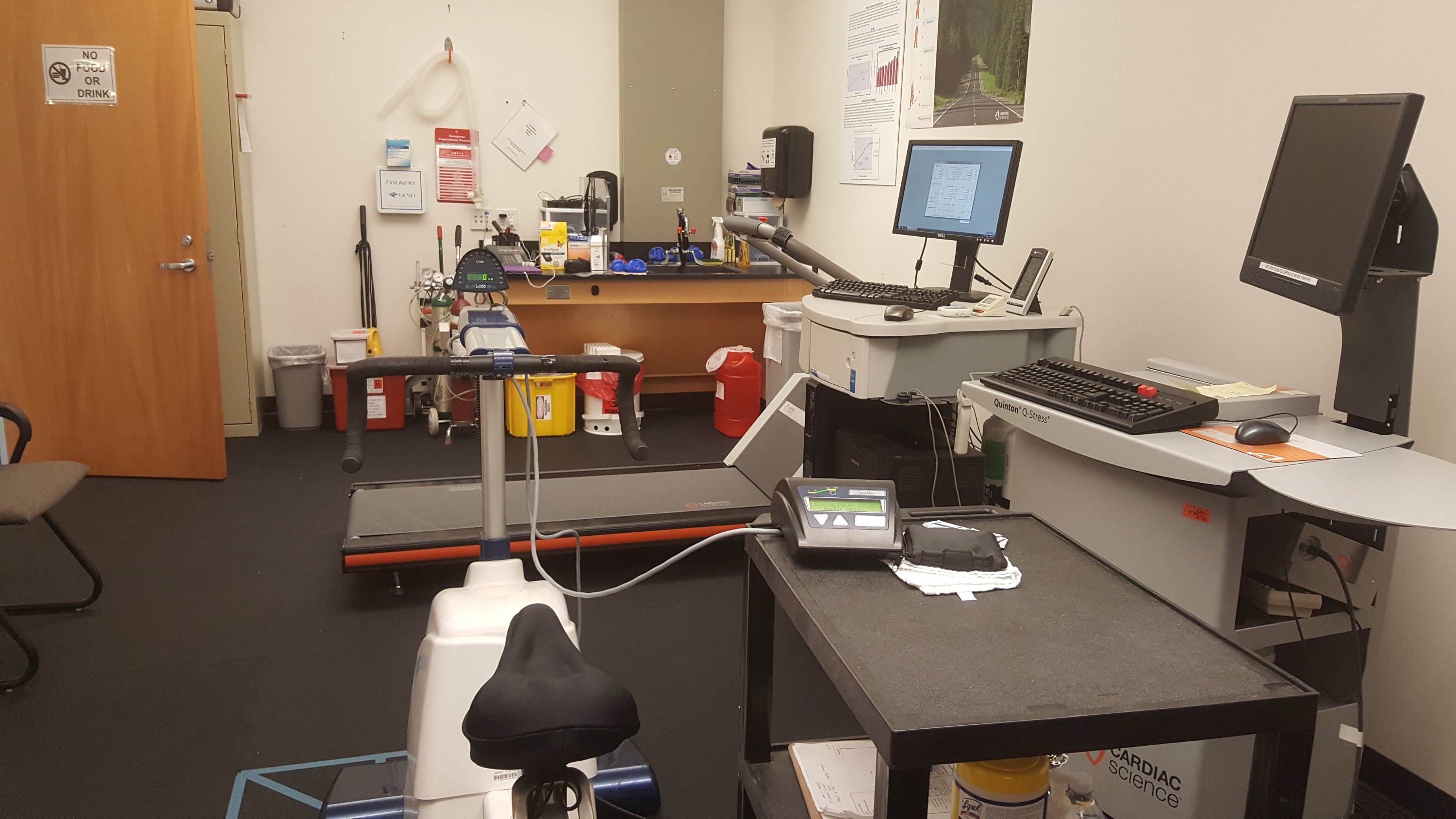
Tuesday was spent driving some of my classmates from City College to UCSD and back for some time in the EPARC lab (Exercise and Physical Activity Resource Center). I wasn’t allowed on the equipment, but I’m welcome back when I don’t have a cast on. We were split into two groups of five and went through the protocol of a GXT (graded exercise test) on an ergometer (bike with external watt adjustment), saw how their Biodex System 4 measures isokinetic strength, and talked about the bone density that DEXA is capable of showing. We finished our time in the lab with me asking questions about a balance machine while everyone else turned in an assignment that was due (I would do this later) and then took the shortcut (stairs) to the car parked in the back and my classmates let me lead the way, which I thought was sweet at the time, but dangerous if I had fallen.


Wednesday is spent on campus from 9 am to 7 pm, which I thought would be a deal, but I spent more time in traffic than if I’d have left home at my usual time. I got to come in late for my Care & Prevention practical (assessing injury of the tendons and muscles surrounding the ankle) and got out early from Physiology. Classmates offer to carry my bag and others open the door; one while I was leaning against it. I attempt some one-legged spin in class, but the others start standing and so I move to a mat for elevated leg core moves and one-legged plank and push-ups. I do some stretches and then get back on the bike to finish with the class.

Yoga will be productive too with the instructor putting us into side-plank and floor-based poses with on-knees alternatives. She looked to see if I would do chair asana and I told her it would probably be easier to do eagle, which in hindsight makes no sense. Chair is squatting down and putting arms overhead (easy enough using the heel of my left foot) and eagle is wrapping one leg around the other, which I can’t stand on my left and with the boot on it won’t fit around my right.

img-20171018-wa0006639522842.jpeg

one-legged spin class

Thursday was my first day back with the little kids, grades transitional kindergarten to fifth, and they were all so curious – was it shattered, is the doctor going to use super glue, and when could I play with them again. Only one kid joked that he would kick it and I need to ask him why. I showed the kids my x-ray picture and tried to explain the importance of a knee-high boot vs just a high-top shoe. I think one kid wanted to play with my crutches.

I haven’t been handicap long, but I’ve noticed that not all doors are easily accessible, that San Diego has some rough and uneven sidewalks, that there’s always going to be one jerk in a large crowd, that the crosswalk light isn’t always long enough, and that handicap parking isn’t always the most convenient — nearest the ramp (uneven surface I could fall on) and farthest from the door (as the stairs are always closer). I need pockets or a bag at home to carry food or clothes and have to sit to dress when I used to pride myself on being able to balance while doing so.

shopping

I’m grateful to the kind, patient, and understanding people who I’ve encountered on my six-day journey, especially the ones who have given me chocolate. I’ve got many more weeks of this ahead and Caleb is stuck between making me stay in bed and leaving the hose down in the tub so I can take a shower before I cook, clean, and go to school. It used to take me 10 minutes to get ready and now can take 75 minutes of hobbling around. I didn’t realize how grateful I was for that time, but it’s another thing I’m learning and taking into consideration about my perspective in life.

I’m grateful that Caleb allows me to be stubborn and maintain a sense of freedom, but also thoroughly happy when he cooks me dinner and delivers it, feeds the dogs and lets them out, washes the dishes and puts them away, makes me do homework and brings me snacks, helps adjust the bed and swaps out my ice packs. He is willing to hop up to do the slightest thing, so that I may recover quickly and less painfully than he has had to deal with after having knee and neck surgery with constant back pain.

I have an appointment with a orthopedist on Tuesday to see if I need surgery.

Posted in Uncategorized | 2 Comments

The History of Light Bulbs

Light bulbs, since they began to spread commercially in 18801, have found their way into every office, home, highway, store, and hospital. They are built into stoves, cars, and televisions — the items that provide sustenance, transportation, and entertainment to millions daily. Thomas Edison, an inventor and businessman, is the most popular name associated with the light bulb and the conglomerate of General Electric1, though it has taken many more secluded scientists, educated engineers, and prosperous patrons to bring this technology into every industry of the 21st century; where this historical invention has more purpose today than when it became popular in the 1920s3.

Lighting went from burning animal fats to flammable gases, leaving homes covered in soot or sometimes burnt. These combustible gases could be a deadly combo for miners when mixed with new or unknown elements on the job site2; as if their jobs weren’t hazardous enough. The bulb itself was a bit of a slow industry, but not from lack of trying. Inventors experimented with different glass, chemical elements, and filaments and tested them against different temperatures and exposed them to their daily hazards of heat (sun, insulation, stove, etc) and height (light distance and breakage)2. 

Light bulbs have been around as long as steam engines and telegraphs and their evolution has had an influence in the home and office during times of war and peace. They have made changes in the economy, the landscape, and bills in Congress; they have led the way for electricity to be built into the walls of homes, the appliances used inside, and the machines to deliver the current needed to keep items lit and working properly. The light bulb might have a relatively short history, but it has made large, sometimes slow, strides forward to keep up with modernization.4

Technology either improves its usefulness or loses its purpose, like a phonograph or VHS tape. The light bulb’s ancestors were born in 1802 when Humphry Davy, a chemist and inventor, discovered potassium, sodium, and chlorine, and created the Davy Lamp — a safe light source for miners near flammable gases.1 The next generation would be the electric light, introduced by Joseph Swan, a British physicist and chemist, in 1860, but by 1878 the incandescent lamp still burned too quickly to be efficient.4

It would take two more years before Thomas Edison began to leave his mark on the electrical industry. He started with the incandescent light bulb, getting it to burn from 14 hours up to 1200, and the ‘Edison screw’ to attach the bulb to the electrical source. By 1882, he was distributing electricity through conduits with a direct current and made the first commercial power utility and first electric meter in Manhattan, New York to measure the consumers’ use via companies and the government for usage patterns, personal payments1, and sometimes rolling blackouts to ensure everyone got a bit of hot water in their well-lit morning shower. 

In 1890, Edison invented the fuse1, and another decade would go by with only failed experiments to pass the time. The need for electricity inspired the first two-phase alternating current generator to be built using a Serbian engineer, Nikola Tesla’s ideas with the American entrepreneur, George Westinghouse’s money, a robber baron of the time, among other great monetary contributors to a five-year project at Niagara Falls. It was George’s love of trains that would take him from inventing the air brake, and standardizing them to a great fortune, to creating a constant-voltage AC generator.

This generator would start the grid towards high-voltage AC transmission lines that were transformed to low-volt AC/DC distribution lines that would bring entertainment and light into the homes of New Yorkers4. Edison helped found and merge the conglomerate that is General Electric, a company that took more power than it gave and has been involved with every piece of the electricity industry, from trains to televisions, since its beginning in 18925.

Lightbulbs were so popular that they were seen as Christmas lights to be hung inside and outside of the home, bragging rights of the 1880s3. Isaac Singer, the founder of the popular sewing machine, made good use of the electricity available in 1889, but wouldn’t make use of the light bulb until 1921 when Frederick Diehl introduced an attachable bulb that ran hot but led the way for improvement4. Although this new technology was safer, inadequate wiring and improper use could lead to fires which led to the development of the Underwriters Laboratories in 1894 and the first National Electric Code in 1897, both of which have only continued to expand their standards and increase their guidelines2. 

Flashlights made their debut in 1898, two years before toy trains were able to light their own little tracks. As trains went from coal to electric, first direct and then alternating current, and then adding diesel4, it became less obvious who had been riding on the track for days with their face out the window as it was no longer polluted with soot. The more popular use of alternating current wasn’t a quick decision, but a battle between Edison, Tesla, and Westinghouse to test situations in which each worked best — even using a human sacrifice. William Kemmler was sentenced to death in 1890 and the first person to experience the electric chair. More lively uses of the current war would be carried out at the Chicago World’s Fair in 1893 and when setting up the generator in Niagara Falls in 1895 that would be the beginnings of a national power grid1. 

The next two centuries would bring changes to the length of the workday, the entertainment at home, and the amount of land needed to supply the cities with light. In order to bring about these advancements, many scientists and engineers with the help of their benefactors, such as George Vanderbilt’s $150,000 investment from family wealth1 (also used to create the Biltmore Estate), would put in long hours in labs and patent offices getting credit, and hopefully payment, for their struggle to increase the wellbeing of the consuming public. 

After WWI, Roosevelt, under the New Deal, created the Rural Electrification Administration in 1935 to distribute electricity to the rural farms to compete with Germany and France. The United States only supplied 10% of their farms, while the other countries were already distributing up to 90% of theirs. It would take almost 20 years for the US to catch up3. 

The idea of light, not just white, and what it could do would continue to grow. Blackout lights in World War II were opaque black bulbs with a small orange bottom and low-wattage filament so the light would shine down and less brightly into the home and not out the window to protect the residents from air-raid bombings common at night4. Similar in name and in purpose, the black light was invented by William Byler the year before the lawsuit that would change the safety of the radium handling process in 1938 at US Radium, and where he would go on to make several more patents6. 

The black light would replace the radium on the instrument panels of warplanes in WWII to keep them from being detected at night. The black light would go on to be used to test for weak spots in metal structures, skin infections and other conditions, and to detect counterfeit art and currency notes. It’s also popular for its use in spotting bodily fluids, reflecting off bare skin and white posters in bedrooms and discos in the 1970s, attracting bugs to death, and actors to the theater to perform7. 

The light bulb was able to encourage the race for industries around it to build new generating plants to power new in-home appliances and to keep factories lit through the night as employers no longer relied on the sun or candles to maintain a well-lit workspace to supply the needs of its consumers, and wealthy owners. Light bulbs weren’t cheap, costing about a dollar each in 1940 (equal to about $17 today), and overtime pay had yet to be introduced, but the idea of debt was well ingrained and the employers got their monies worth from the working class (with the minimum wage law of 1938 starting out at 25 cents) who could now “work around the clock” in the “city that never sleeps.”3

Building designs began to change to make room for electrical wiring and light placement — to disperse heat, to be installed the proper distance from the floor for efficient light distribution, and to keep maintenance costs low over the life of the bulb and lamp. Buildings could now have fewer windows and more floors helping to increase production space and capabilities. Lights were installed in offices, stairwells, and on elevators. These profits went towards more generators and conduits to grow the distribution system. The grounding pin would be introduced in 1928 and would mean no more electrical shock via outlets and less of a fire hazard4. 

Light bulbs brought about the night shift which would lead to even more unfair working hours then and to extra pay today. Factories were able to double their output and lit docks and airports made it easier for nighttime delivery; as did having well-lit streets to encourage pedestrians and vehicles to safely patronize stores with signs in their windows saying, “OPEN.” World War I increased night invasions, ship signaling, and the use of spotlights. WWII would help spur the development of the fluorescent bulb, 40 years in the making, due to GE’s holds on the patents. The demand for economical lighting would bring light to ships, planes, and the battlefield — no longer just a daytime opportunity. It would take another 30 years to make these bulbs compact2. 

Lightbulbs were put into vacuum cleaners in 1932, refrigerators in 1940, car visors as vanity lights in 1946, and the Brownie Hawkeye camera in 19494. Women were able to maintain cleaner households, on their own, due to the ease and speed of the technology. The first lightbulbs cost around $23 (considering inflation) and were seen as a status symbol for those who had more than one. Families went from reading around the hearth, which could be warm in the summer, to collecting around a dining table and reading by lamplight. Bulbs would make their way into televisions in 1930, which would one day become monitors for computers, a technology that society relies on heavily today as engineers continue to make improvements as consumers drive innovation3.

The LED (light emitting diode) was invented in 1962 and only being available in red was put into $400 watches and $2100 calculators that consumed a lot of battery2. It wasn’t until 1993 that LEDs were available in white, but still too expensive for the average consumer until the Energy Department made a push in 2000 to help drop the cost. This didn’t stop companies from selling light-up shoes for $50, computer mice for $75, and introducing the LED TV in 2004 for $10,0008. The price would finally drop to $25 per bulb in 2012 and sales would increase to save energy and money in the long-term. LED bulbs are now used more in flashlights, stadiums, and traffic lights to replace the carbon of 1880, the tungsten of 1904, the nitrogen of 1913, the mercury vapor of 1948, and the high-pressure sodium of 19708.

The 1973 oil crisis caused a reduction in oil imports and a quadrupling of the price leading electric utilities to give away fluorescent lamps to slow the growth of demand for incandescent, but they were still the preferred bulb9. This was a good thing for the companies’ wallets as it was still $30 per bulb in 19852. The price would drop to $1.74 in 2005 and yet customers were buying incandescent in bulk for the varied options — silver-bottomed, antique Edison, and soft pink — not concerned with the more energy-efficient option because they prefer the warmth these bulbs have offered for generations and the style it represents for their businesses4. 

Light bulbs have changed to support the future of the planet, the economy, and the consumers who still want: Christmas lights, that can now be powered via solar anywhere; highway lights that cause sleep deprivation in people and cause birds to lose their migratory path, that are being exchanged for dimmer ones in San Diego to help with light pollution; and lights with mercury, while ensuring the Chinese workers making these lights are in safe working conditions via policy changes at GE4. 

As great as light bulbs are, as the population increases along with their need for light, this technology has some drawbacks of its own. Historically, the equipment needed to mass produce them was too expensive and the right materials hard to find. The bulbs had short lifespans and through faulty wiring could cause fires. The lights helped to deter crime in parking lots and lessen injuries around the home3, but their current brightness can cause retinal damage to drivers and disturb the nesting patterns of aquatic shore animals. Light pollution is another issue for birds as it interferes with their circadian rhythm usually dictated by the sun7. 

Sunlamps were used in WWI to heal wounds, treat Vitamin D deficiency, cure sleep disorders, and prevent rickets. The first solar cell was created in Bell Labs in 1954 and was quickly used with phones, radios, cameras, boats, and calculators4. The cells would go on to power telescopes in space, traffic lights, and apartment buildings. The sun may soon play a larger part, when prices drop, in supplying homes and offices with energy throughout the day, via solar panels on roofs and quantum dots on transparent materials over windows, and helping people to sleep through the night via light filtering apps on phones7. Currently, companies are studying sleep patterns and lighting effects from phones and computers as the blue light emitted can simulate the sun to your retina and disrupt melatonin production in the brain8.

The government has been behind this industry from the beginning, to support it personally, but also to make sure that laws are enacted to look out for the land space needed for generators at power plants and in dams (Federal Water Power Act of 1920 for regulation and affordability), the grid lines going around farms and through cities (OSHA maintaining ten feet of safety space and NERC assuring reduced risks to reliability), and the wiring processes in homes and businesses to reduce fire hazards (NECA — National Electrical Contractor Assc. — Chapters to ensure proper licensing for public safety).

As with all high-want commodities in the economy, light comes with a price tag. General Electric currently makes over $150 billion annually and is constantly in the spotlight for being the sixth largest firm in the US but being able to legally dodge 30% taxes using loopholes to lower their percentage rates and keep money overseas and in their shareholders’ pockets. This conglomerate was also able to pollute the Hudson River for 30 years with toxic PCBs and claims it spent $1.7 billion over six years to dredge up 40 miles of river, but have fought longer than that in court to delay the process and decrease the cost of cleaning up their mess.

The government is also behind the push for better lights — more efficient and economic, less of a biohazard, and longer working life. It’s this responsibility to people and the planet that has made San Diego replace 35,000 lights in 2011 to induction lamps that last 100,000 hours and have a color temperature similar to an incandescent bulb at a cost of $16 million over a period of 18 months. This switch should save the city at least $2 million annually, and luckily for San Diego, its temperatures don’t get over 95 degrees, one of the caveats about these long-lasting bulbs10. 

There’s only one direction for light bulbs to move, and that’s forward — from the National Electric Code of 1897 to the Energy Policy Modernization Act of 2016 the government has been forcing businesses to use better programs, which means buying better products, and lots of hours in a lab for the engineers to create these designs. Mazda and Tesla used to be names associated with lights, and to a tiny fraction they still are as headlights, dome lights, cup holder lights, and visor lights play a big part on the beauty and functionality of the vehicles now manufactured under those names. 

Every advancement in history comes with pros and cons, and it’s the founder’s job to weigh those positive and negative aspects before releasing something to the public. History shows that just because guns are used massively to kill people, and rarely to still kill animals to survive, their production hasn’t stopped. Though there is a downside to light, it definitely has way more good things to show for it, like doubling the possibilities that society is able to accomplish by “burning the candle at both ends”. 

Bibliography

1. Friedel, Robert, Paul Israel, and Bernard S. Finn. Edison’s Electric Light: Biography of an Invention. New Brunswick, NJ: Rutgers UP, 1987. 24-93. Print.

2. Cox, James A. A Century of Light. New York, NY: Benjamin, 1979. Print.

3. Green, Harvey. The Light of the Home: An Intimate View of the Lives of Women in Victorian America. Pantheon Books: n.p., 1983. 59-92. Print.

4. Chaline, Eric. Fifty Machines That Changed the Course of History. Buffalo, NY: Firefly, 2013. Print.

5. “Light.” GE Transformation Timeline. N.p., n.d. Web. 02 May 2017. <http://www.ge.com/ transformation/#light>. 

6. Santucci, Karen, David Nelson, and Kemedy McQuillen. “Wood’s Lamp Utility in the Identification of Semen.” Pediatrics. American Academy of Pediatrics, 01 Dec. 1999. Web. 02 May 2017.

7. Kitsinelis, Spiros. The Right Light: Matching Technologies to Needs and Applications. Boca Raton, FL: Taylor & Francis, 2012. Print.

8. Zheludev, Nikolay. “The Life and times of the LED — a 100-year History.” Nature Photonics 1.4 (2007): 189-92. Nature Publishing Group, 17 Apr. 2007. Web. 02 May 2017.

9. Frum, David. How We Got Here: The 70’s. New York: Basic, 2000. Print.

10. Union-Tribune, San Diego. “San Diego Switches to ‘green’ Street Lights.” Sandiegouniontribune.com. San Diego Union-Tribune, 19 Sept. 2011. Web. 02 May 2017.
Posted in Books, Education, History | Tagged , , | Leave a comment

Kangaroo Paw

20170413_125249.jpgAn assignment for Physical Geography with classmate Matt and professor Lisa Chaddock.

Our service project was planting Kangaroo paw, and other plant species, in the garden on the east side of the science building of City College to introduce environmentally friendly flowers to the local bird and bee populations and increase the number of pollinators. Kangaroo paw is a perennial plant that does well in a variety of habitats but prefers well-drained and slightly acidic soil with sun exposure throughout the day. They are a Zone 9 plant and tolerate drought. San Diego is Zone 10, meaning the city provides warmer winters for the Western Australian native. 

Planting native species, and plants that local critters like, increases the amount of food availability (caterpillar larvae and leaves) and provides more shelter for amphibians and mammals in the undergrowth. These plants provide pollen for birds, bees, and butterflies. They require little water and less fertilizer and therefore save a lot of money on landscaping and seeds when nature is set up to succeed. Plant density provides variety and security for the animals and beauty and pride for the school grounds. 


20181106_190149.jpg

reused another student’s tri-fold poster board


We were careful in our digging amongst the thick clay and medium rocks to not injure the grub worms feeding on the roots of grass. Kangaroo paw consists of a tubular flower coated with dense hairs that will transfer the pollen from the head of a feeding bird to the next plant. The long red stalk provides the advertisement of pollen and the perch while eating. Kangaroo paws are resilient to most insects, not including snails, and only struggle with Ink Disease in cool and moist climates. 

With global warming, more birds are losing their natural habitats. By planting bird-friendly species we are extending their available ecosystems and extending the life of their species. We are limiting the obligation to needlessly mow grass and water non-native species, cutting back on resources to reduce the greenhouse gases produced by mowers and weed-whackers that contribute to water and air pollution. Less mowing also reduces noise pollution that can be scary to birds and harmful to human ears.


kangaroo-paw-anigozanthos-bush-ballad-kangaroo-paw-gardening-with-angus

photo via inspiredroombox.com

The rusty patched bumblebee was added to the Endangered List, the first of its species, just this year. Since 2000, the Federal Register has seen an 88% decline in the number of populations and an 87% loss in their territory. The protected status allocates federal funds to states to rehabilitate and hopefully recover the bumblebee species by improving degraded habitats and reducing the use of pathogens and pesticides. 


A recent study, by the UN, suggests a 40% decline in invertebrate pollinators around the globe, which affects 75% of crops grown. Food supplies don’t just affect scientists or activists, they affect us all, plants and animals alike. Developers should be held responsible for their destruction and implementing methods to lessen the effects of their actions on the environment. Homeowners and renters can also do their part to plant pollinator-friendly gardens and reduce their use of poisons into the atmosphere and earth. 

1. Kangaroo Paws. (2015, December 24). Retrieved April 22, 2017, from https://www.anbg.gov.au/anigozanthos/ 

2. Bird-Friendly Plants FAQ. (2017, March 28). Retrieved April 22, 2017, from http://www.audubon.org/news/bird-friendly-plants-faq

3. Kennedy, M. (2017, January 11). U.S. Puts Bumblebee On The Endangered Species List For 1st Time. Retrieved April 22, 2017, from http://www.npr.org/sections/thetwo-way/2017/01/11/509337678/u-s-puts-first-bumblebee-on-the-endangered-species-list

Posted in Animals, Education, People, Plants, Project | Tagged , , , | Leave a comment