The History of Light Bulbs

Light bulbs, since they began to spread commercially in 18801, have found their way into every office, home, highway, store, and hospital. They are built into stoves, cars, and televisions — the items that provide sustenance, transportation, and entertainment to millions daily. Thomas Edison, an inventor and businessman, is the most popular name associated with the light bulb and the conglomerate of General Electric1, though it has taken many more secluded scientists, educated engineers, and prosperous patrons to bring this technology into every industry of the 21st century; where this historical invention has more purpose today than when it became popular in the 1920s3.

Lighting went from burning animal fats to flammable gases, leaving homes covered in soot or sometimes burnt. These combustible gases could be a deadly combo for miners when mixed with new or unknown elements on the job site2; as if their jobs weren’t hazardous enough. The bulb itself was a bit of a slow industry, but not from lack of trying. Inventors experimented with different glass, chemical elements, and filaments and tested them against different temperatures and exposed them to their daily hazards of heat (sun, insulation, stove, etc) and height (light distance and breakage)2. 

Light bulbs have been around as long as steam engines and telegraphs and their evolution has had an influence in the home and office during times of war and peace. They have made changes in the economy, the landscape, and bills in Congress; they have led the way for electricity to be built into the walls of homes, the appliances used inside, and the machines to deliver the current needed to keep items lit and working properly. The light bulb might have a relatively short history, but it has made large, sometimes slow, strides forward to keep up with modernization.4

Technology either improves its usefulness or loses its purpose, like a phonograph or VHS tape. The light bulb’s ancestors were born in 1802 when Humphry Davy, a chemist and inventor, discovered potassium, sodium, and chlorine, and created the Davy Lamp — a safe light source for miners near flammable gases.1 The next generation would be the electric light, introduced by Joseph Swan, a British physicist and chemist, in 1860, but by 1878 the incandescent lamp still burned too quickly to be efficient.4

It would take two more years before Thomas Edison began to leave his mark on the electrical industry. He started with the incandescent light bulb, getting it to burn from 14 hours up to 1200, and the ‘Edison screw’ to attach the bulb to the electrical source. By 1882, he was distributing electricity through conduits with a direct current and made the first commercial power utility and first electric meter in Manhattan, New York to measure the consumers’ use via companies and the government for usage patterns, personal payments1, and sometimes rolling blackouts to ensure everyone got a bit of hot water in their well-lit morning shower. 

In 1890, Edison invented the fuse1, and another decade would go by with only failed experiments to pass the time. The need for electricity inspired the first two-phase alternating current generator to be built using a Serbian engineer, Nikola Tesla’s ideas with the American entrepreneur, George Westinghouse’s money, a robber baron of the time, among other great monetary contributors to a five-year project at Niagara Falls. It was George’s love of trains that would take him from inventing the air brake, and standardizing them to a great fortune, to creating a constant-voltage AC generator.

This generator would start the grid towards high-voltage AC transmission lines that were transformed to low-volt AC/DC distribution lines that would bring entertainment and light into the homes of New Yorkers4. Edison helped found and merge the conglomerate that is General Electric, a company that took more power than it gave and has been involved with every piece of the electricity industry, from trains to televisions, since its beginning in 18925.

Lightbulbs were so popular that they were seen as Christmas lights to be hung inside and outside of the home, bragging rights of the 1880s3. Isaac Singer, the founder of the popular sewing machine, made good use of the electricity available in 1889, but wouldn’t make use of the light bulb until 1921 when Frederick Diehl introduced an attachable bulb that ran hot but led the way for improvement4. Although this new technology was safer, inadequate wiring and improper use could lead to fires which led to the development of the Underwriters Laboratories in 1894 and the first National Electric Code in 1897, both of which have only continued to expand their standards and increase their guidelines2. 

Flashlights made their debut in 1898, two years before toy trains were able to light their own little tracks. As trains went from coal to electric, first direct and then alternating current, and then adding diesel4, it became less obvious who had been riding on the track for days with their face out the window as it was no longer polluted with soot. The more popular use of alternating current wasn’t a quick decision, but a battle between Edison, Tesla, and Westinghouse to test situations in which each worked best — even using a human sacrifice. William Kemmler was sentenced to death in 1890 and the first person to experience the electric chair. More lively uses of the current war would be carried out at the Chicago World’s Fair in 1893 and when setting up the generator in Niagara Falls in 1895 that would be the beginnings of a national power grid1. 

The next two centuries would bring changes to the length of the workday, the entertainment at home, and the amount of land needed to supply the cities with light. In order to bring about these advancements, many scientists and engineers with the help of their benefactors, such as George Vanderbilt’s $150,000 investment from family wealth1 (also used to create the Biltmore Estate), would put in long hours in labs and patent offices getting credit, and hopefully payment, for their struggle to increase the wellbeing of the consuming public. 

After WWI, Roosevelt, under the New Deal, created the Rural Electrification Administration in 1935 to distribute electricity to the rural farms to compete with Germany and France. The United States only supplied 10% of their farms, while the other countries were already distributing up to 90% of theirs. It would take almost 20 years for the US to catch up3. 

The idea of light, not just white, and what it could do would continue to grow. Blackout lights in World War II were opaque black bulbs with a small orange bottom and low-wattage filament so the light would shine down and less brightly into the home and not out the window to protect the residents from air-raid bombings common at night4. Similar in name and in purpose, the black light was invented by William Byler the year before the lawsuit that would change the safety of the radium handling process in 1938 at US Radium, and where he would go on to make several more patents6. 

The black light would replace the radium on the instrument panels of warplanes in WWII to keep them from being detected at night. The black light would go on to be used to test for weak spots in metal structures, skin infections and other conditions, and to detect counterfeit art and currency notes. It’s also popular for its use in spotting bodily fluids, reflecting off bare skin and white posters in bedrooms and discos in the 1970s, attracting bugs to death, and actors to the theater to perform7. 

The light bulb was able to encourage the race for industries around it to build new generating plants to power new in-home appliances and to keep factories lit through the night as employers no longer relied on the sun or candles to maintain a well-lit workspace to supply the needs of its consumers, and wealthy owners. Light bulbs weren’t cheap, costing about a dollar each in 1940 (equal to about $17 today), and overtime pay had yet to be introduced, but the idea of debt was well ingrained and the employers got their monies worth from the working class (with the minimum wage law of 1938 starting out at 25 cents) who could now “work around the clock” in the “city that never sleeps.”3

Building designs began to change to make room for electrical wiring and light placement — to disperse heat, to be installed the proper distance from the floor for efficient light distribution, and to keep maintenance costs low over the life of the bulb and lamp. Buildings could now have fewer windows and more floors helping to increase production space and capabilities. Lights were installed in offices, stairwells, and on elevators. These profits went towards more generators and conduits to grow the distribution system. The grounding pin would be introduced in 1928 and would mean no more electrical shock via outlets and less of a fire hazard4. 

Light bulbs brought about the night shift which would lead to even more unfair working hours then and to extra pay today. Factories were able to double their output and lit docks and airports made it easier for nighttime delivery; as did having well-lit streets to encourage pedestrians and vehicles to safely patronize stores with signs in their windows saying, “OPEN.” World War I increased night invasions, ship signaling, and the use of spotlights. WWII would help spur the development of the fluorescent bulb, 40 years in the making, due to GE’s holds on the patents. The demand for economical lighting would bring light to ships, planes, and the battlefield — no longer just a daytime opportunity. It would take another 30 years to make these bulbs compact2. 

Lightbulbs were put into vacuum cleaners in 1932, refrigerators in 1940, car visors as vanity lights in 1946, and the Brownie Hawkeye camera in 19494. Women were able to maintain cleaner households, on their own, due to the ease and speed of the technology. The first lightbulbs cost around $23 (considering inflation) and were seen as a status symbol for those who had more than one. Families went from reading around the hearth, which could be warm in the summer, to collecting around a dining table and reading by lamplight. Bulbs would make their way into televisions in 1930, which would one day become monitors for computers, a technology that society relies on heavily today as engineers continue to make improvements as consumers drive innovation3.

The LED (light emitting diode) was invented in 1962 and only being available in red was put into $400 watches and $2100 calculators that consumed a lot of battery2. It wasn’t until 1993 that LEDs were available in white, but still too expensive for the average consumer until the Energy Department made a push in 2000 to help drop the cost. This didn’t stop companies from selling light-up shoes for $50, computer mice for $75, and introducing the LED TV in 2004 for $10,0008. The price would finally drop to $25 per bulb in 2012 and sales would increase to save energy and money in the long-term. LED bulbs are now used more in flashlights, stadiums, and traffic lights to replace the carbon of 1880, the tungsten of 1904, the nitrogen of 1913, the mercury vapor of 1948, and the high-pressure sodium of 19708.

The 1973 oil crisis caused a reduction in oil imports and a quadrupling of the price leading electric utilities to give away fluorescent lamps to slow the growth of demand for incandescent, but they were still the preferred bulb9. This was a good thing for the companies’ wallets as it was still $30 per bulb in 19852. The price would drop to $1.74 in 2005 and yet customers were buying incandescent in bulk for the varied options — silver-bottomed, antique Edison, and soft pink — not concerned with the more energy-efficient option because they prefer the warmth these bulbs have offered for generations and the style it represents for their businesses4. 

Light bulbs have changed to support the future of the planet, the economy, and the consumers who still want: Christmas lights, that can now be powered via solar anywhere; highway lights that cause sleep deprivation in people and cause birds to lose their migratory path, that are being exchanged for dimmer ones in San Diego to help with light pollution; and lights with mercury, while ensuring the Chinese workers making these lights are in safe working conditions via policy changes at GE4. 

As great as light bulbs are, as the population increases along with their need for light, this technology has some drawbacks of its own. Historically, the equipment needed to mass produce them was too expensive and the right materials hard to find. The bulbs had short lifespans and through faulty wiring could cause fires. The lights helped to deter crime in parking lots and lessen injuries around the home3, but their current brightness can cause retinal damage to drivers and disturb the nesting patterns of aquatic shore animals. Light pollution is another issue for birds as it interferes with their circadian rhythm usually dictated by the sun7. 

Sunlamps were used in WWI to heal wounds, treat Vitamin D deficiency, cure sleep disorders, and prevent rickets. The first solar cell was created in Bell Labs in 1954 and was quickly used with phones, radios, cameras, boats, and calculators4. The cells would go on to power telescopes in space, traffic lights, and apartment buildings. The sun may soon play a larger part, when prices drop, in supplying homes and offices with energy throughout the day, via solar panels on roofs and quantum dots on transparent materials over windows, and helping people to sleep through the night via light filtering apps on phones7. Currently, companies are studying sleep patterns and lighting effects from phones and computers as the blue light emitted can simulate the sun to your retina and disrupt melatonin production in the brain8.

The government has been behind this industry from the beginning, to support it personally, but also to make sure that laws are enacted to look out for the land space needed for generators at power plants and in dams (Federal Water Power Act of 1920 for regulation and affordability), the grid lines going around farms and through cities (OSHA maintaining ten feet of safety space and NERC assuring reduced risks to reliability), and the wiring processes in homes and businesses to reduce fire hazards (NECA — National Electrical Contractor Assc. — Chapters to ensure proper licensing for public safety).

As with all high-want commodities in the economy, light comes with a price tag. General Electric currently makes over $150 billion annually and is constantly in the spotlight for being the sixth largest firm in the US but being able to legally dodge 30% taxes using loopholes to lower their percentage rates and keep money overseas and in their shareholders’ pockets. This conglomerate was also able to pollute the Hudson River for 30 years with toxic PCBs and claims it spent $1.7 billion over six years to dredge up 40 miles of river, but have fought longer than that in court to delay the process and decrease the cost of cleaning up their mess.

The government is also behind the push for better lights — more efficient and economic, less of a biohazard, and longer working life. It’s this responsibility to people and the planet that has made San Diego replace 35,000 lights in 2011 to induction lamps that last 100,000 hours and have a color temperature similar to an incandescent bulb at a cost of $16 million over a period of 18 months. This switch should save the city at least $2 million annually, and luckily for San Diego, its temperatures don’t get over 95 degrees, one of the caveats about these long-lasting bulbs10. 

There’s only one direction for light bulbs to move, and that’s forward — from the National Electric Code of 1897 to the Energy Policy Modernization Act of 2016 the government has been forcing businesses to use better programs, which means buying better products, and lots of hours in a lab for the engineers to create these designs. Mazda and Tesla used to be names associated with lights, and to a tiny fraction they still are as headlights, dome lights, cup holder lights, and visor lights play a big part on the beauty and functionality of the vehicles now manufactured under those names. 

Every advancement in history comes with pros and cons, and it’s the founder’s job to weigh those positive and negative aspects before releasing something to the public. History shows that just because guns are used massively to kill people, and rarely to still kill animals to survive, their production hasn’t stopped. Though there is a downside to light, it definitely has way more good things to show for it, like doubling the possibilities that society is able to accomplish by “burning the candle at both ends”. 

Bibliography

1. Friedel, Robert, Paul Israel, and Bernard S. Finn. Edison’s Electric Light: Biography of an Invention. New Brunswick, NJ: Rutgers UP, 1987. 24-93. Print.

2. Cox, James A. A Century of Light. New York, NY: Benjamin, 1979. Print.

3. Green, Harvey. The Light of the Home: An Intimate View of the Lives of Women in Victorian America. Pantheon Books: n.p., 1983. 59-92. Print.

4. Chaline, Eric. Fifty Machines That Changed the Course of History. Buffalo, NY: Firefly, 2013. Print.

5. “Light.” GE Transformation Timeline. N.p., n.d. Web. 02 May 2017. <http://www.ge.com/ transformation/#light>. 

6. Santucci, Karen, David Nelson, and Kemedy McQuillen. “Wood’s Lamp Utility in the Identification of Semen.” Pediatrics. American Academy of Pediatrics, 01 Dec. 1999. Web. 02 May 2017.

7. Kitsinelis, Spiros. The Right Light: Matching Technologies to Needs and Applications. Boca Raton, FL: Taylor & Francis, 2012. Print.

8. Zheludev, Nikolay. “The Life and times of the LED — a 100-year History.” Nature Photonics 1.4 (2007): 189-92. Nature Publishing Group, 17 Apr. 2007. Web. 02 May 2017.

9. Frum, David. How We Got Here: The 70’s. New York: Basic, 2000. Print.

10. Union-Tribune, San Diego. “San Diego Switches to ‘green’ Street Lights.” Sandiegouniontribune.com. San Diego Union-Tribune, 19 Sept. 2011. Web. 02 May 2017.

Posted in Books, Education, History | Tagged , , | Leave a comment

Kangaroo Paw

20170413_125249.jpgAn assignment for Physical Geography with classmate Matt and professor Lisa Chaddock.

Our service project was planting Kangaroo paw, and other plant species, in the garden on the east side of the science building of City College to introduce environmentally friendly flowers to the local bird and bee populations and increase the number of pollinators. Kangaroo paw is a perennial plant that does well in a variety of habitats but prefers well-drained and slightly acidic soil with sun exposure throughout the day. They are a Zone 9 plant and tolerate drought. San Diego is Zone 10, meaning the city provides warmer winters for the Western Australian native. 

Planting native species, and plants that local critters like, increases the amount of food availability (caterpillar larvae and leaves) and provides more shelter for amphibians and mammals in the undergrowth. These plants provide pollen for birds, bees, and butterflies. They require little water and less fertilizer and therefore save a lot of money on landscaping and seeds when nature is set up to succeed. Plant density provides variety and security for the animals and beauty and pride for the school grounds. 


20181106_190149.jpg

reused another student’s tri-fold poster board


We were careful in our digging amongst the thick clay and medium rocks to not injure the grub worms feeding on the roots of grass. Kangaroo paw consists of a tubular flower coated with dense hairs that will transfer the pollen from the head of a feeding bird to the next plant. The long red stalk provides the advertisement of pollen and the perch while eating. Kangaroo paws are resilient to most insects, not including snails, and only struggle with Ink Disease in cool and moist climates. 

With global warming, more birds are losing their natural habitats. By planting bird-friendly species we are extending their available ecosystems and extending the life of their species. We are limiting the obligation to needlessly mow grass and water non-native species, cutting back on resources to reduce the greenhouse gases produced by mowers and weed-whackers that contribute to water and air pollution. Less mowing also reduces noise pollution that can be scary to birds and harmful to human ears.


kangaroo-paw-anigozanthos-bush-ballad-kangaroo-paw-gardening-with-angus

photo via inspiredroombox.com

The rusty patched bumblebee was added to the Endangered List, the first of its species, just this year. Since 2000, the Federal Register has seen an 88% decline in the number of populations and an 87% loss in their territory. The protected status allocates federal funds to states to rehabilitate and hopefully recover the bumblebee species by improving degraded habitats and reducing the use of pathogens and pesticides. 


A recent study, by the UN, suggests a 40% decline in invertebrate pollinators around the globe, which affects 75% of crops grown. Food supplies don’t just affect scientists or activists, they affect us all, plants and animals alike. Developers should be held responsible for their destruction and implementing methods to lessen the effects of their actions on the environment. Homeowners and renters can also do their part to plant pollinator-friendly gardens and reduce their use of poisons into the atmosphere and earth. 

1. Kangaroo Paws. (2015, December 24). Retrieved April 22, 2017, from https://www.anbg.gov.au/anigozanthos/ 

2. Bird-Friendly Plants FAQ. (2017, March 28). Retrieved April 22, 2017, from http://www.audubon.org/news/bird-friendly-plants-faq

3. Kennedy, M. (2017, January 11). U.S. Puts Bumblebee On The Endangered Species List For 1st Time. Retrieved April 22, 2017, from http://www.npr.org/sections/thetwo-way/2017/01/11/509337678/u-s-puts-first-bumblebee-on-the-endangered-species-list

Posted in Animals, Education, People, Plants, Project | Tagged , , , | Leave a comment

America as an Empire

“When the power of love overcomes the love of power, the world will know peace,” said Jimi Hendrix, an influential rock guitarist, in the mid-twentieth century.5 The world is far from realizing this utopia as children still fight over ownership of toys as men have fought for centuries over land, religion, science, fear, racism, and women. Popular adjectives for man are: powerful, strong, educated, healthy, and rich. A man needs to be in charge of his domain — to include his home, church, office, country, and everything in between (farms, roads, and rivers) and within reach (the next mountain, the new frontier, and the closest islands). Man is a proud creature and has proven repeatedly through bloody wars and conquering efforts that he will fight for what he believes is right or his, regardless of the outcome, especially when using other people as his pawns.

Pythagoras, known for his theorem and the start of philosophy, said in 500BC, “Power is the near neighbour of necessity.”6 If humans were able to separate themselves from the animal kingdom by not fighting over territory, something our government makes us pay to live on, the world would have one less dangerous aspect. Living on free, unmarked, and unregulated land was seen as barbaric and something to abolish.4 Now it’s frowned upon and charged for so that all activities may be regulated — houses, cars, and jobs taxed while walking and sleeping can acquire fines depending on their location. Humans used to share their existence — farming, hunting, and wives, but over time have felt the need to distinguish between ownership, and seem to be slowly going back to sharing the burdens of existence with co-ops and community gardens. Above are the underlying reasons behind the leaders of history trying to dominate the world, some more than others.

The following is a discussion of man’s excuses to conquer another people, push them from their land, or dominate them in their own territory for the benefit of religion, business, beliefs, and fear of the unknown. President McKinley wasn’t the first, and definitely not the last president to justify his actions with the words of the Bible and the sharp edge of a sword. His tactics were unChristian to the extent that I understand the Word and the ways it has been interpreted to me — love your neighbor as yourself (Mark 12:31)7, but only if he’s white. It’s also not fair to “civilize” someone and then deny them the rights to read or vote.

As Larry Madaras, author of Taking Sides, stated, “the acquisition of California and the subsequent discovery of gold there spurred interest” in finding faster ways to connect the government of the East coast with the wealth of the West coast, and acquiring more places to stop for refueling and repairs along naval trade routes to grow American businesses and sell the plethora of industrialized products to a larger market.4 I agree with free trade (definition: international trade left to its natural course without tariffs, quotas, or other restrictions)8, but not with forcing another nation to open its borders or change its beliefs in order to accomplish it. Similarly, as if a vacuüm cleaner salesman was to come to my door I’m not going to let him in to kill my son and teach my daughter a new religion.

Racism has played a large role in the public and private sectors throughout history and did not disappoint as the United States strove to win the race to be the next leading empire. Walter LaFeber, author of Inevitable Revolutions: The United States in Central America, agrees that the racial attitudes of the nineteenth-century “considered all races other than white to be inferior,” which made it easier for people like William Walker, American soldier turned Nicaraguan president, to attempt “to impose Anglo-Saxon values on the unwilling.” This feeling of power was instilled in ‘white males’ since their proclamation of personal freedom in the Declaration of Independence.4

I believe in the right to “Life, Liberty, and the pursuit of Happiness,” but only so far as being fair will allow. Life is full of competition and it keeps nature and economics healthy, but demoralizing and killing other humans deemed inferior due to skin color is heartless. The legacies of fighting Indians for the frontier and Blacks over slavery were even carried over to other Europeans that had different cultural beliefs.4 These standards are still prevalent today as citizens agree to ban Muslims on planes and to build a longer, taller, and wider wall to keep out Mexicans, as if their country is the only one that can have a corrupt government and unfair policies towards ownership, religion, and personal pursuits — sexual, educational, or recreational.

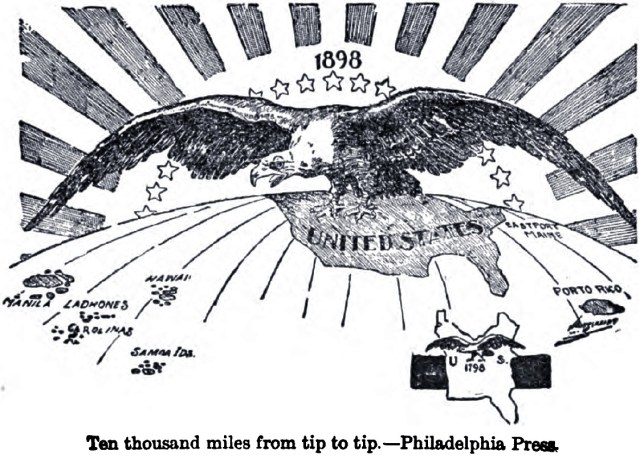
The United States invested “a highly disproportionate amount” of time, money, and military into the five Central American nations, a region that covers “only a little more than one-hundredth of the Western Hemisphere’s land area.”4 I applaud their effort that every little piece and person counts and helps to make up the whole of the planet, but America was more interested in the number of profits they saw in the new wealth-based soil frontier that was Central America — Nicaragua, Costa Rica, Panama, and Honduras; and the Caribbean — Puerto Rico, Cuba, Haiti, and the Dominican Republic, and keeping out the British, Germans, and Soviets. Most of the invested millions in 15 years, about $93 million by the eve of WWI, went towards plantations of bananas, sugar, coffee, and tobacco, and the railroads to transport it all.4

a sugar plantation in Cuba

America’s goal in gaining the Caribbean and the Philippines was to have better access for “economic penetration” into China and have a large new market of buyers. This goal was worth the investment and loans were given to Latin American countries, repeatedly, even after their governments defaulted on payments and used the funds for other purposes until “the whole process of contracting such debts became a vicious game without rules,” claimed David Healy4. America went south, in Nicaragua for 21 years, to ensure foreigner’s debts were repaid, giving those other countries no reason to tread on the States’ property, but increasingly had to agree on only a fraction of the loan to be repaid.4 I understand how this would lead to another world war as nations are going broke and their citizens hungry and dying of disease while they fight battles for their leaders that are overseas. The war in the Middle East is still an issue today as America battles with the growing debt now in the trillions10.

W. T. Stead, a newspaper editor, predicted that America would “emerge as the greatest of world-powers” through their “pursuit of wealth.”3 Such is the case now, where America chooses how much to pay for oil, bananas, and coffee; much like the government chose to do with the crops of Central America. The United States chose cash crops to take up land the locals could’ve used to feed themselves.4 This also relates to corn and grain farms today — valuable land that should be used to grow food for human consumption is grown and given to cows to feed those more wealthy or dependent on the government for food allotment when more people would benefit from fruits and vegetables instead11. It’s terrible how greed can make people treat each other with disdain for the color of their skin, deeming them unworthy of a meal and leading to “malnutrition, even starvation, ”4 while the rich prosper from the land of the poor.

Control of the market and food deprivation are ways to maintain power as is passing laws making the actions legal or making amendments to bills already passed that approve of the behavior. Roosevelt did this with his Corollary of the Monroe Doctrine, a warning to European nations that an attempt to colonize the Americas further would be met with aggressive interposition, but not “for the purpose of oppressing them, or controlling in any other manner their destiny.” President Monroe hoped “to leave the parties to themselves, in hope that other powers will pursue the same course, ”9 so it’s easy to understand while under the fear of another world power intervening, the United States would force the islands into a state of dependency under military control.

The “principles that made the United States the globe’s greatest power: … a fear of foreign influence, and a dread of revolutionary instability” were the opposite tactics they used in Central America as a way to maintain power — fueling revolutions to bring about change, at least in the short-term of keeping citizens focused on the upheaval of their lifestyle while the leaders formulated methods to bring about more longterm stability with an outside control from a foreign power.4 It was also for these reasons “to ensure investments, secure the canal, act as a ‘natural protector’” that Roosevelt felt it was necessary to preserve the position of world police4, to keep order in a place with so much of America invested.

The United States believes that just as “England and France and Germany have stood”4 that they too will have their time as the leader of power, especially as they lead the way in the industrial enterprise that continues to grow in the world. This power comes with the obligation to sustain control and to “have the right to knock their heads together until they should maintain peace between them,” as President Taft believed was necessary between the governments of Central America.4 The United States was a country built on the dreams of freedom from government, religion, and persecution, but that was worth fighting bloody battles for and instilling those beliefs in others as “The first taste of power is always the sweetest”4 and the young nation wasn’t ready to let go of what they felt was in their grasp.

The United States has influenced other countries through the Declaration of Independence and grass-roots movements towards equality of race, sex, and gender. America has led the way in new technology, scientific discoveries, and military presence which helped them maintain power in the past, but I question how it will work moving forward as other countries lead in children’s education, green technologies, and equality among genders. What aspects of society are the most important to focus on to keep citizens motivated to defend it? America’s answer is fear of the unknown, hate of the other, and a belief that anything or anyone not like us is wrong and bad and should be done away with. That is not a way of life I want to defend. I believe Americans have a lot of false freedoms, negative ideologies, and an ignorance of the world around them.

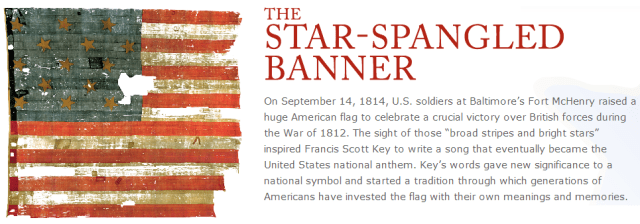
The governing people use their followers’ lack of knowledge, and the fears previously instilled through history and stories shared around the campfire, to inspire a sense of American pride and nationalism to keep a herd mentality alive. In moments of despair, new rituals are introduced. In 1893, it was the Pledge of Allegiance and standing for “The Star-Spangled Banner.”2 In 2001, it was the sight of the flag on every home, car, and person, and the start of TSA and phone tapping for the sake of the nation’s security. The United States even went as far as to spy on other nations, ones that are supposed to be their friends and allies — not how I treat my friends or believe they should be treated.

Humans are big on acting on their beliefs from fear, religion, and media. Josiah Strong, a published minister, believed that all social problems could be solved with God because whites were superior, Christians the only rightful missionaries, and the Anglo-Saxons were to wipe out or assimilate their inferiors for a worldwide game of survival of the fittest.1 Americans still assume this role today, of going to countries deemed less fortunate and trying to supply them with water or birth control or free enterprise. Some of these goals are honorary, but others are pointless when juxtaposed with the other countries religion, government, and historical beliefs. Those who want to change are told they can’t because women can’t drive in Saudi Arabia and men can’t be gay in Russia and those who don’t want to change are forced out of their businesses in Africa or into the streets in India.

Critics believed that “some races were destined to dominate over others”1 making it easier for the American public to believe in the inferiority of non-white people who were “ignorant, lazy, backward” and obviously in need of a Christ intervention to save them from “dreaming the years away.”4 These colored people were ‘incapable of self-government and economic development’ so America went in to improve these countries in such decay by pushing them onto reservations, forcing their sons into battle, and making them second-class citizens. Europeans saw non-whites as obstructing the possibilities for whites in improving their society with the raw materials and agricultural products available to the barbarians of the world if they would act more civilized. Today, Marines are taught about the extremists of the Middle East and not the Muslim’s inshallah, God-willing, lifestyle before they are sent into battle against a religion they know nothing about.12 No one goes above God.

Except for maybe a religious extremist group that chooses to walk beside their faith and reinterpret it dramatically to fit their own outlook. This process happens naturally, but what doesn’t help is when one group begins to assume that all people of the same skin tone, dress type, or religious scripture follow those same beliefs. These accusations can lead to violence and misunderstanding as people are kicked off planes and tackled outside of hospitals. These beliefs can cause unnecessary laws to be passed, even if temporary, and can destroy future business relations or children’s outlooks on their future as they are raised in hate, but can’t understand why.

The United States, though consisting of millions of people, sometimes has the personality of a macho man trying to prove his masculinity. America pretends to sit on the sidelines for only so long before giving all its resources towards a battle so that it can claim the all-powerful trophy. This behavior is seen in the treatment of the Caribbean, the Philippines, and WWI and II. We supply the enemy with weapons to defend themselves in their revolutions and when it’s not working at the American pace or in a way seen fit to civilized standards, America steps in to clear the battlefield to maintain hegemony of the Western Hemisphere and the globe which may seem useless and expensive to some, but which is just the almighty dollar diplomacy at work.

Assumptions make navies grow to stay alert, prep for war, and retain a presence where a threat is felt. This fear causes people to be on edge, be judgmental, and act out of accordance with the law and their religious beliefs. These are problems that only an empire should have — Ottoman, Russian, and British as they unjustly command a people they know nothing about from a land far away without any representation in government dealings. A democracy, which America sits on the edge of, shouldn’t be the parent setting the children straight with violence, but the parent of peaceful protests setting the example for how a fair government should deal with its citizens.

America jumps in to benefit itself, develop other countries, and to scare off foreign powers, but what about the immigrants living in the United States that feel threatened by the countries leaders and their beliefs? If America isn’t leading the way on bombing children and withholding funds till its goals are achieved which country will take its place to do the “practical, right, legally justified, and even necessary” things to keep the economy of the world in trillions of debt while its own people starve? Who will want to take on that burden of responsibility or will China or Germany focus on a different set of beliefs? Fears are meant to keep you safe, but ignorance is more dangerous than any falsehood.

*all images courtesy of Google

1. Foner, Eric. “17.” Voices of Freedom: A Documentary History. 4th ed. Vol. 2. New York: W.W. Norton, 2014. 66-72. Print.

2. Foner, Eric. “17.” Give Me Liberty!: An American History. 4th ed. Vol. 2. New York: W.W. Norton, 2014. 529-42. Print.

3. Foner, Eric. “19.” Give Me Liberty!: An American History. 4th ed. Vol. 2. New York: W.W. Norton, 2014. 575-80. Print.

4. Madaras, Larry, and James M. SoRelle. “Issue 7.” Taking Sides: Clashing Views in United States History. 12th ed. Vol. 2. Boston: McGraw-Hill Education Create, 2017. 157-80. Print.

5. “Jimi Hendrix.” PBS. Public Broadcasting Service, 22 Feb. 2016. Web. 06 May 2017. <http:// http://www.pbs.org/wnet/americanmasters/jimi-hendrix-jimi-hendrix-biography/2743/>.

6. Harbottle, Thomas Benfield. Dictionary of Quotations (classical), with Author and Subject Indexes. 3rd ed. N.p.: Swan Sonnenschein; Macmillan, 1906. 356. Print.

7. “Mark 12:31.” The Bible: King James Version. Glasgow: Collins, 2008. N. pag. Print.

8. Abate, Frank, and Elizabeth J. Jewell. “F.” The New Oxford American Dictionary. New York: Oxford UP, 2001. N. pag. Print.

9. Monroe, James. “Monroe Doctrine.” Welcome to OurDocuments.gov. Avalon Project at Yale Law School, n.d. Web. 06 May 2017.

10. Hubbard, Ben, and Michael R. Gordon. “U.S. War Footprint Grows in Middle East, With No Endgame in Sight.” The New York Times. The New York Times, 29 Mar. 2017. Web. 06 May 2017.

11. Council for Agricultural Science and Technology (CAST). 2013. Animal Feed vs. Human Food: Challenges and Opportunities in Sustaining Animal Agriculture Toward 2050. Issue Paper 53. CAST, Ames, Iowa.

12. Fuentes, Gidget. “UPDATED: Marines with 11th MEU Join the Ground Fight in Syria.” USNI News. U.S. Naval Institute, 09 Mar. 2017. Web. 06 May 2017.

Posted in Books, Education, Government, History, Media, Military, People | Tagged , , , , , , | 2 Comments

Why Wake Up?

main-qimg-711c1dbf7721acc3951ee877b04e59de

Do you ever wonder why you wake up; like what makes it so great and different from the day before it or the next day to come, or does it all feel like a routine in a gerbil maze — wake up at some given time, poo once a day to once a week, eat one to seven meals daily, sit in a cubicle of your mind (whether in an office, at home, or work space), find ways to get more exercise (pay for a gym membership, buy a dog, buy gym equipment), rinse, and repeat.

Some people thank others for giving them a reason to “rise and shine”, some thank the great creator, and others are just grateful when they get their flavor donut from the mix. Others have death, dismemberment, divorce, and depression to fill their day and yet they find a way to crawl out of bed to face another eight to sixteen hours of conscious time away from dreams that could be extraordinary, regardless if they’re remembered — kind of like sex with an ex.

piglet_gratitude_(1)

What is the motivating factor that drags people into social situations, painful processes, and anxiety attacks from stress at work, lectures from parents, and deadlines at school? What do we tell ourselves daily is worth it — the booze or chocolate, the new show or tenth rerun, the neighbor or the alley cat. What do we feel we owe the world with our existence? What separates us from those that lose this feeling, so much that they’re able to take their own life and sometimes the lives of others with them.

Suicidal people feel that their life is an endless tunnel into destruction and darkness, and that their heartbeat is a burden on society that would be better without them. They feel that no amount of activities that used to bring them happiness — finding cloud shapes, playing peek-a-boo, climbing a new mountain, finishing a book, learning a new technique, getting accepted into a program — no longer do. What can they do to bring this feeling back — with who, with what?

images1

Is there a certain formula for happiness, for success in life, for just existing and being ok with that? Nature is made to evolve and changes drastically, but what happens when people are too afraid to follow suit — and where did this fear come from? People seem to want to be the best — fastest, smartest, loudest — but they don’t all want to do what it takes to get there. We had competition built into our nature, and then we built around it to protect those too weak, too young or old, too poor to compete for the resources that would keep them alive.

People need a purpose, which is sadly why so many work at dead-end jobs, sometimes multiple ones, to feel needed, to feel that they are serving society and making a difference. What if we all went back to cooking our own food, making up our own workouts, and defending ourselves in a court situation? What if robots take on all these jobs more efficiently and leave but a limited few programming us into the future? How many kids, plants, pets, and hobbies will we need then to distract ourselves from our mundane existence.

Happiness-RS

I wish for the world to change, but mine would be too drastic to happen in one hundred years, and when often heard is thought to be a fantasy novel I read. People are caught on the wheel of the familiar and they don’t like to venture far from it, but I imagine a world in which we do — a place where all are free to explore the bounds of their brains. Would this mean more peace and harmony or would the world quickly fall into the hands of a powerful few that would try mass extinctions as shown in the past.

I would rather feel free to love, fight, learn, or perish than to watch an existence of people moping about from their shit pay jobs, to their lie-filled relationships, to their families in prison or the hospital to fund the starving kids in Africa while not giving them a long-term solution, while blowing up other nations for a biased political opinion instead of leaving them to figure it out (even if it does take centuries more), and all while our own children starve or over eat, feel abuse or neglect, and struggle to be creative.

love-autumn-tree_759_thinkstockphotos-177812216

Is the “system” the problem for repression or is that an individual fault? Everyone seems so driven in history to make change and to conquer, but now people are fine with minimum wage and cable television. Would uncontrolled anarchy or freedom of expression come to pass if we were to get rid of some of the systems in place?

Posted in Media | Tagged , , , , , | Leave a comment

Jared Jacobsen at Spreckels

20170416_150104.jpg

I went to the Spreckels Organ Pavilion in Balboa Park, home to the largest outdoor organ consisting of over 5,000 pipes, some 32 feet long and comprising 80 ranks. This organ was donated from the Spreckels brothers in 1915 for the Panama-California Expo after being built in Connecticut. I attended on Easter Sunday and was attracted to the warm-up as were passersby. Jared Jacobson, a former Civic Organist from 1978 to 1985 playing weekly concerts, has returned for his 358th opportunity to play this grand organ.

The audience gets a new perspective when the stage door rises. The stage is small in comparison to the space needed for the pipes in the 75-foot tall pavilion. There are trees surrounding the seating courtyard and some clouds just above them. I’m sat under the shaded awning overlooking the 2,500 seats on simple metal benches, arranged in five columns and 27 rows. Above me are a bunch of small incandescent bulbs, over 1,600 total, that are used at night to bring a different ambience to this wonderful place.

cropped-sunsetcombo2j2r1000

photo credit – spreckelsorgan.org

There are 250 people sat around me, and for those willing to part with $2, are sitting with a bright rainbow umbrella to protect them from the sun during the show. Two potted white-flowered plants are placed on the organ’s sides once it’s rolled out closer to the audience, near the California and American flags on stage. This pavilion is surrounded by pedestrian-heavy areas and a large parking lot that is full when I walk through. It’s surprisingly quiet and peaceful minus the three airplanes that fly over. The church bells sound on the hour and the architecture brings the place together.

Jared, in his blue jacket and khaki slacks, is accompanied on stage by his page turner dressed in a black suit and standing sideways to the audience, helping to smooth transitions. Jared sounds happy to be here and to share this moment with us. He shares the emotions of the piece and some of its history before playing each one. I’m taken aback by the simplicity of the wood and the amount of keys and pedals that I can see from a distance. I am even more impressed once Jared’s fingers begin to move with profound precision.

20170416_110339.jpg

The first verse of “America” (My Country, ’Tis of Thee) by Rev. Samuel Smith, a warm and happy song, is played before Dale Sorenson, the curator, gives the audience a welcoming introduction. The first song is Toccata from Organ Symphonie V and is said to be the most famous organ piece. It starts with a fast dancing-flute tempo and leads into deep baritone ‘toe dips’. The sound takes on the tone of a piano and then simulates the strings walking up stairs before a light solo is performed. Next, is a ballerina in fast forward as the sounds mix richly and play together. I begin to feel anticipation just as the piece comes to a long, clean finish.

Choral—Improvisation on “Victimae Paschali” was made up as the piece was made by Tournemire and is a mix of “love tappy, party hard, and exotic chords”. It starts out with a retro haunted house mix, fast tempo but long notes, and then wobbles together before going back to more separate tones that are very individual but smooth and grow in volume and depth. The piece begins to resemble a spritely horn with a bass combo and with a silent beat that makes me think of reminiscing and the goodbye at the end of a movie. There’s a crescendo, then a trumpet interruption before the instruments ‘fall down the stairs’ and help each other back up to run till they arrive to a gate.

America-Light_1200x1200

photo credit – Whimzical Woods Barn

Night by Cyril Jenkins is introduced as a shimmering landscape piece with the magic of instruments not tuned together but still playing in harmony. It starts out slow and warm and lightly picks up before going back to the beginning with a higher pitch. In comes the whispering French horn and trombone with a bit of whimsy, long overtone with little notes underneath. It goes back to the light pick up before alternating between light and dark, like testing a chord, and then completing it.

Bach, always a favorite composer, will have his Orchestral Suite III in D Major performed with weightlessness, and a skipping and weaving of the notes. The Air movement sounds like success and graduation on a sunny day. Birds whistled as the piece went to a peaceful march with twirling accompaniment, and a woman beside me referenced A Whiter Shade of Pale by Procol Harum (which upon checking YouTube seems to be a common theme). The piece wants more, bit by bit, advancing slowly to the longest note before the Gavotte movement is played. It sounds like skipping through trees and light stepping with heavy feet. The woodwinds are less dramatic before the ‘space gadget’ of twinkling electronics plays peekaboo with the end.

5957

photo credit – Sternberg Clarke

“Go Down, Moses,” we are told, is an African-American spiritual based on deliverance from the oppression of slavery as the Jews were when they traveled through the Red Sea. The piece sounds like big open arms with a grand church welcome. The choir is questioning with long resounding notes that reverberate and it’s over too soon.

“The Lost Chord,” the highlight of the program, was written while Sullivan was weary and ill at ease but finished with the sound of an amen. The notes go up and down and have a grainy vibration. The notes are wandering and the composer is trying to pick an instrument. The symphony is good but they are practicing chords out of harmony. The final note brings peace.

star-spangled-banner-story

photo credit – Know-It-All

Bolero, a love or hate piece, has a crescendo from beginning to end. It sounds like waltzing in love with an angry interruption, like a sharp curve in a meandering river. There are short abrupt notes like a sing-along and the piece becomes celebratory, holiday festive, and very joyous. There’s another interruption but this one is of a loud uncle or carnival, which fits the merry-go-round to a spin of a finish.

The last piece got the loudest applause. There wasn’t time to play Dieu Parmi as it’s tradition to play The Star-Spangled Banner after each concert. The song was smooth, but not as emotionally evoking for me without a talented voice. Parts of the audience were singing along. Jared finished with applause and a bow. There was a lot of crowd movement during Night, misplaced applause during Bach, and the wind picked up during “Go Down, Moses.” Jared tells us events like this fulfill the vision of the Spreckels brothers of ‘a good day in a park’ and invites us to: come again, donate to the Spreckels Organ Society, and buy souvenirs from the gift shop. The audience is invited on stage to see the organ and ask questions.

Orchestre-Symphonique-small (1)

photo credit – Monsieur Valancony

There was plenty of photo taking pre- and post-show, but most of the audience was respectful during to keep their hands and voices to themselves and let people enjoy the music. I think someone saw the importance of introducing kids to classical music without the possibility of them interrupting a paid show in an enclosed theatre. It also gives tourists, new locals, and those otherwise unaware a taste of the art this city has to offer. I will be going back next week for the Earth Fair. I enjoy events I can attend without having to pre-plan, free or not.

It’s important for everyone to be introduced to as many new things as possible to inspire ideas and to collaborate with what they already know or are influenced by. Indoor concerts leave the audience with applause, low light, and music, but I love the outdoors and would prefer the minor distractions in a beautiful afternoon to a dark room in the middle of the day. I’m grateful for the free opportunity to listen to such grand, historical, popular, and memorable music from excellent composers and the people lucky enough to read their music and play it so properly and respectfully.

Posted in Education, Entertainment, Events, History, Music, People | Tagged , , , , | Leave a comment