As Requested… a one-month update

freeze-dried: grapes, kiwi, avocado, onion, carrot

I’ve been keeping some notes on the process, but I feel like there is so much I’m leaving out, not on purpose but because I get into the ’empty trays, clean them, buy more food for them, wash them, reload them’ zone along with continuing to keep the house clean and fridge stocked with food for us to eat now.

We plan on hiking the PCT, the Pacific Crest Trail, which runs between Mexico and Canada through 2,500 miles of California, Oregon, and Washington. It can also be done going south, but we’ve chosen to go north for reasons Caleb can share with me later, as he has done a majority of the pre-trip planning to account for weather and us avoiding crampons. We will find out at the end of this month when we can start next spring.

As of today, we’ve had a freeze dryer (FD) since September 19th, so almost five weeks and I have learned a lot, but I am finding out I still have more information to gain, such as oxygen absorbers come in different cc’s of capability. I will be ordering more now that we are out of the 50 little packets that came with our 209-pound package (shipping weight), which we carried half of up a flight of stairs.

Our first few loads were simple fruits and veggies to learn how to load the trays and how long the process takes, averaging about 24 hours for simple items. We’re lucky that the FD comes with a book, and Caleb’s mom has had one for some time, so we had some guidance. You can not over-dry the food, so it’s best to choose extra dry time instead of bagging wet food or keeping it around for your friends to try (good for them, but it doesn’t help us on the trail).

freeze-dried: tomato/carrot, mixed veg, quartered biscuits

I started out spacing the fruits and veggies with room for the Holy Spirit until I realized that you can pack meals on the tray (which will take more time in the FD), but some things will spread out or be sticky. Having the lids (ordered with silicone mats for less sticking and loss of food powder) with their “spacing ridges” makes it easier to portion meals, and then I put apples and protein brownie bites (and other snacks) on the trays because I can portion them out.

Freeze-dried foods are better nutritionally than dehydrated foods, which is why we went this route. We debated spending $8 to $11 per breakfast so that 150 meals each would cost roughly $1,200 to $1,650 (around 3k for both of us), and then we still need lunch/snacks, dinner, and desserts occasionally. This could easily bring our food cost to $7,200 to $9,900 just for meals and without drinks, which will consist of cocoa and coffee powders added to water.

Hikers don’t have to be rich to set out on long distances, and we will be doing this on a military retirement check, but we don’t want to live off Pop-Tarts and Ramen for over four months (apparently, we’ll be too old for that nonsense). I also don’t want to get stuck eating beef stroganoff because it was the only meal available in a trail store or hiker box.

Some hikers need to repackage food that they buy in town. We are packaging our own (with a balance of carbs, protein, and fats found in similar meals), so we need fewer boxes mailed to resupply stations (trail stores and local post offices) and can carry more food in a smaller space.

going in: cherries, raspberries, bell peppers, apples

Packaging our own food gives us more diversity in vegetables, flavors, and recipes (we’re hoping to have some friends help with this). It is surprising how many things can be freeze-dried, minus peanut butter by itself and other items that are too oily and will remain too moist for long-term storage. If properly done, these foods should last up to 30 years, but we only need them to survive for up to a year.

It will take about a month to make all the breakfasts, mostly granola and egg scramble, before we make the dinners. Our FD is on the floor, so it’s not the best for draining, but it’s also no issue when we were woken at 3 am to unload the trays and leave the FD to thaw with the door open. The other option is to heat the trays for two hours so that the thick ring of ice has an increased melt capacity. I’d say that after 30 minutes, you can break the seal with a butter knife (a guy posted a video using needle nose pliers).

The FD is too imposing on our counter, so it could drain into the sink, even though this is the most counter space we’ve had in the States. I prefer to use that space for loading trays, making coffee, keeping tea, and, if I’m lucky, a batch of homemade biscuits before I finish them within 24 hours.

I got woken again, this time at 4 am, with the FD beeping, and it can take up to an hour to measure the bag rolls (pre-cut sizes are awesome!) to the estimated size needed, seal one end, load them with food, add an oxygen absorber packet (while keeping them from sucking in all the oxygen in the kitchen), and vacuum seal them with a 15 seconds timer each (unless I have to re-flatten the bag end to get a better seal).

cooked breakfast scramble and fresh chickpea salad with apples

I do this for 12-15 meals and then either leave the trays by the sink (to get a nap) or wash them and set them to dry to reload as soon as all moisture has been removed from FD; otherwise, the oil pump will smoke aka puff oil vapors into the room (not so bad when the temperature and humidity allow for an open door to vent the space).

The rubber ring around the FD door (to aid in making a vacuum) will drip condensation, so we have a tea towel underneath. I was told the company Harvest Right used to sell something for that, but we just use the drain pan to catch ice pieces when we pull the chunks out. The ring has to come off, the tray rack comes out (so it can be wiped down if needed), and the interior chamber can be squeegee’d and wiped. I use a microfiber towel, so I don’t let tiny fibers get stuck in food or ice.

Our FD kit came with an impulse sealer, which provides an electrical pulse to seal poly and foil bags with candy or small tools and components. Hair ties and paint brushes don’t have the same shelf-life concern as our food. Other FD users (the videos I’ve watched) are also using jars (there’s an adapter) for long-term storage in their basement (heat can spoil things) or making tons of sweets to sell out at the farmer’s market/street fair/next vending opportunity.

For this reason, we bought a vacuum sealer and saved over $150 by not ordering the orange-button option. I was taking pictures of each load, but it’s difficult to get all five in the photo at a decent angle, so I won’t be posting all of them (but we all knew that). I need to come up with a new way to track how many batches are done so I can replace the vacuum pump oil every 20 to 30 uses for proper maintenance.

Posted in Camping, Family, Food, Hiking | Tagged , , , , , , , | 1 Comment

In Florida for 4.5 or 5.75 Months

I wrote about our 2023 December trip to the Tampa area. We came back for nine days in March to find a place to live within a one-hour commute from Caleb’s transitional position into the civilian sector at Cummins Inc. We were supposed to move into our new place on April 12th, but the carpet had to be replaced, which took the weekend. We were able to stay at a friend’s place and got a discount on the rent. Then, the moving company we hired showed up two hours late, after we’d moved half the 16-ft truck up a flight of stairs, and still demanded to be paid in full.

Caleb unpacks boxes and puts their contents in cabinets… some things are still missing. We keep busy with spring fests, local parks, clubhouse events, making new friends, and going diving. Caleb had to take two months off work (from the Navy) before starting his new job. We had to go somewhere… that’s where Ireland comes in for ten days in May. We explore museum deals, live music venues, and visit a long-time friend before we go to San Diego for a week in June. We leave directly from the hotel to drive up to Washington, where we will join Caleb’s Uncle Ed on a cross-country trip.

We will visit 25 states in two weeks, which was enough time to stay a night at Jessi’s (Caleb’s sister) in Montana, visit his mom, Terri, at work, stay a night at Kris’s (Caleb’s brother) in Wisconsin, and a half day at Niagara Falls with Ed’s old friend Mark. Maine would mark the goal of this trip, and then we skipped more stops the closer we got to our new place so we could rest over the holiday weekend. Caleb started work on Monday morning before I got out of bed (before the sun did too!) He agreed to work four days at ten hours each for four months.

August and September are spent with friends — in their pool, at the park, at restaurants, paddle boarding, celebrating my birthday, and at a women’s expo. We go diving, donate blood, replace the mirror motor on the car, shop for some necessary trail supplies, and buy a freeze-dryer (so we can make our meals for the PCT we’re planning to hike in 2025). My friend, Farid, came to visit from New York City for five days, and we spent them cooking and beaching it up when we weren’t in the hot tub. The tide wasn’t always in our favor, but it was a great time. Though I love my alone time, I also enjoy house guests.

Now, we’re in October, and I just received my first emergency evacuation. I didn’t heed the order to leave. I filled up camelbacks as a water supply, and Caleb grabbed our highlighter suits from the garage so we could walk around for live storm updates. The water in the pond went up, we went to bed after 10pm with high winds and blue lightning, and woke to a beautiful morning — no traffic stress, no worry about gas, no getting in the way of those who needed to get out because their homes were already damaged less than two weeks ago. People outside the state were more concerned for my safety, and I’m grateful for their consideration in this situation.

Posted in Family, Food, Friends, Hiking, Places, Plants, Travel, Water | Tagged , , , , , , , , | Leave a comment

Immersion and Preservation

Thanks to I Love the Burg for sharing things to eat and places to visit in St. Petersburg. I came across a free entry day (otherwise $48 for us) for FloridaRAMA: Immersive Art Experience from 12 to 5 pm, with the help of a sponsor. They feature over 75 local and international artists celebrating Florida. We definitely didn’t spend five hours there, and initially I was glad we got in for free, but I understand that making and transporting art comes at a cost, even if I didn’t come prepared to take multiple selfies with each installation.

I’m not done taking pictures, though. We will drive the few miles to Boyd Hill Nature Preserve and pay the $3 each to walk along their six miles of trails through hardwood hammocks, freshwater swamps, and upland scrub. They have boardwalks and birds, and baby alligators near the water’s edge. We see a raccoon and a gopher tortoise along with a larger-than-life metallic armadillo. Being in nature is always a great way to spend the day and I’m glad that I feel more relaxed around trees than I do in a giant shrimp cocktail disco room.

Posted in Animals, Art, Hiking, Photography, Plants, Water | Tagged , , , , | Leave a comment

Celtic Tiger

Ireland’s economy boomed between 1995 and 2007, growing at over 9% each year. This drew the attention of a reporter, as Ireland had previously been one of Europe’s poorest countries. The title, Celtic Tiger, was referring to the Four Asian Tigers (Hong Kong, Singapore, South Korea, and Taiwan), but soon, the nickname caught on and is still used occasionally as the island’s economy is still doing well.

We left the house before 6 am, dropped off the rental car (which was faster and easier than picking it up), and grabbed the shuttle back to the airport. We had to wait twice for separate pairs of glass doors to be unlocked from the other side once the crew got the ok. While we waited, we met two other couples (one reminding me of Grumpy Old Men, but in love) who also drove (one from Michigan or Minnesota and the other couple from the Tri-state area).

Once seated, the couple behind us is from Tampa. The passengers are brought snacks, drinks, and a meal (all the food being white/tan in color) in quick succession so that many can sleep through the flight. I will use this time to try the Tayto (The Original Irish crisp) salt & vinegar chips and Keogh’s (Grown with love in Ireland) shamrock and sour cream chips, which are yummy!

I was still up reading about Sue on the Appalachian Trail with two hours of flight time to go, so I went to the back to get another drink and snack. The crew brings around ‘sandwiches’ (pita pizza pocket) an hour later. We’re deplaning, and I get the opportunity to see a man with a metal ball for an eye. If I had more time, I perhaps would’ve asked him questions that others deemed inappropriate.

We land in New Jersey, and I eat a salad (mostly a post about food consumed over international waters rather than anything to do with Ireland), and on the next flight, I see a woman sneaking Cheez-Its under her sweater with her sunglasses on. If I get the chance to return to Ireland, I would want to see the northern half and then come back for a lighthouse tour.

I debated posting this, as there’s not much here, but I wanted to complete the ten nicknames for Ireland and mention the crisps, of which there are so many flavors available online. The flights were about half the cost of this trip, and we have a road trip planned for next month as we enjoy the last few months of Caleb being on active duty with a consistent paycheck every two weeks.

Growing up, I always wished to get away. I found someone I could staycation or escape with and who would help fund my long periods of unemployment. I have worked roughly eight years in the last 21 and some of that time was unpaid. Once Caleb retires, I still hope to get an annual cancellation in our passports, and I know that may require some earnings on my part.

Posted in Food, Marriage, Media, People, Travel | Tagged , , , | Leave a comment

Inis Fáil Is Our Fate

This nickname, Inis Fáil, means the Island of Destiny. The Tuatha Dé Danann race brought this stone, Lia Fáil, to Ireland, and it’s been used as a coronation stone in the belief of its mythical powers and ability to make noise when a king sits upon it. Legend has it that this is one of the twelve zodiac crystals the Atlantean mages used to amplify the Earth’s energy. It is one of the four treasures (stone, sword, spear, and cauldron) that the Tuatha Dé Danann brought with them and the only one that remains standing on the Hill of Tara.

Dún Na Sí Amenity & Heritage Park

An Irish warrior and demigod, Cú Chulainn, tried to angrily split the stone. He died in 1 AD, and the last king the stone declared was Brian Boru in 1002, credited with ending the Viking invasions of Ireland. The stone has been silent since. All old Irish roads lead to this site where palaces once stood, and now only earthworks endure the patter of boots and hooves. The oldest visible monument, the Mound of the Hostages, built around 3000 BC, was used for 1,500 years to bury human remains. This site is an important connection point between two worlds that maintains its significance today.

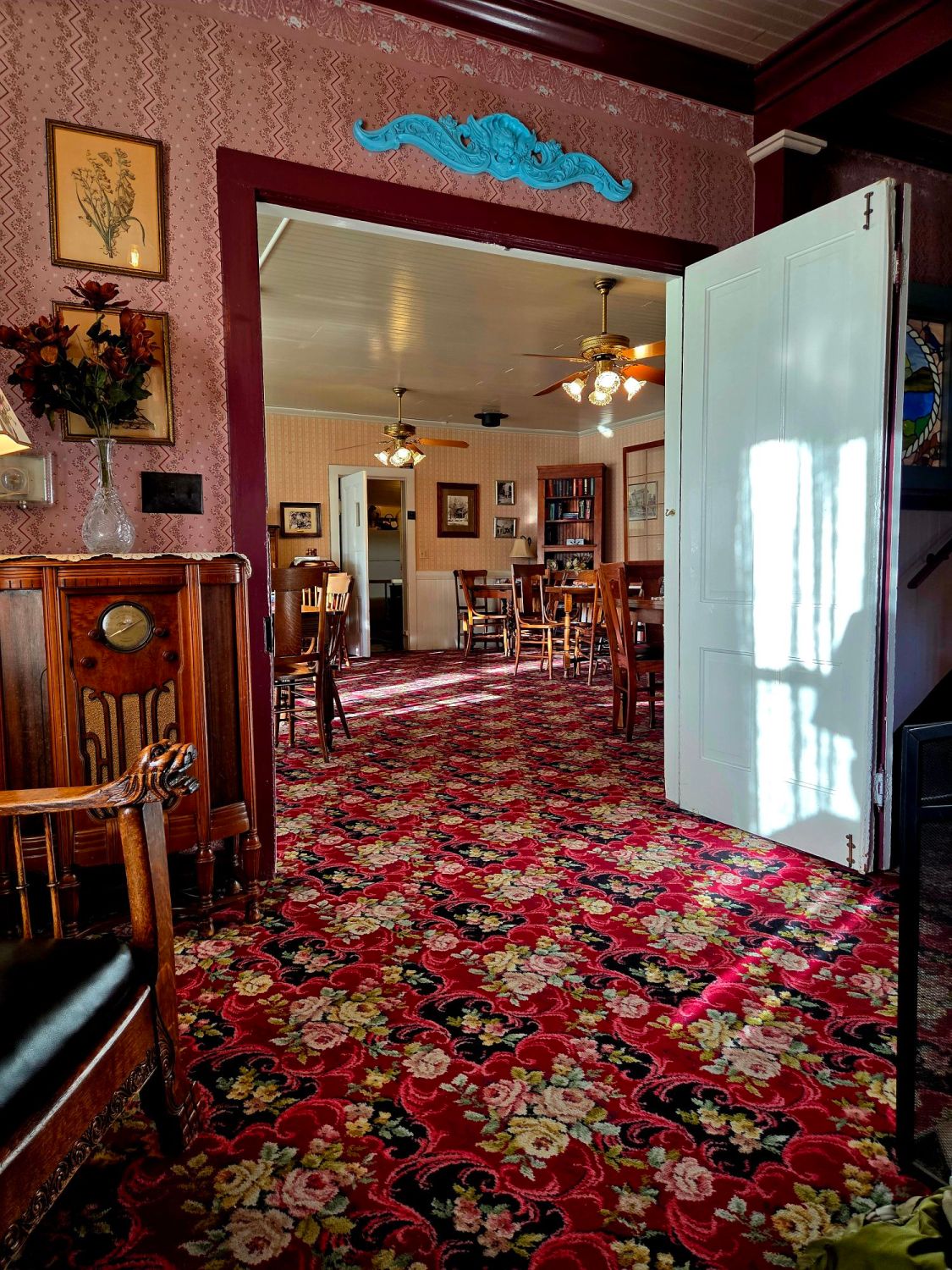
We leave Riverview House B&B an hour after sunrise while the sky is bright gray and the bushes a gallimaufry of color. There’s no one in the lounge with two tables, a dining set for four, hotel kitchen amenities with a toaster, and a fireplace next to the bookshelf, with authors Charlotte Bingham and Kingsley Amis among the collection. Our first stop is the success of a road sign that draws our attention to Dún Na Sí Amenity & Heritage Park, even though it’s closed. We park in front of the locked entrance and walk along the sculpture garden, peeking in at a man walking his dog.

It’s at least an hour before we pass the mural of a scene from Gulliver’s Travels on the side of a building that used to have large serving windows. Instead of selling fresh cow’s milk, it appears to be more fitting as a sheep shelter. We’ll see more of Meghann Quinn’s art as we enter the town of Trim. We stopped at Coffee Works Trim for breakfast, which only opened a year ago, and in three days will be giving out 50 free coffees to celebrate. We pass a few uniformed kids on their way to school while we walk towards Trim Castle, the one used in the filming of Braveheart in 1994 that served as the Tower of London inside and the city of York outside.

Mel Gibson was granted the Freedom of Trim in 2010, an honorary position since 1877, in recognition of his service to the town and part of a traditional system. In the 12th to 19th centuries, this gave honorees the right to participate in political and economic life as a full citizen. The year 2010 was also the beginning of the Braveheart 5k, organized by the Trim Athletic Club along the River Boyne. This race also takes place in Sarasota, FL (kilt encouraged), Radford, VA (for American Heart Assc.), Sherman, TX (as part of their Celtic fest), and in Franklin, NC (to honor the film Rob Roy also released in 1995).

Newtown Abbey

The castle, started by Hugh de Lacy in 1173, is the largest and best-preserved Anglo-Norman castle in Ireland, mostly unchanged since the 13th century. It’s closed as we walk by, so we continue to the River Gate (added so boats could avoid the weirs) and the Barbican Gate (an elaborate system to improve security) that guard the castle. Trim was originally a walled town, and only the Sheep Gate survives from the original five that were used as toll and tax stations as people went through. We pass by the Trim Donkey Family animal park, just a few asses spending their time in a corner meadow lot.

River Boyne, as seen from Ireland’s oldest bridge

We cross the River Boyne and follow it east to the Newtown Abbey, also known as the Cathedral of St. Peter and Paul. The church was established in 1206 by Simon Rochfort and suppressed in the Dissolution of the Monasteries in 1537 by King Henry VIII. Here, the tomb effigies of the Jealous Man and Woman lie, with a sword of state (God-given protection) between Lucas Dillon and his first wife. Over 400 years later, people are still being interred at this site by a field of Kerry Hill sheep that originated in Wales near Newtown. They are raised for meat, but I would collect them for my love of black and white animals.

Cathedral Church of St. Patrick, Trim

Back towards the water, we see a sculpture depicting the Salmon of Knowledge, a fish who ate hazelnuts falling into the Well of Wisdom. He was eaten by a boy who grew up to become the leader of the Fianna, a group of hunters and warriors in the Iron Age and early Middle Ages. This myth is similar to those found in Iceland, Scandinavia, Baltic countries, and across Central and Eastern Europe. The Germanic version replaces the salmon with a serpent, and this special creature is depicted in ruins all over the planet. The myth’s most modern rendition is in a song by Gilla Band released in 2019.

Bective Abbey

Another few feet west brings us to Ireland’s oldest bridge, unaltered and in use since 1393, over 630 years and counting. The average age of bridges in the US is 42, with a lifespan design of 50 years. It’s double that in the UK, though weather and vehicle weight can reduce that time. I’m more impressed with this bridge than I imagined I would be. Millions of people have ensured its success through the centuries, which is rare unless the structure happens to be a temple, mosque, church (the oldest being the Pantheon built in 125 AD), or Acoma Pueblo in New Mexico still inhabited since around 1100 AD.

Hill of Tara

The Cathedral Church of St. Patrick, with its grand exterior and locked but gorgeous interior, will be our last stop in Trim. We visit Bective Abbey, the second Cistercian abbey of Ireland, which became an important monastic settlement after its founding in 1147. Most of what’s left today dates back to the 15th century and was sold to the state in 2012. The site includes a 13th-century church, a 15th-century cloister, and a 16th-century tower. Many historical places have either been added to or built upon (perhaps unknowingly or in a show of power) to maintain the enchantment of the location and preserve the traditions.

In 1386, men of Irish birth were barred from entry, and in 1536, this abbey was dissolved, too. It was converted into a mansion with fireplaces and large stone windows by Andrew Wyse after he purchased the church in 1552. I’m not sure of the Wyse to Wise relationship as my family tree is lacking apples before the birth of my third great-grandfather in 1839. Today, a few people choose to pose, some obnoxiously so, among the walls and windows of this ancient abbey. I wonder what brings the other visitors to this place other than to see beautiful ruins in a field, as there’s not a big car lot, but there’s a sauna and hot tub with a view less than a quarter mile up the road.

If only Caleb had been wearing a robe and carrying his Kindle, he would blend into the surroundings, and we could spend the afternoon reading and sipping imaginary tea. I love books and documentaries about traveling, real and imagined, and their ability to transport me. When getting the chance to explore, it’s watching the places I go come to life historically, in the present, and futuristically. It’s such an explosion that the experience can be overwhelming, not only of how small I am in the totality of things but just how little my existence is in all of time, ever.

Boyne Ramparts Heritage Walk

We make it to the Hill of Tara, an internationally important site, with a few rules — no camping, no fires, and dogs on leads please. The fire and tent poles could damage sensitive archaeological material. We find street parking behind a line of cars. At first sight, it’s just a field, a very green and lumpy one. Upon further investigation, the site begins to take shape. We peek inside the Mound of the Hostages and see the marker from the Battle of 1798, commemorated with a mass grave marker of the 400 rebels who died after having chosen this location for its symbolism of ancient sovereignty.

Between the church (visitor center) and the hill, on a fence, is a sign that warns of the damage being caused by bicycles, team training, climbing on the monuments, and walking in wet and mucky areas. The church is simple on the outside, and it’s the large stained glass window and other small details of stone, wood, and tapestry that catch my eye while exploring the sanctuary. This is just one of Ireland’s six royal sites associated with myths and the transformation of Ireland from paganism to Christianity. The shop next door has Celtic and goddess vibes, a cute children’s sweater that I didn’t fit in (so we got matching Aran styles in different colors that fit), and sampled some turtle juice (Caleb’s drink) in a planet-friendly bottle to go with his tuna and sweet corn sandwich.

Hill of Slane

Ollie, the otter, welcomes us to Boyne Ramparts Heritage Walk. Sadly, we won’t see a live one as they have become rare in Ireland and extinct in much of Europe and are more likely to be spotted around dawn or dusk. This towpath, between a river and canal, runs from Stackallen Bridge to a place too far away to see today. We are promised heritage, beauty, and ruins and are met with cascades, birds, and stinging nettle (respectively, of course).

Besides having roommates with kids and having to look after them sometimes, this experience will be the closest we come to the perseverance required of some parents to keep going even though we’re physically exhausted. Each rest in the car to wipe our blistered noses and cover more countryside gives us just enough energy to even contemplate getting out at the next spot on the list. For us, this would be the Hill of Slane. It’s here, on Easter Saturday in the year 433, that St. Patrick lit a bonfire in protest of King Laoghaire’s pagan festival (bonfire ban) on the Hill of Tara.

The king didn’t convert to Christianity but allowed St. Patrick to preach. Over eleven centuries later, King Henry VIII dissolved a monastery built just 30 years ago and granted the land to Sir Fleming for an annual rent of just one penny. We’re here to see the remnants of Slane Abbey. We park at the bottom of the hill and follow the wide-mowed path to the beautiful stone ruins that now provide a home for ivy-leaved toadflax, a purple-flowered trailing plant native to rocky habitats. We enjoy the weathered walls, worn windows, distant views, and cherished cemetery.

We zigzagged our way, mostly east, through County Meath and now begin our route south for our return to Dublin for our flight tomorrow morning. Balrath Woods, another chance to bask in Ireland’s emerald-ness, is the fifty remaining acres of a once larger estate of mixed broadleaf woodland that was mostly replanted in 1969. This park is part of the NeighbourWood Scheme to plant and develop areas for public access that can be used as outdoor classrooms to learn about different species of plants and animals, various habitats created in woodland, and the importance of proper management.

These woods are home to birds, butterflies, and bunnies, but my favorite feature here is the beguiling beech with an expressive root structure and bright green expansive canopy. Between the Balrath Woods and the Wonderful Barn sits Emerald Park, Ireland’s only theme park (around the Irish potato crisp brand Tayto) and zoo. The park was renamed when the partnership deal ended, but the mascot remains. The park has the island’s only wooden roller coaster, and though they have great rates, about $45 per person, we are not stopping until we get to the corkscrew-shaped grain store.

Balrath Woods

The Barn was built in 1743 with 94 steps of cut limestone to reach the top. Follies are towers or mock ruins built by the wealthy for decorative purposes and to employ the locals during times of famine. This Barn has been referred to as a folly in many books but actually serves a practical purpose while also being a more pleasing addition to the landscape. This 73-foot-high structure was built to avoid a repetition of the flour scarcity that led to hoarding, price gouging, and theft. It consists of five vaulted chambers inside walls over two feet thick and protected from rain by slates on the exterior.

Two dovecotes, for pigeons, were built so the birds could feed off the spilled grain and then become meat (squab) for winter, preferring the birds before they grew their flight wings. The Kildare County Council has been responsible for the site since 2005 and has mended the brick and stone masonry and made extensive roof repairs to the wings. The Barn was placed on the World Monuments List of 100 Most Endangered Monuments in 2006. I see more rabbits here than I have all day. We are nearing the close of our check-in window for Angel’s home on the outskirts of Dublin, with a mostly highway route to the airport.

The Wonderful Barn

I knock on the door upon arrival, and after a few minutes, I knock again. There are cars in the driveway, but no one is around. I call the number listed, and for a moment, the guy who answers seems confused until he realizes I’m a house guest for the night. I’m not sure if it was his daughter from next door who let us in, but she gave us a tour and a heads-up about the long-term renter staying upstairs. It was a good thing she wasn’t home yet, as the front door was tricky to close, and she was able to show us how to keep it that way.

We get back in the car for dinner and drive to The Halfway House. After looking at maps, asking the internet, and searching through photos, I still had no idea where we had dined. The picture time gap led me to believe that we had walked, but no such place fit the description: cozy bar seat with sunlight coming through the stained-glass skylight, making the wooden bar and floor shine (it could also be overhead lighting). There’s a wooden dog statue, a heavy curtain, and some bench seating. They serve club sandwiches and had a buffet around the corner that we weren’t interested in.

I asked Caleb, and he suggested a place outside of walking range, so I went to the credit card statements to confirm. The customer service agent wasn’t able to give me the restaurant’s name for Caleb’s protection, but he did let me know that even though our card number changed recently, I’m still able to pull up two years’ worth of statements (my first attempt only found the recent three months) and there I found our last dinner in Ireland — The Halfway House. I’m not sure why we went there instead of walking to Hartstown House (a double H logo instead of one), but it was nice to have salt and vinegar chips (fries).

I had asked the tenant about a recycling center, but she thought they were too far away. We found one within ten minutes of walking distance and got back €0.50 for our efforts after dinner. Back at the house, we started to wind down as the evening seemed to just be getting started in the backyard. Had I been a day younger and 98% less sick and exhausted, I might have invited myself to the hooley (noisy party) and learned another thing about the local culture. As it was, we read for a bit with the window open and went to sleep by their second or third beer.

Posted in Animals, Art, Food, History, Media, Plants, Travel, Water | Tagged , , , , , , , , , , | Leave a comment