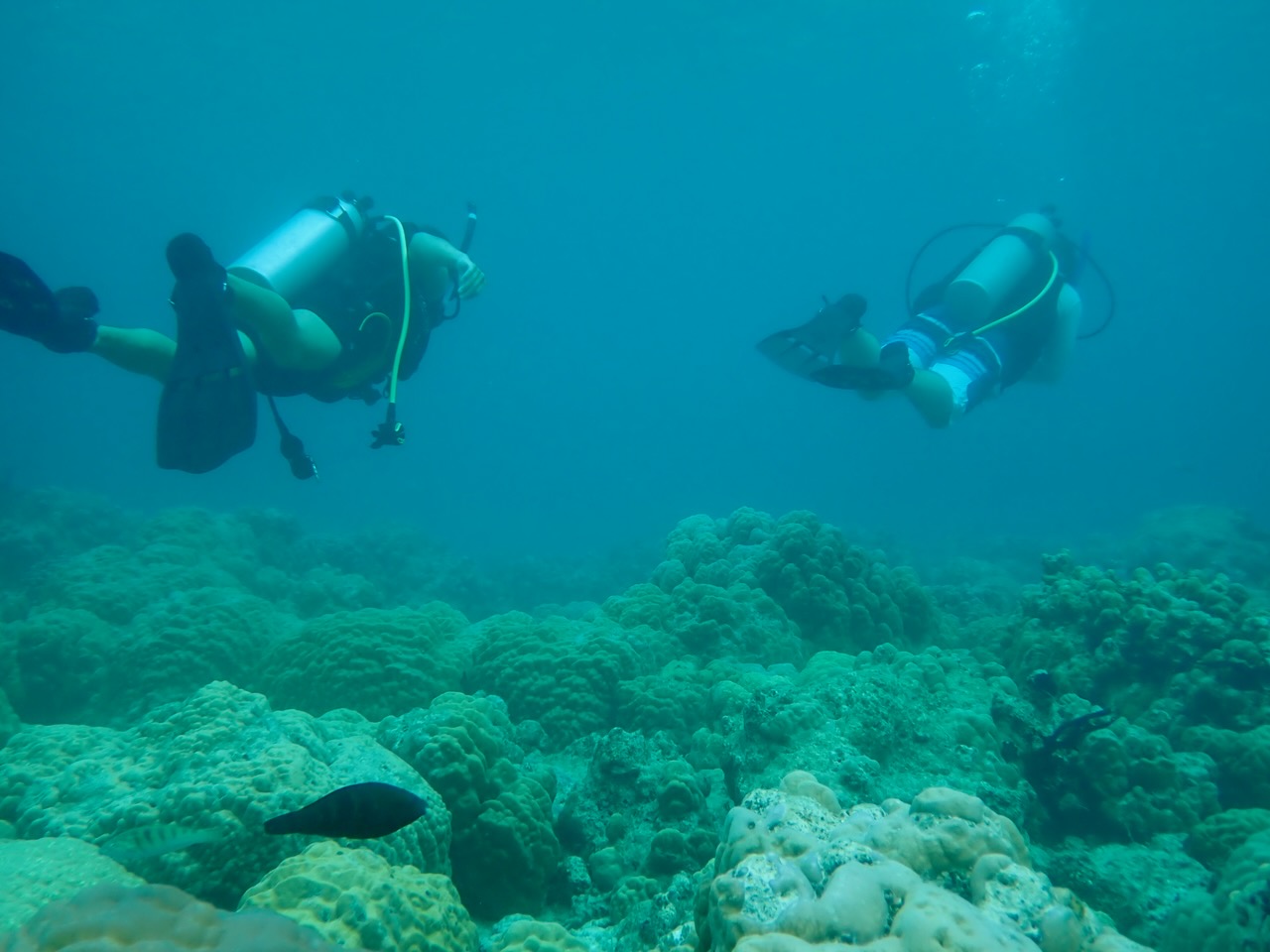
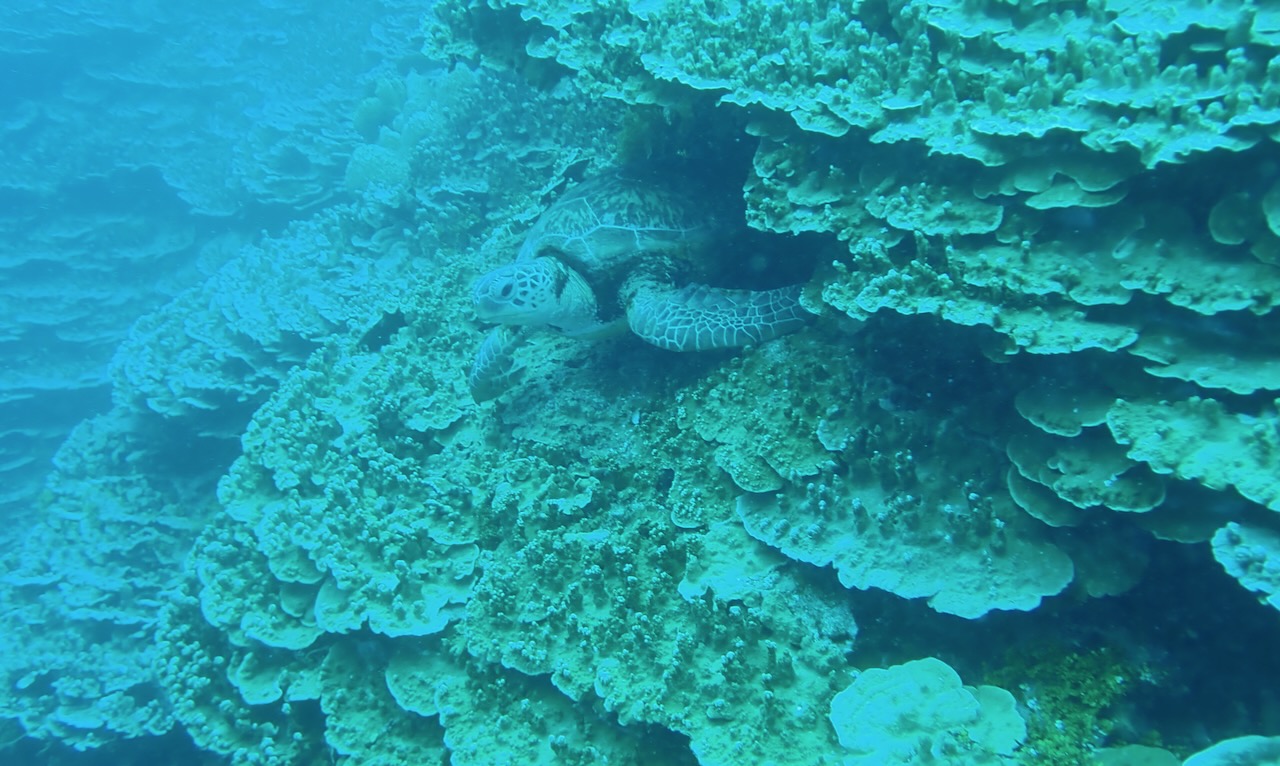
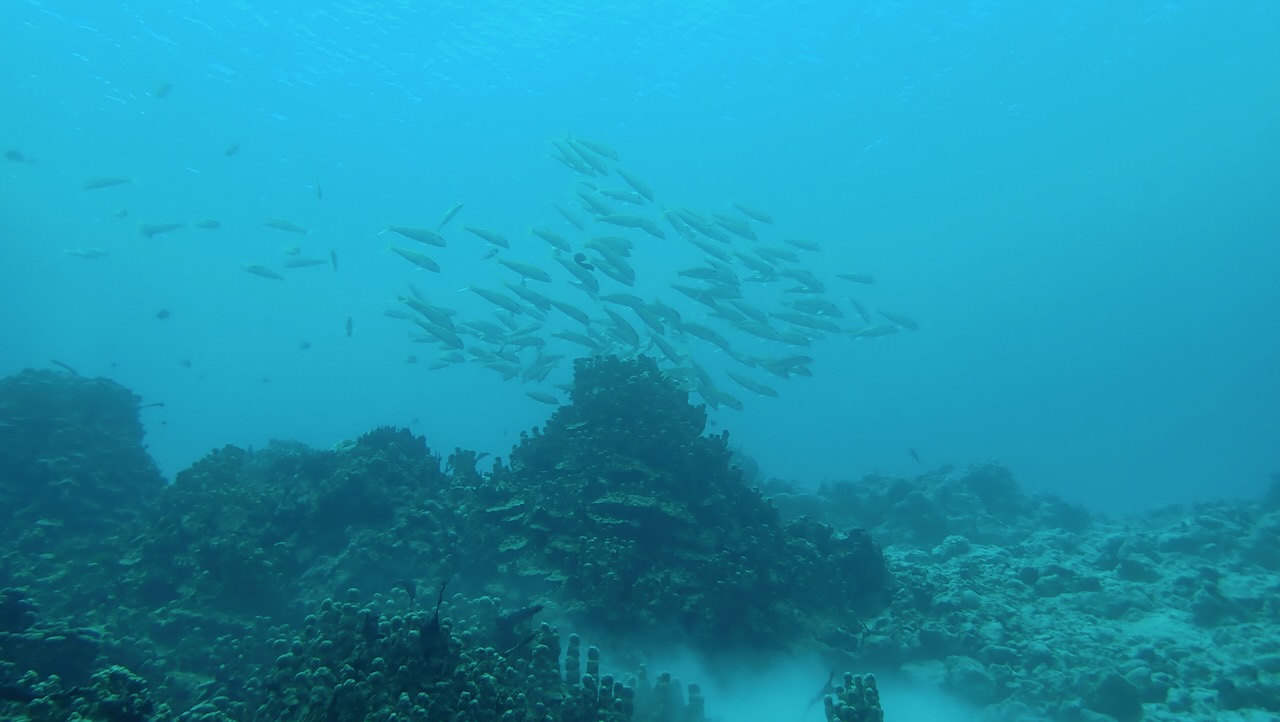
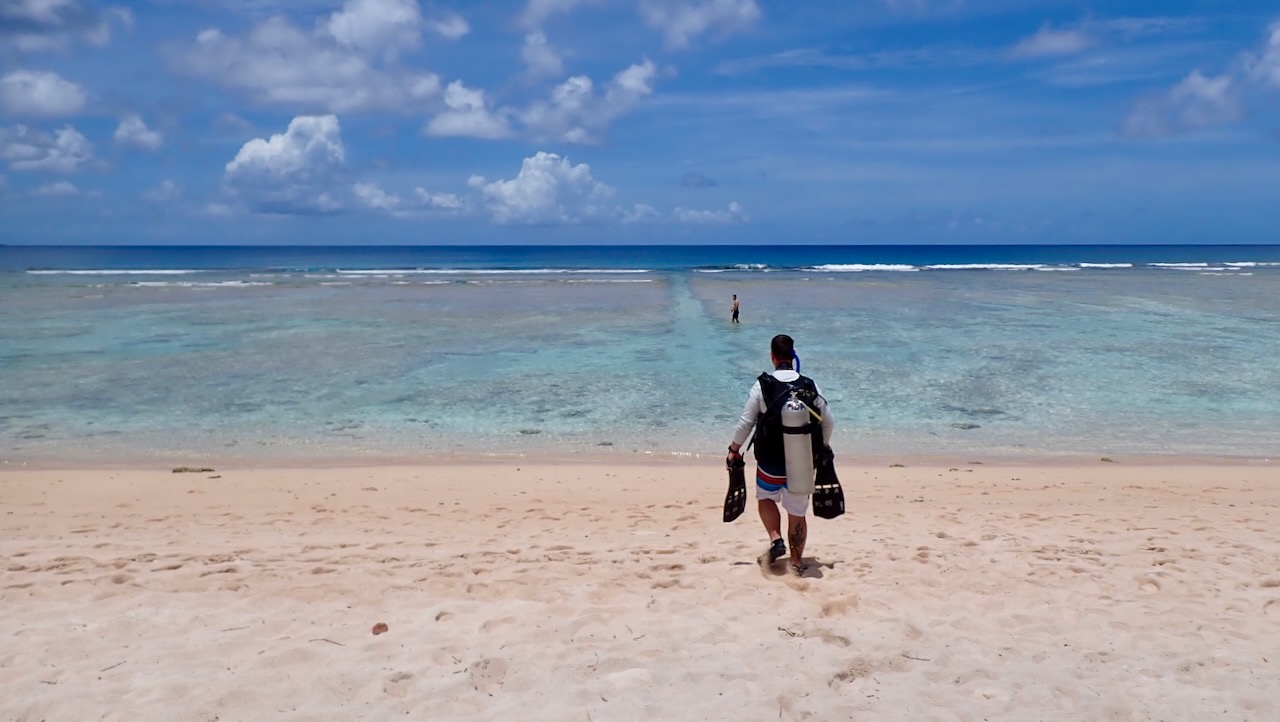
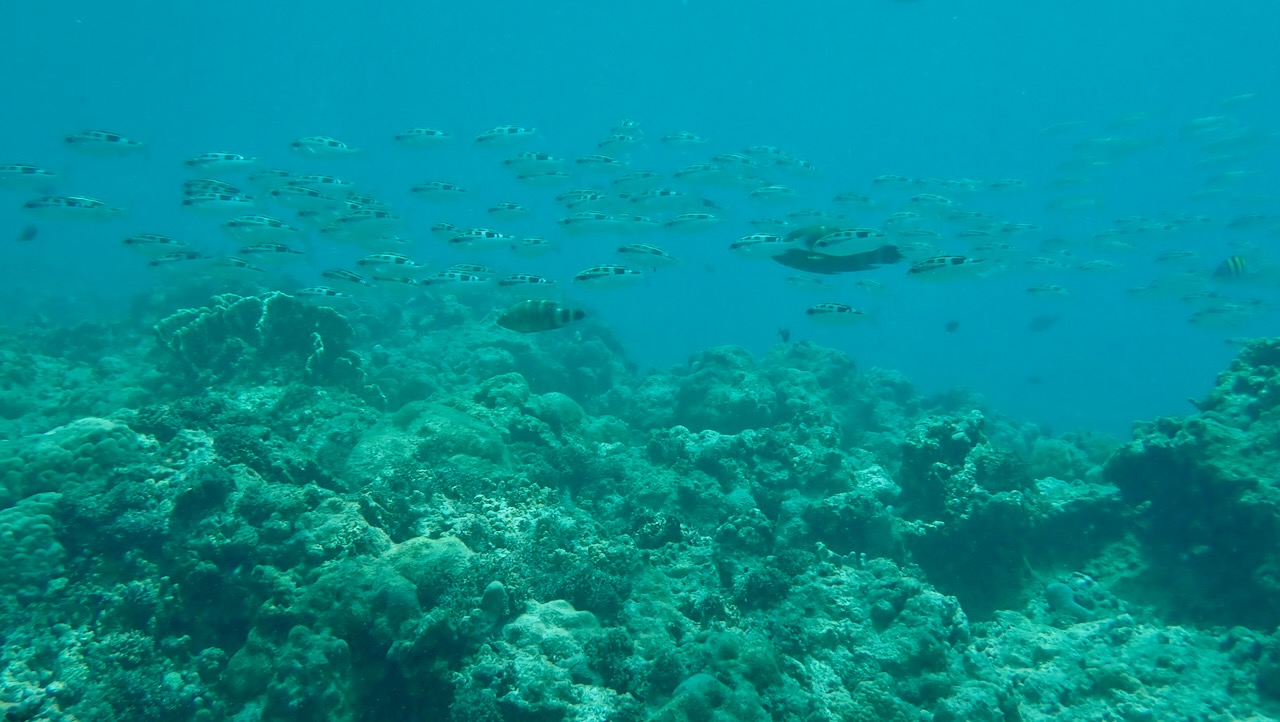
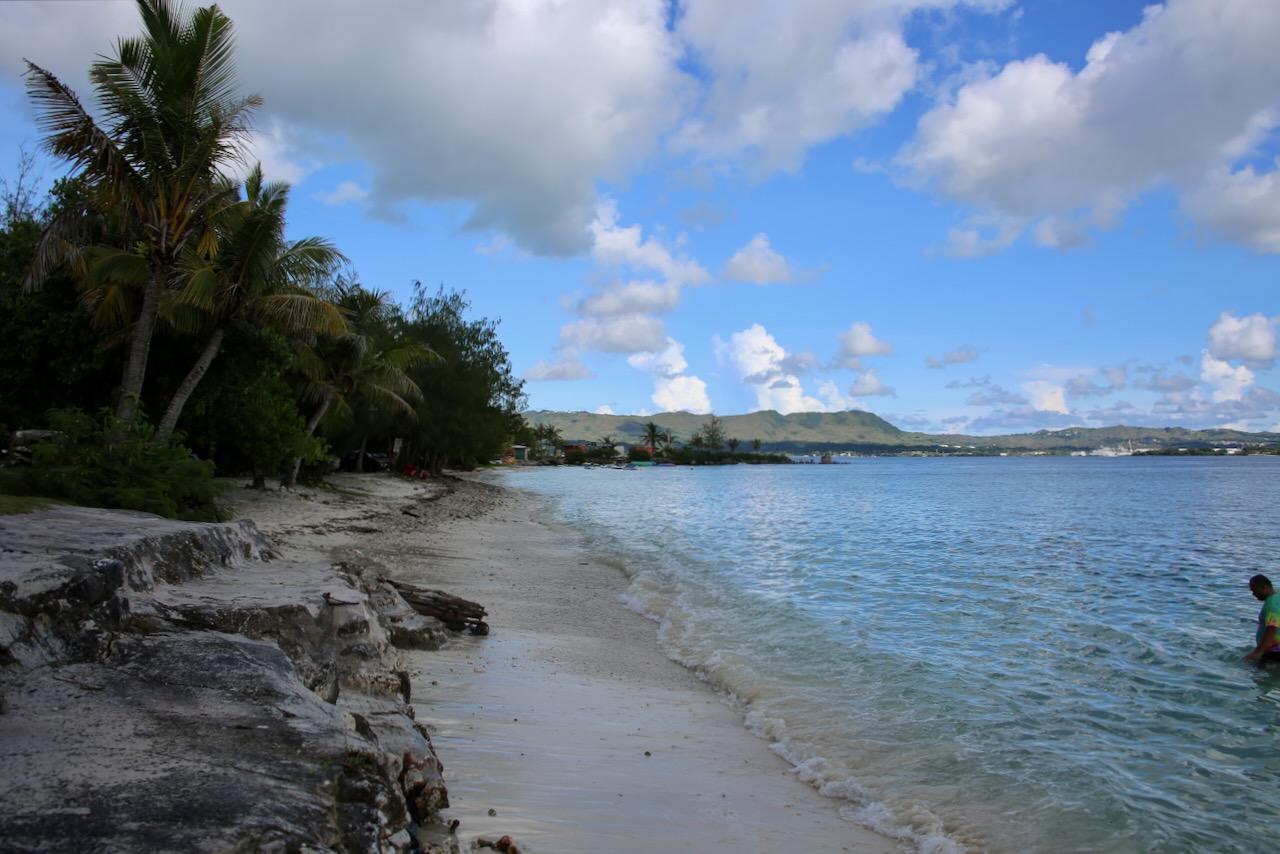
I’ll have some banana donuts (buñelos åga) from last night before we pick up Boraski (the only other diver in the group) and go to a proper breakfast at Manny’s. We dive at Gab Gab Beach, and it’s great to only be restricted by air consumption and not a mandatory time set by the company that owns the boat. We enter via ladder, swim over the short shelf, and then view the fish and deeper water safely. We are thrilled to see two sea turtles and get our tanks refilled to go to Gun Beach with much enthusiasm.
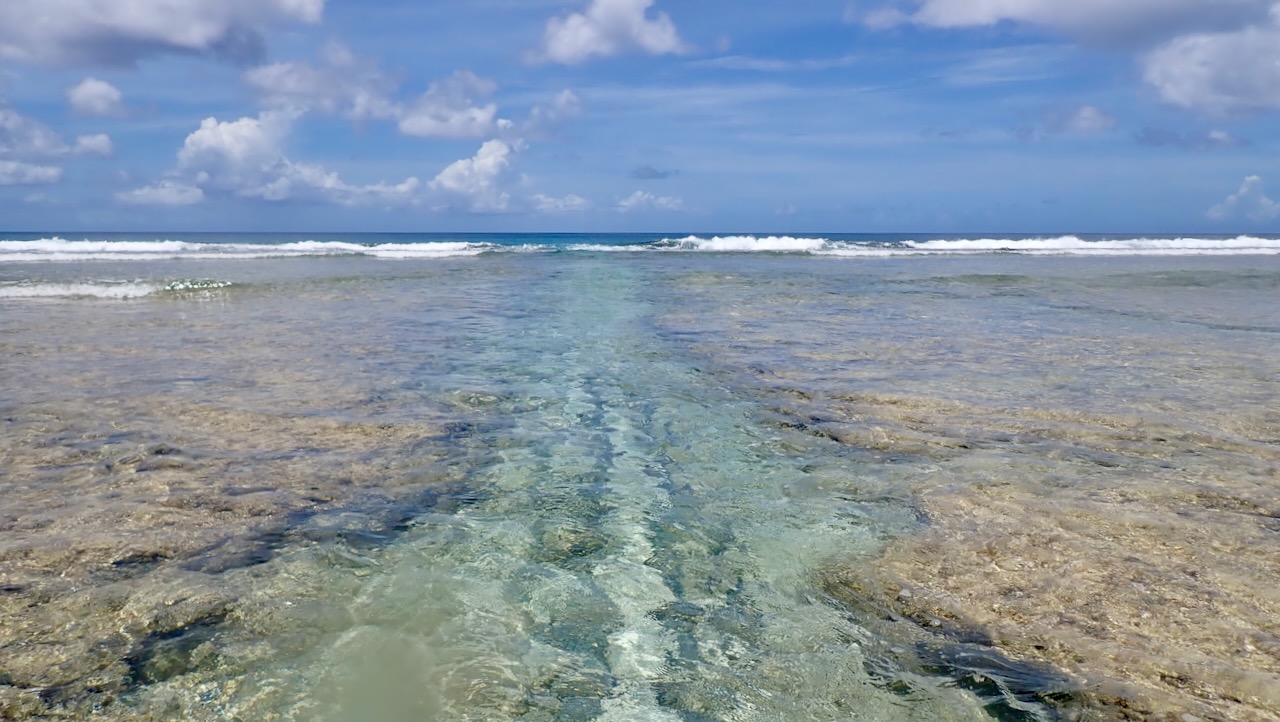
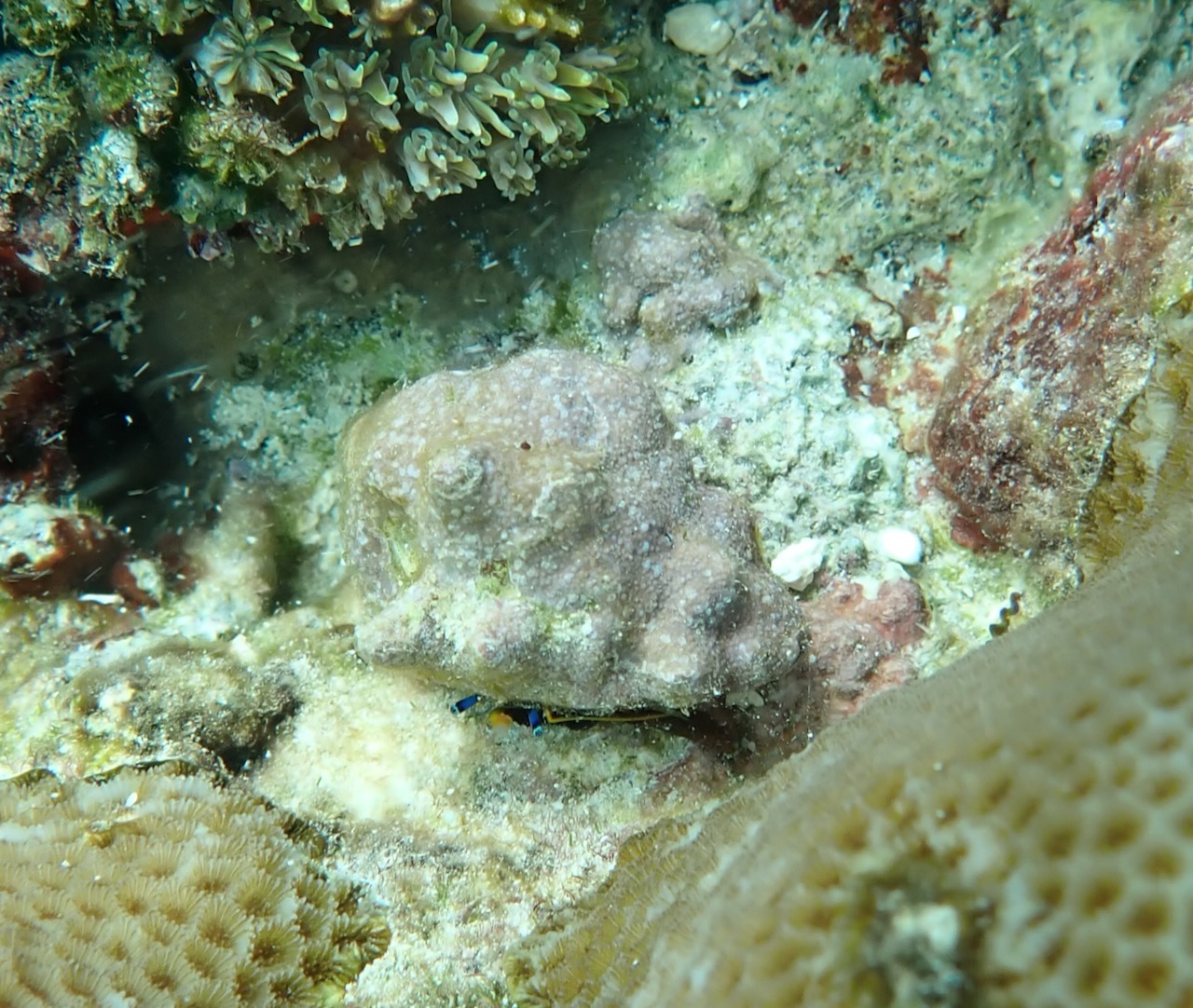
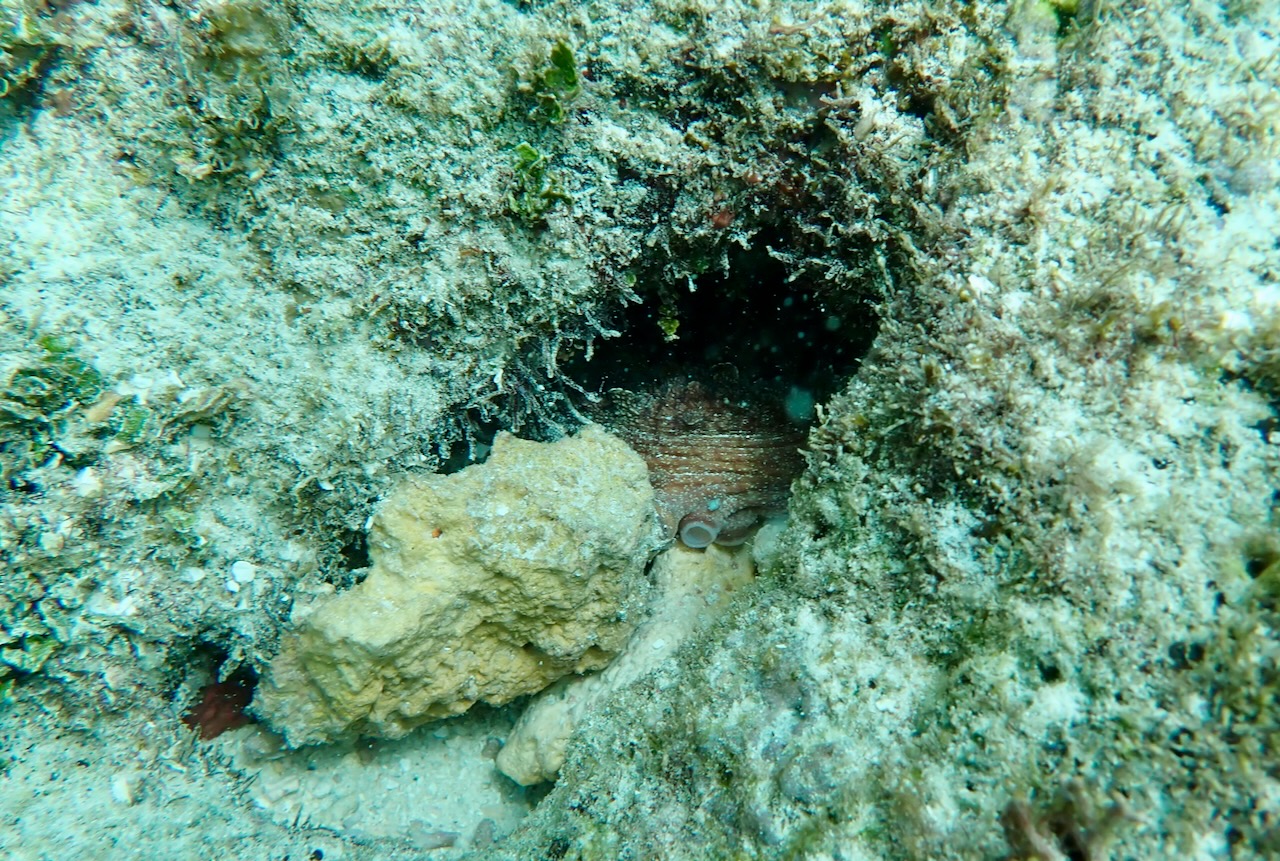
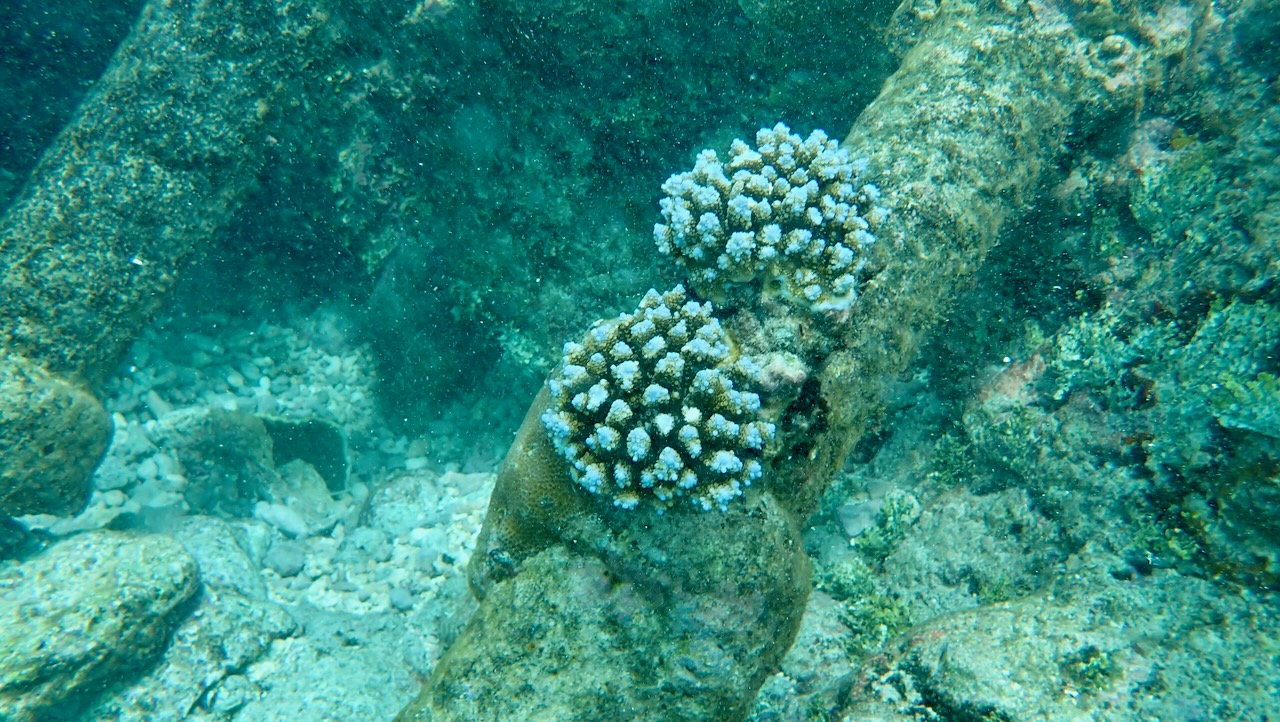
The dive shop told us to follow the pipes out over the shallow rock bed, which I thought was local code for something, but the four pipes are visible and will come in handy later when the sea gets rough. We walk out, see more turtles, and come back early because the tide is changing. I’ll get some fire coral on my left arm and leg, and while I’m holding on with my fingernails to one of the algae-covered pipes, I happen to see an octopus hiding in the safe confines behind a rock. I attempt a photo-op while the ocean keeps trying to toss me around and worsens visibility.
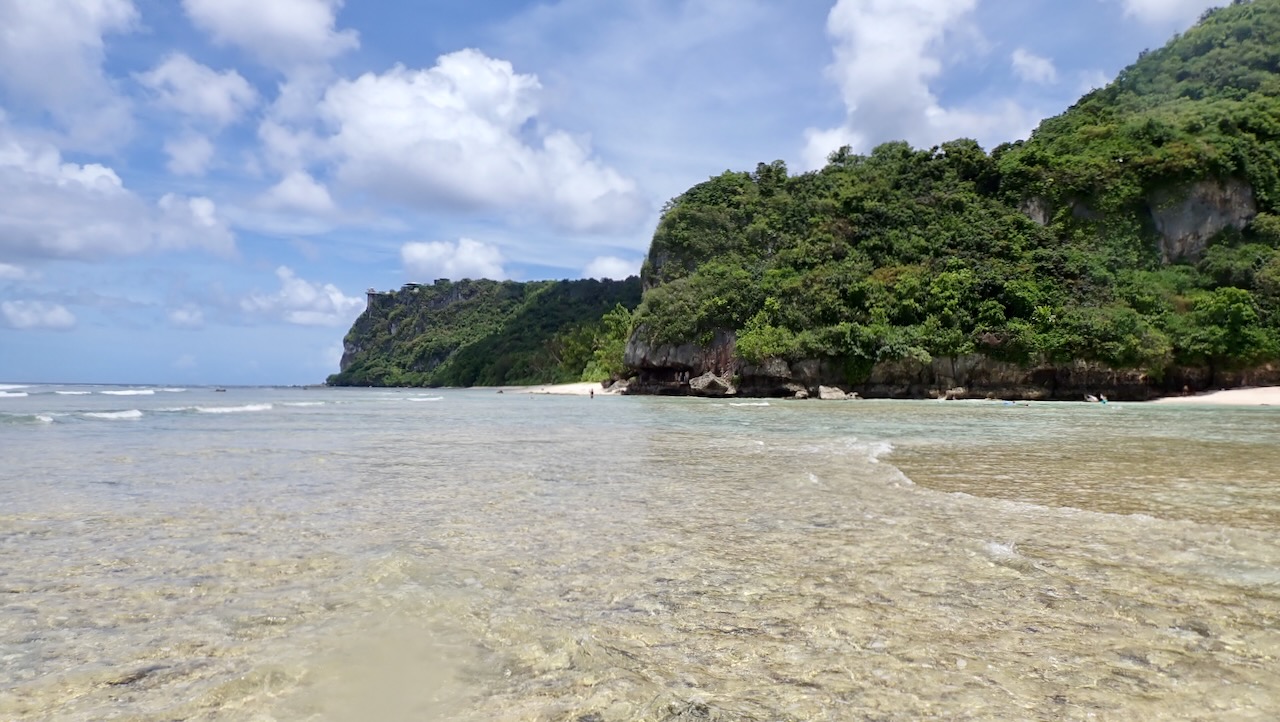
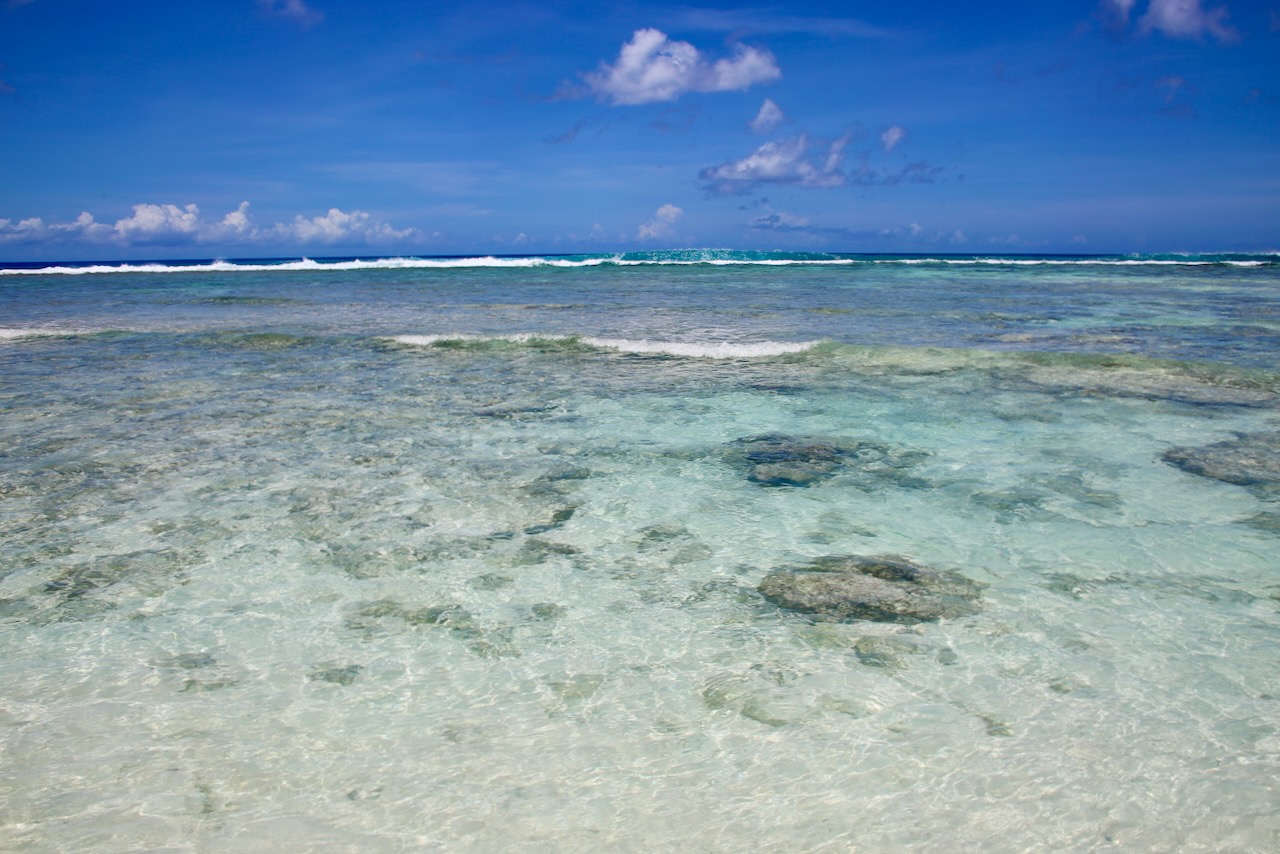
Gab Gab Beach
I knew I still had plenty of air, so I was going to attempt to ride out whatever this was (without knowing how long these tide changes last), especially at three feet below the surface. It’s a good thing I didn’t wait longer, as the guys had caught a wave heading towards the beach that sent their bodies and bubbles my way first and then left them bloody-legged on the rocks. As I stood to steady myself with the weight of my tank, I saw Caleb coming out to rescue his wife and go for round two if need be. He helps me to shore, and I’m still exhilarated.
Gun Beach
We stop at Fish Eye Underwater Observatory, where the water is calm and shallow, but the guys are beat, literally, so we get gas for the car ($1.28 cheaper on base) and return our rental gear. The shop charges us for not capping our regulators before rinsing them, as salt water can damage internal components and requires immediate servicing. We’re used to capping them and then rinsing gear when we get back to shore, so it was our mistake. Caleb gets a shirt with a hood, and Boraski sleeps on the way back to the hotel.
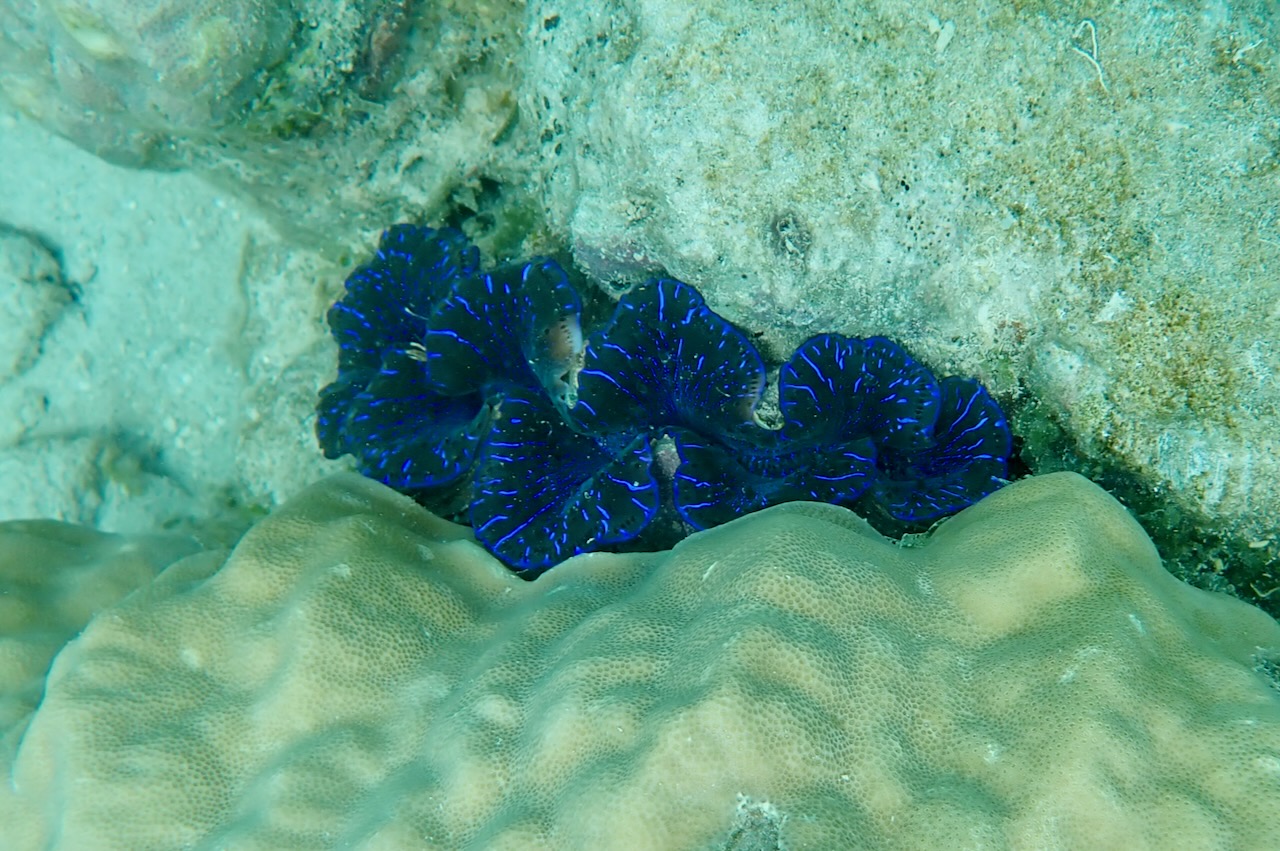
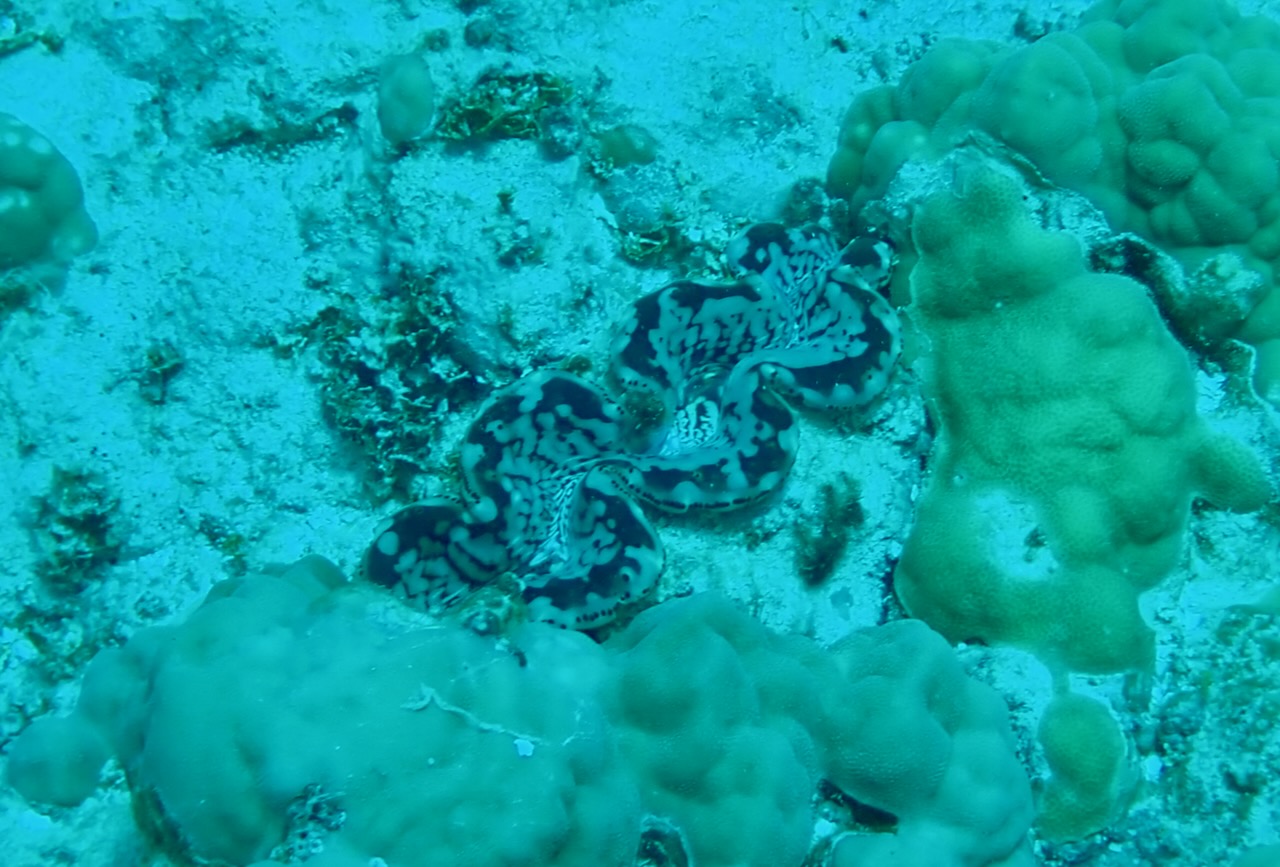
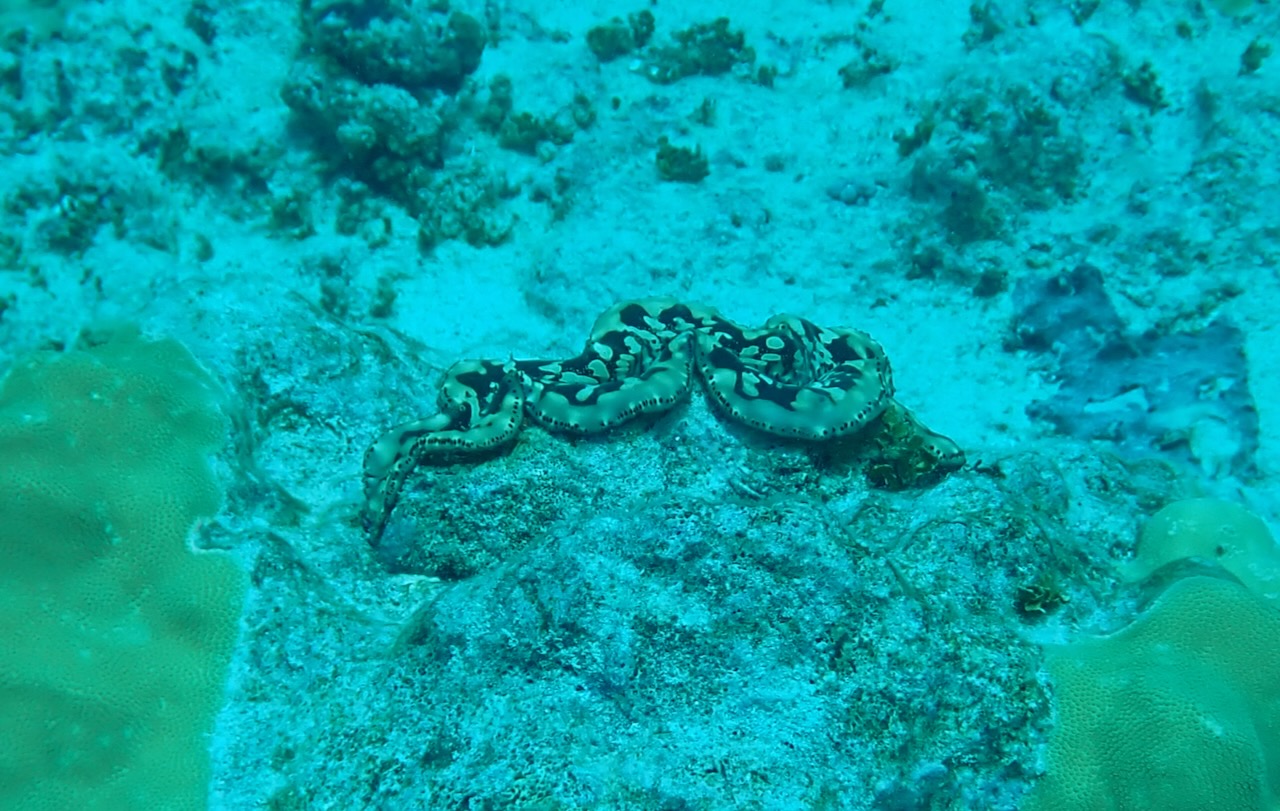
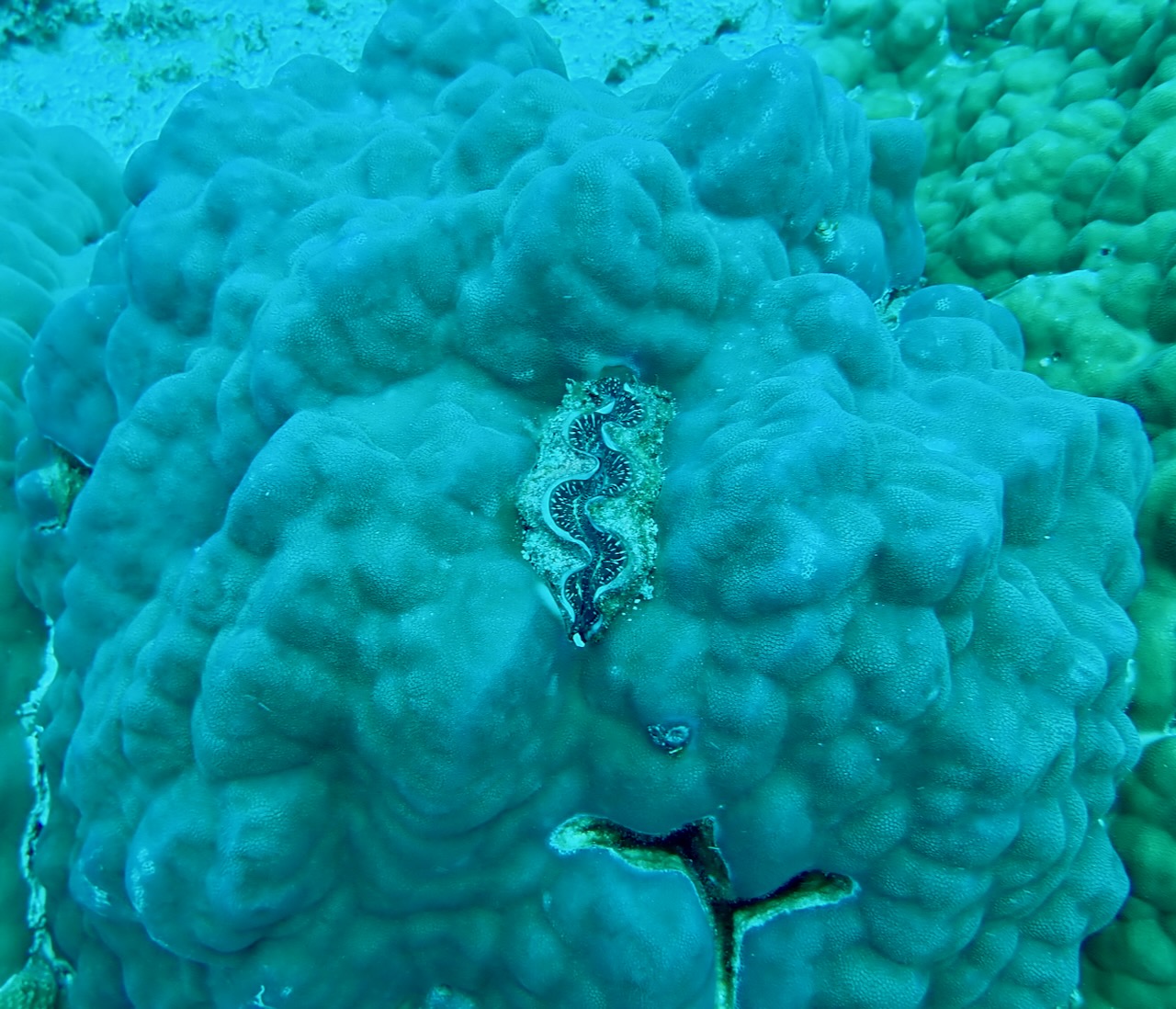
giant clam
We make an early dinner while oohing and aahing over our dive pictures. Two hours later, and I’m ready for bed. I tried reading, but the lamp wasn’t installed with that in mind (in bed or the chair), and there is no ceiling light. It seems that diving for hours had a tiring effect on me, too, as well as spending the day under the sun. Caleb finally gives in, and we’re in bed by 730 pm.
We woke up to an envelope that was shoved under the door because the hotel wanted to charge $75 for a bloody pillow case that I found on the bed we hadn’t used. I now know to ruffle the sheets for beds in our rooms to check for anything, and so that they can be cleaned. I can imagine how long that blood might’ve been there if everyone had chosen the bed by the window as we had. Caleb drops me off in downtown Hagåtña, and we agree to meet at the Agaña Spanish Bridge when he’s done with work, less than two hours later.
I visit the Plaza de España, the former palace of the Spanish governor from 1736 to 1898, which was then used by an American naval governor who added a baseball field before surrendering the island in 1941 to the Japanese. The plaza was damaged in 1944, and repairs were completed in 1980. It is still used today for social and civic functions. The Summer House had the custom of serving hot chocolate in the afternoon to guests of the Spanish governor, and that tradition was replaced with tea by the American governor’s wife.
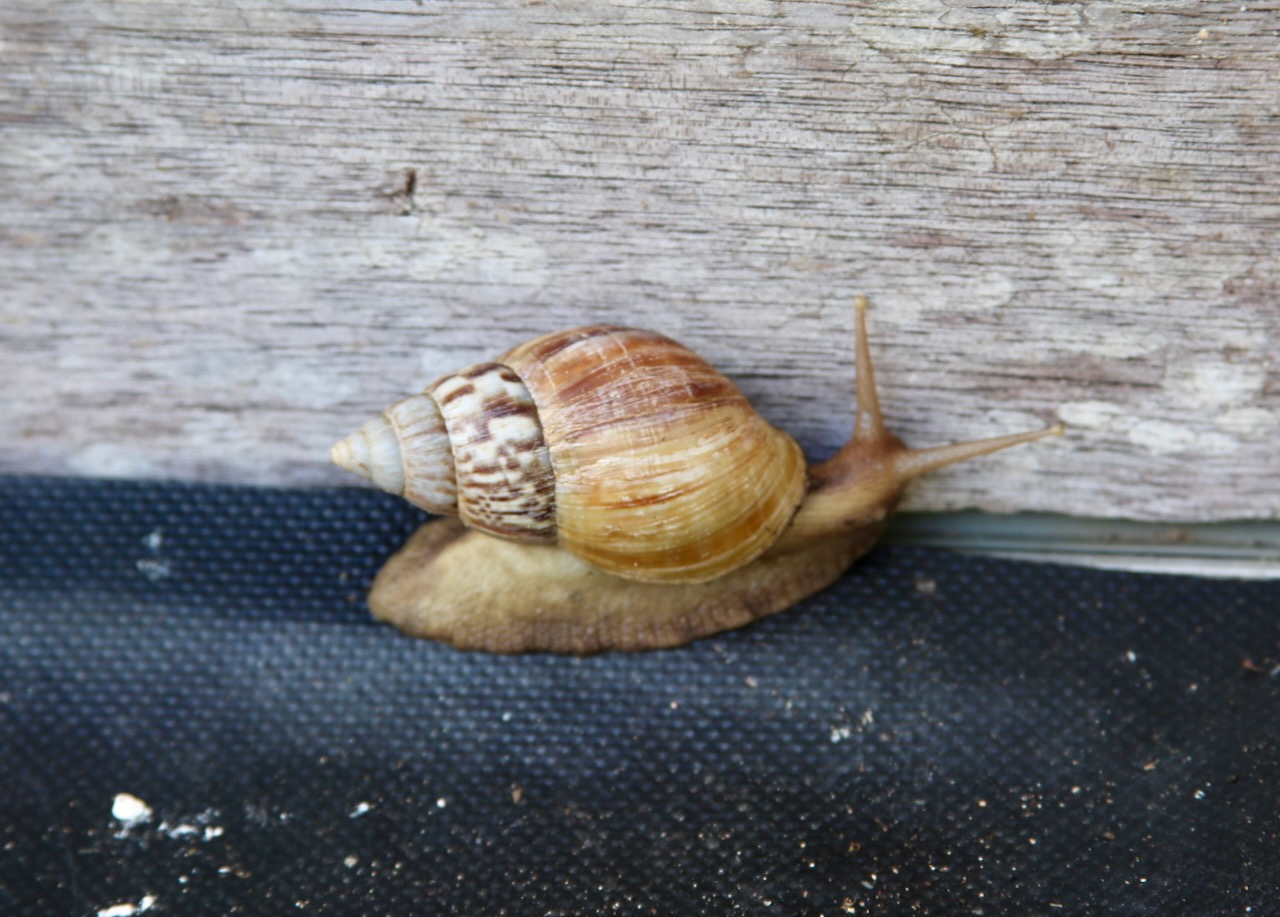
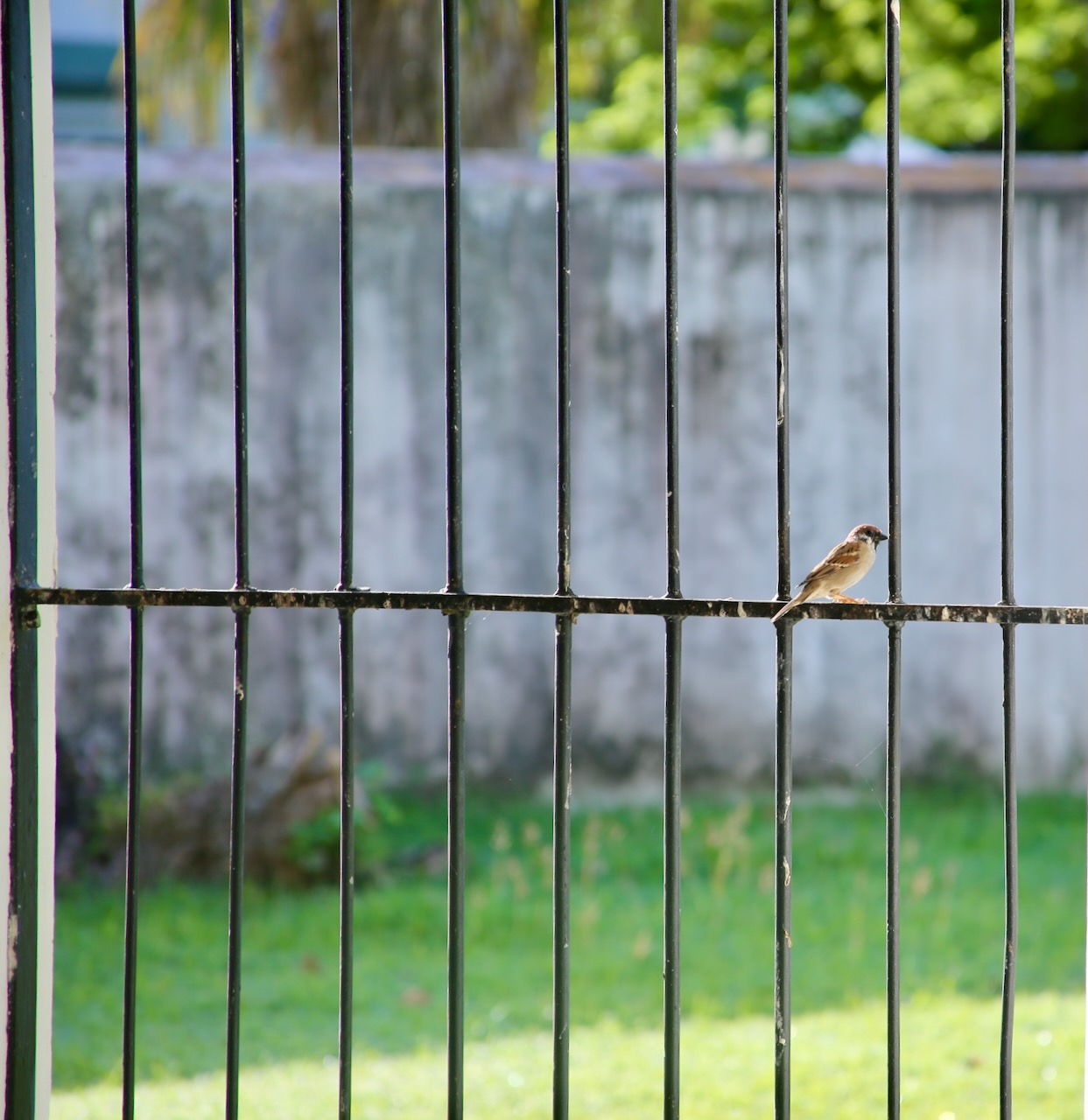
There is an Eurasian tree sparrow in the window, and in front of the Garden House door, seemingly knocking to be let in, might be an escaped Helix pomatia (sold on the island for culinary purposes) or a Giant African snail (one of the most invasive species globally). Either way, I send a photo to Caroline, like I always do. The Garden House was used to store Spanish tools and supplies, then used as an American schoolhouse, and the Guam Museum has used it since 1954 to display historical items of the plaza. My last animal encounter of the early morning is a Sicilian buttercup chicken, so called for the shape of their comb.
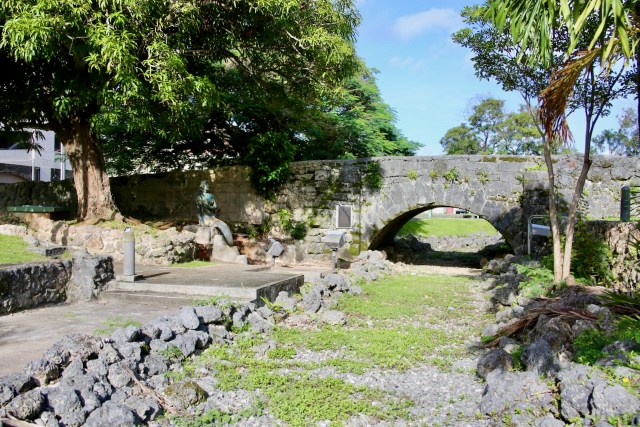
Sirena in the shade by the Agaña Spanish Bridge
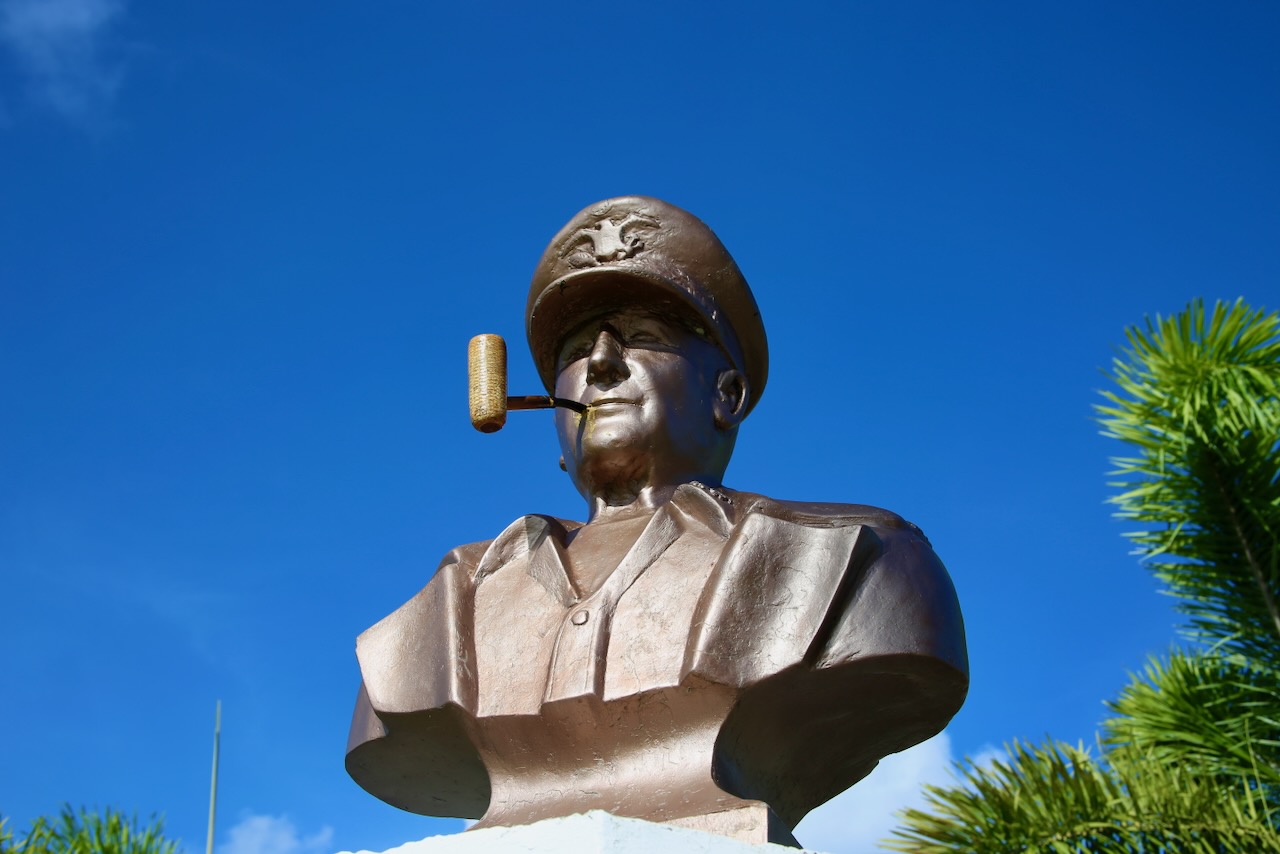
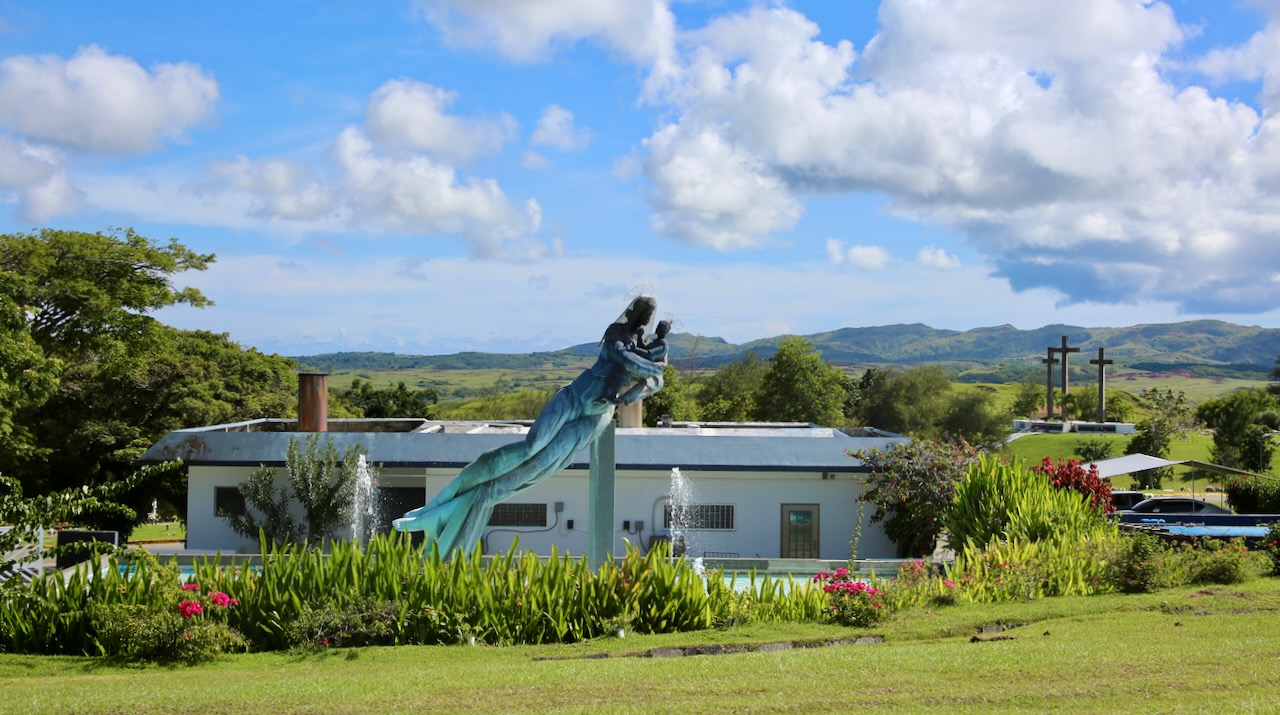
Commercial farming has made this once consistent egg layer a modern rare breed. They were brought to America in the mid-1800s and became so popular by 1912 that a club was formed. In 1918, the bird was admitted to the American Poultry Association’s Standard of Perfection. It’s a good thing that not all chickens have egos, or there might have been a historical fustercluck over this honor. Or there could be a plaque like the ones for Frank D. Perez (and portico) and General Douglas McArthur (and his bust). Or a full statue for Don Pedro Pangelinan Martinez (for having no enemies) and Sirena the mermaid (Guam’s maiden of the sea).
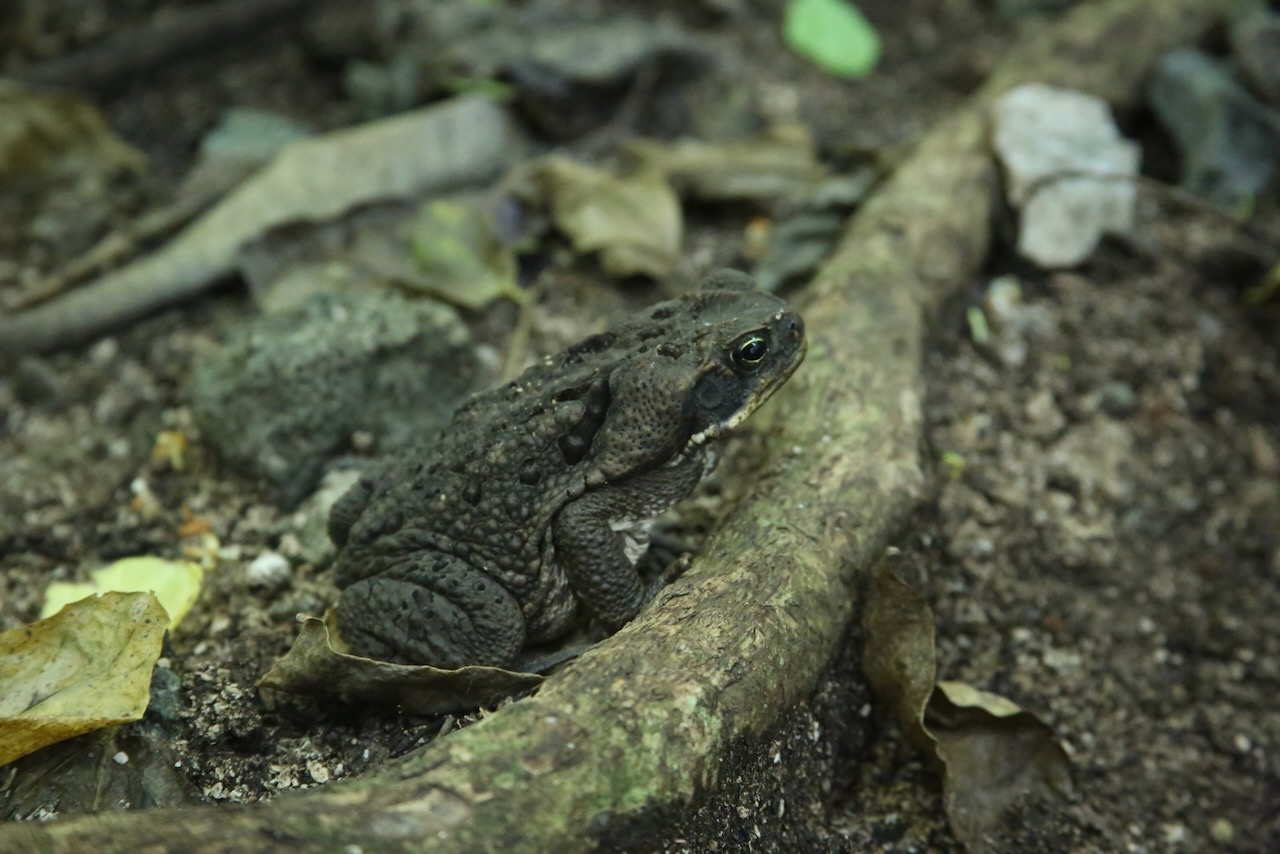
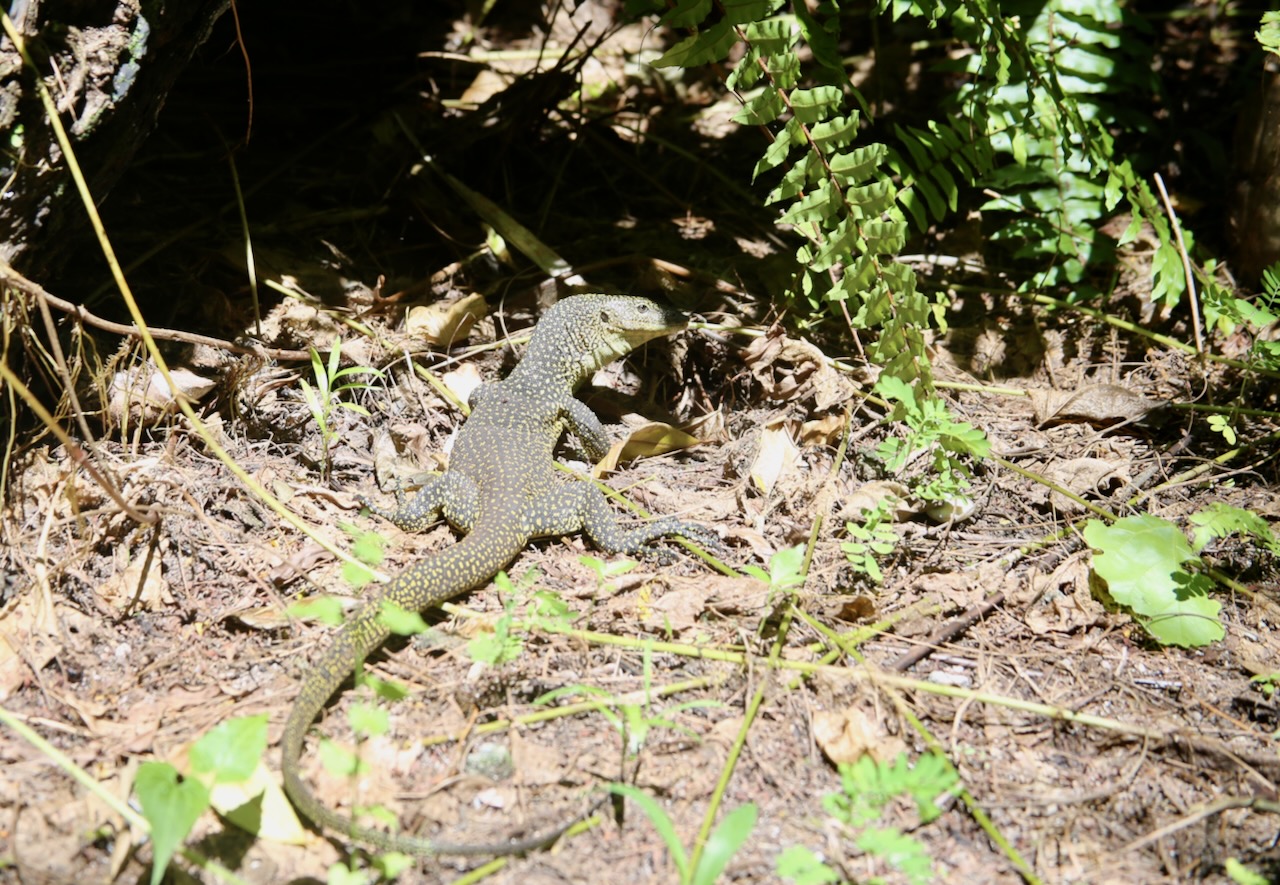
Caleb picks me up, and we drive out to the Guam National Wildlife Refuge, and stop in the empty visitor center to see the highlight reels of a world timeline to include the Sphinx, the Mayan, the Aztecs, and the Jesuits’ first mission. While imagining myself in the large scenes of the beach, forest, and marine habitats available in the park, we spoke with an intern who wants to become a ranger. We’ll walk the western half of the trails, including Latte Loop, and see Blue Moon butterflies, Mariana Monitor lizards, a Cane toad, and a bloated pig covered in flies. The mosquitoes follow us back along the beach.
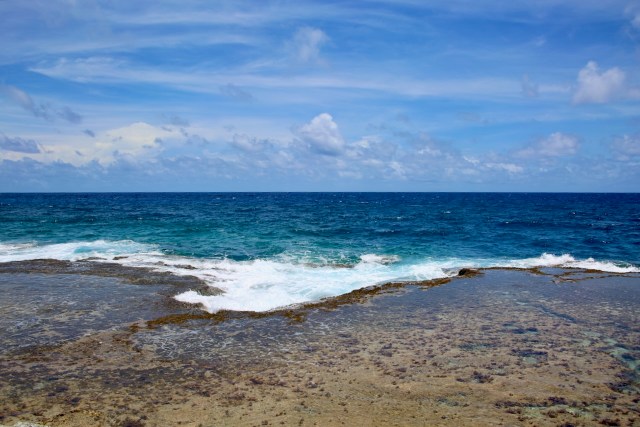
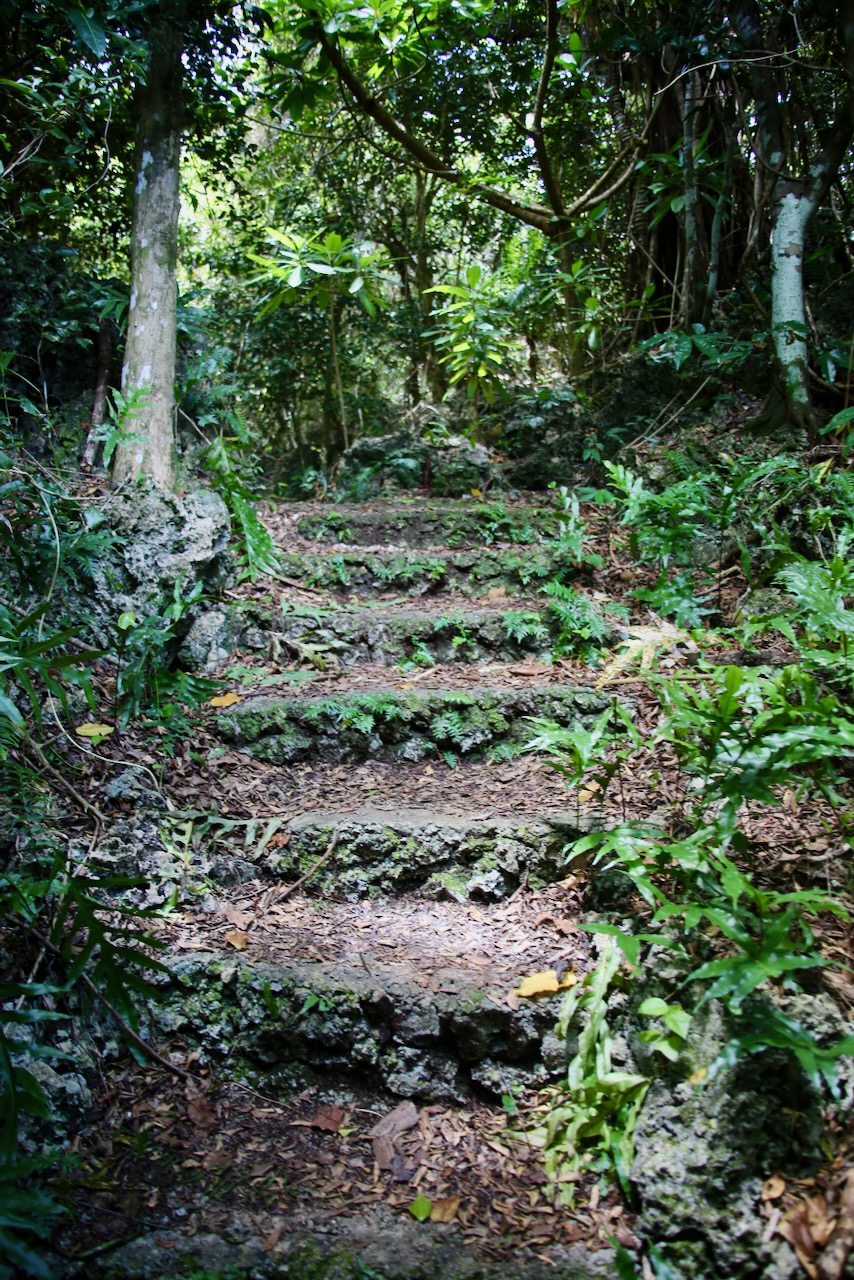
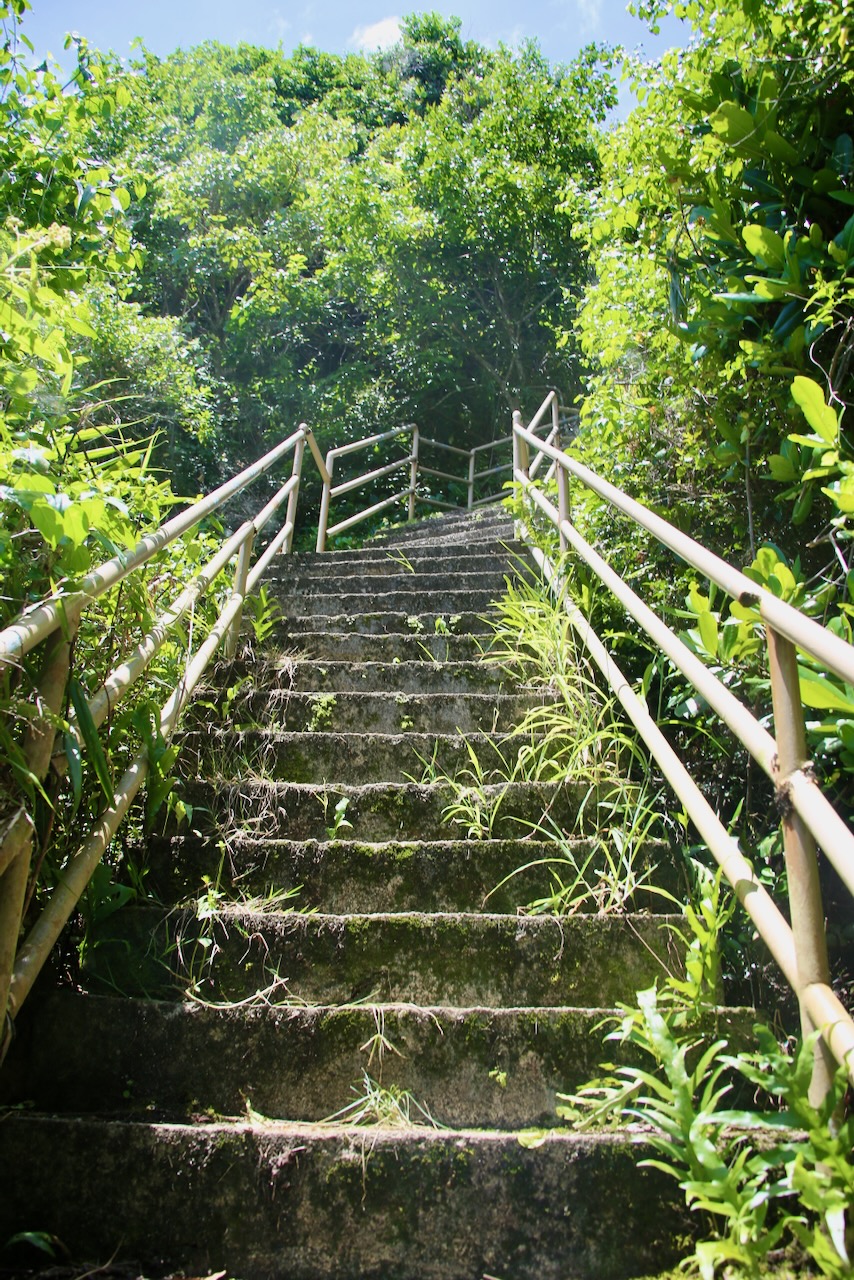
We make our way to the east side of the island, and I notice a sign for Fadi’an Point/One Thousand Steps. There are only about a quarter of that, but the elevation on the return makes it feel more strenuous, especially in flip-flops. There is a clear path and railing for the most part. The ocean becomes visible over the trees, then the plants and rocks, before the tidepool is revealed with the shades of blue beyond. We’re both soaked in sweat after the climb out.
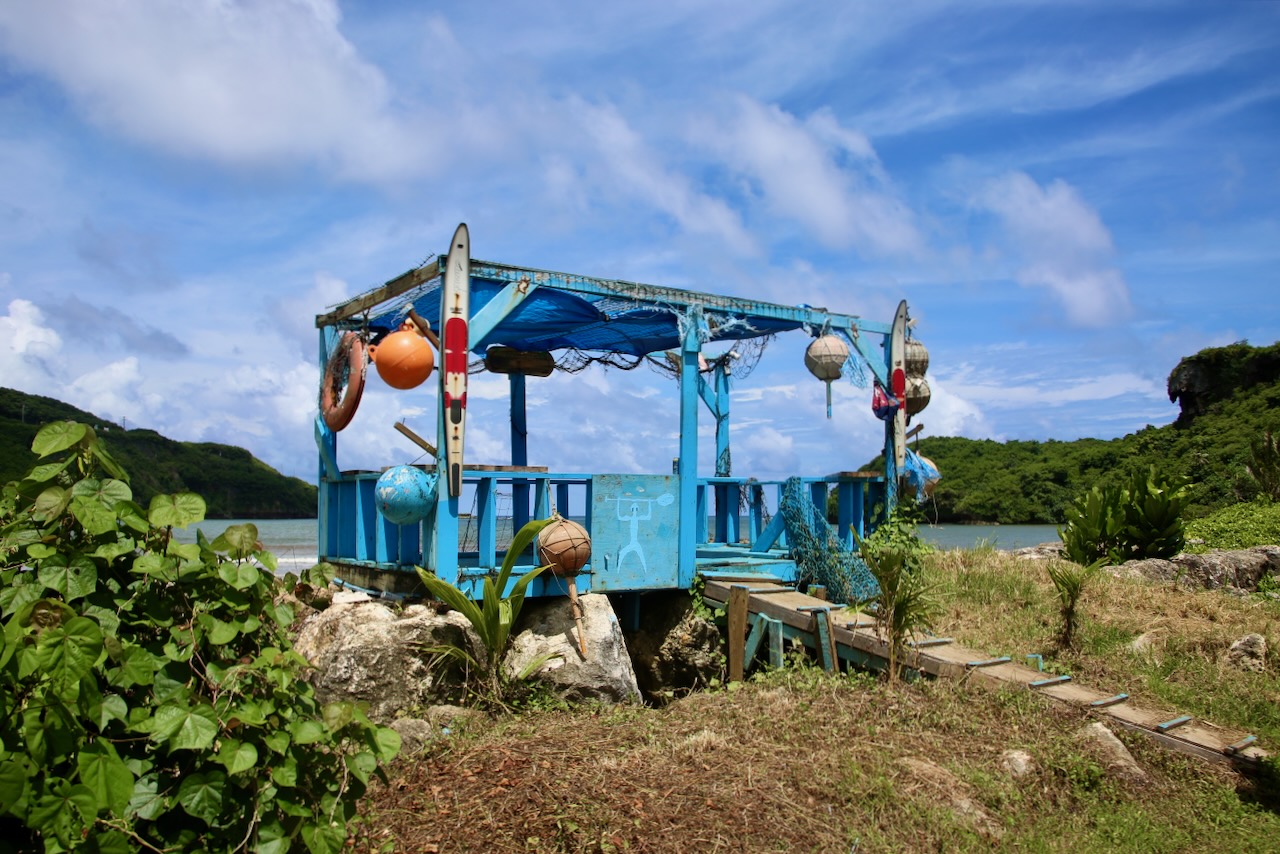
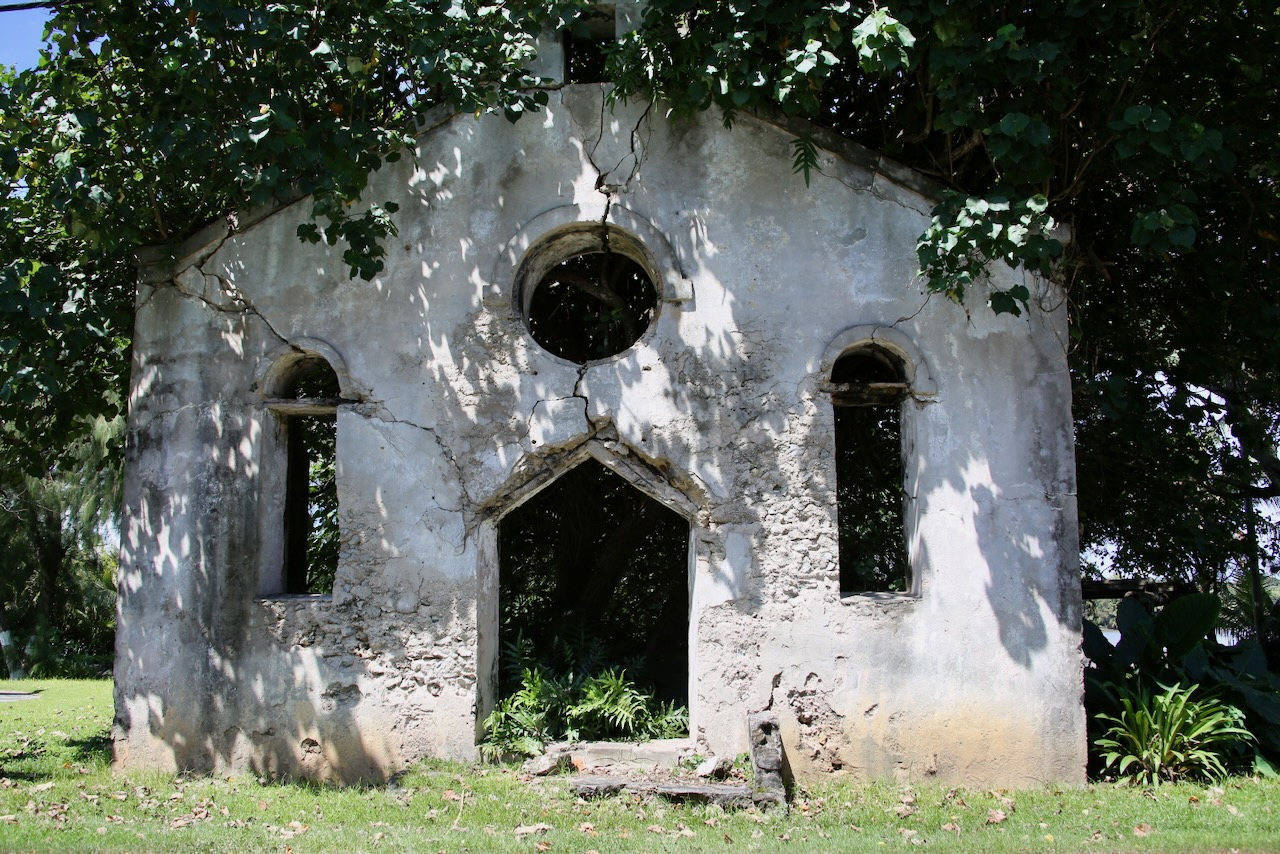
We visit Surf Side Beach when the bright blue lifeguard station grabs our attention, and we have the shiny dark sand and low rolling waves to ourselves. As we continue south, we see the front wall of the Inalåhan Baptist Church, the only part of the structure remaining from the 1920s, which was erected in a predominantly Catholic area. The Merizo Pier is empty on a workday, and a reenergizing late afternoon meal is had from Infusion Coffee and Tea — egg sandwich, 24k cupcake, and mochas (mine with activated charcoal).
I get pulled over for going 55mph in a 35 marked zone, which is the majority speed for the island. I tell the officer I passed a car, but that’s not an excuse. Caleb says his demeanor changed, and I got off with a warning. An officer steps into the busy street and waves people over, and a line of officers is available to issue tickets. The officer admitted we were keeping up with traffic and let us know they do this from time to time. I agree with their method and told him he won’t see me again, as that would be a pricy addition to our trip that we don’t need.
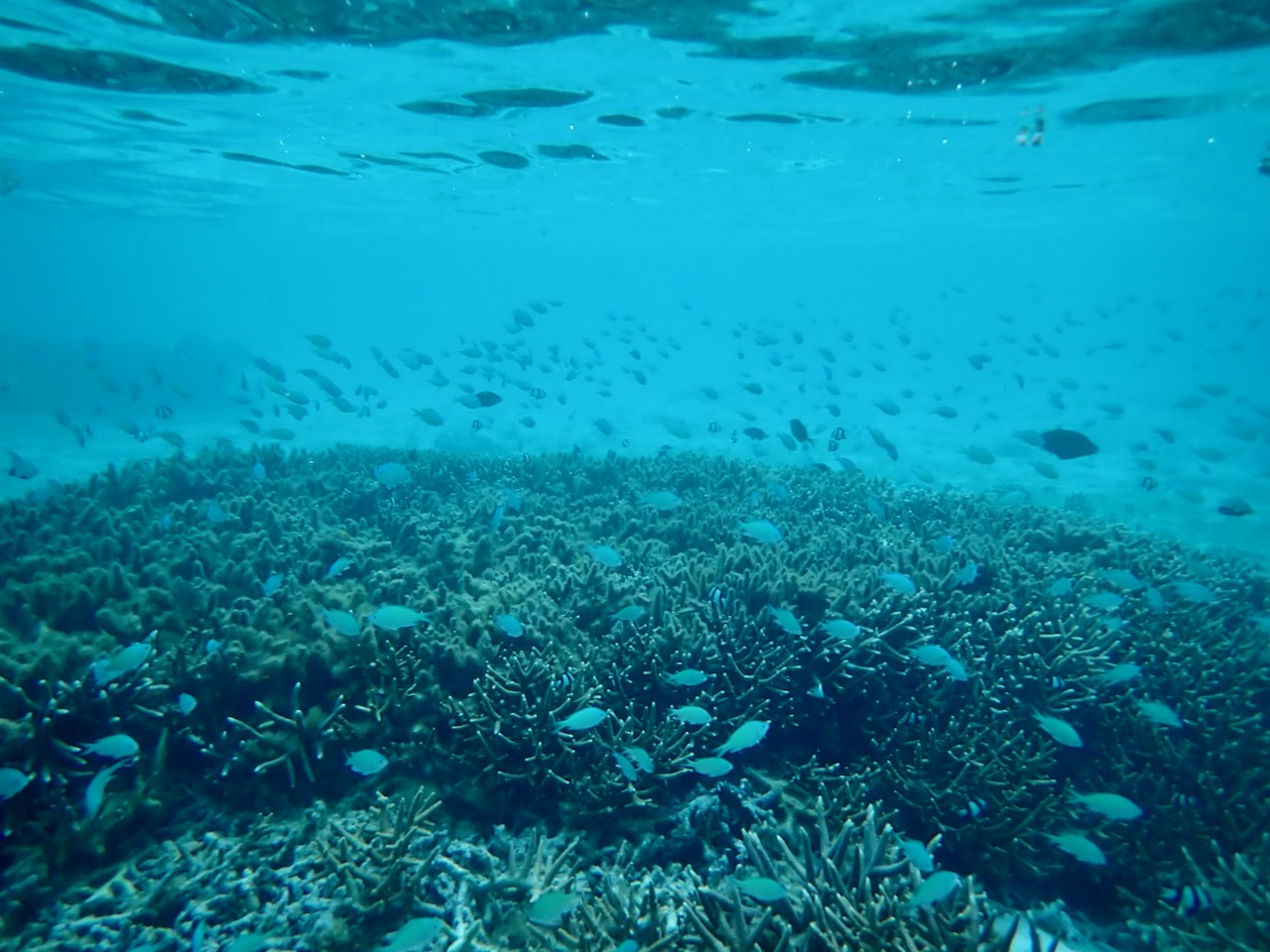
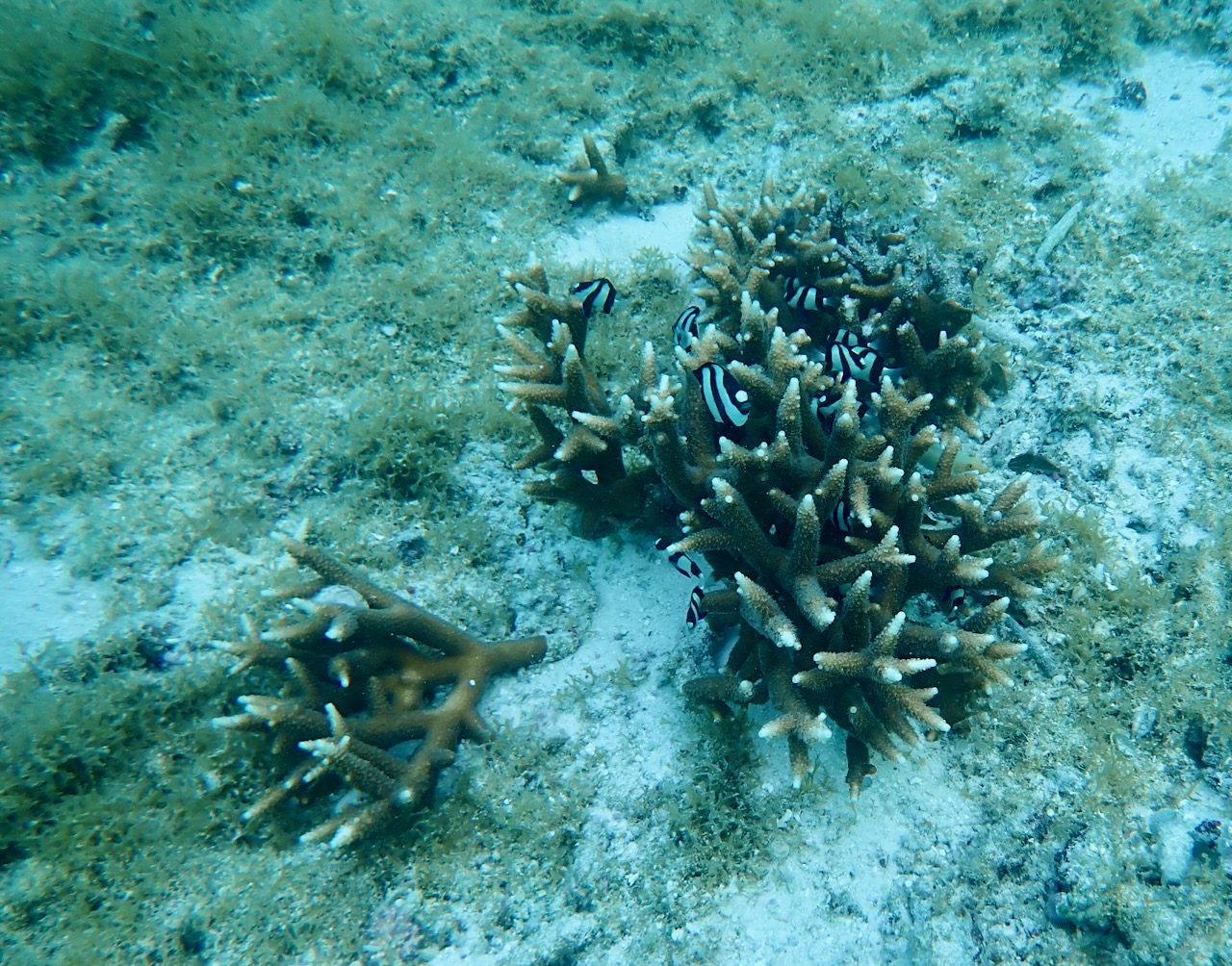
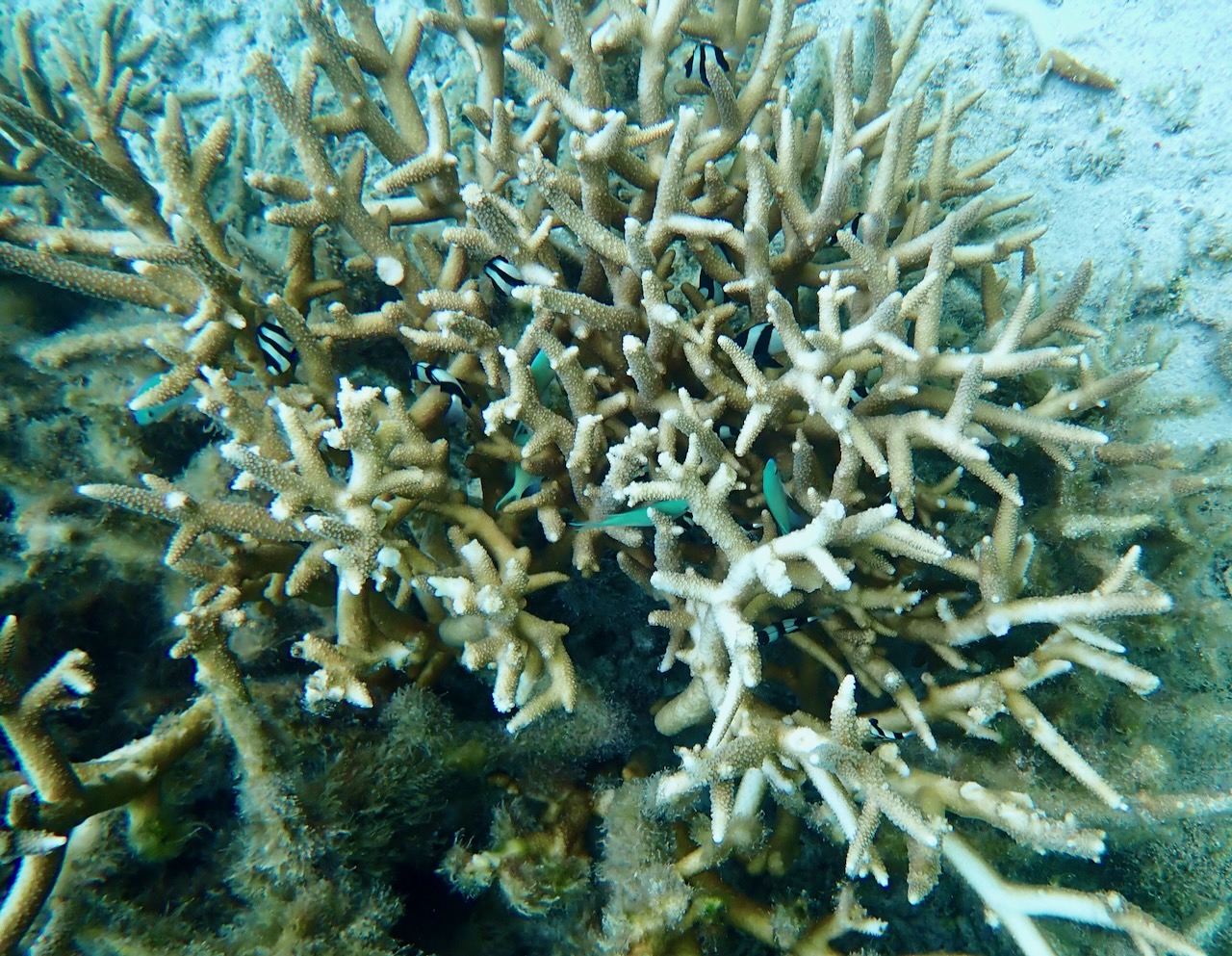
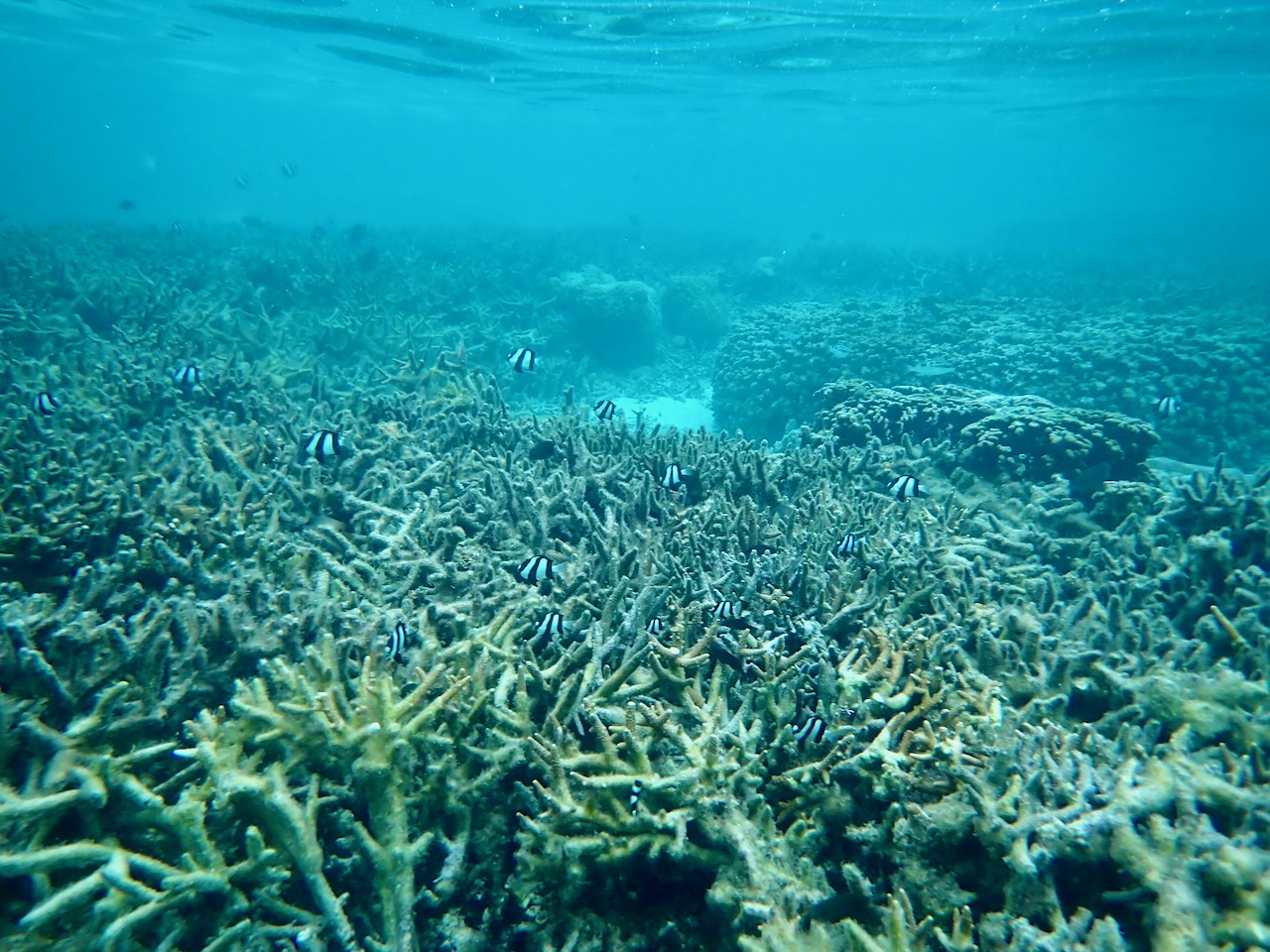
We get back to the hotel, pick up Boraski (one of Caleb’s ‘kids’), and make it to base to get rental dive gear put in the trunk for tomorrow. I met some of his other underlings playing dominoes, and then we went upstairs to get changed to go snorkeling until the sun touched the horizon. We see a Picasso triggerfish, a plastic spoon with googly eyes, a bunch of humbug damselfish, a blue sea star, a leopard sea cucumber, and many other faces and fins among the coral. I’m constantly defogging my mask. Our after-dark entertainment will come at the Wednesday Night Market in Hagåtña.
It’s different, and though I’m not sure if I’d look forward to going every week, I know I like an excuse to get out of the house (or hotel) and enjoy the journey too. It’s mostly BBQ food stalls, but we got to see a boy on a carabao, a kiddie race track, a rock climbing wall, jewelry, people dancing to country music, and an Indian dance group that took volunteers on stage while we ordered dry chicken, good rice, a wet salad, and sweet cheesecake from Jamaican Grill. While we sat on the wall waiting, the guy next to me tried to get me to join him up there. We take our food and move to a bench to eat.
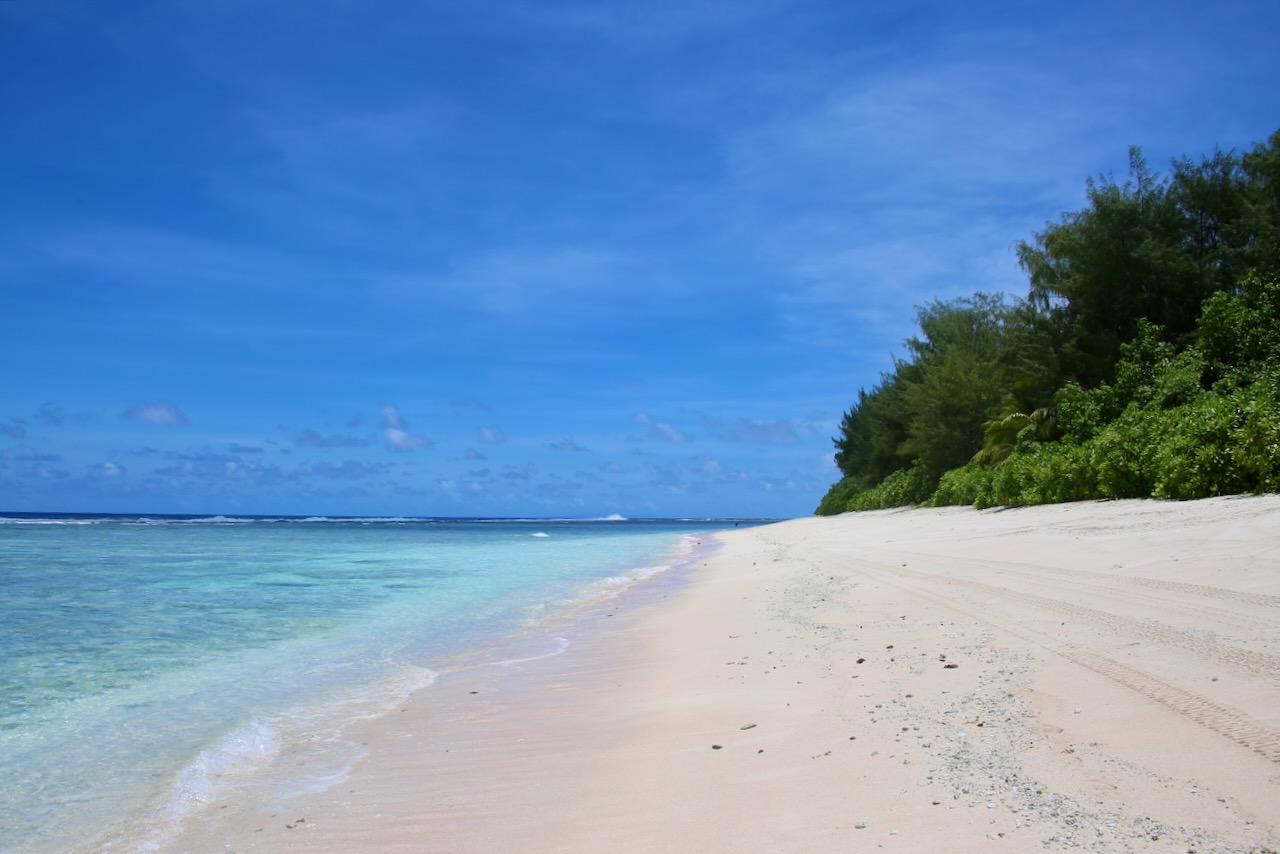
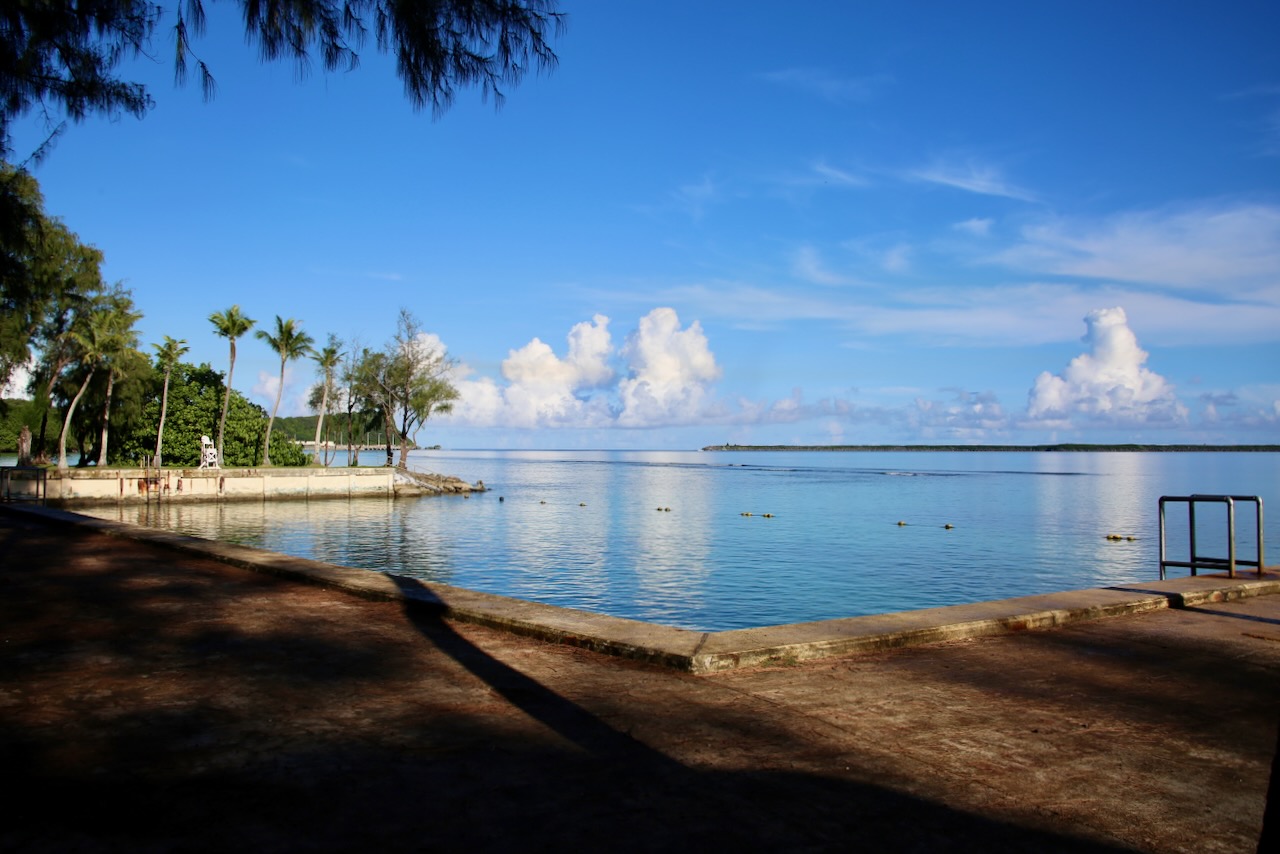
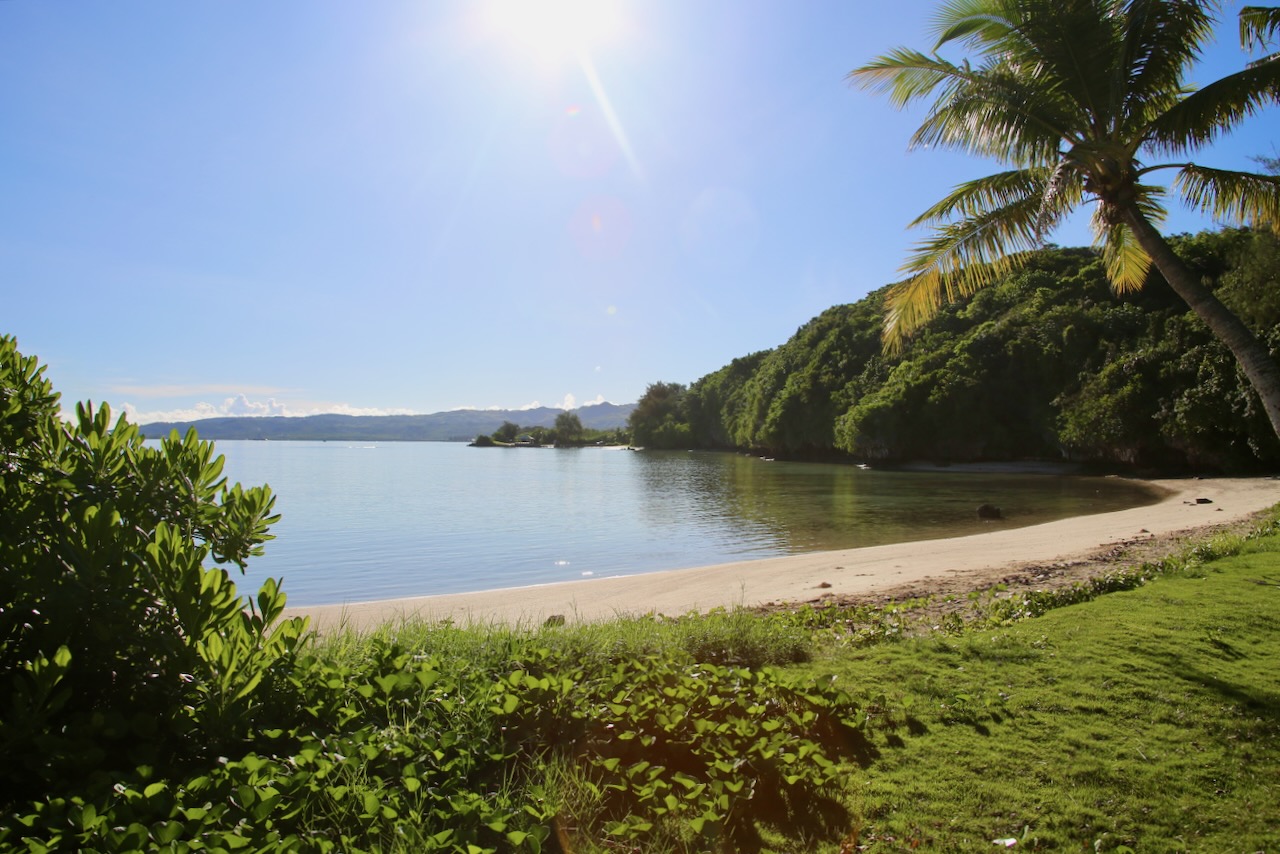
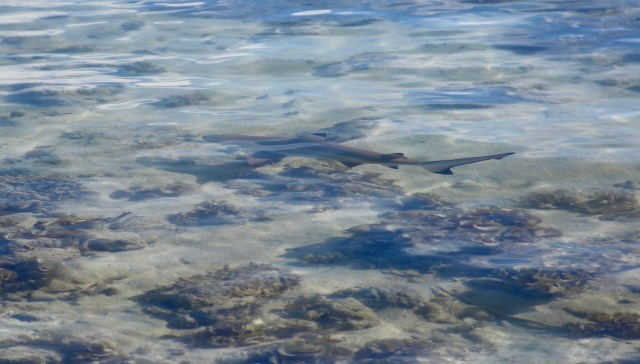
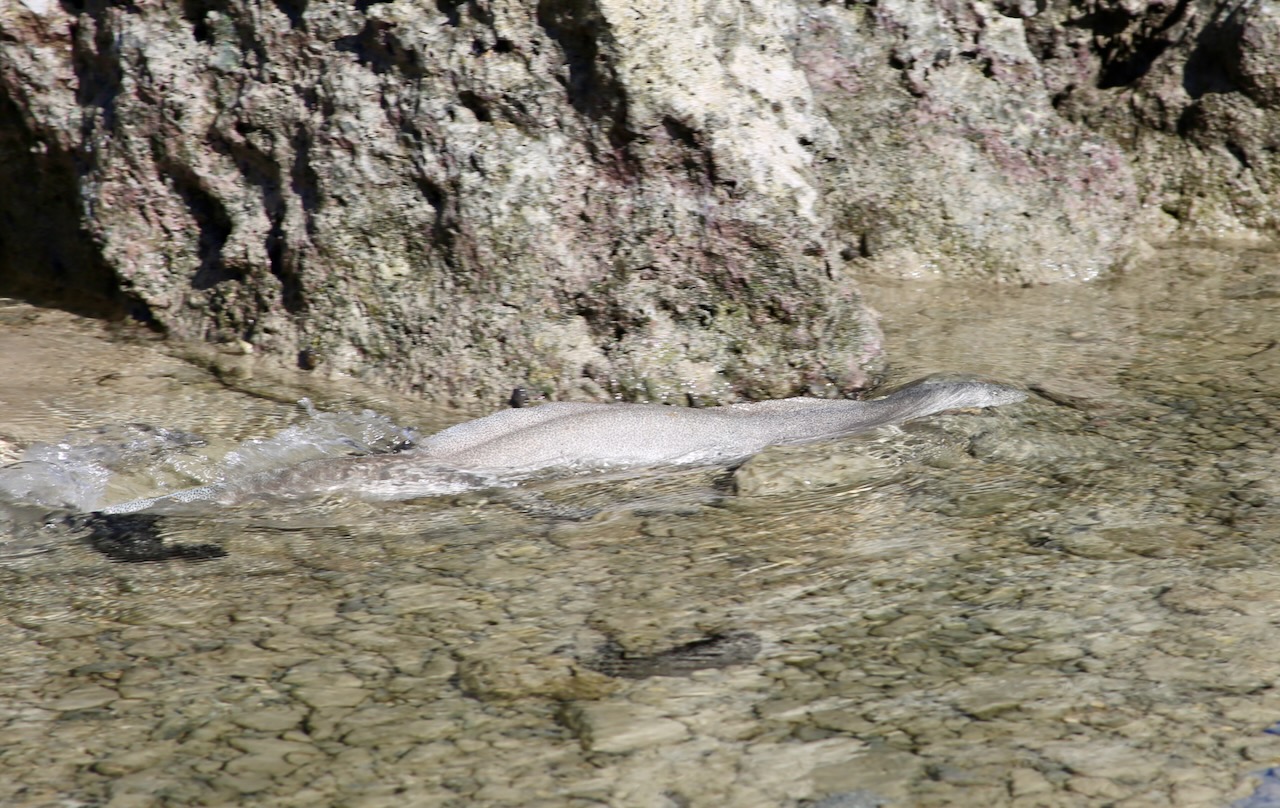
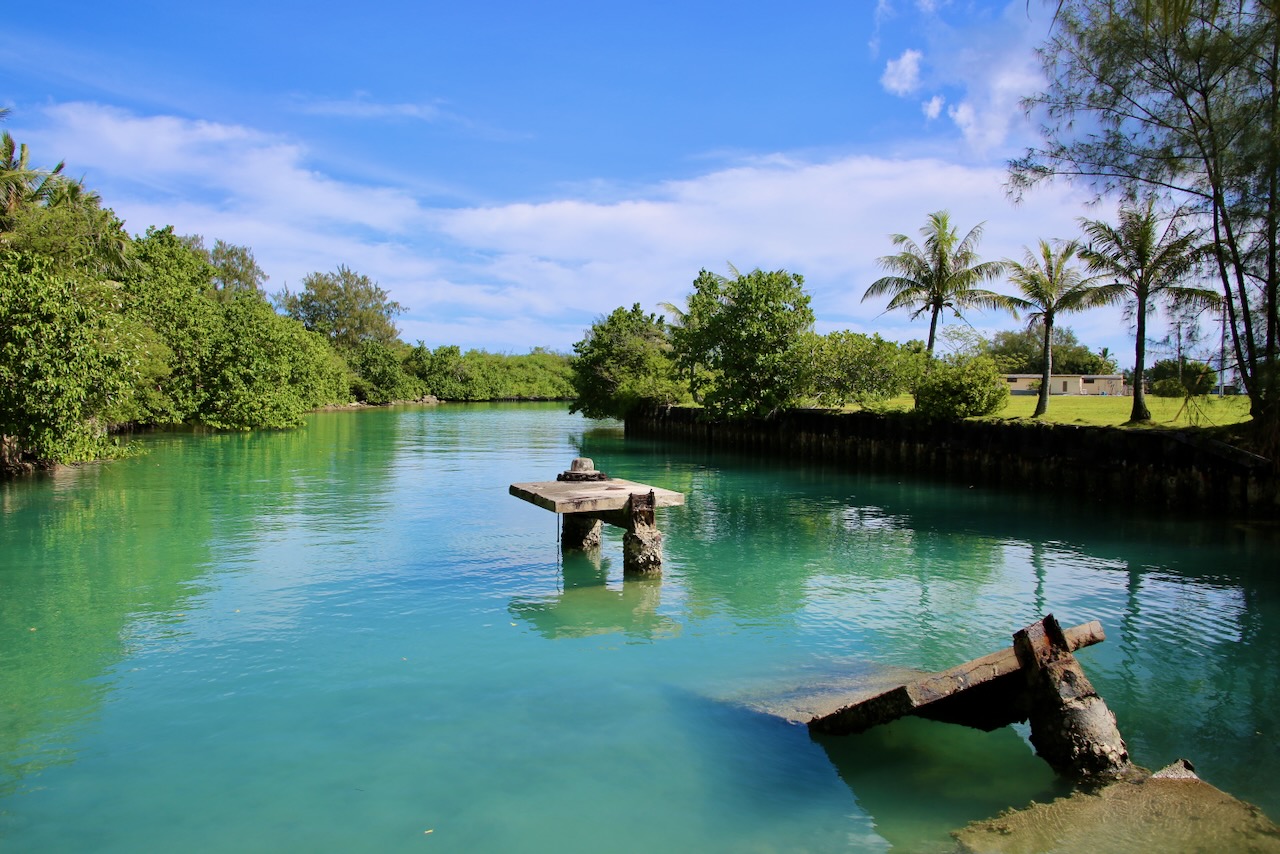
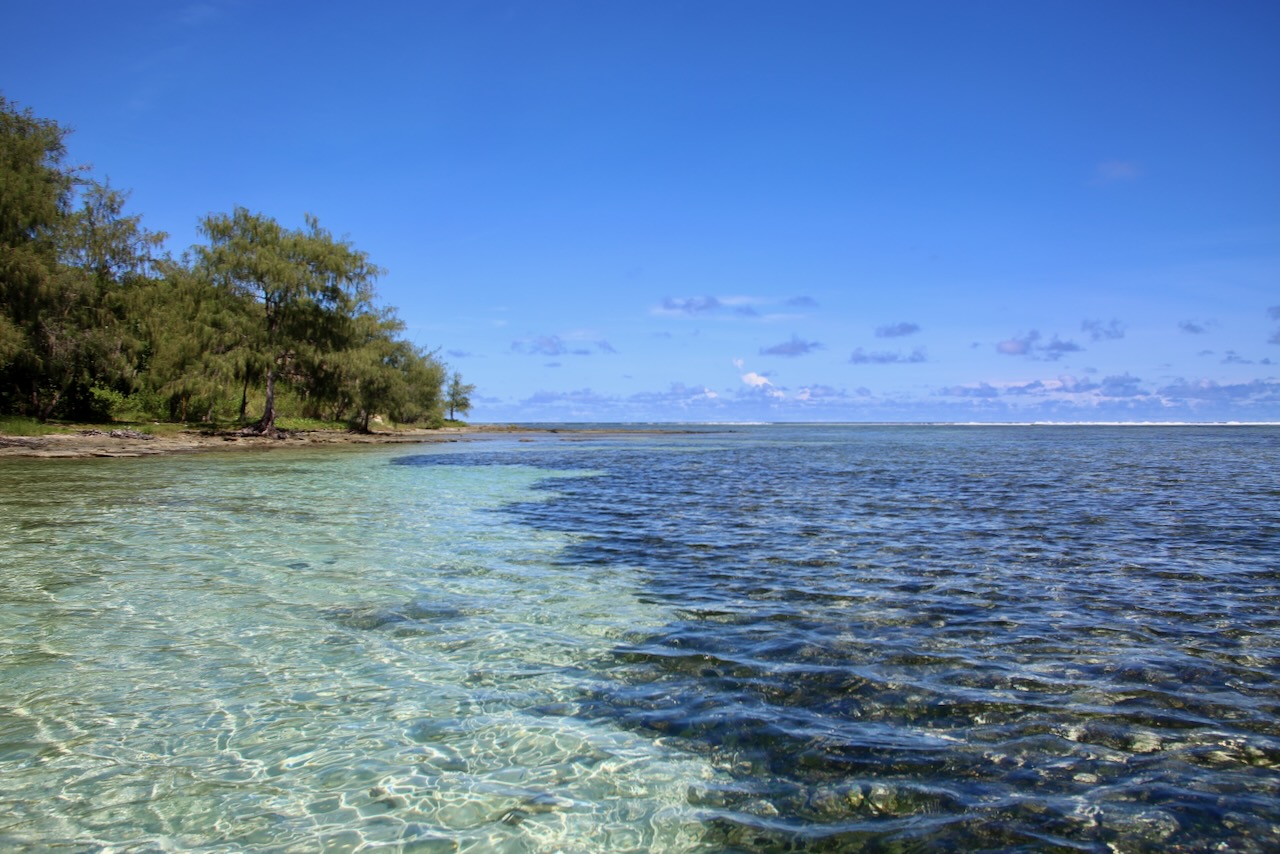
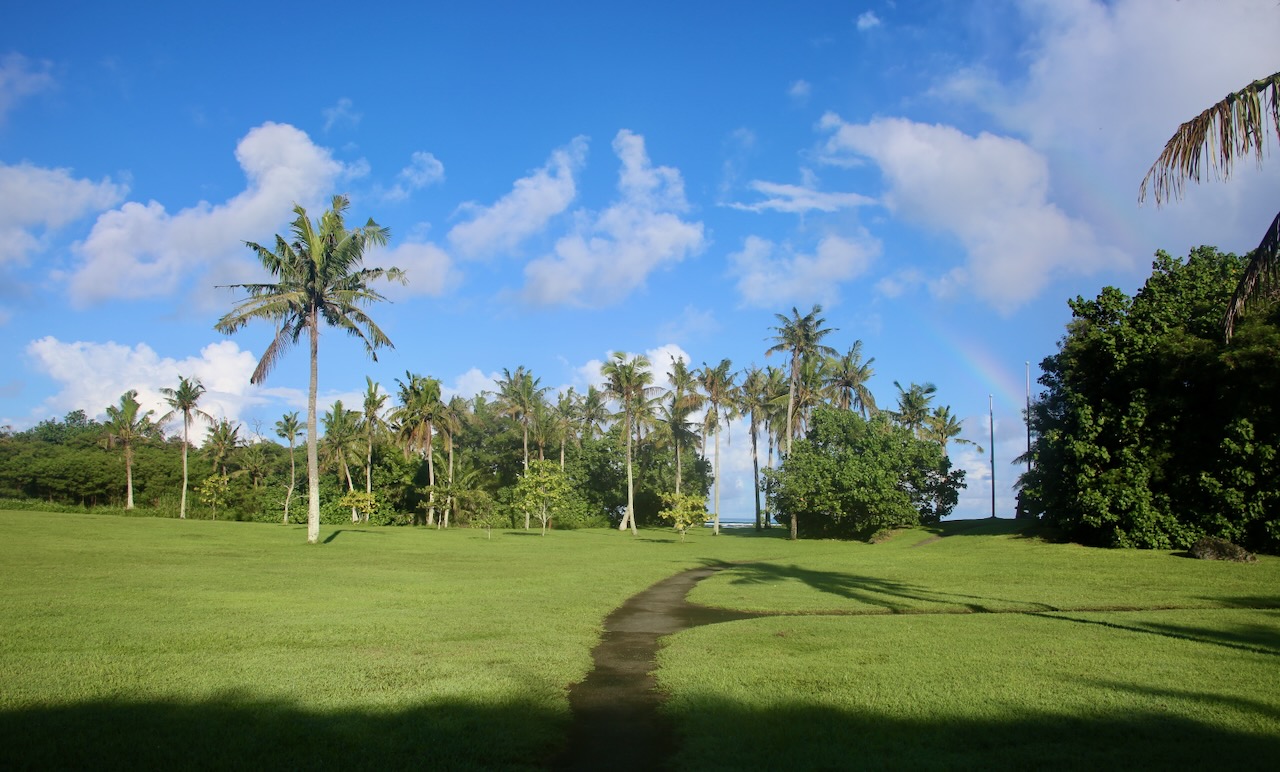
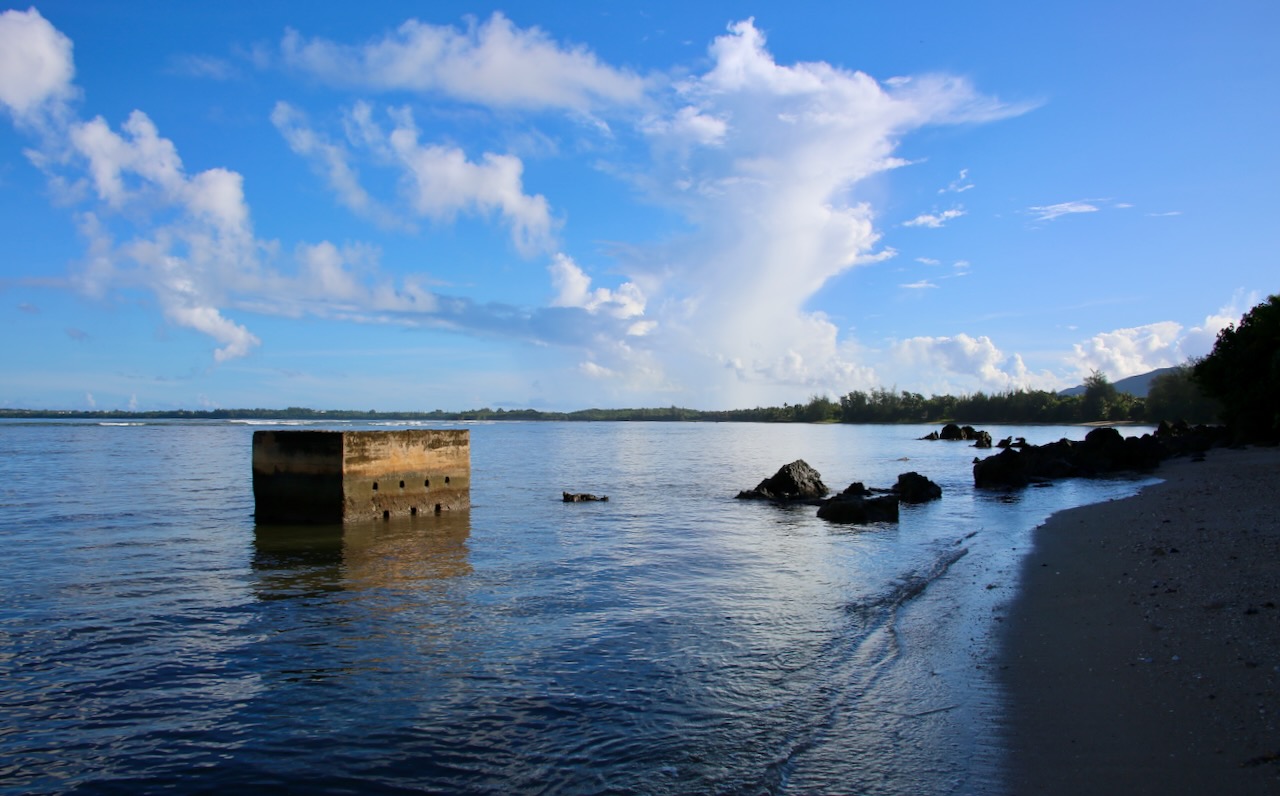
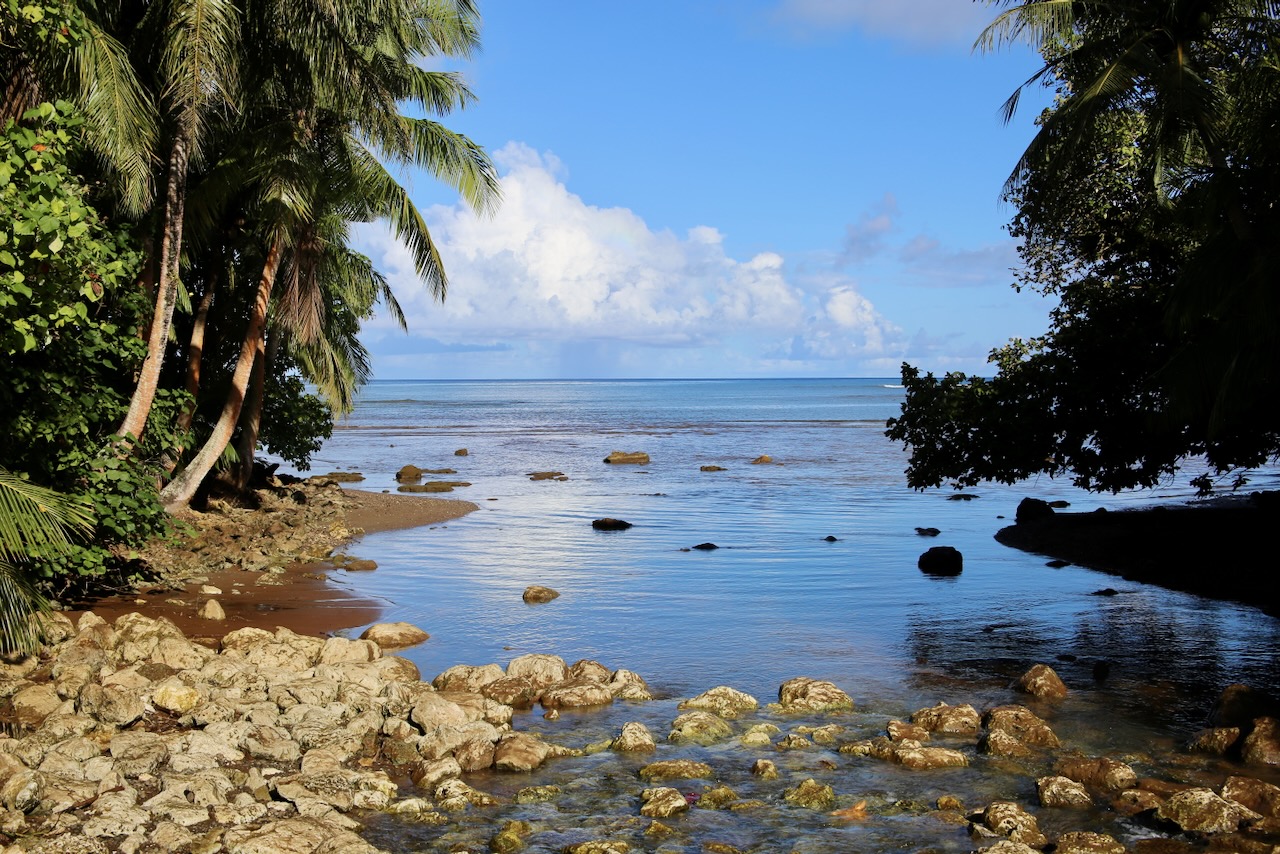
We stopped at Manny’s Bakeshop for some breakfast on the go. I start today’s sightseeing at Gab Gab Beach, which I have to myself. With my feet in the sand, I watch a baby blacktip reef shark, a spotted hermit crab, and a white ribbon eel explore the sandy depths and jagged rocks. There are also a few flathead grey mullet, a fish with a bad haircut name. I am also amazed at the layers of limestone, the colors of cumulus, and the reflection of rays. I understand why some cultures never stepped out of nature and into a board meeting; just because we can doesn’t mean we should.
Gab Gab Beach
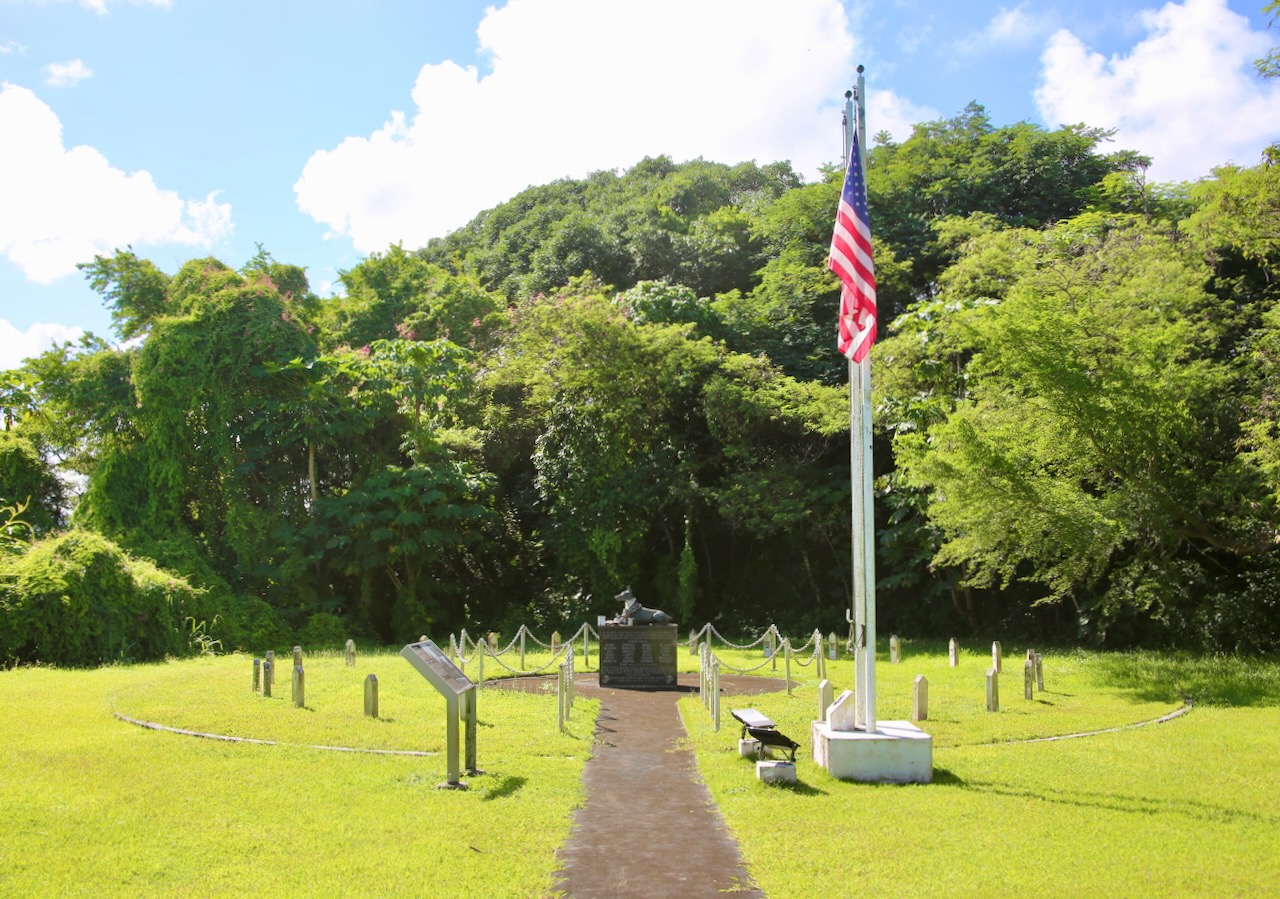
After soaking up some salt and sunshine, I was lucky enough to see a young Atlantic ghost crab, probably not due to its sandy camouflage, but its speed (over 2mph when running). Twenty-five dogs, mostly Doberman pinchers and German shepherds, helped the Marines sniff out mine fields, carry medical supplies, and warn of an approaching enemy. These duties cost these “Devil Dogs” their lives, but saved hundreds of Marines, so they are laid to rest with affection and respect in the War Dog Cemetery.
There is a simple, bright yellow sign with Historical Trail written in blue located on the roadside. The chainlink fence and concrete path are overgrown, so I park by the open gate and make my way into this secret garden. Somewhere on the Orote Peninsula is an old runway, parts of which are still used for military training, while I must have found an old parking lot. I see another sign, this one a bit weathered, telling me about a fuselage located 320 meters down the historic trail of sharp limestone, with the rest of the warning missing a few letters.
War Dog Cemetery
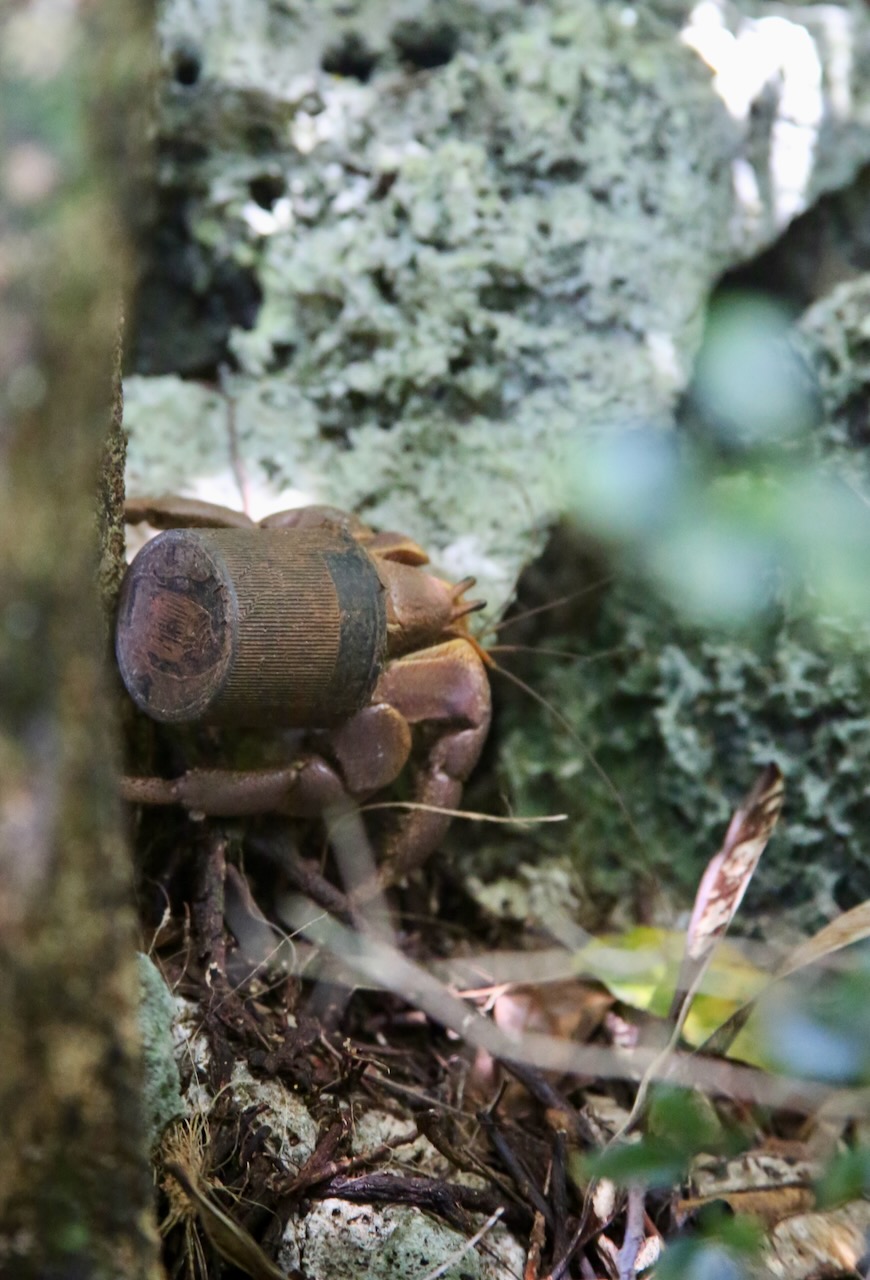
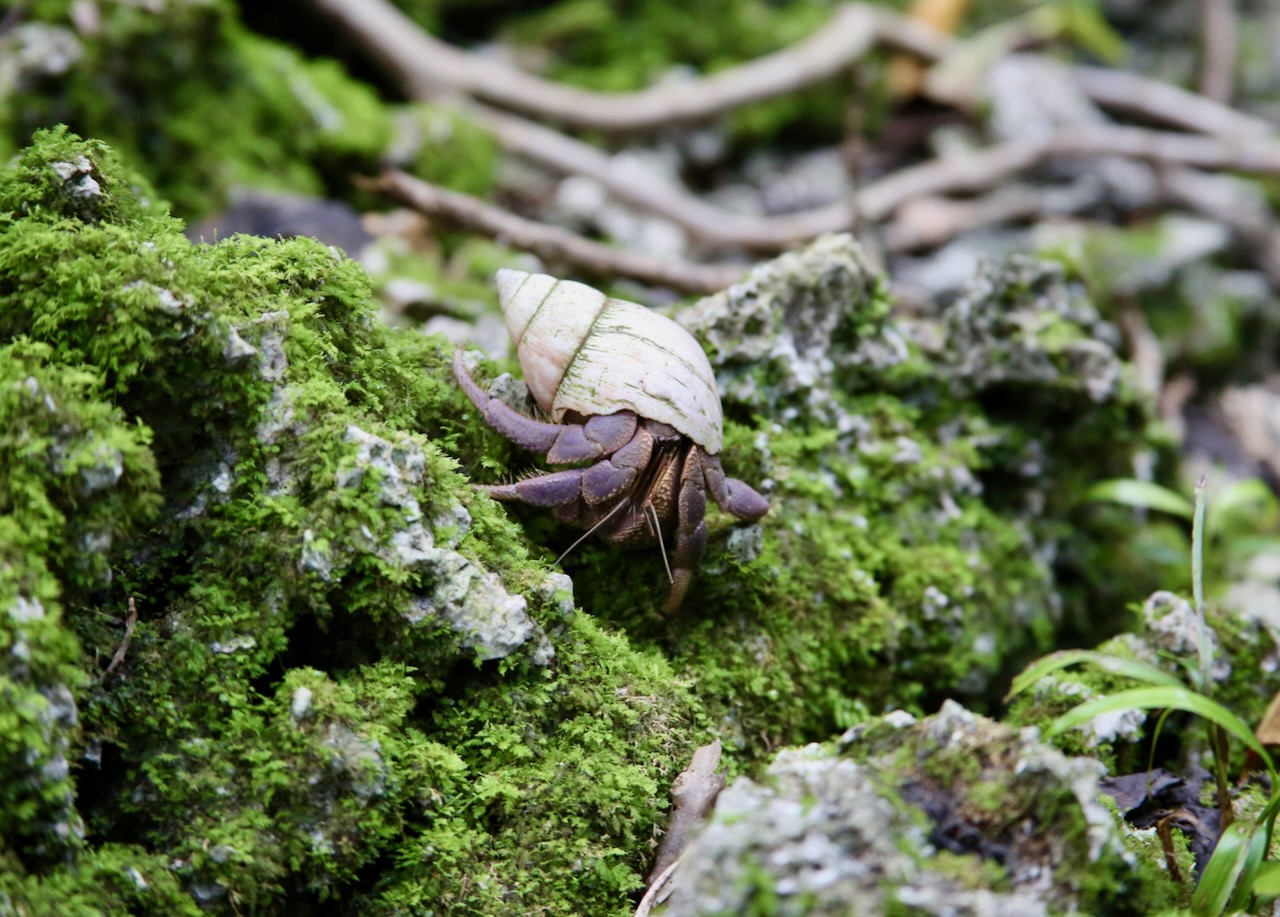
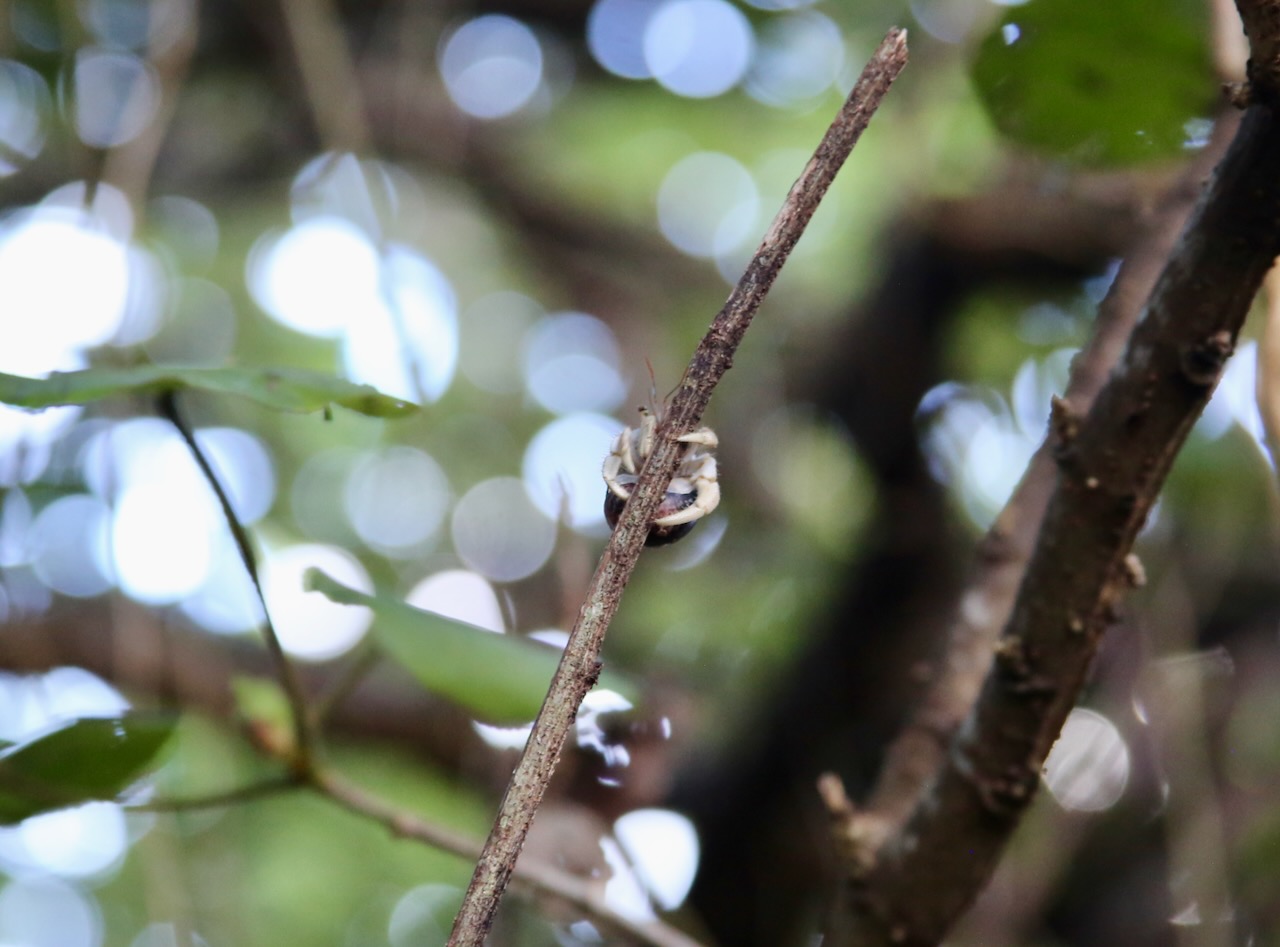
Always excited at a chance to explore, I set off into the jungle, the ground covered in the rough rock mentioned, in my flip flops. I am soon distracted by an Indonesian hermit crab and a female eggfly butterfly. This hike is going wonderfully, until twenty meters in, I’m ambushed by a swarm of mosquitoes that don’t stop stinging me until I reach the clearing. Perhaps I should’ve run the other way, but I had no idea what other diversions and traps awaited. I make my way back to the car, sad that I wasn’t more prepared to deal with the bothersome, so I could indulge in the beautiful.
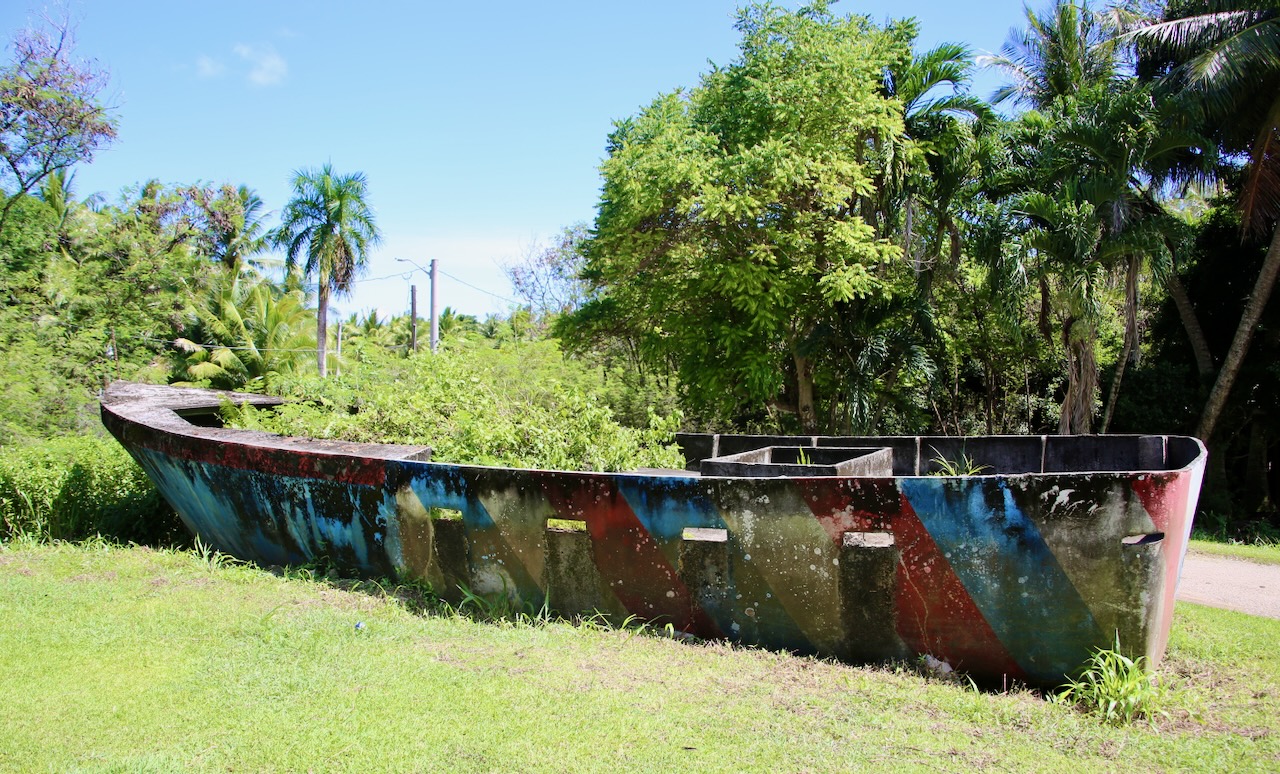
I get to the security gate as a guy is dropping off Caleb, so we can get Thai food (likely from Lemon Grass Restaurant) for an early lunch, and then I return him to work at noon. I drive to the T. Stell Newman (the first superintendent for the park) Visitor Center. Outside is a two-man submarine that ran aground more than a week after the battle ended. The Japanese built more than 2,000 of these over ten years, and these subs are credited with sinking only one ship during WWII. At the end of the war, most other military equipment was to become artificial reefs.
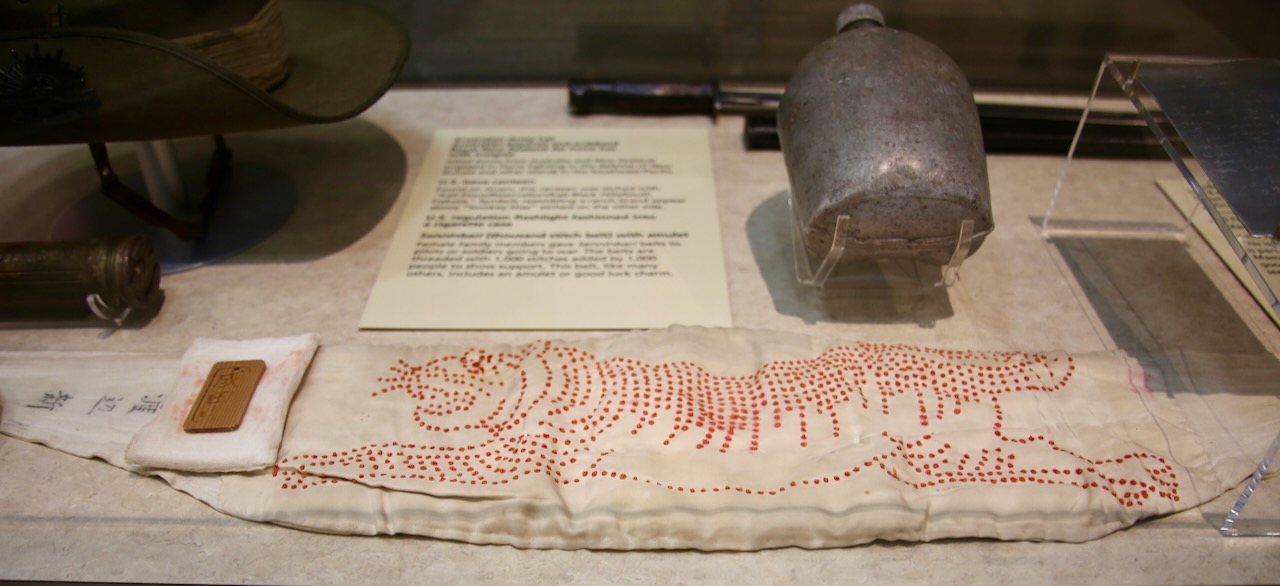
Senninbari (thousand stitch belt) with an amulet
America brought in the Navajos to develop a code based on their language that baffled the Japanese, and that would be used for decades after the war. America used second-generation Japanese-Americans (Nisei) to translate Japanese. It takes a lot of violence and usually behind-the-scenes peaceful operations to win a war or come to an agreement faster. I hope that in a thousand years, this island can find more focus on a thriving turtle population than on the history of humans trying to destroy each other. I leave the museum with two stamps in a cute envelope and make my way around the southern end of the island, this time past Umatac Bridge.
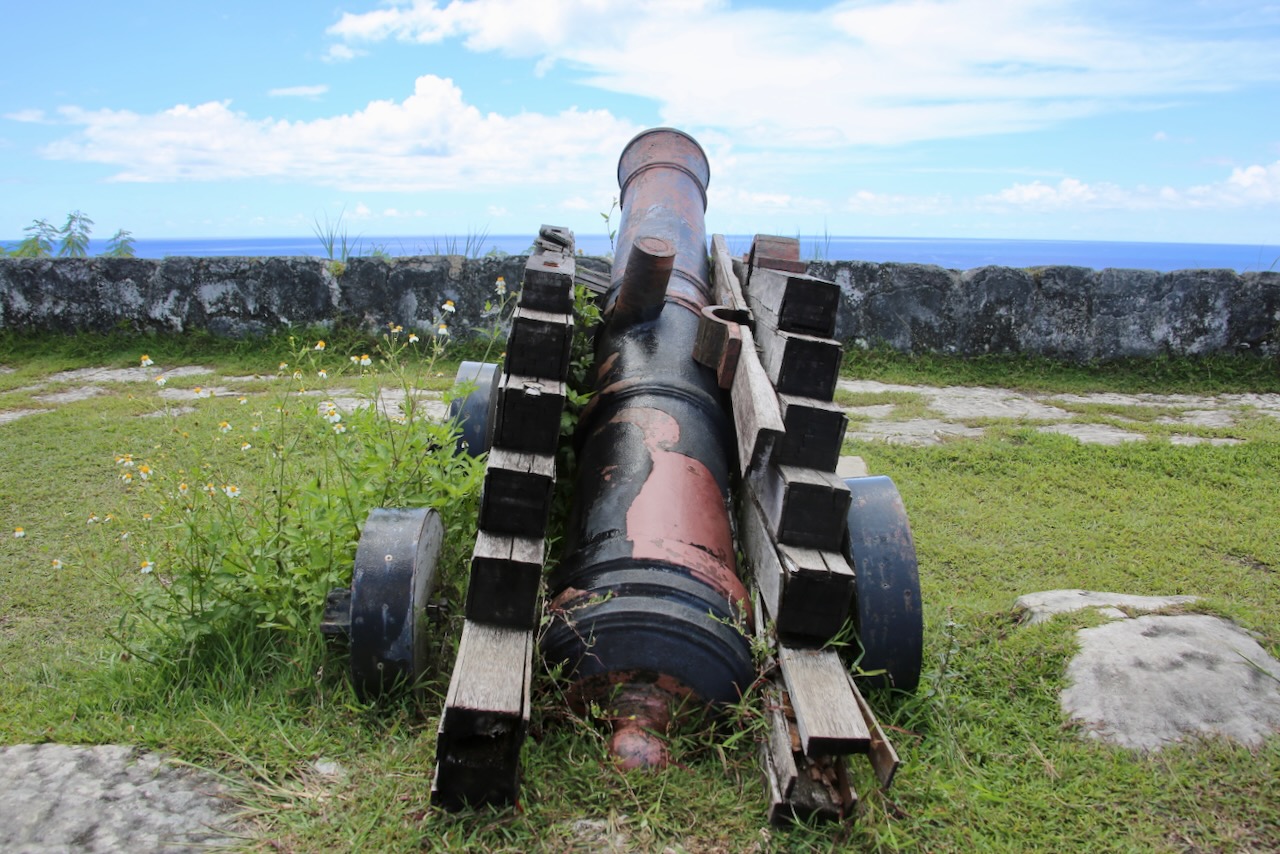
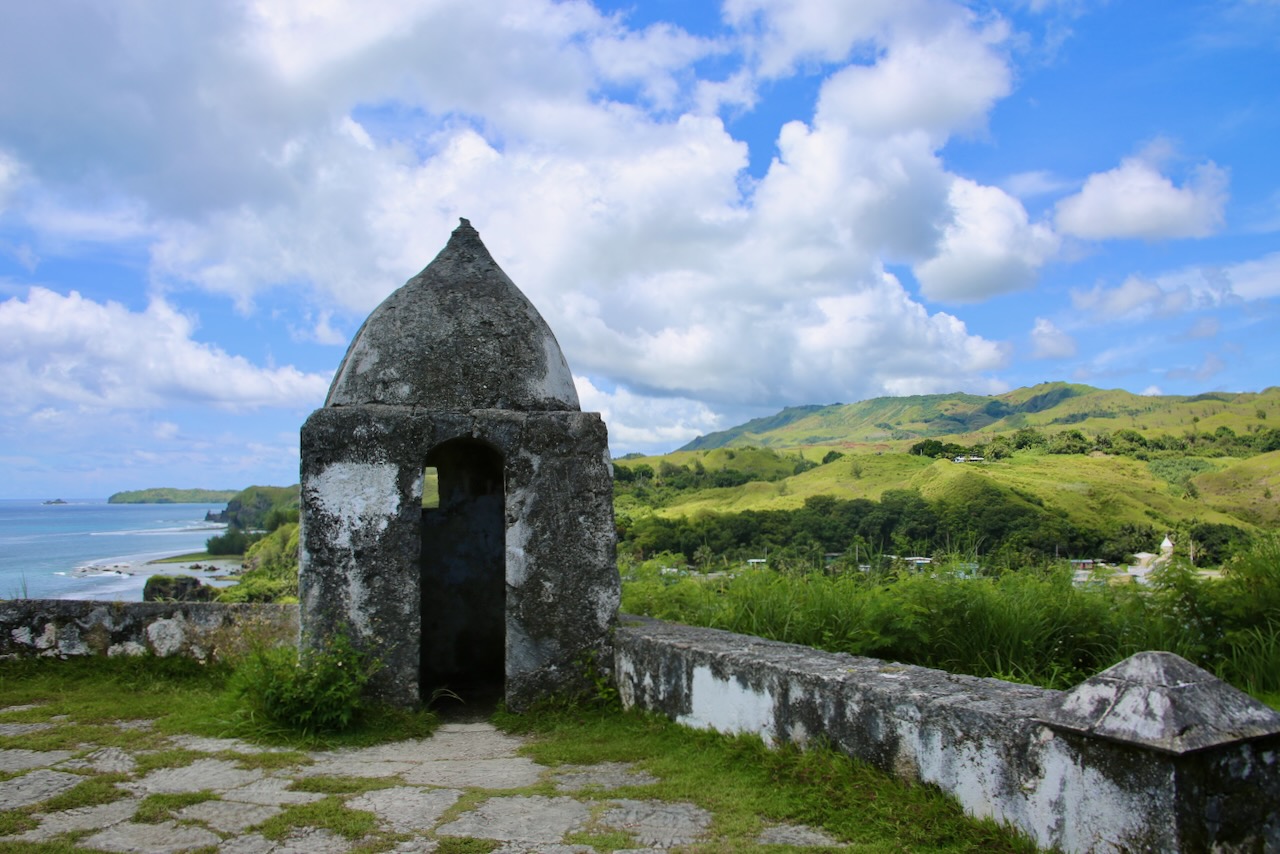
Fort Nuestra de la Soledad, 1810, the last of four fortifications built by the Spanish to protect their replenishment spot between Mexico and the Philippines from pirates, was left to weather and treasure hunters by 1815. After WWII, the remaining crumbles and cannons were turned into a park, which is what I get to see today, with vast views of the sea below. A few minutes away is the Merizo Pier Park, where a few signs talk about the boats (sakman and galaide’ proa), hooks (bones of fish and human), nets (lagua’ pula, and the central tenet of Chamorro culture (inafa’ maolek – to make good: repair relationships, maintain peace, and ensure the community thrives together).
The large pier is used for swimming, and the skinnier piers have cleats, but only tourists with kids and cameras on them, no boats. The 24-foot tiered Merizo Bell Tower might not look like much, but its significance comes from the blend of Spanish colonial architecture (mamposteria) in 1910 and the local identity. The Chamorro used the bell as a call to worship, a notice for village meetings, and disaster warnings. The bell was listed in 1975 on the National Register of Historic Places.
There is a trail behind the San Dimas Church with a metal railing that accompanies a majority of the climbing path. From the top, I can see Cocos Island, roughly a mile from the mainland and just as long, and only available for day trips. The ferry across is supposedly $40 for tourists, but the bird watching is greater than on the mainland. It’s cute to see small islands taking advantage of smaller islands as getaway destinations, and a place to charge visitors even more.
Family Beach
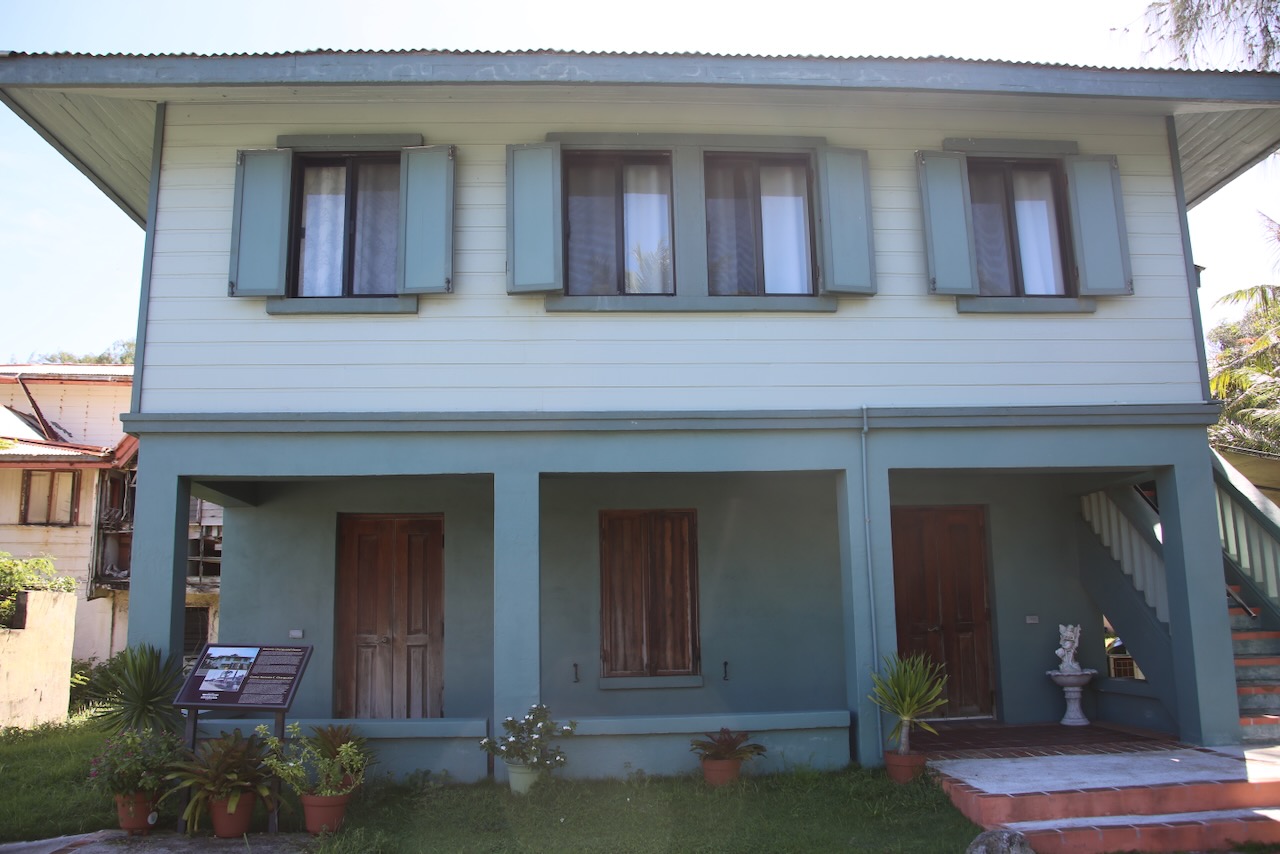
Instead of dealing with ferry schedules and fees, I’ll check out some abandoned cars along the road and then get in the water at a nearby beach. I have yet to meet an empty beach that I don’t love. The Antonia Chargualaf House was built in the 1940s of ifil (termite-resistant hardwood) posts, flooring, and framing. During the Japanese occupation, it was used to distribute rice to the village residents, and the couple that lived there raised their ten children. The house was destroyed in 2002 and rebuilt in 2018, with the help of the Guam Preservation Trust, to modern standards, ensuring its longevity.
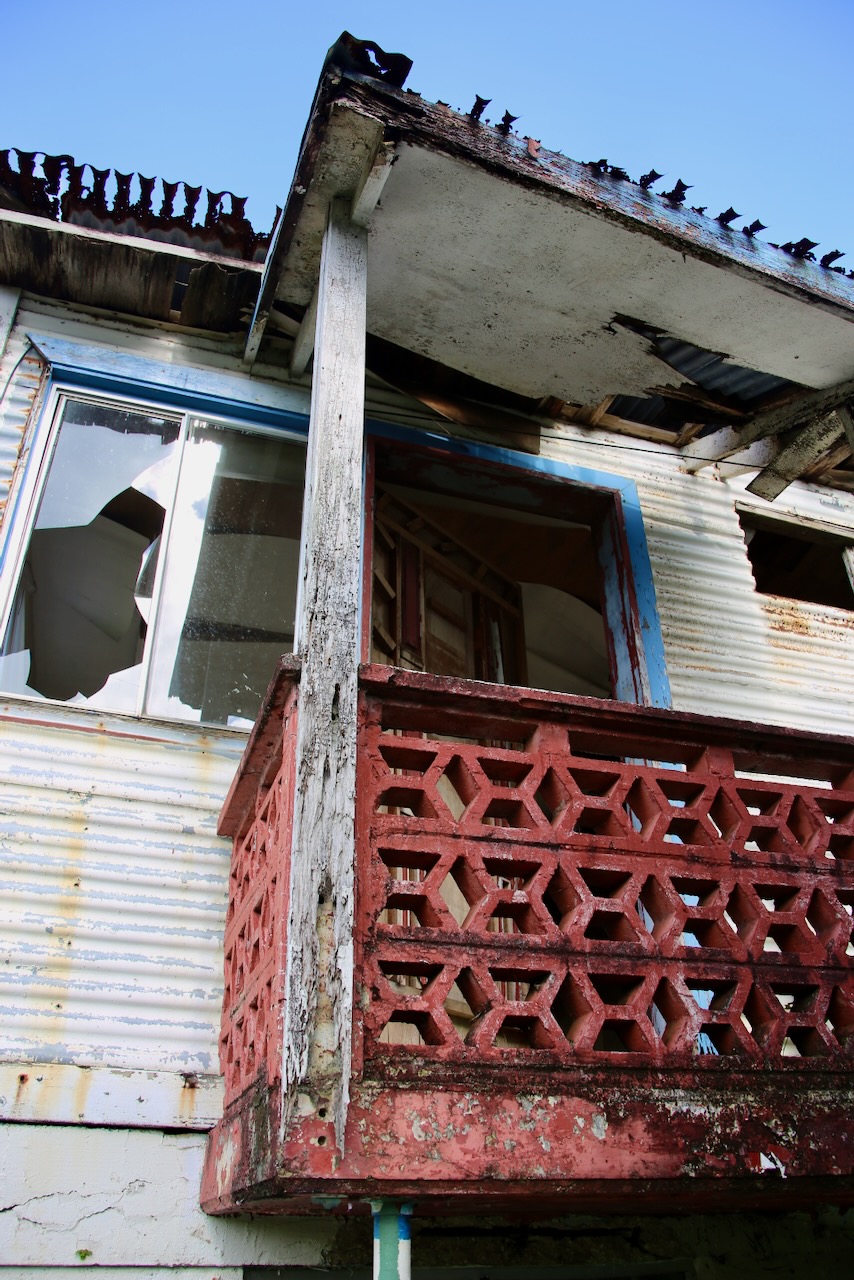
The house is seen as a symbol of CHamoru resilience and heritage that can be used to teach others about architecture, family life, and community. Meanwhile, the surrounding homes were left in a state of disrepair due to WWII, neglect, typhoons, and the widening of Highway 4, which runs directly through the historic district. It’s not until I turn onto the 4A to complete the southern loop that I get lost and end up in someone’s yard, with a car-attacking dog. I’m not sure if just overly friendly in an aggressive way or doing its part to ensure a strict no-visitor policy.
I’ll spend the rest of the late afternoon at Family Beach, which is better for a BBQ than it is for swimming, but apparently a great area for snorkeling and diving. The road is in rough condition, perhaps because the slender shore is sandwiched between restricted areas, either municipal or military. I meet some divers who tell me that Gun Beach is good for seeing turtles and watching octopus porn. I should’ve told them to wait there while I picked up Caleb, and then we could go diving together, but it takes us an hour to reach the room after he gets off work.
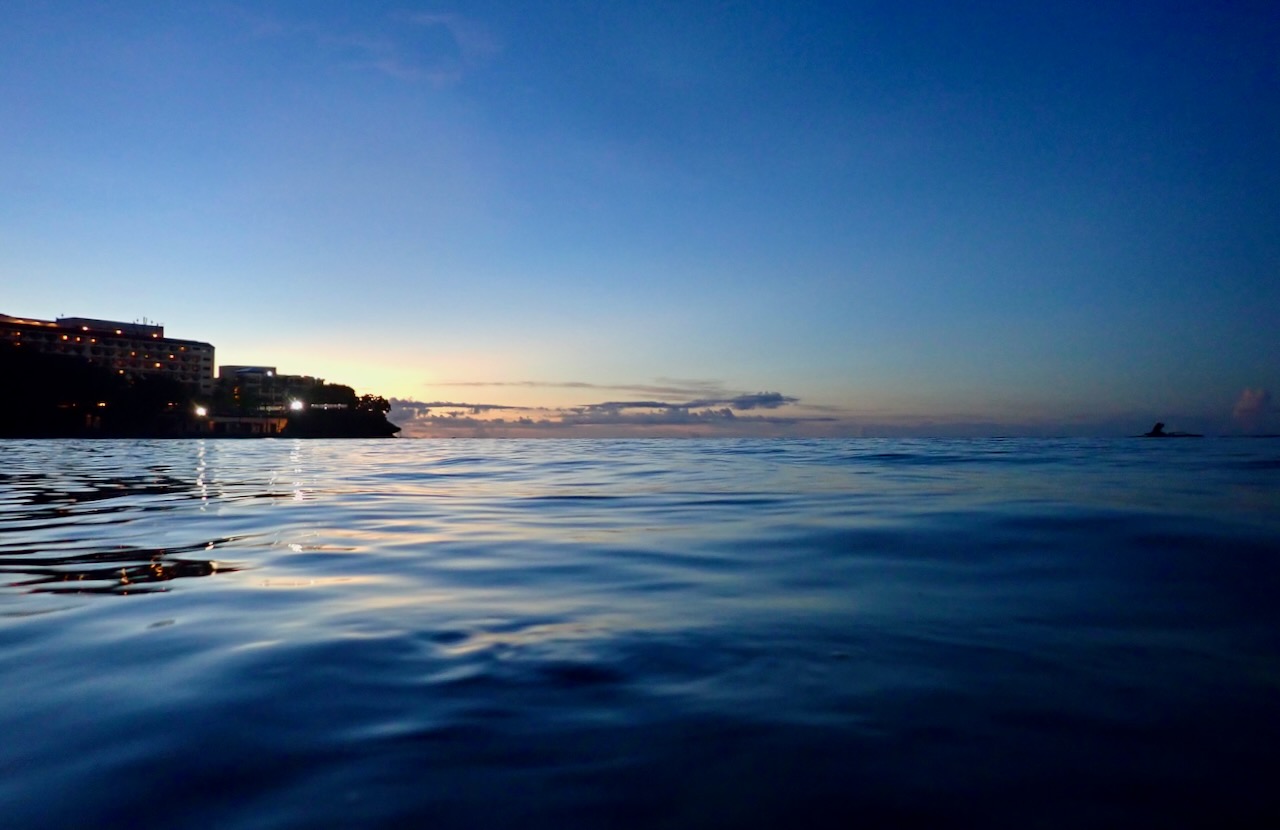
We walk to Ypao Beach to snorkel in the darkening waters of sunset and see more sea cucumbers, another Moorish idol, and a boxfish (one of my favorites). Now that Caleb has rinsed off the sweat in the ocean, he can rinse off the salt in the shower before dinner. Then we go searching for coconut crabs on the dimly lit beach, Caleb in shoes and me barefoot. I have no trouble adjusting to island life and am sufficiently tired when we return. We rinse our feet and go to bed.
Up at dawn and sit on the balcony, watching the sunrise as people get in the water and enjoy the rest of the park. On our way to breakfast, I notice the $5.14 per gallon sign, but even more eye-catching is what’s written below: Losers sulk; posers talk; winners walk – choose wisely. We chose the Rancho combo from Linda’s Diner so that I could have more than not-so-good boxed pineapple shortbread. The French toast and coffee fill me up.
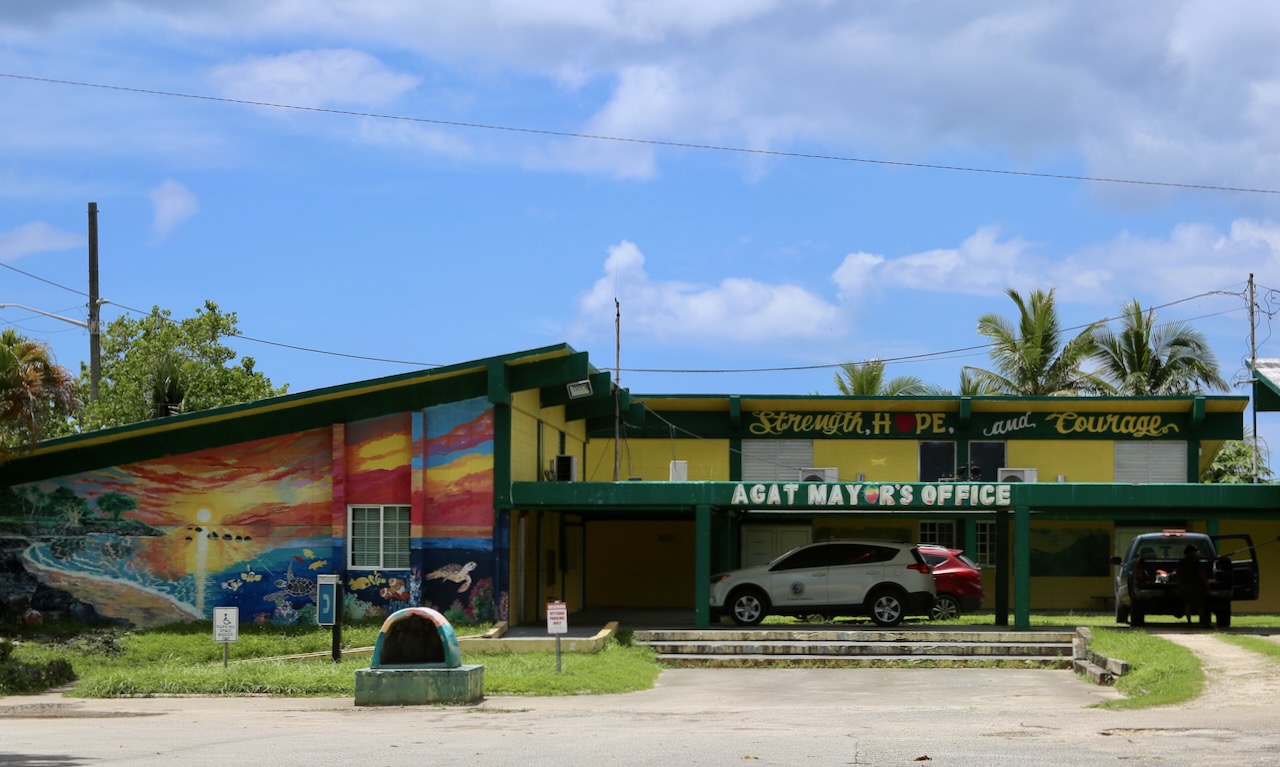
Caleb is off to complete military chores while I spend the morning exploring. I start at Ga’an Point, where the American Navy landed in July 1944 and cleared the dense groves of coconut palms to build shelters for the more than 6,000 Chamorros released from Japanese concentration camps on the east side of the island. This explains why the interpretive signs are written in English, Chamorro, and Japanese. The next sign at the War in the Pacific National Historical Park warns about the current dangers of the tens of thousands of bombs, grenades, or shells dropped during WWII on a patch of land the size of the city of Chicago.
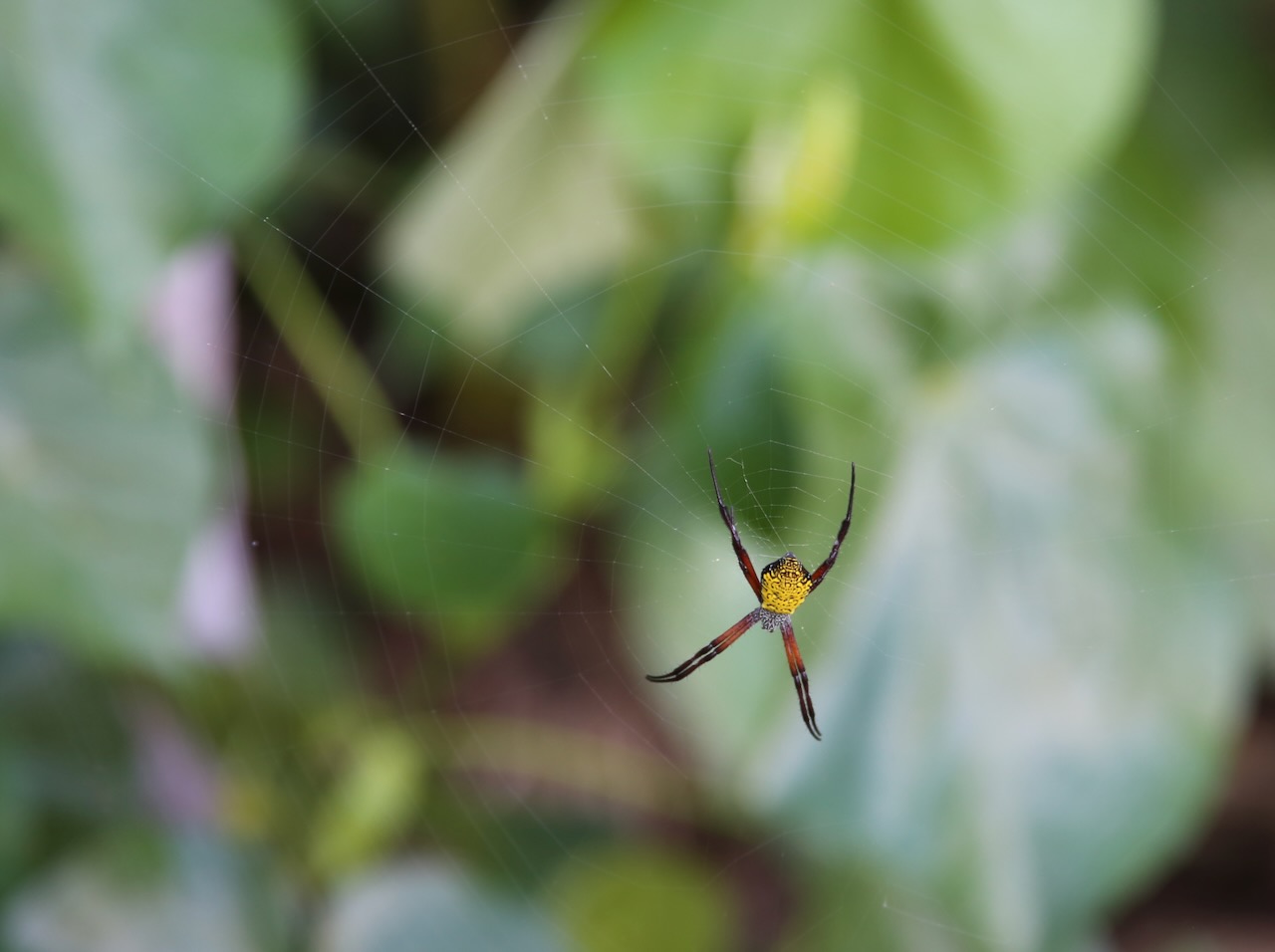
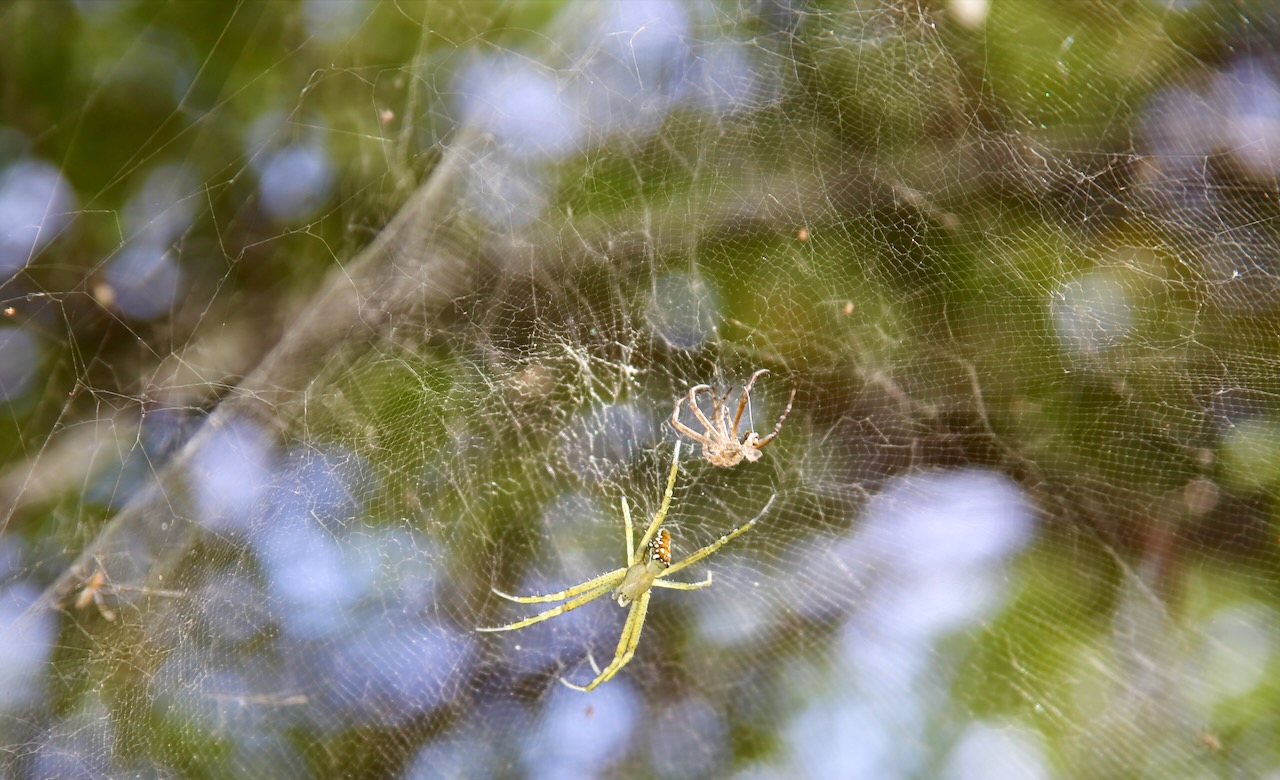
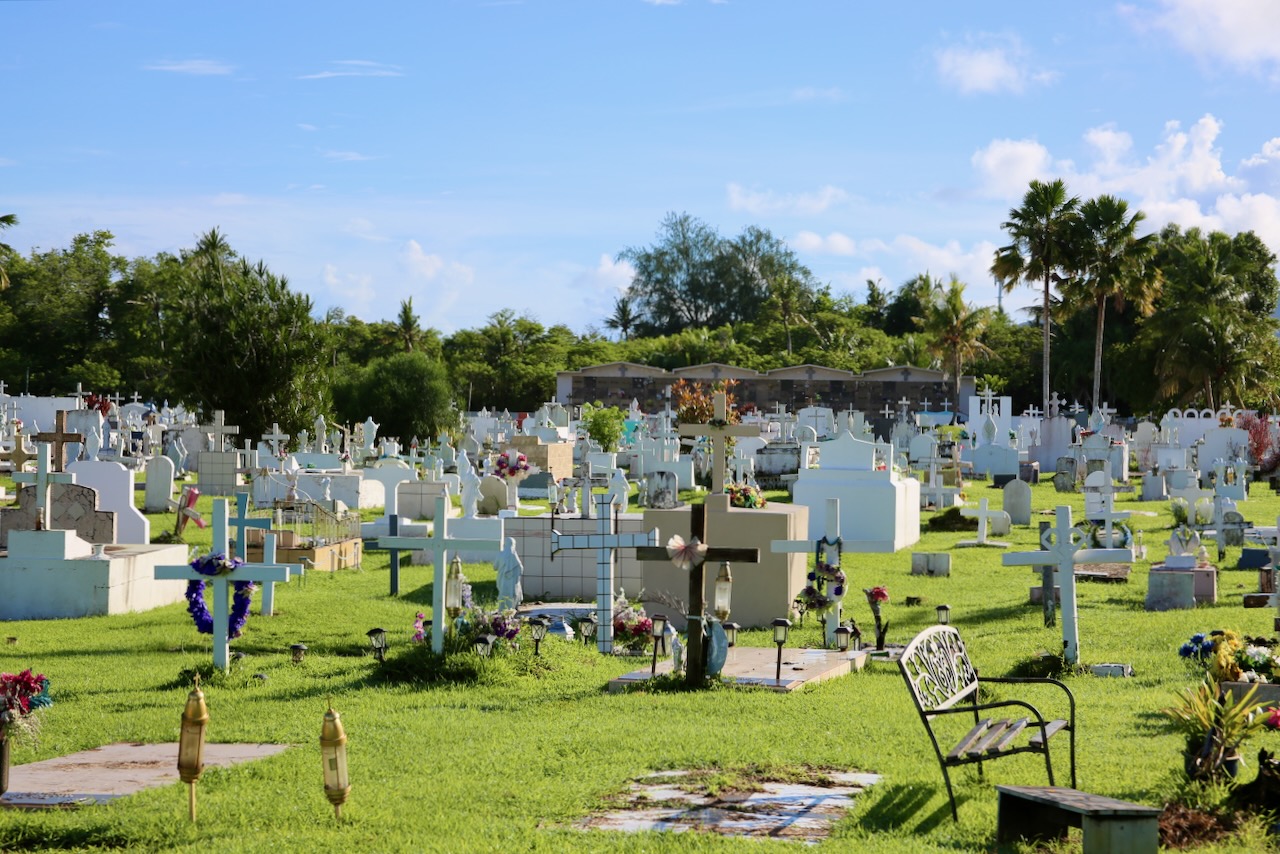
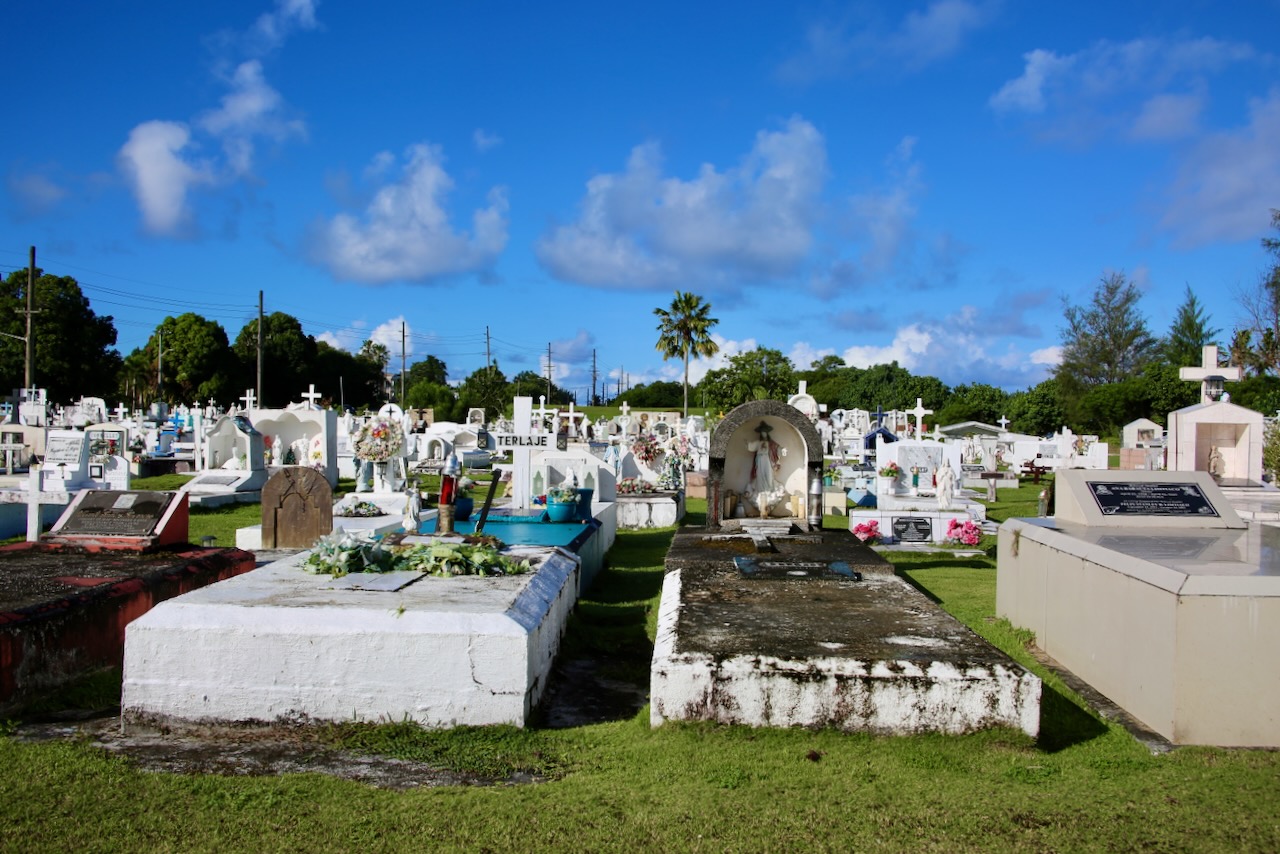
The views are tropical, the water inviting, the spiders vibrant, and the crabs confident in climbing and socializing. By August 1944, the Seabees had extended runways, and Apra Harbor became a major supply port for the US island-hopping offensive. I take a short walk through the Mount Carmel Catholic Cemetery beside the Agat Unit of the park (there are seven) to appreciate the commonalities and nuances of how different cultures remember their ancestors.
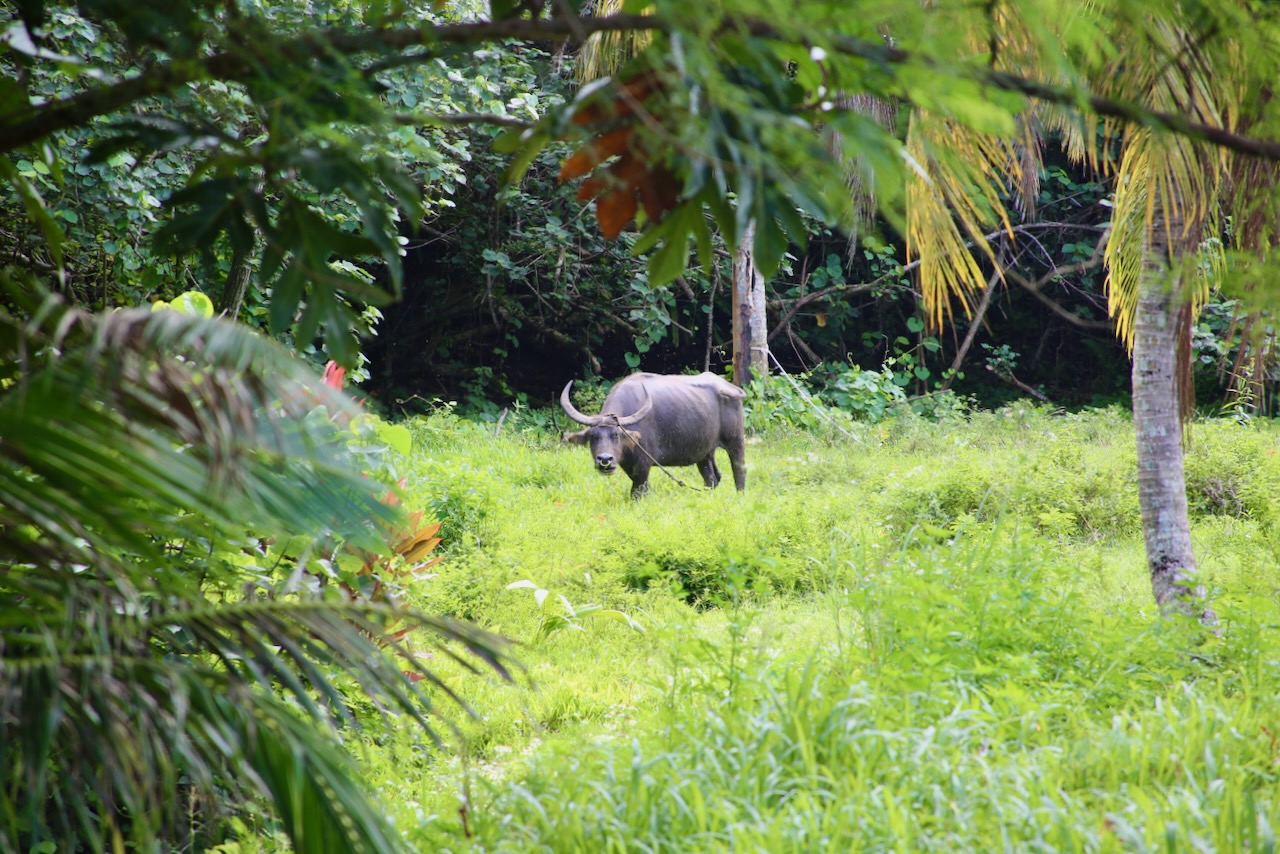
After this, I’m back to the water in a few minutes as I admire the Historic Talaifak Bridge that’s not really that old. The current stone version was built in the 60s, but I would be impressed if the wooden original from the 1780s still stood. On my way to Sella Bay, or to get a look at Mt. Lamlam (the world’s tallest mountain), I spot my first carabao, a swamp-type water buffalo, used for draft work and likely brought to the island by Spanish colonists. I also see a many-lined sun skink that’s better at blending into its surroundings. All the animals seem unconcerned with my presence.
I meet many friendly locals as I make my way from Sella Bay Overlook to Cetti Bay Overlook, both of which are inland, where there is more evidence of the volcanic history in the area. There is also a 1.2-mile hike to a waterfall, which is steep and takes about three hours. I could have ventured in, but as I’ll be meeting Caleb soon, I saved the temptation of going into the forest for driving further south along the island. Evidence of the Spanish colonization, thanks to the ruins of the San Dionisio Church, is still present from 1862.
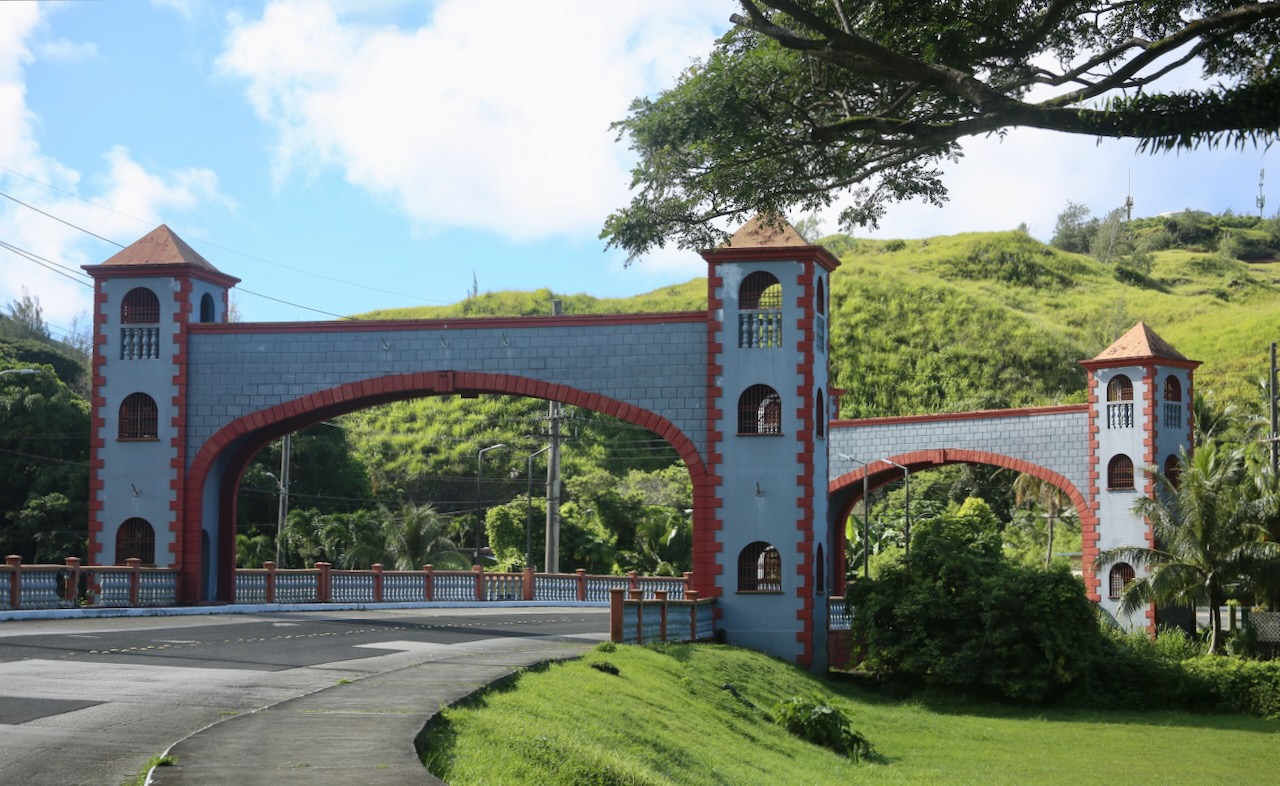
The first version of the church was erected in 1681 of wood and thatch, but was burned down. The next one was destroyed by a typhoon, and the three after by earthquakes. The Spanish ceded Guam to the US in 1898, so when another earthquake destroyed the latest rebuild in 1902, the structure was never put back together again. This leaves some Spanish stone masonry behind to be grown over by local plants and moss. A few hundred meters away is the Umatac Bridge, built in the 1980s, to resemble the Spanish-era bridge that stood before it, with the railing along the road to match.
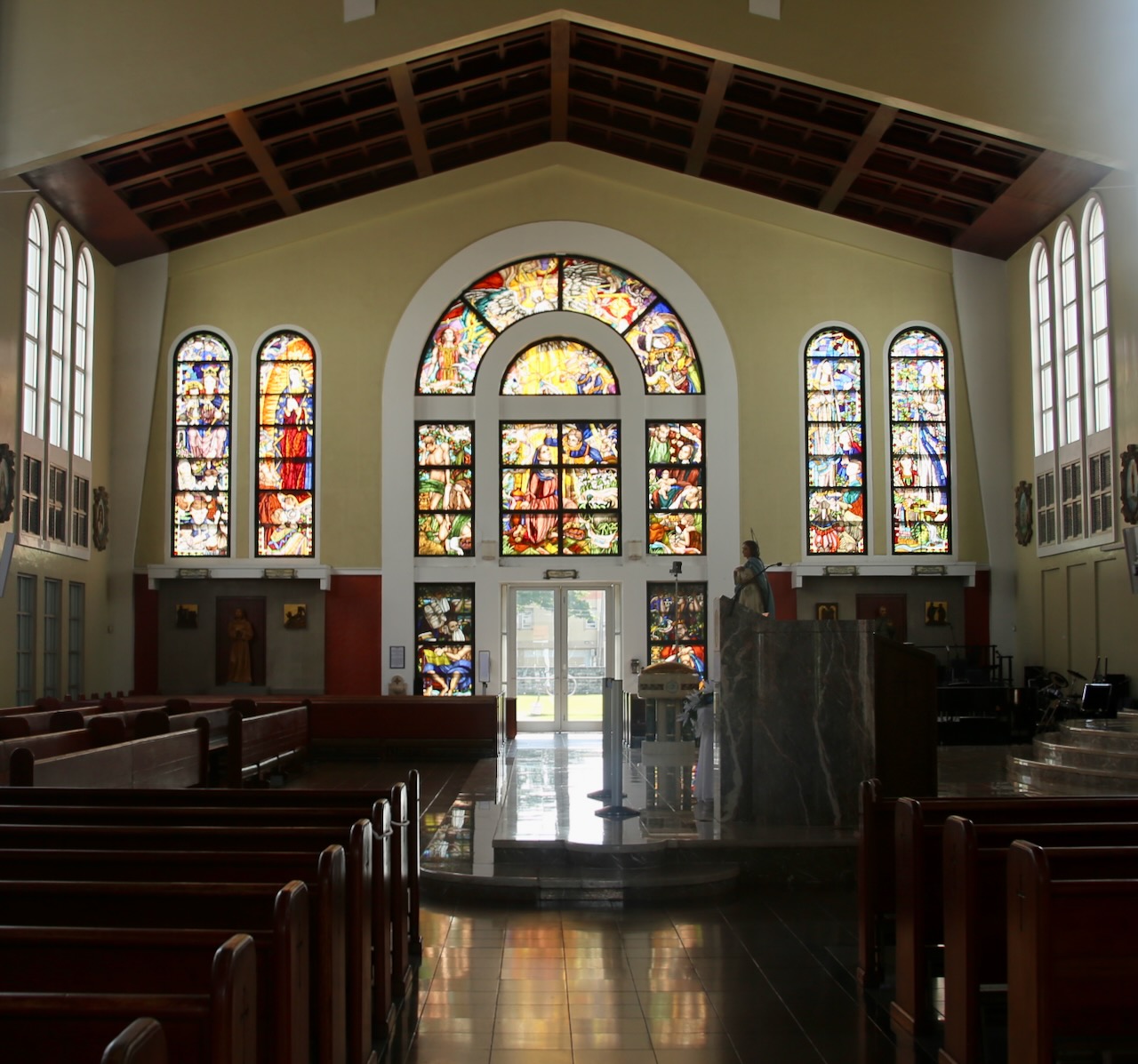
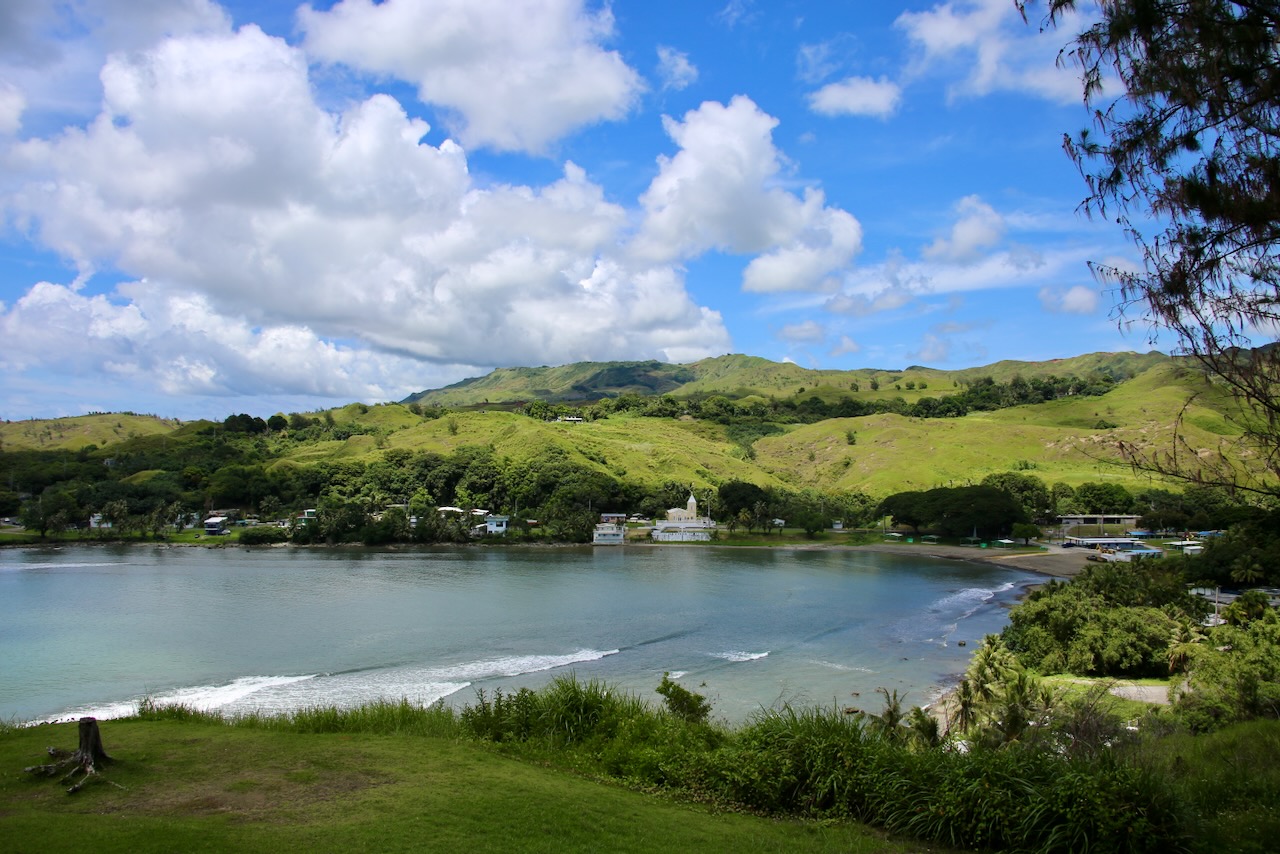
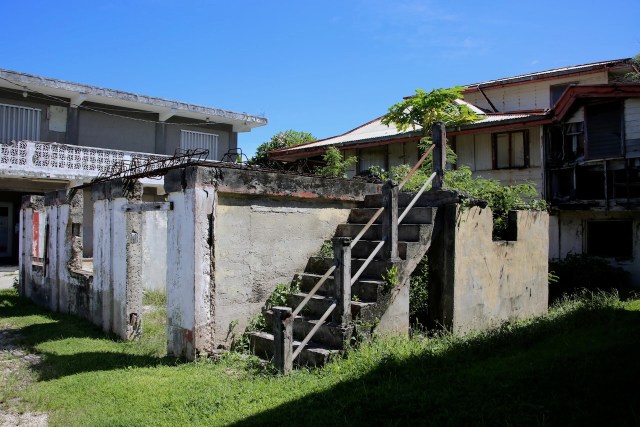
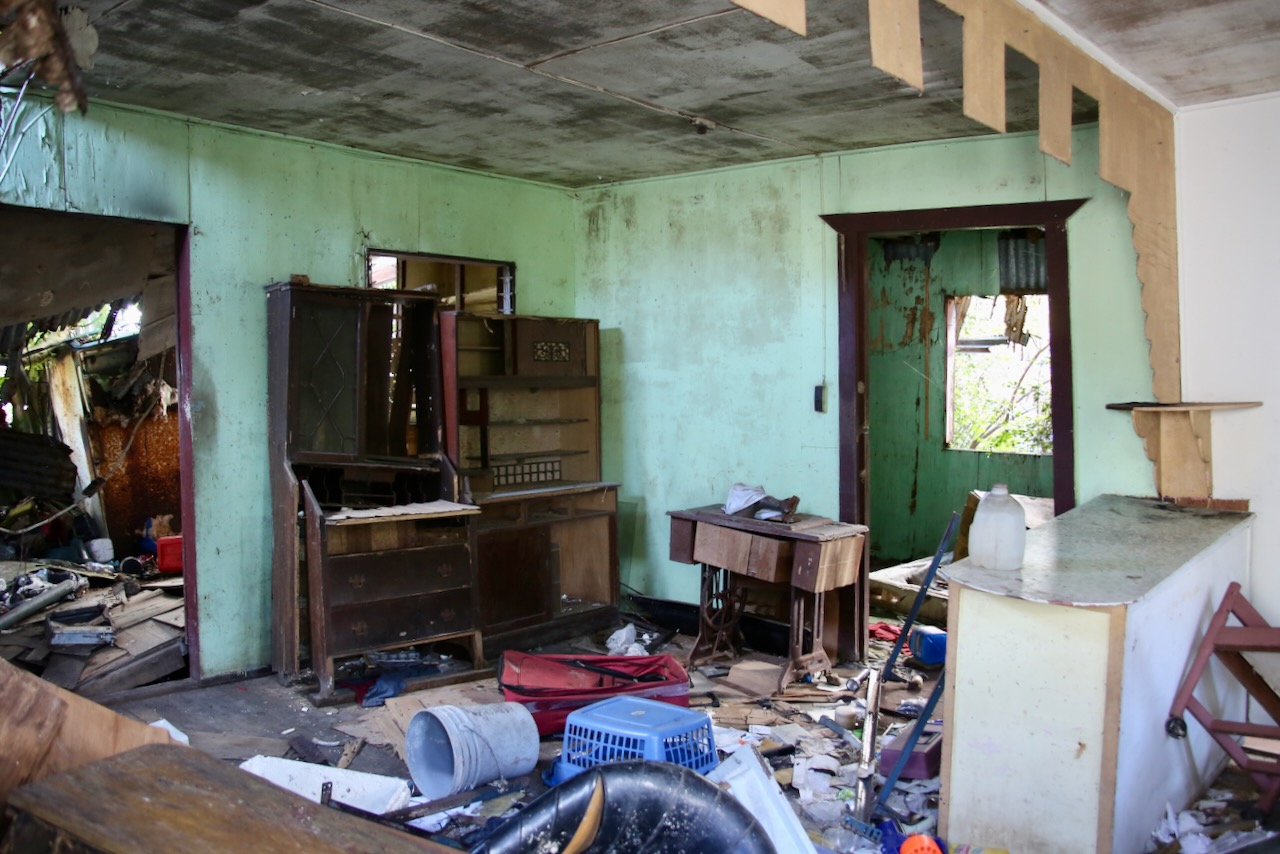
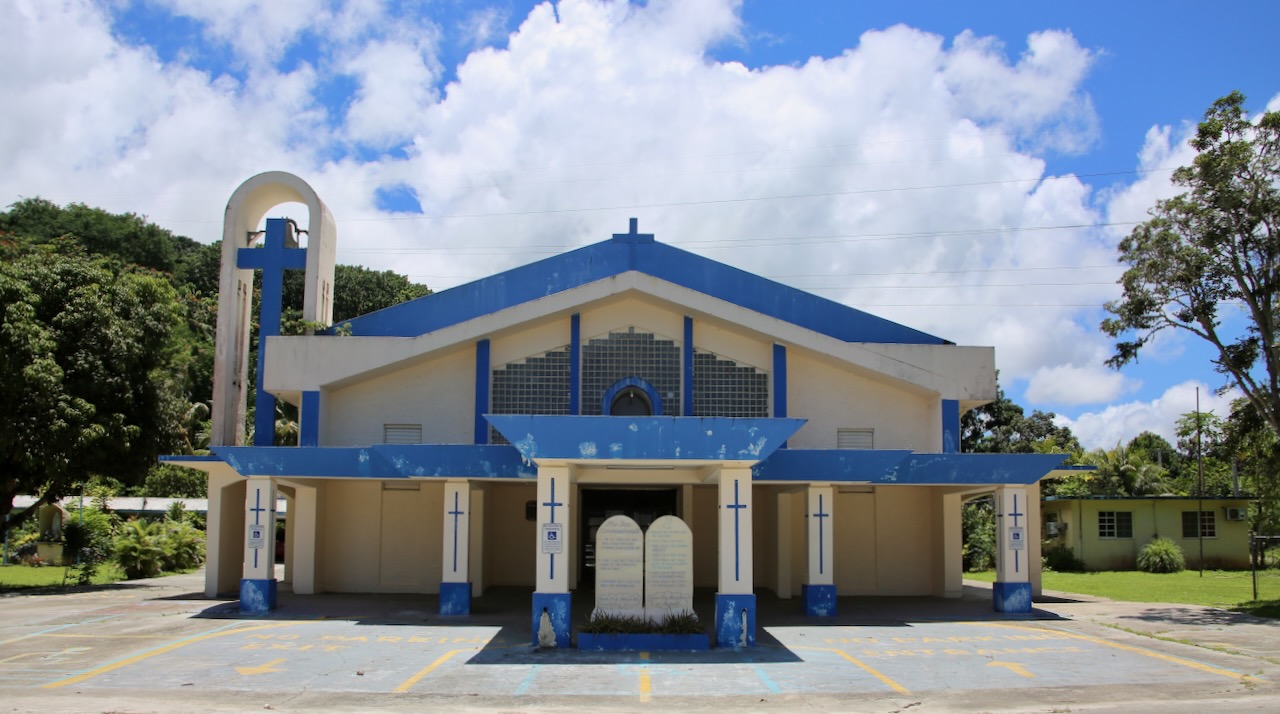
This is my turnaround point, and I get to see the new San Dionisio Church, built in 1939 on the site of the Spanish Governor’s summer house. This church has been able to withstand WWII, a series of typhoons, and a massive earthquake in 1993, making it one of the two oldest churches in Guam that is still in use. Instead of holy water, there is a bottle of hand sanitizer by the door, and the six-feet-apart stickers from Covid leading the way between the pews. Some of the nearby houses didn’t fare so well in the natural disasters and were left to be neglected until the next storm can finish the job.
There is a small park that memorializes the 74 Chamorro men out of the 4,000 who served and didn’t make it home. Guam was a medivac station, a forward attack base (temporary base near the front lines), a processing center for over 100,000 refugees, the first US soil for MIAs (missing-in-action), and a “rest and recuperation” area like Bangkok, Tokyo, Taipei, and Honolulu for soldiers and nurses serving multiple tours overseas. For shorter breaks in-country, they were offered Da Nang Beach, Vung Tau, and Saigon. This park was established by the Guam Women’s Club and later adopted by different men’s associations of America and Guam.
carabao
I drive the twenty minutes to base, hang out with Caleb while we wash his laundry, and then he takes me to Piti Guns Trail, another unit of the War in the Pacific NHP, to show me where he went with Smeltkop, a guy who works for him. It’s a wet forest, as everything on this most humid of islands usually is, but we are smart not to slip and slide in flip-flops and lucky to be here on a drier day. We stop at Asan Landing Beach, a third unit, now quiet and imbued with serenity, with a history of a different vibe. We visit the room to eat lunch before continuing on.
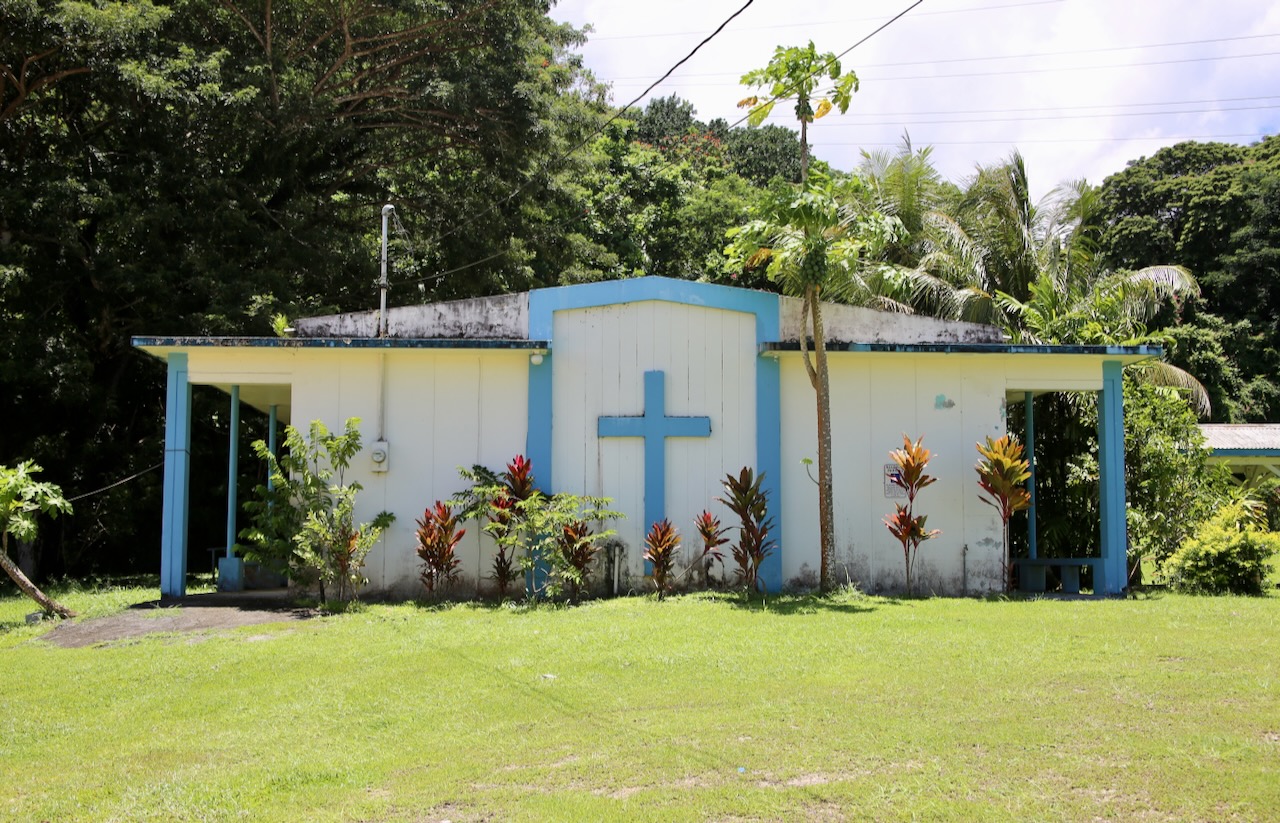
church by Piti Guns Trail
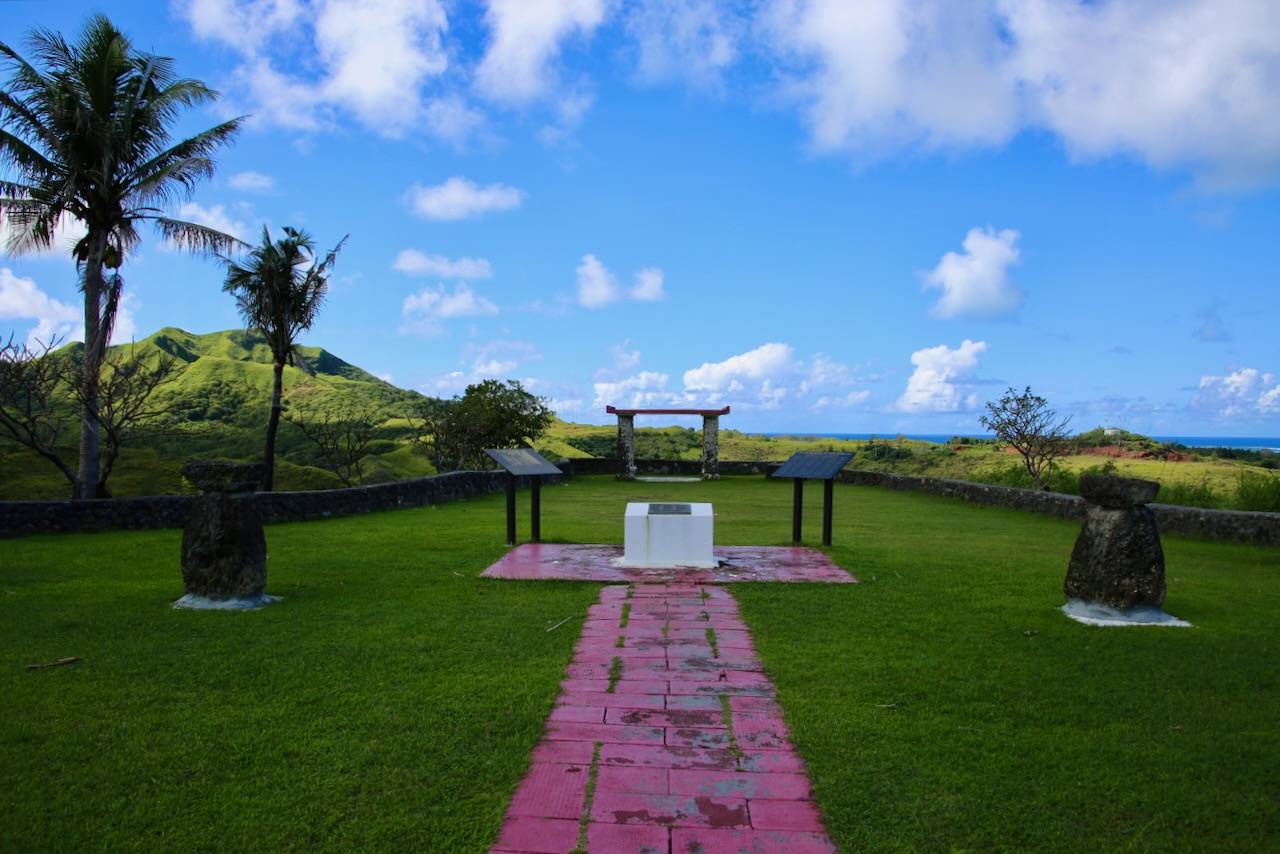
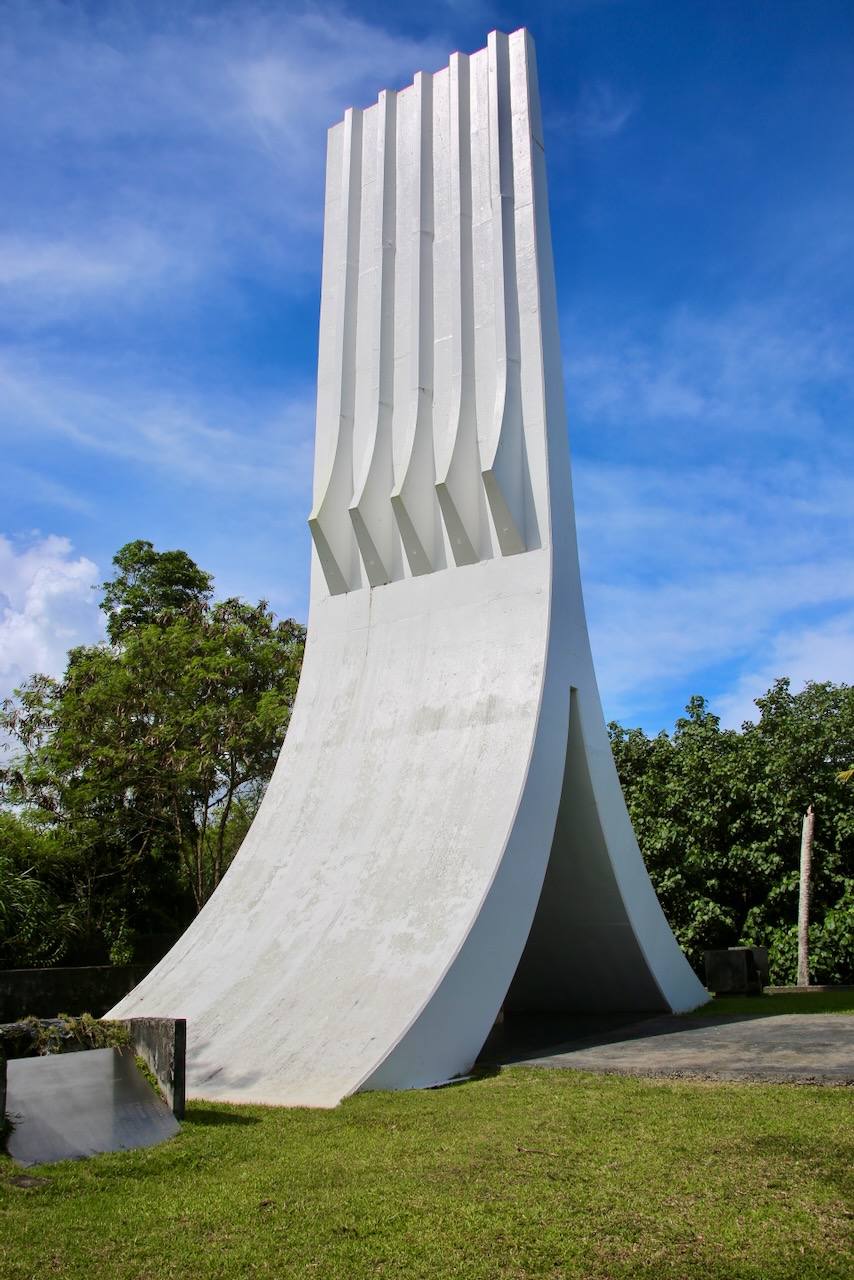
Our next stop, the Ritidian Unit of the Guam National Wildlife Refuge, is closed when we get there. The military owns two other units that make up 95% of the park, and their initiative is to preserve the Serianthes nelsonii tree, which only grows on Guam and Rota of the CNMI. The other five percent preserve a pre-Magellan village, a former barrier reef now a cliff, and a nesting site for threatened green sea turtles (which is what we were hoping to see). Instead, we will visit the South Pacific Memorial Peace Park featuring a 50-foot-tall monument of clasped hands to remember the fallen and maintain peace.
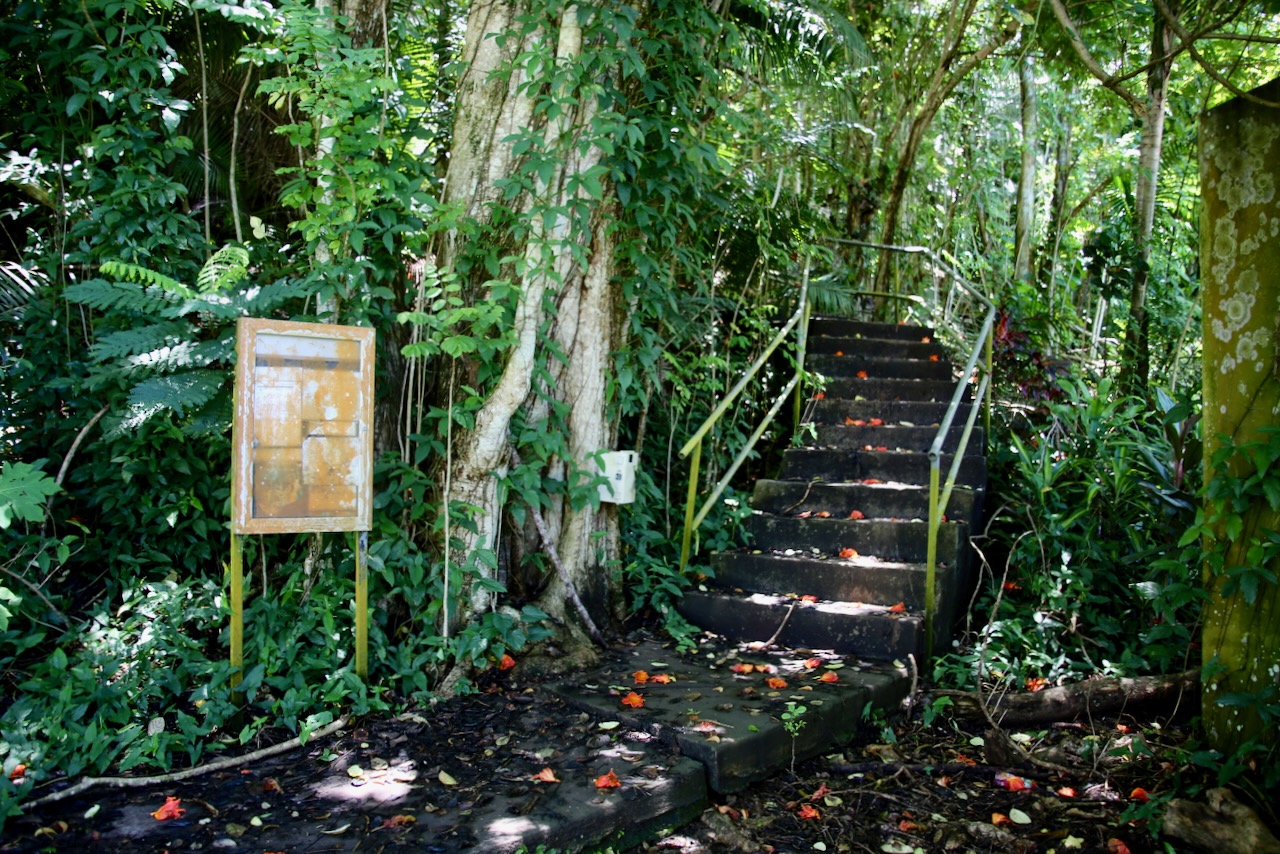
Piti Guns Trail
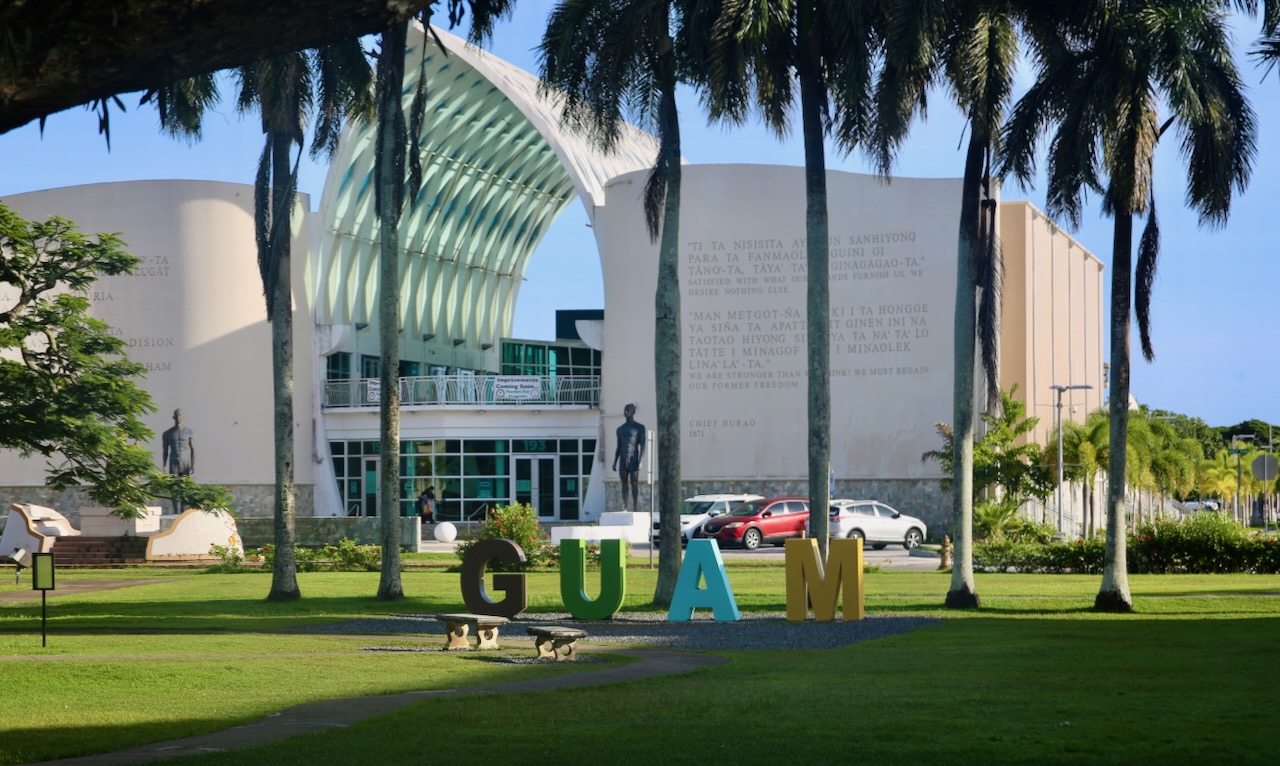
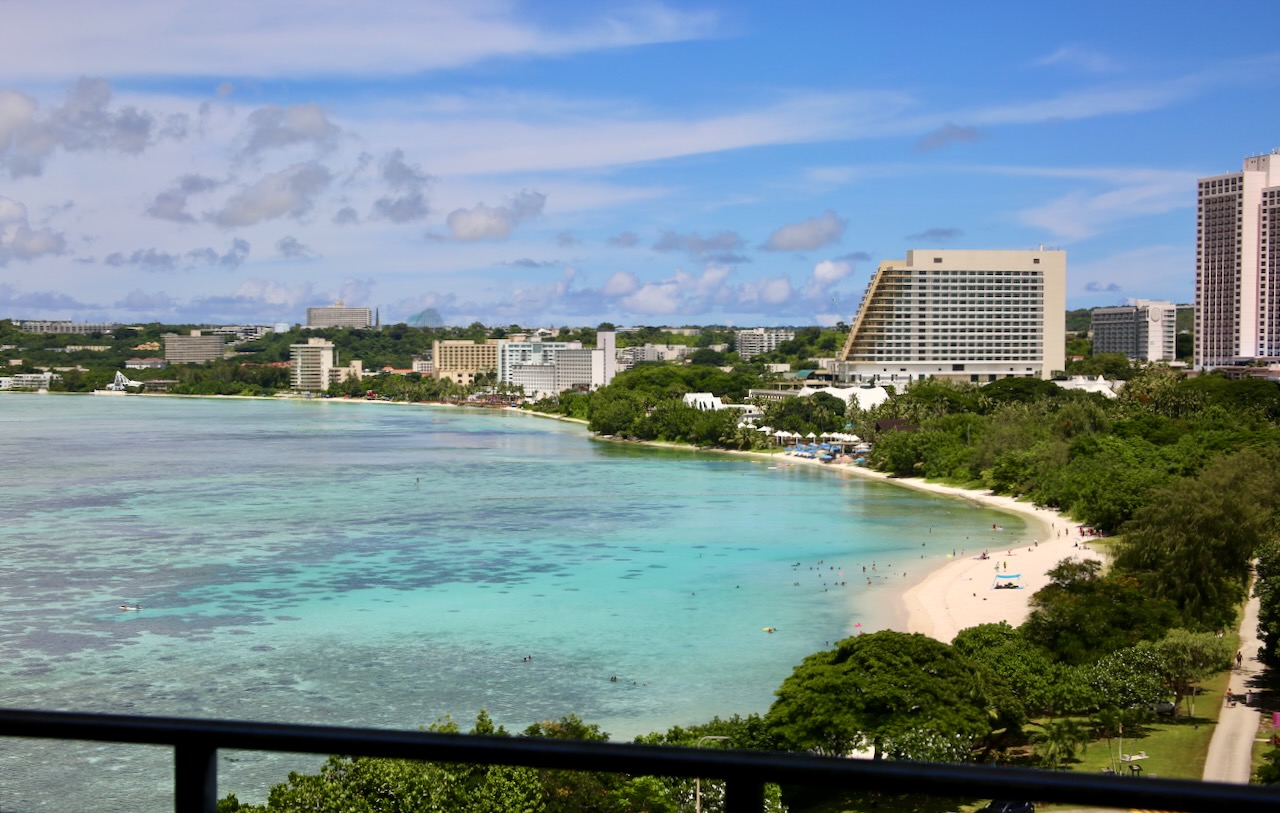
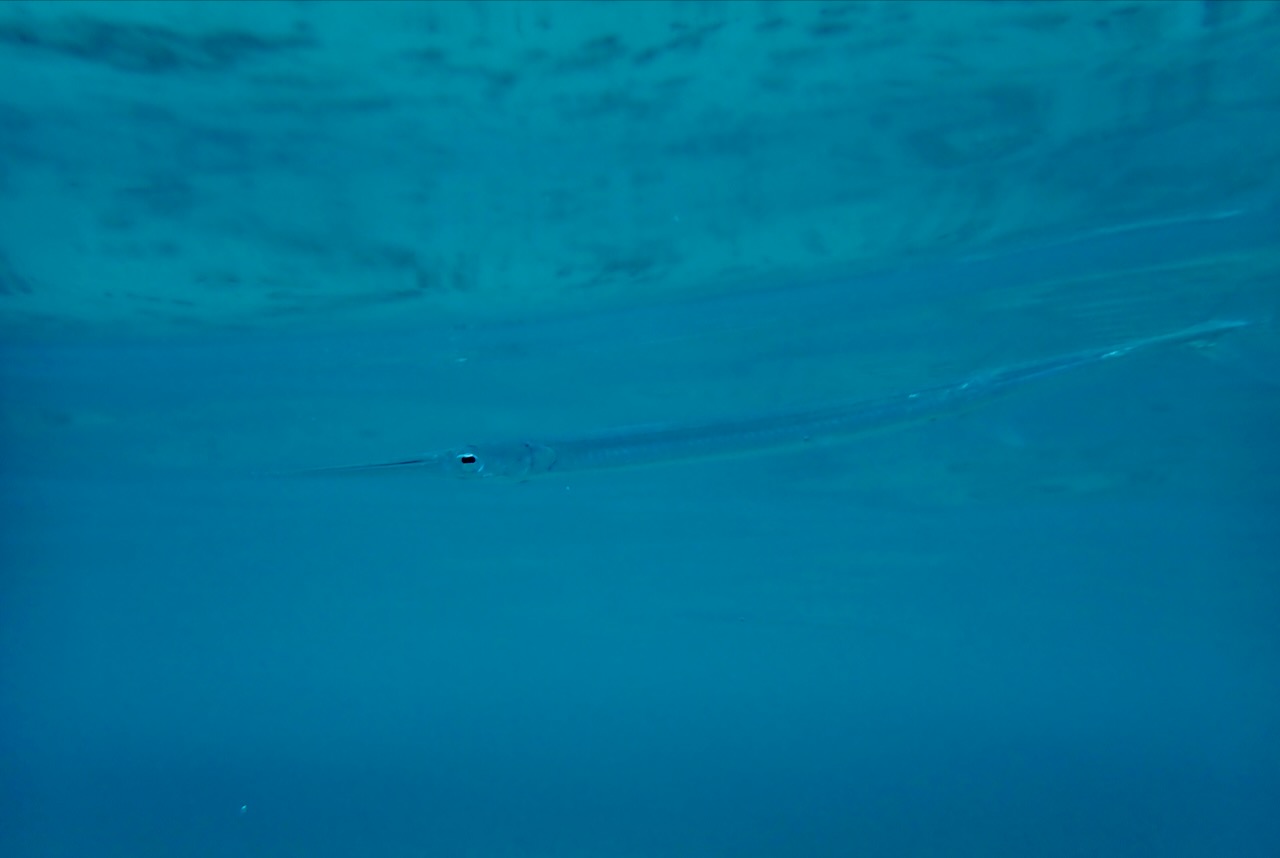
Caleb let me know that places were only open two days a week, and I thought perhaps it was just a scheduling conflict. However, as we attempted to visit the Guam Museum (which opened in 2014), I realized it was us going to these places on the two days a week that they are closed. We change into swim gear back in the room and walk to the calm and shallow bay for over an hour of snorkeling. While face down in the water, I see a snake sea cucumber (usually about seven feet long), banded archerfish (known for shooting down land-based insects), a few orange-spotted filefish (distinct long nose), some sammara squirrelfish (giant low-light eyes), and the majestic Moorish idol (not an angelfish).
where we snorkeled and the 50-foot-tall clasped hands
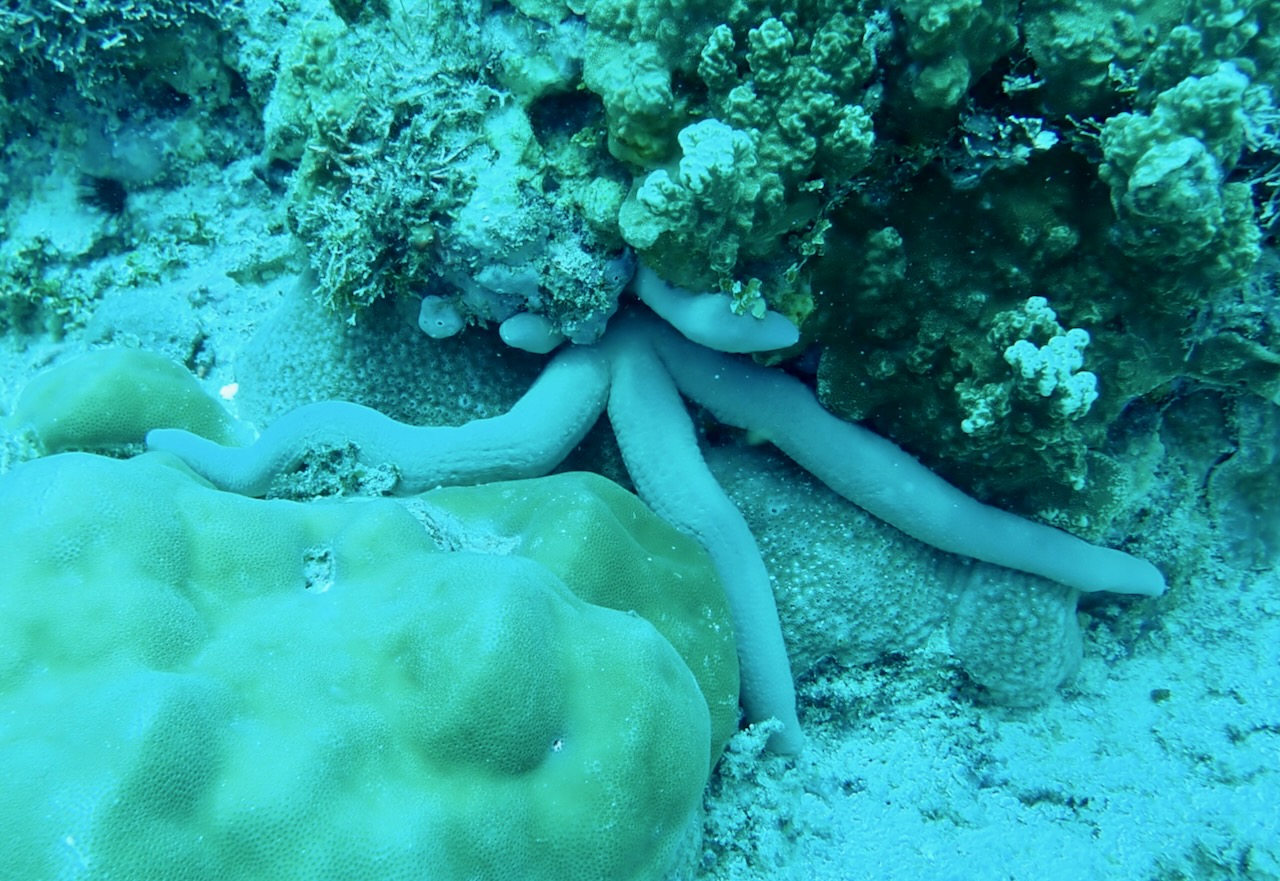
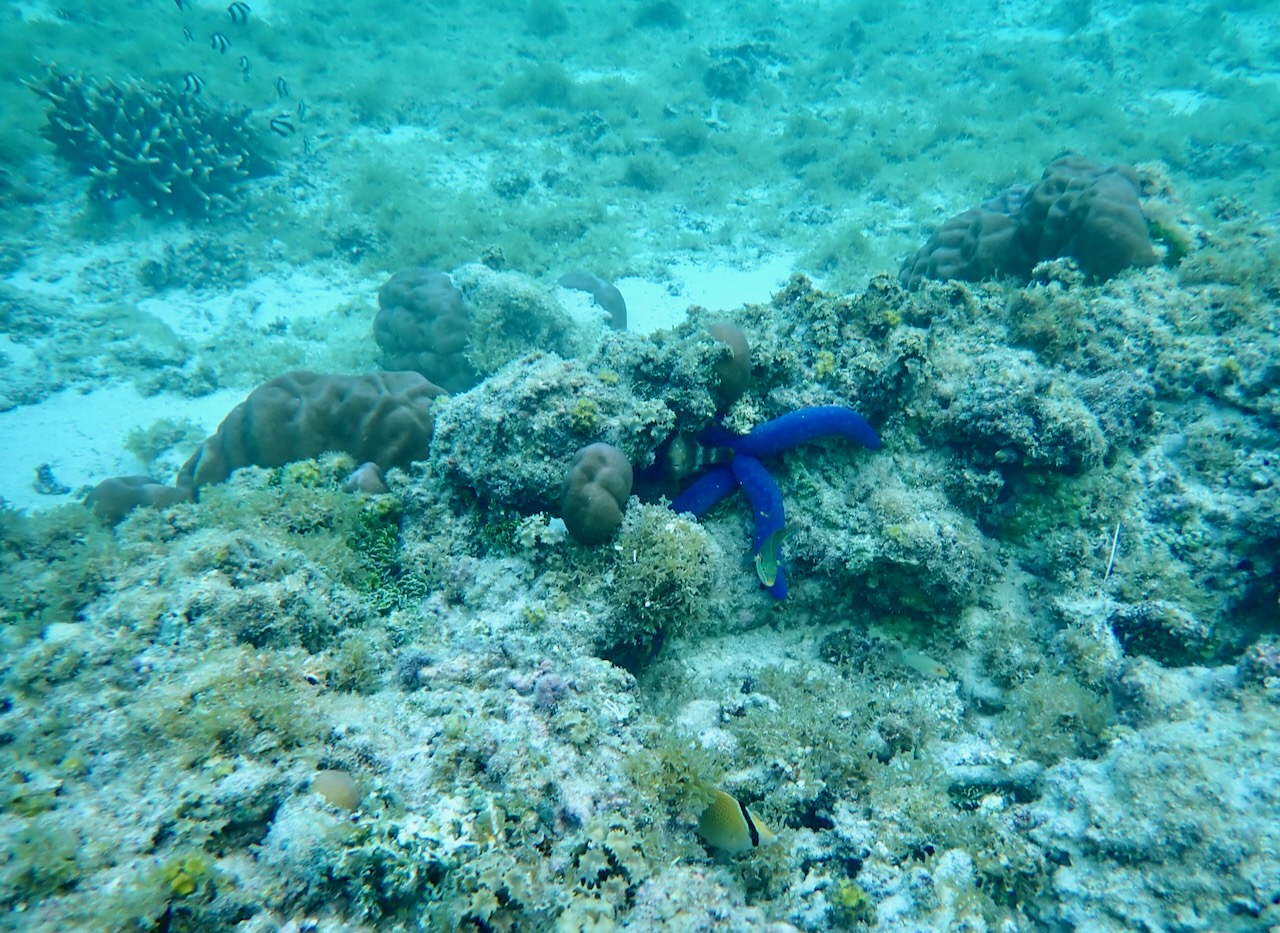
I also see an unidentifiable white slithering object (either a brown tree snake or banded snake eel), a Picasso triggerfish (able to swim backwards like the eel and knifefish), a four-legged blue sea star (they usually have five), and a raccoon butterflyfish (which are generally aggressive towards lionfish and triggerfish). The walk back to the room is cold, but after a warm shower, we are ready for dinner. Smeltkop has invited us to The Beach Restaurant on Gun Beach, where coconut crabs were more common before being overharvested; hunting them is banned on base, and there are now collection laws in place to protect the remaining population.
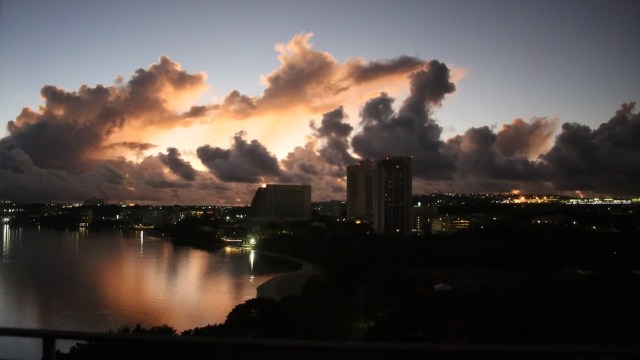
We get seated near the bar and live music that the guys have to talk over to discuss work. Smeltkop asks the waiter if “the DJ can turn it down,” instead of requesting to move away from the giant speakers. We are treated to a cloudy yet beautiful sunset, and then go looking for crabs in the dark with no luck. Caleb is more tired than he lets on, but as soon as he sees the bed, there will be no time for reading, just sleep. I have to remember that he worked and had a full day with me. I’m glad and grateful that I’m able to join him on his shorter work trips, as the Navy frowns upon stowaways.
Caleb had to go to Guam for work and when he left we weren’t sure that I was going to visit because of his possible work schedule, but he got to the island over 6,400 miles away and missed me and I him, so we knew I’d be leaving soon… and then even sooner so we could spend more time together with the room and rental car already paid for.
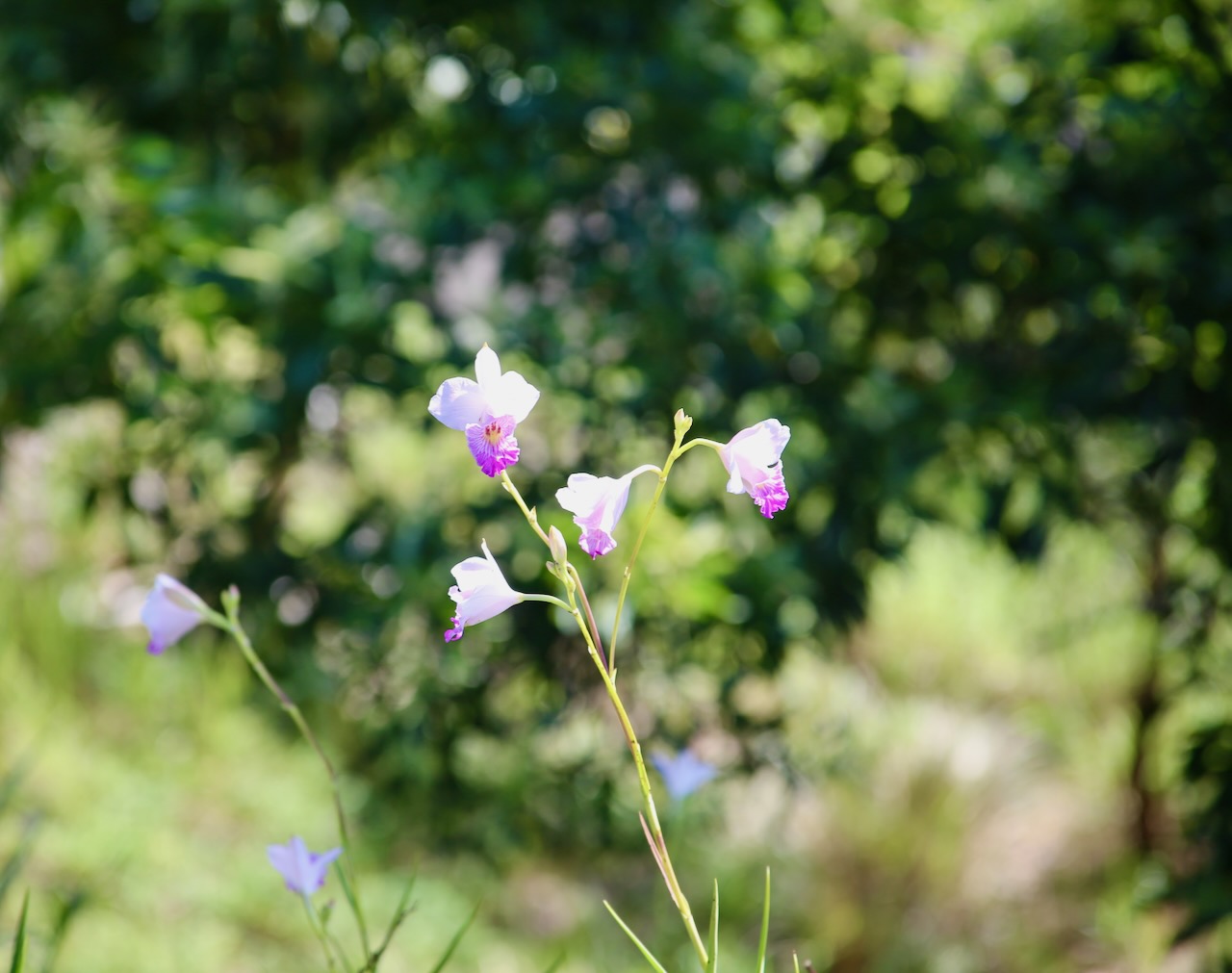
Caleb sent me beautiful views from his balcony, pictures from the park, and a video of rain while he waits in the car. I sent in return a photo of my bruised leg, a spider hanging in front of the door, and a jar of tarrango lilies. I look up things to do in Guam, at first, so that Caleb would have a list of ideas if and when he got time off to enjoy places that are open for two days a week and only for a few hours.
I spend two days packing — the first day is for collecting everything onto the bed and then tossing most of it in the bag I’m taking (checking for fit) while charging all electronics that will go. Then the second day is going over the pack list and making sure all items needed make it into a bag, purse, or pocket. This process was all done in 24 hours and finished just six hours before I was due to arrive at the airport.
My Uber arrives, driving a leased Tesla Model 3 while his car is in the shop. He wouldn’t want to spend over $50,000 on a taxi with expensive diagnostic tests. Ernesto may not want to drive a car like this, but that’s what California and New York are pushing for — a ban on selling new gas-powered vehicles and replacing them with zero-emissions vehicles by 2035.
In my pre-trip research, I had wondered why Guam, the most southerly island of the archipelago, was listed differently from the 14 Northern Mariana Islands, and what I found included a battle between Spain, the Philippines, Germany, Japan, the United States, and the Chamorro people over hundreds of years that left the Guamanians unwilling to reunite in the 1960s. Guam became a territory in 1950, and the CNMI wouldn’t gain this status until 1986, so they remain separate.
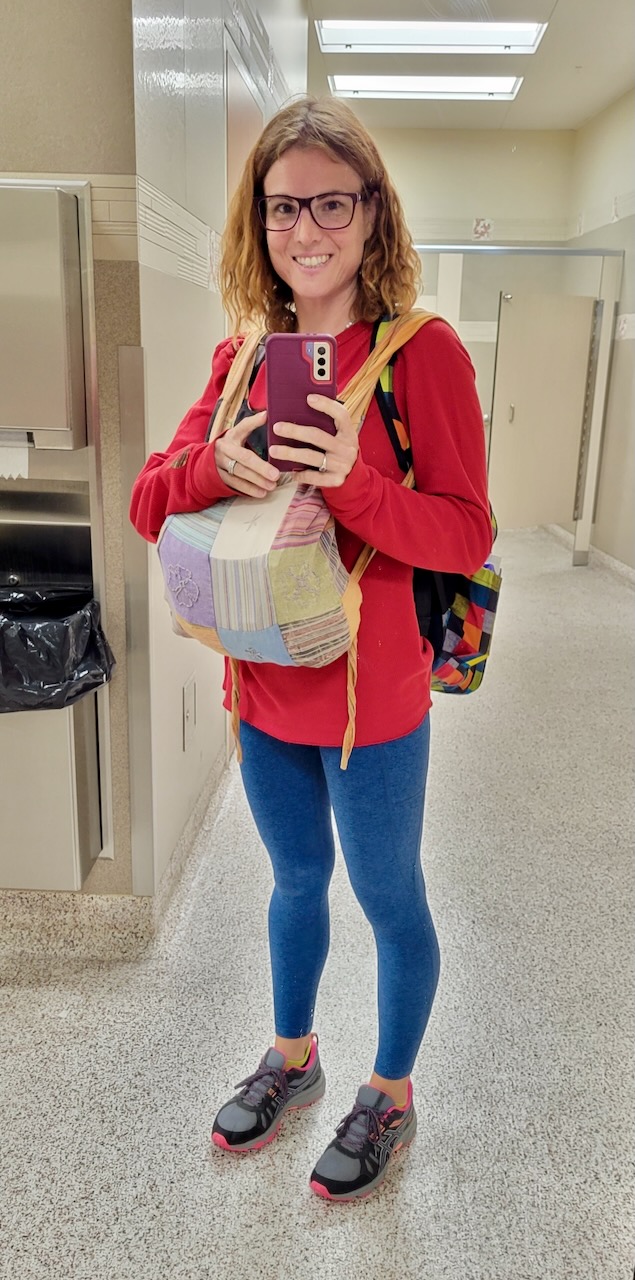
I have fun walking the empty security line as it zigzags, in preparation for the crowds that will soon fill its barriers, as I look forward to seeing my husband in roughly 19 hours. This translates to a whole day and three flights to get me 17 hours into the future (according to the time zone difference). I then have to wait my turn while I watch a very elderly woman have her whole body thoroughly patted down, as I reach out to catch her with the force of the search being applied.
I think it’s ridiculous, but I understand that criminals come in all forms and that this woman could’ve been taken advantage of — though that’s what I saw and worry what would’ve happened to this frail woman had I not been there to hold her up. The agent turns to me, gloves still wet, and pats my sleeve. I’m more concerned with getting drunk off the amount of alcohol she applied than she should be about her disposable gloves catching something, as I don’t see doctors dousing their gloved hands before surgery.
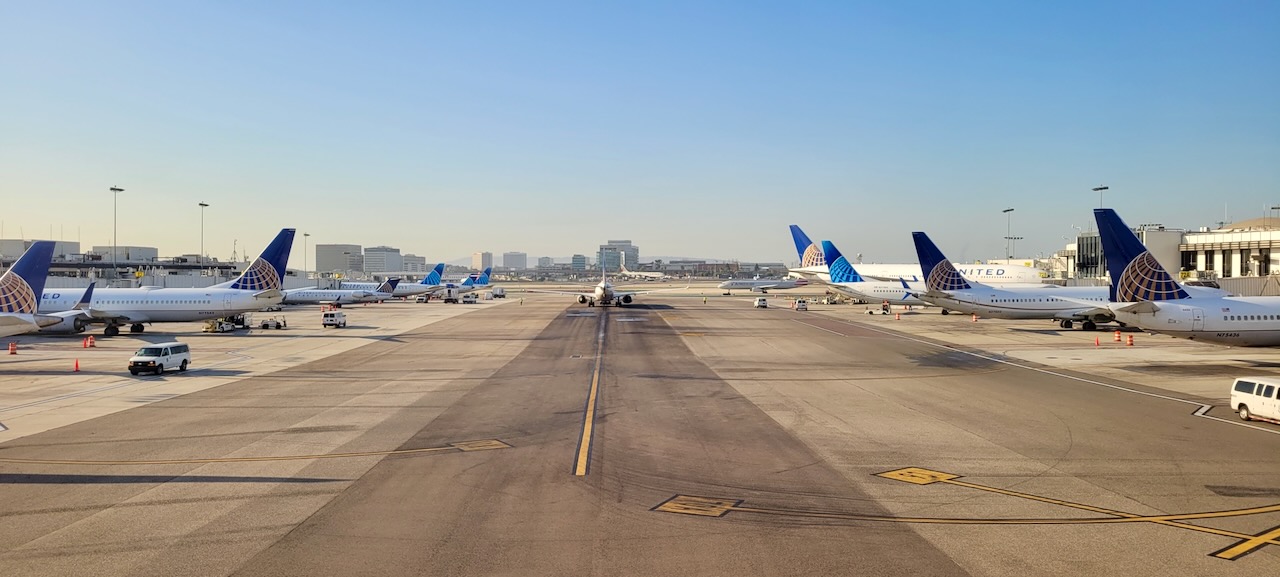
I’ll grab a snack from my bag and finish one of the books I brought while I wait to board for Los Angeles. I moved up a row to have a window seat, but not sure I napped at all on the 75-minute flight. My first layover is two hours, and I’ll spend the majority of it walking. I board the plane, and this man’s bag tosses half a bagel my way as the weight of everything else in there hits him in the head. I’ll scoot from my middle seat to the aisle to allow a couple to sit together.
I was nervous that I wouldn’t have space in the overhead compartment for my backpack, as I am also traveling with my overstuffed purse separately. I do pride myself on my ability to travel so light unless I’m bringing snorkel/dive gear, which I suppose is the equivalent of some people’s wardrobes and shoes, special event gear, and instruments, and baby food or pillows or booze.
I’m served a stroopwaffle and bubbly water, eat the wrap I overpaid for in the airport, and close my eyes for two hours. I get up to stretch, and a conversation with a friendly attendant ends with me getting a free blueberry oatmeal (an $8 value) that I will save for later. While I’m stretching during the second drink service, a man asks me to hand him a soda, and when I tell him I don’t work here, he helps himself.
The little door to access the cart was open, and he wasn’t taking anything that wasn’t being offered for free, so I didn’t feel the need to report him and returned to my seat with a handful of stroopwaffles as the attendant was passing out the last of them. As the plane approaches Honolulu, I wish I had more than the two-hour layover to explore.
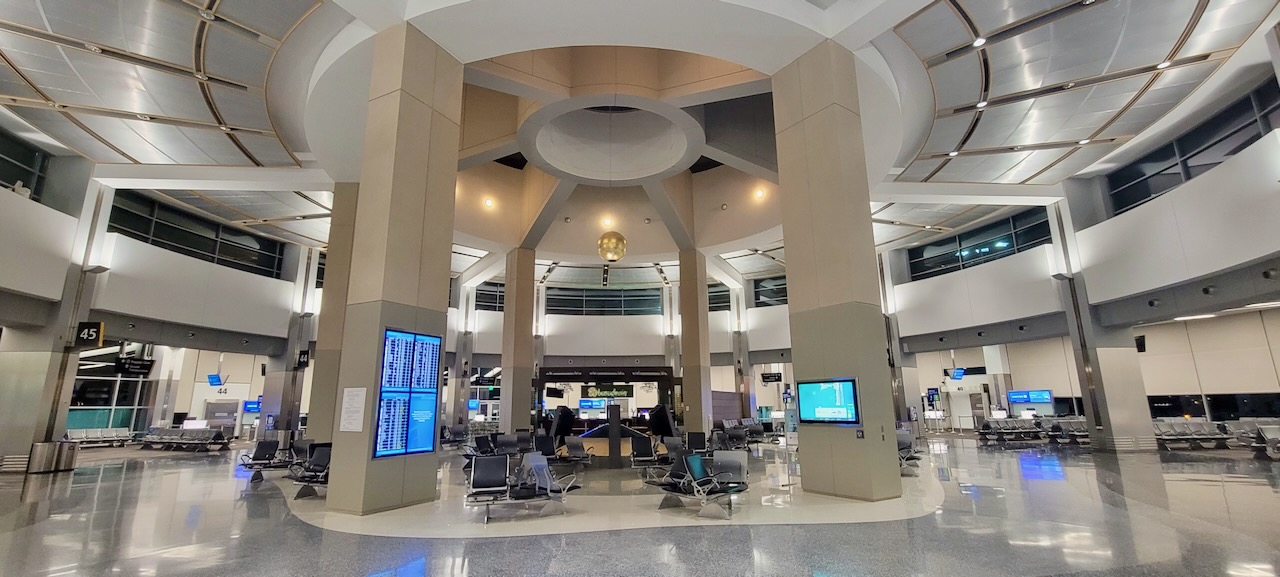
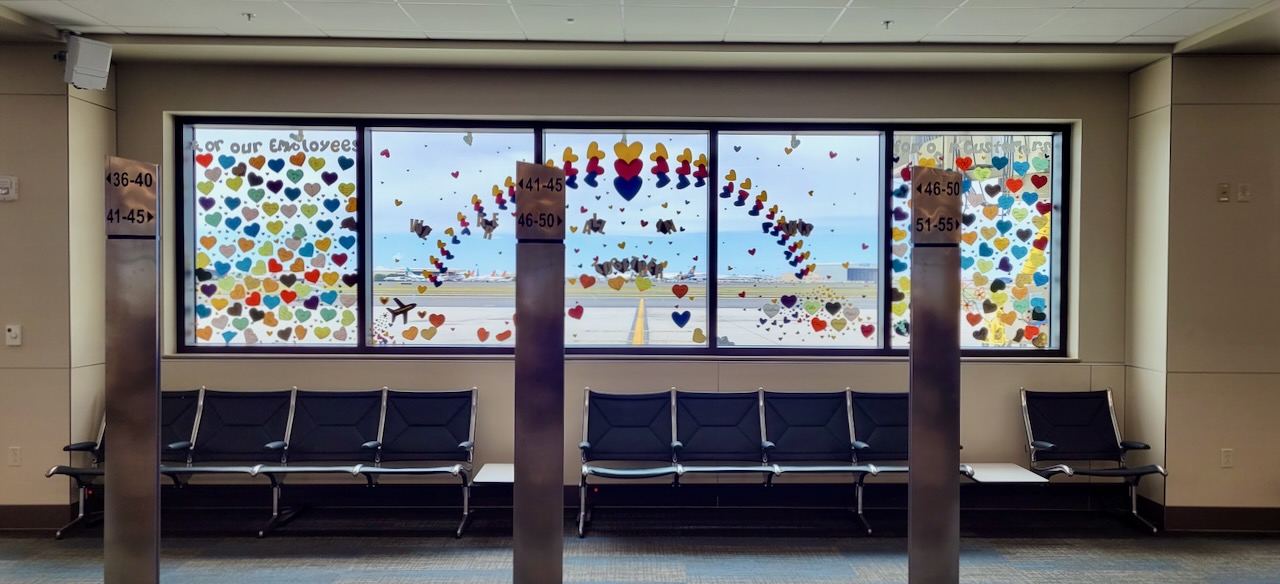
The airport seems tiny at first, even though there’s an escalator going up as I come out of the gate, of which I assume there are about ten, and I’ll take another one down to explore the empty seats and shuttered shops and say hello to the one employee guarding the door. Upstairs has a group of payphone booths, which might seem outdated now, but they (as a whole) have a unique history, and some have been transformed to serve other purposes, such as a little library, tiny office, or small food stand.
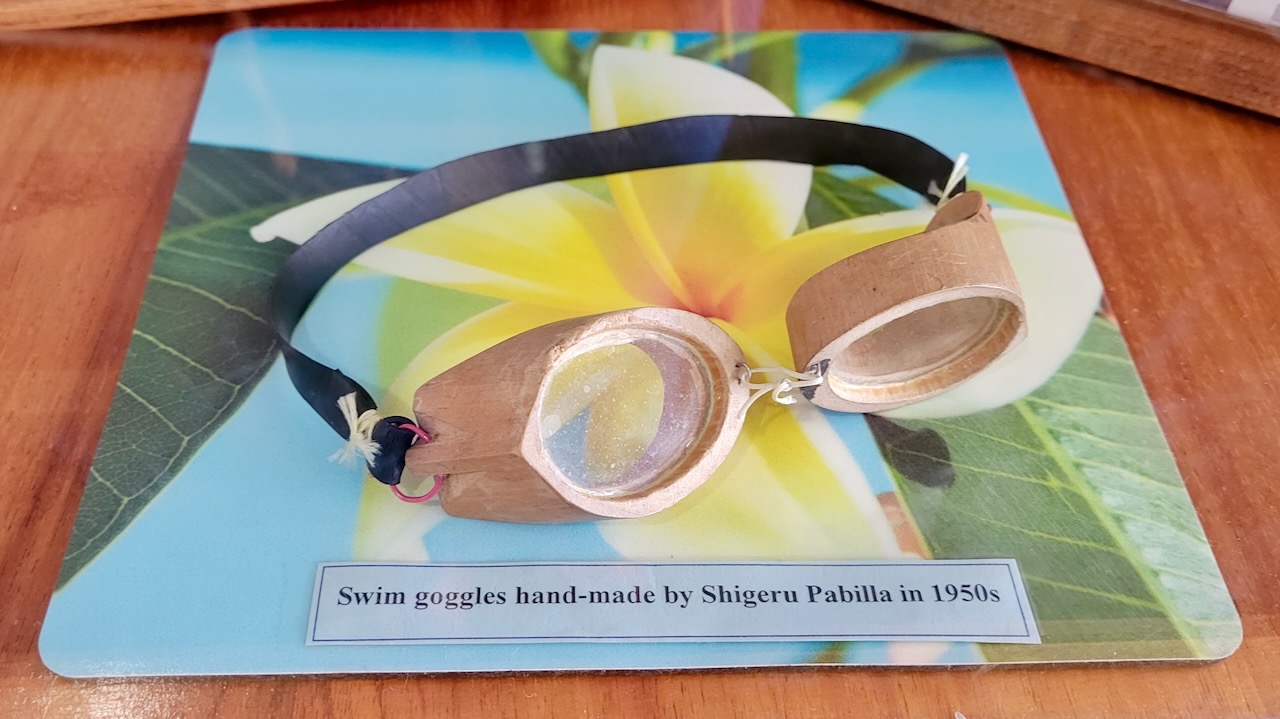
There’s an exhibit and the sign about “the greatest swim coach in the world” catches my eye because that’s quite a claim, but one that was earned after Coach Sakamoto took his men’s swim team to the 1948 Olympics and won every event to include 11 out of 16 medal opportunities. There are goggles that were handmade, in the 1950s, by Shigeru Pabila, who made it into the Hawai’i Swimming Hall of Fame for ocean swimming, of which he placed first in his age group many times in the Waikiki Roughwater Swim, which is a 2.348-mile race.
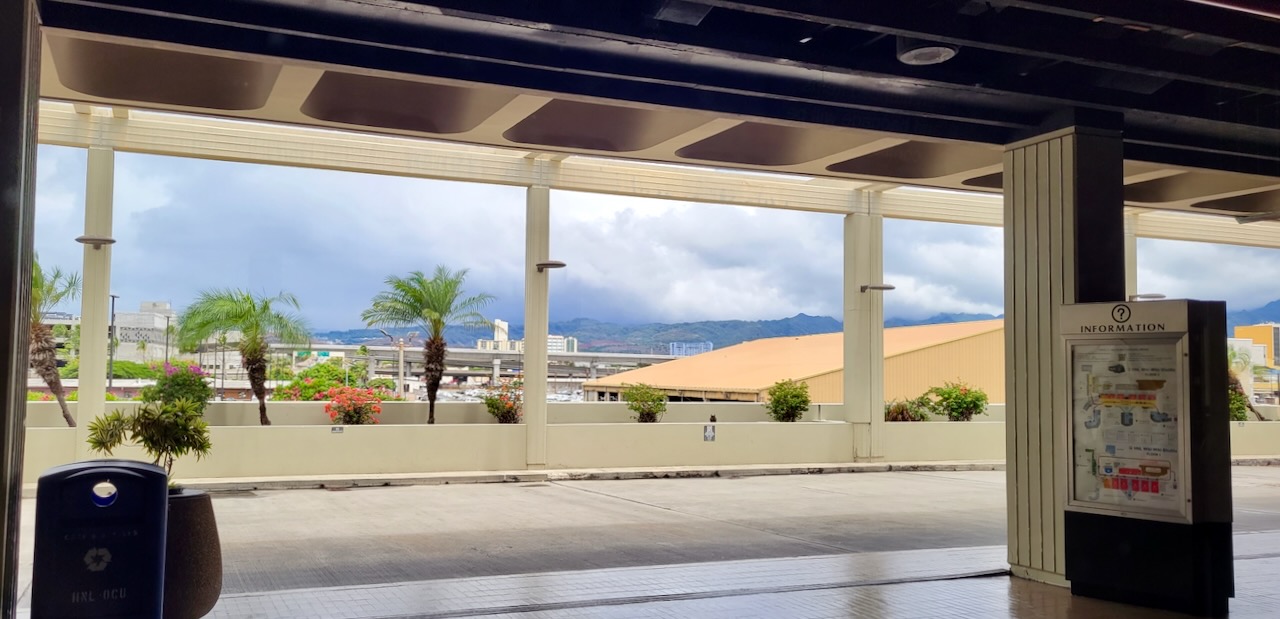
The doors are wide open, and I’m not the only one who thinks that security must be super lax here, as it seems people can just be dropped off and walk in. I’ll take in the distant mountain view obscured with clouds behind all the airport roads and high rises in between. It’s not until I sit down to eat that I hear the announcement for the USO and realize the other terminals are connected by an outdoor pathway. I’ll learn that the military lounge is outside of security, so not worth the free sandwich I might have had.
I’ll wander the outside gardens instead and wonder why more airports aren’t increasingly layover-friendly. It’s calming to sit amongst the greenery and listen to the birds, and also watch employees eat lunch and tourists take selfies. I appreciate airports that have places for smokers, children, pets, praying, breastfeeding, sleeping, and reading about their current exhibit in arts, science, sports, music, etc. I’m not here long before it’s time to return, past the sharks holding pineapples, to my gate for boarding.
The middle seat is empty, and the woman in the right aisle seat seems a bit dramatic, but I’ll learn that she’s just excited to be returning to Guam, on a visit from DC, after so long, as she’s been dreading this unavoidable amount of flights and the day of travel it takes to accomplish them. She’ll offer me one of her jackets while we wait for blankets to arrive, which will be her cue to use the two seats to nap while I eat pasta and sip on coffee instead.
I try to sleep but return to reading with burning eyes, knowing that when we land in four and a half hours, I’ll be excited and exhausted. On my last flight, there was a group of three friends traveling from Britain who had spent three days in Los Angeles, on their way to a week in Hawai’i, and then three days in San Francisco before their return. The couple that sat beside me was also spending a week in Hawai’i, not sure if they’re meeting up with her family.
I’ll stand for a while and talk with a guy who is from Hawai’i and recently got back from San Diego, and here he is on another flight. He grabs a blanket and returns to his seat. I get up again to move my legs and head to the back for some hot green tea and a piece of marzipan — not sure if it was for First Class or the attendants, but it still tastes good. After some more stretching and reading, I’m ready for a nap.
Upon waking, I’ll talk with Mickey from Saipan (about a fourth the size of Guam), who has another 40-minute flight to get home but says it was worth it to spend the summer in Los Angeles with his other young friends. It was something for me growing up to save a few dollars (that had more value back then) to get out of the house, which is why I joined the military because I didn’t want to wait around too long to save up enough, but to imagine having to save up so much just to leave your home island… though I just found a flight for $660 that takes 36 hours to get to Los Angeles.
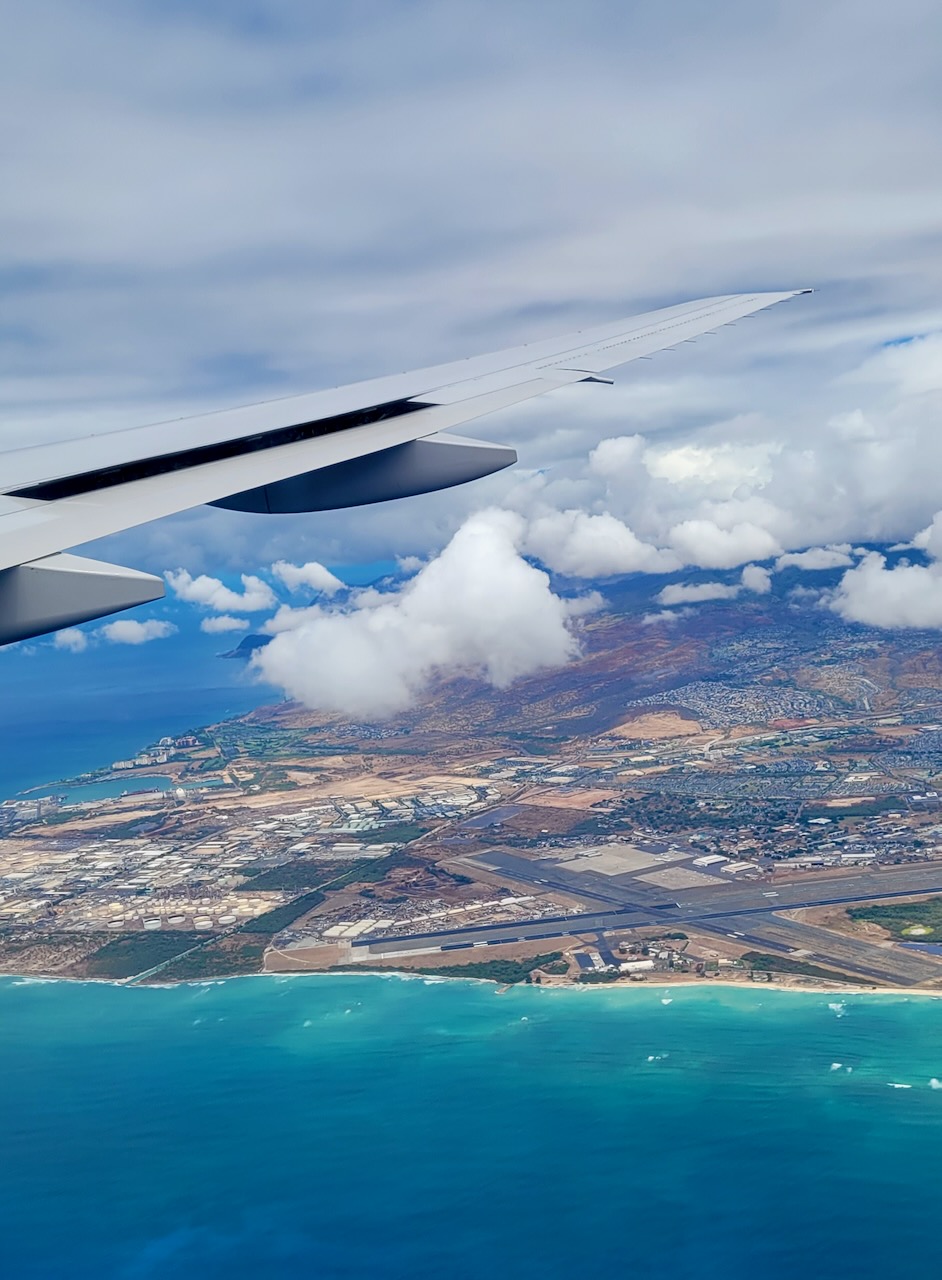
I make my way through the last airport for a week, and Caleb is parked outside nearby waiting for me. I love the smile I see when he notices me, taking my time to notice him as I stare at clouds and ocean in awe of another place reached and somewhere new for us to make lasting memories. Caleb drives us the twelve minutes to the hotel so I can shower and change into fewer clothes to accommodate the warmer weather. We thought we’d walk to dinner, but by the time we got out of the hotel parking lot, both decided we’re too tired for that thirty-minute adventure.
We chose the five-minute drive instead to King’s Restaurant, a recommendation from someone who has eaten the opened food in a dumpster and had their tongue burned in a horrific show of dominance, and can no longer differentiate between decent food (foreign or not) and what you eat for free after being starved for days without anything edible in reach.
Though we may not have been excited about the tinala katne (seasoned, smoked, and dried beef) with hineksa’ aga’ga’ (red rice with bacon grease and achiote powder), cabbage salad (cabbage and mayo), and finadene (vinegar, soy sauce, onions) we also ordered Italian cheese bread (cheddar and Swiss) with a meat marinara dipping sauce that was just as disappointing. It’s as if we were eating the fast food version of these recipes, with all the tasty details left out, which makes sense since the restaurant is American — the opposite of what we look for when traveling, even stateside.








 TheJessicaness