The Florida Botanical Gardens in Largo is twenty miles from our place and has free admission. There are over a hundred acres to explore – art installations, Florida-flavored water, paintings for sale, and bird watching.


Heritage Village is under half a mile between parking lots and separated by a creek. This living history museum offers 28 structures on 21 acres. There’s a log cabin from Clearwater built in the 1850s, the 1924 Gandy Tower from the first bridge to connect St. Pete to Tampa, and a 1930s sponge warehouse from Tarpon Springs among their collection of temporal and geographical representations of Pinellas County.

The Safety Harbor Church is simple, exactly what the builders had in mind, and early members have left their names in the community. The church was built in 1905, repositioned via hurricane in 1921, and relocated here in 1977. During its 97 years of service, there were 41 pastors and only five organists.


We walk around from the back door to the front, on the porch, before we are invited in, on the other side, for a docent-led tour of the House of Seven Gables, built in 1907 in Queen Anne Style with 13 rooms consisting of heart pine panelling. This part of the tree requires 30 years of growth, so it’s more likely to be found in reclaimed wood than in fresh sawn. The house was given to the park in 1976.
We are joined by a couple and a family, and the tour begins. The dining room is my favorite, with built-in cabinets and bookshelves. There is elegance and detail in every room – the wood, textiles, and porcelain. There are a few musical instruments, hung paintings, a candlestick phone, and a Hoosier cabinet with a grain mill. I’m ready to move in as the docent ensures our departure.

There’s a bright orange caboose (from the Seaboard Coast Line), an idea in the 1840s to house the engineer, fireman, conductor, and two brakemen who would manually stop each car as the train slowed to a stop. In the 1870s, those men would use flags to signal the engineer. Bright painted steel replaced the weaker and more flammable wooden crummy in the 1920s. With the invention of radios and computers, the way cars are becoming extinct.
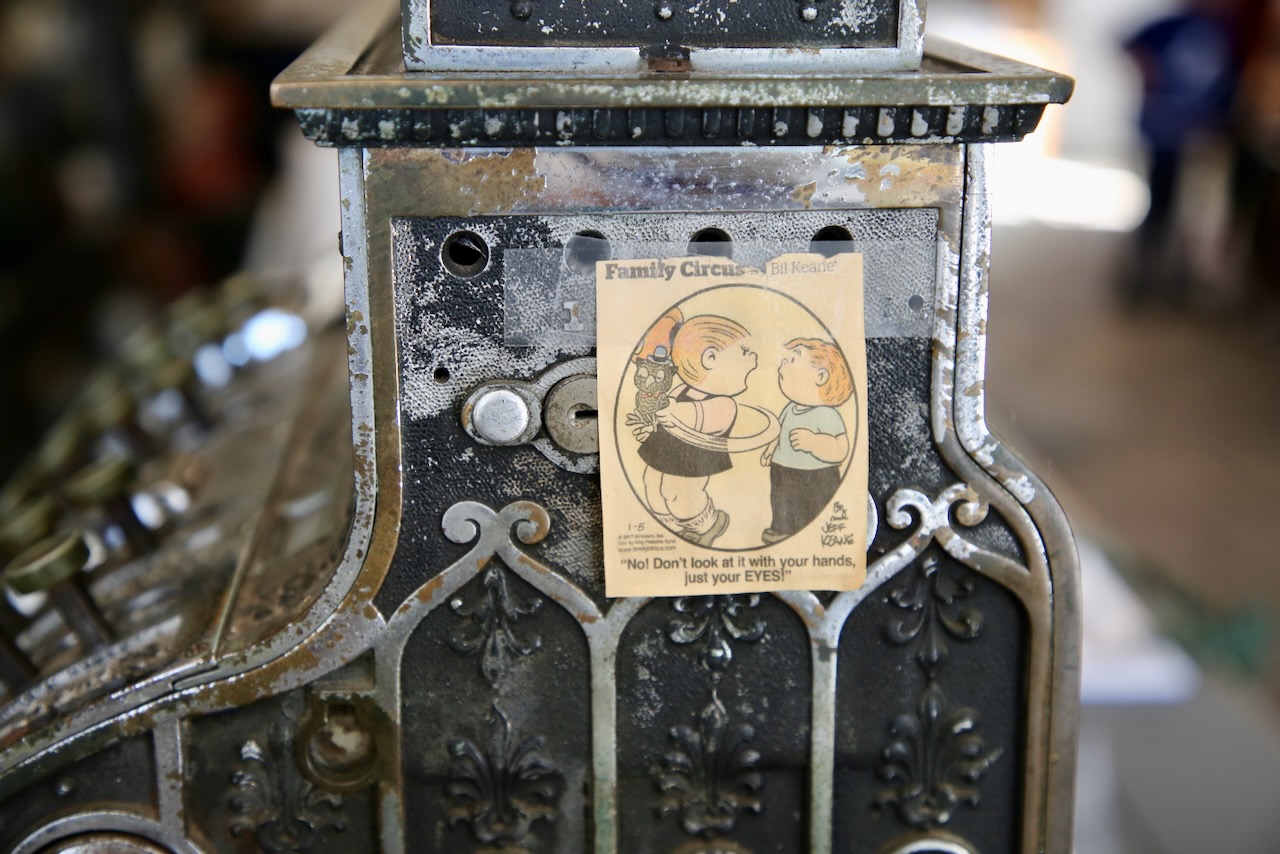
The H.C. Smith Store was run from 1915 to 1955 under various names and sold groceries and clothing, with part of the building being used as a butcher shop, bakery, and sometimes as a home for the employees. The store struggled to compete with air-conditioned malls. Today, it still sells soda, and the side of the building houses a barbershop and post office. The space in the back has been turned into a mechanic’s bay with two 1925 Ford Model T’s and a 1928 Model A on display.

 TheJessicaness