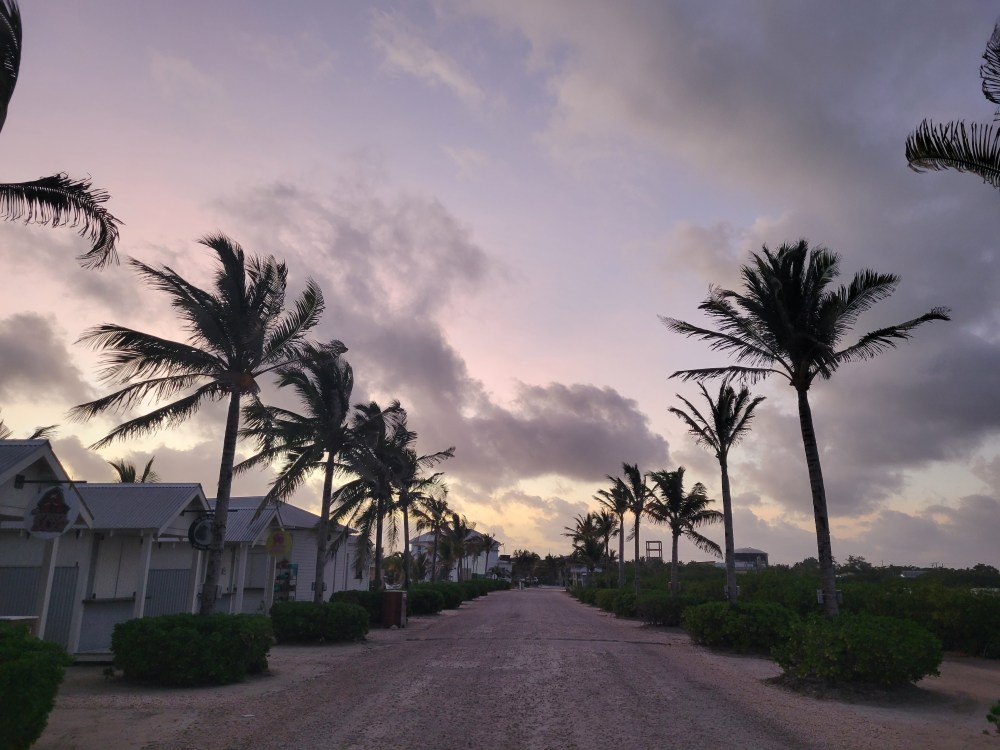
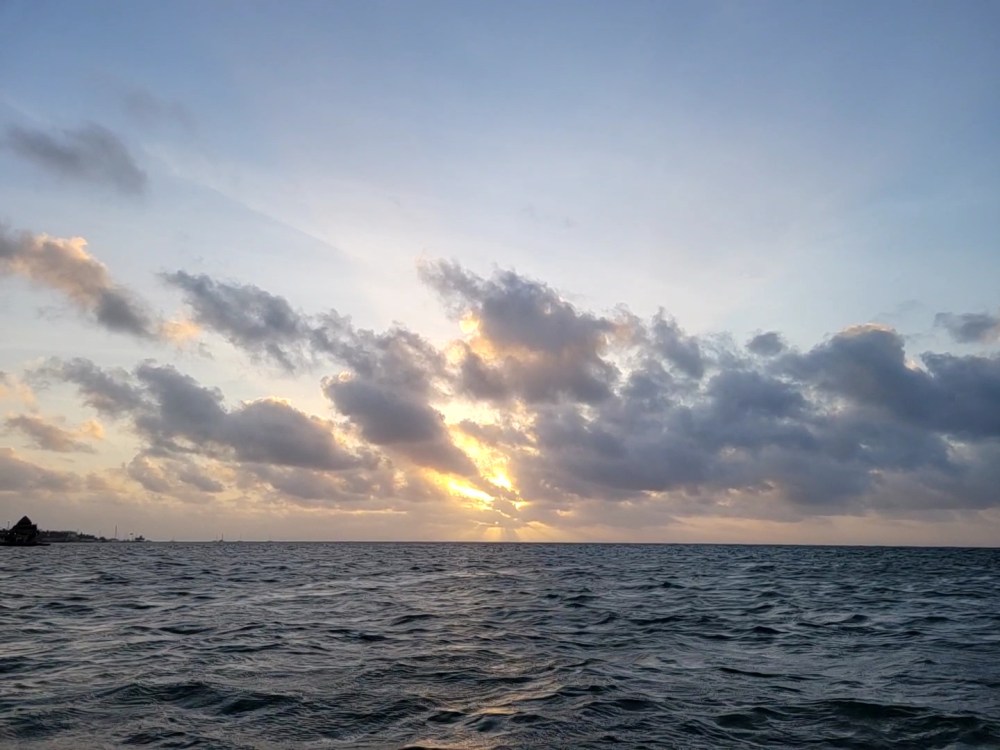
I’m grateful that we packed the night before, so all I need to do is cover up my sunburnt skin and help drag my gear, in a rolling bag, across the street. It’s a good thing we got to the dock early as our stop is the furthest from the shop where the big boat that will be taking us into the open ocean awaits and leaves us and the other ten divers waiting on a lone traveler to join us at her pace. Perhaps she’s already on island time, but the team was early because the ride out is 2.5 hours. We meet John and George, our divemasters and are given banana bread and watermelon for breakfast while they move our gear.


Caleb and I will walk to the bank ATM to pull out the $40 per person park entry fees that I forgot in the room. I’m used to authorizing a credit card and being charged upon return depending on how the day turned out. The boat leaves at 6am and Caleb and I will talk with Dolly and David, a couple visiting from Los Angeles, with their adult sons. I usually avoid boat heads because I’ve already peed in the water a bunch and going down into a hot closet is the opposite of salty, Vitamin D filled, air; but the crew secures the facilities for rough seas, waves at four feet high.
Caleb had looked up water temperatures before coming to the island so we knew which wetsuits to bring. Well, we brought too many as we learn that the Blue Hole will be 83 degrees today, instead of the advertised 67 degrees on the internet. I’ll still put on my white 3mm because I get cold easily, but we don’t need his 5mm or my 7mm for the rest of the trip. We are the first ones in the water, out of habit, but have to float between a military law enforcement boat (tied off to the dive boat) and the reef to wait for everyone to make the surface swim together.


It’s easy enough for most people to jump in the water with dive gear on and not die, especially with an instructor nearby, but the joy increases with the details — buoyancy, awareness, and breathing slowly so the dive can last longer. None of that matters at this site though as we’re here to get down and get back up before anyone runs out of air, but if they do, there are regulators and tanks in the water at the safety stops so they don’t get a side of the bends too. I prefer my descents to go at the speed that I can equalize the pressure in my ears and appreciate that I was able to keep up and not get left behind.
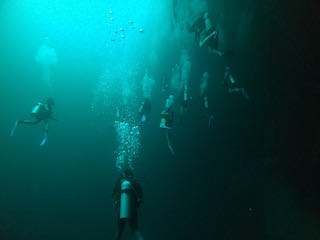
The dive leader gives the signal to go down and will check in with us at 40ft before we make the plunge to 132ft (or 135ft for me and 154ft for Caleb, because he attempted to save a necklace). The other divemaster will make the rounds to all the divers to check their air and situation. Going down in a crowd sucked and I tried to keep my distance so that I wouldn’t catch a fin in the face. I know this is something I’m going to have to work on if this hobby becomes employment. Perhaps I become a trail volunteer in a park for a season and then spend a few months underwater, just the two of us, every year.

I had in my BCD and tank pockets a total of 18 pounds of weight, which is more than the 10% of my body weight needed to sink me, while alive. Learning the proper ratios of wetsuits to weights in rental gear with different salinity is quite a science, which is why having your own gear is good for gaining this knowledge and making changes accordingly; as some companies will still prep and clean your gear too. I usually surprise people with the amount of lead I ask for, but this amount caught me off guard, as it might’ve been ok in my 7mm, but was quite the workout without the extra buoyancy support.
We go over the edge and it almost seems too dark to see, but then we’re quickly at another ledge with resting nurse sharks and giant stalagmites and stalactites. By the time you realize what you’re seeing, it’s time to go up. I didn’t notice the little fish until looking at the pictures after. I was swimming vertically and the divemaster told me to stop kicking and swim horizontally, but I was fighting gravity and nitrogen narcosis; apparently fun at first, but then deadly by becoming unconscious underwater. I would love to be able to go back down and spend a few more minutes exploring.
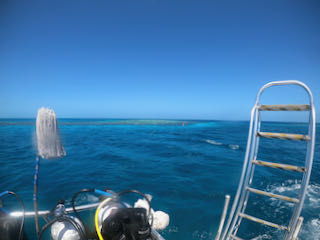
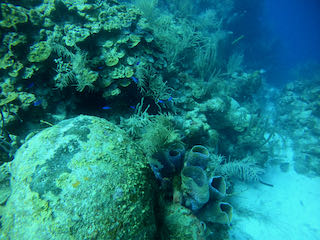
I quickly burned through my air and came up, first, with 500 psi in my tank (the minimum to maintain them safely for longer) after our safety stop. We were below 100ft of water for eight minutes. Lesson learned: always check for proper buoyancy before a new dive situation as depth (atmospheric pressure changes) can make a huge difference as tons of water compress all the air out of your wetsuit and the extra lead, that was no big deal at the surface, now causes you to swim like your life depends on it. Once on the boat, I notice that my once semi-healed wound is now wide open and swollen with salt water – no surprise there.
Wide open meaning that where there was once 1.5mm of the epidermis and tendon sheath protection, there is now a third of that gently covering the inside of my hand from the outside world. I ask the boat captain for a bandaid and while he has the first aid kit open I venture to ask for a butterfly stitch, but quickly retract with bandage in hand and claim no injury so that my other two dives don’t get canceled. I’ve already destroyed my hand, so there’s no point in ruining the trip for both of us. Caleb will get me an ace bandage so that I can conceal the damage and, “stop staring at it.”
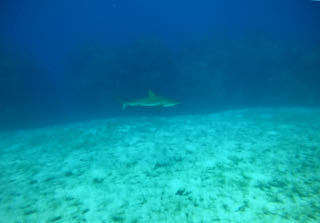

Caleb agrees that this dive was not fun, but that’s in the moment. Looking back, had I read some blogs or done more research before we left I would’ve had a better idea of what we were in for, but there’s only so much that reading can prepare you; such is the life of a traveler, hiker, diver, or learner of anything but reading itself. The other authors tell you about the narcosis, the 10-person minimum to make the trip, and how crazy, awesome, and fast it all is – just like the ball drop on NYE in NYC or the Formula Rossa roller coaster in Abu Dhabi. Some experiences are only meant to happen once, but given enough time, you can ride again without getting too dizzy.
I suppose Mammoth Cave would be a better comparison — something so big and beautiful but rushed through with a crowd — of wanting more time to appreciate the history and science of the Blue Hole. We love the theory, but the execution of safety impedes enjoyment. I’m grateful to have experienced this and if anyone in the future wants to fly me down there, then I will gladly join them for another opportunity to experience narcosis in the depths of this formation and take in more of the abyss. We’re hoping for more space between divers in the next two locations.
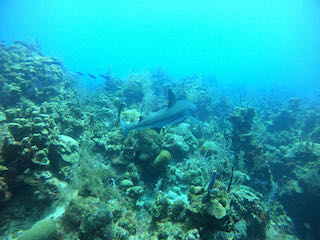
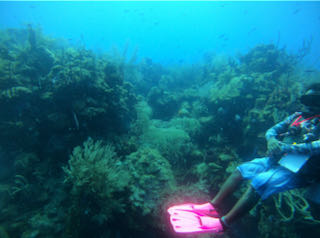
It’s probably a 30-minute ride to Half Moon Cay Wall, six miles south, to our second dive site. I enter the water after almost an hour of surface time. The max depth for this dive will be 65ft for 45 minutes. I hold the ace wrap on, stay a bit above the others, and watch the Caribbean Reef shark that follows our group but maintains its distance. There’s definitely more here that catches the eye, but that’s because red quickly turns to black at shallow depths and you lose half the color spectrum by 80 feet. I’m given permission after this dive to wear a glove because we’ll be out of the protected parks.
Lunch is set up on board and we can take our potato salad, rice & beans, and actual stewed chicken (in reference to the drier meat I got the first night on the island) on reusable plates to picnic tables set up on Half Moon Caye; the first 42 acres to be designated a nature reserve in Belize and the first marine protected area in Central America. I’ll have Caleb’s slice of coconut pie in place of bird. Sadly, the pictures that we took from the bird stand of the nesting Red-footed boobies (in their only sanctuary in the world) and a “great beach” (the side of the island with beautiful volcanic rock but not a safe sand to water transition) were lost.

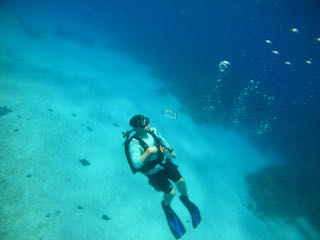
We should’ve worn our dive boots to explore, but the heat tempted us to wear flip-flops in the sun that exposes Caleb’s red feet. I’ll stay in my wetsuit for that reason, but the sand is too hot to go barefoot and builds up in our sandals which worries Caleb that he’ll get a free sanding with a side of blisters on his already sore tootsies. I wanted to explore the island, but we were only given an hour and were asked to return our plates after dining so they could be washed before departure. We return and sit on the lower dock to rinse our feet.
After our hour and a half surface interval to off-gas some built up nitrogen, it’s time to get back in the water for our third dive of the day. I’ll go down to 14lbs, which makes a different but is still too much weight, so I struggle for the first half of the dive to not sink, but then being lighter have to worry about getting in front of the guide. I’ll tread water a few times and then just start circling back so that I can see the area three times instead. I see sharks, an eel, trumpet fish, and see a belly rub (hand signal for good eating). I’ll come up close to 500 psi again, having gone down each time starting at 2750 psi.

I hang my wetsuit to drip some on the return trip, but next to all the other wetsuits it definitely won’t be dry. I pull my skinsuit down halfway and put on a light hoodie for sun protection. I’ll have to put on more sunscreen for the walk back to the room and then apply a new bandage once my hand has dried out. I feel like it’s going to take so long for my hand to heal now. We get back to shore at 430 and return to our room with the help of two spear fishermen who give us a ride from halfway down the entrance.
With the salt washed off, we walk to dinner and get a mid-meal table wipedown; not sure if done hourly or for the ice melt rivulets. We’re both ready to get back to the room so that I can wet my contacts and then use my nails to peel them off my eyeballs instead of blinking and massaging my eyelids for up to 15 minutes for the same results. We read until I start to melt into the bed, with a warm blanket and inflamed skin, under the A/C and ceiling fan. Caleb wants to keep his eyes upon just a bit longer, but soon joins me in slumber.


 TheJessicaness